


Documentation: PyCFRL Documentation.
Software paper: PyCFRL: A Python library for counterfactually fair offline reinforcement learning via sequential data preprocessing.
Note: This library was originally named CFRL, but we later changed the name to PyCFRL.
$ pip install pycfrlCounterfactual fairness is one variation of fairness metrics. However, unlike well-known group fairness metrics such as demographic parity and equal opportunity, counterfactual fairness defines fairness based on causal reasoning and enforces it at the individual level. In short, a reinforcement learning policy is counterfactually fair if, at every time step, it would assign the same decisions with the same probabilities for an individual had the individual belong to a different subgroup defined by some sensitive attribute (such as race and gender). At its core, counterfactual fairness views the observed states and rewards as biased proxies of the (unobserved) true underlying states and rewards, where the bias is often a result of the observed sensitive attribute. Thus, to ensure counterfactual fairness, we want the policy to be based on the true underlying states and rewards rather than their biased proxies.
We refer interested readers to Kusner et al. (2017) for a detailed discussion of counterfactual fairness in the single-stage predictions setting, and to Wang et al. (2025) for a detailed discussion of counterfactual fairness in the reinforcement learning setting.
PyCFRL is designed with two main functionalities:
-
Provide algorithms that enforce counterfactual fairness for reinforcement learning policies. The current version of PyCFRL implements the sequential data preprocessing algorithm proposed by Wang et al. (2025) for offline reinforcement learning. The algorithm takes in an offline RL trajectory and outputs a preprocessed, bias-free trajectory. The preprocessed trajectory can then be passed to any existing offline reinforcement learning algorithms for training, and the learned policy should be approximately counterfactually fair.
-
Provide a platform to evaluate RL policies based on counterfactual fairness. After passing in their policy and a trajectory dataset from the target environment, users can assess how well their policies perform in the target environment in terms of the discounted cumulative reward and counterfactual fairness metric.
| Module | Functionalities |
|---|---|
reader |
Implements functions that read tabular trajectory data from either a .csv file or a pandas.Dataframe into a format required by PyCFRL. Also implements functions that export trajectory data to either a .csv file or a pandas.Dataframe. |
preprocessor |
Implements the data preprocessing algorithm introduced in Wang et al. (2025). |
agents |
Implements a fitted Q-iteration (FQI) algorithm, which learns RL policies and makes decisions based on the learned policy. Users can also pass a preprocessor to the FQI; in this case, the FQI will be able to take in unpreprocessed trajectories and directly output counterfactually fair policies. |
environment |
Implements a synthetic environment that produces synthetic data as well as a simulated environment that simulates the transition dynamics of the environment underlying some real-world RL trajectory data. Also implements functions for sampling trajectories from the synthetic and simulated environments. |
evaluation |
Implements functions that evaluate the value and counterfactual fairness of a trained policy. Depending on the user's needs, the evaluation can be done either in a synthetic environment or in a simulated environment. |
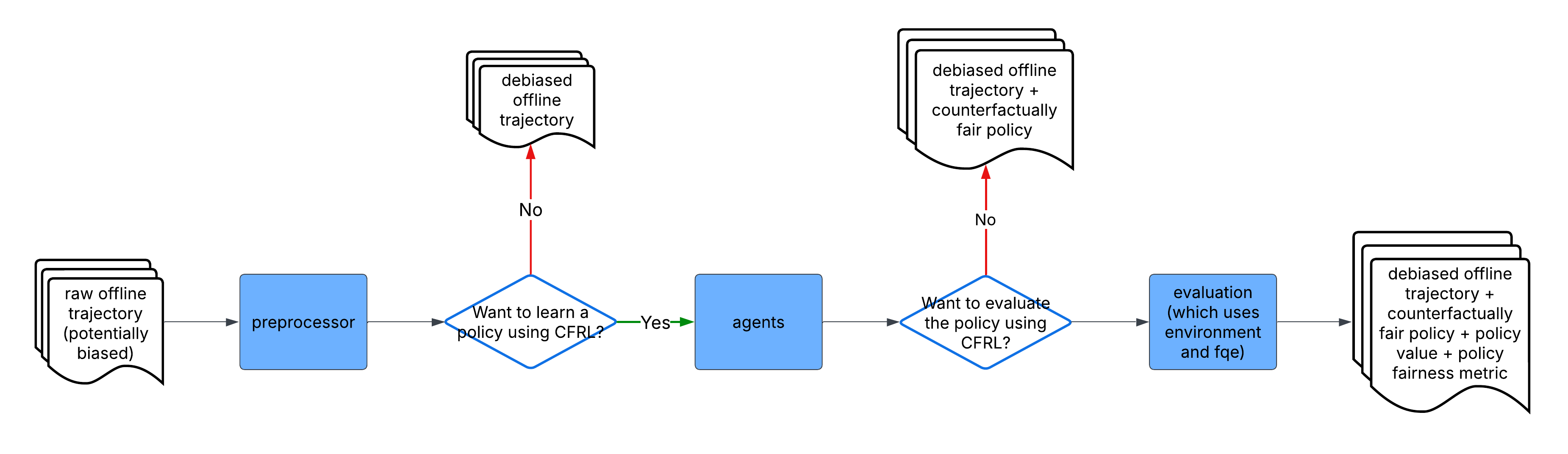
A general PyCFRL workflow is as follows: First, simulate a trajectory using environment or read in a trajectory using reader. Then, train a preprocessor using preprocessor to remove the bias in the trajectory data. After that, pass the preprocessed trajectory into the FQI algorithm in agents to learn a counterfactually fair policy. Finally, use functions in evaluation to evaluate the value and counterfactual fairness of the trained policy. See ... for more detailed workflow examples.
We provide a few short code examples showcasing some key use cases of PyCFRL.
1. Trajectory Preprocessing Only: See here.
2. Preprocessing + Policy Learning: See here.
3. Assessing Preprocessors using Synthetic Data: See here.
4. Assessing Policies using Real Data: See here.
We provide unit tests as well as integration tests for the main functions of the PyCFRL. The tests can be
found in the tests folder of the PyCFRL repository. To run the test, first install pytest:
$ pip install pytestThen run
$ python -m pytestNote that this library relies heavily on machine learning and deep learning methods such as neural networks. The outputs from these methods are not exactly predictable because of the stochasticity involved. Therefore, most of the tests focus on testing the shape and data type of the outputs rather than the value of the outputs.
Note: Currently, the 'lm' model type is not supported. Thus, pytest will skip the test cases that involve the 'lm' model type.