Add new optional metadata field for pull request added #2146
Conversation


This PR adds the ability to encode the pull request when an ontology was added to the OBO Foundry GitHub repository.

It's true that this repository does not well-reflect ontologies that were pulled over from SVN, and therefore the oldest ontologies will not have good entries for this. Please do not let this deter the acceptance of this PR.

This PR will allow an alternate venue of identifying the date added for new repositories. It can be made a requirement for new ontologies later. It can also be a nice curation task as a "good first issue"
 cthoyt
changed the title
cthoyt
changed the title

 matentzn
left a comment
matentzn
left a comment
matentzn
left a comment
There was a problem hiding this comment.
@cthoyt awesome. I think this is very useful, and we should merge it. I would note that there is some minor risk involved that you make the issue tracker where the request was made implicit in the metadata, which means that an external consumer of the metadata needs to know the repo that handles the requests. I kinda would prefer, just with an eye for future use of this, using the full URL. This also alleviates the risk of the metadata registry moving to a different repo (ok, that is.. a cosmetic risk, not really realistic). What do you think? I will merge either way, just wanted to check whether you thought about this or not.

|
One more thing:
|
|
I think it's better to keep just the issue number, because there are several ways it can get used to construct a URL, API call, etc. It would be annoying to have to do text parsing every time you want to use this field. WRT pull request/issue, the solution I took in the Bioregistry is to track both. In theory, all pull requests should explicitly link back to the issue they close and use a magic commit message so when the PR is merge the issue is closed. It's only implicit how an issue gets matched to the PR that closes it. Also, since the secondary goal of this field is to look up the actual work done (not the description of work) I still think we should start with tracking the PR. |
Ok, convinced. I guess when we expose the registry metadata as RDF we can construct an appropriate URL if needed.
Ok, not that convinced here, because I don't really see the value of tracking "work done" in this context (the PR is really no "work" in the same sense as other repos, its a quick copy-paste action). I thought that you are trying to get a backdoor to get "date added"? Is this not your main interest? Given that you can use the close date of the issue for that, wouldn't that give it to you? Minus that, what is the actual value of "look up the actual work done", when "looking about the discussion that led to the acceptance" is clearly of huge value? |
|
If we were to do it the other way, what instructions would you give to someone to curate them? I was just looking at issues tagged with "new ontology" (see here) and there are only 70. I am worried that this field will not be complete, because it might be the case that there weren't issues for some ontologies in the past wild west times. However, this could also be true for pull requests. I think the compromise here is still to enable tracking both (then use automated methods as good as possible to keep them complete). I will add the second field |
|
Ok! |
|
added accompanying NOR field in a281a73. Here's a screenshot of how the ontology layout page looks now:
|
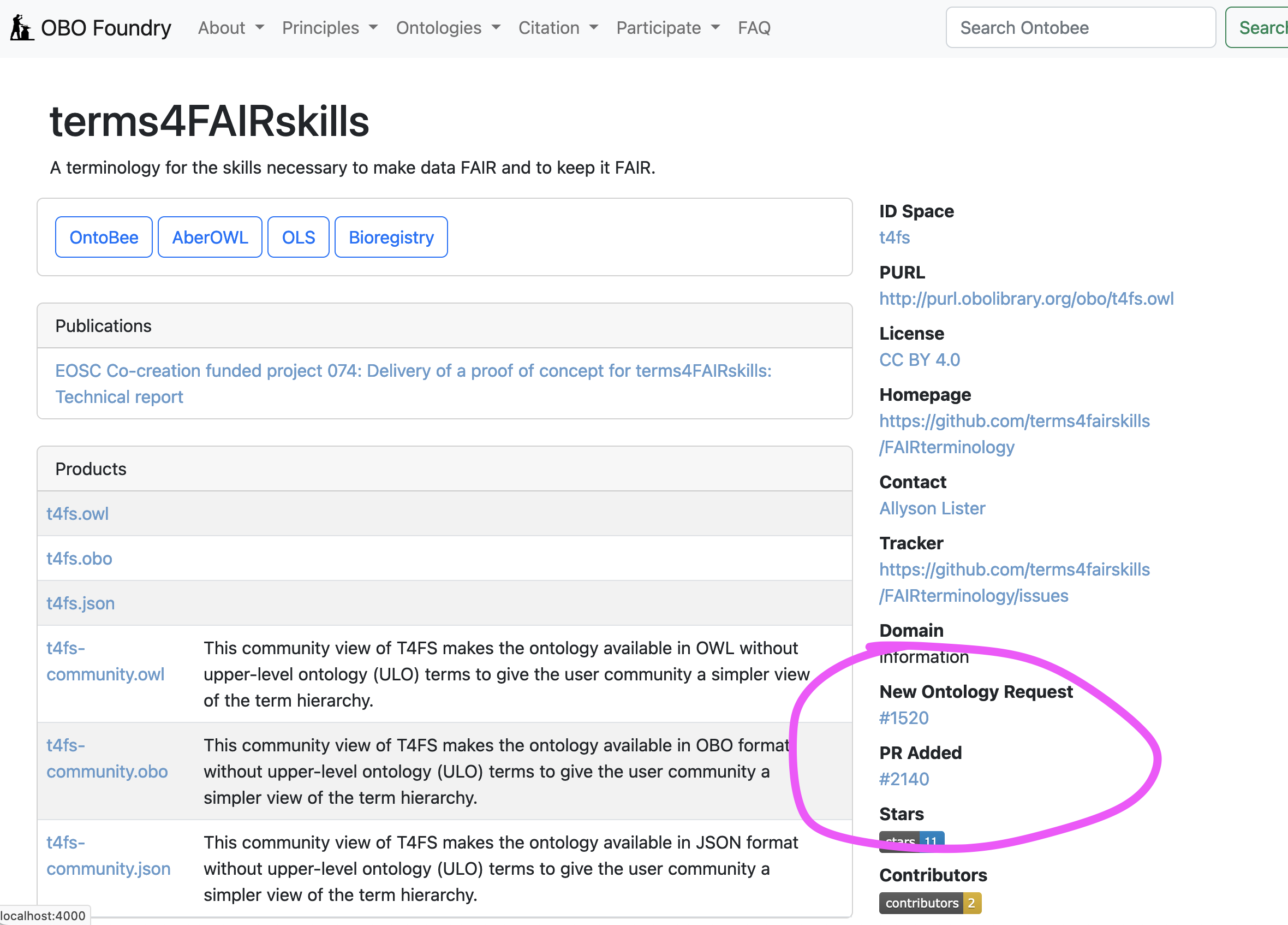


2 participants


This PR adds the ability to encode the pull request when an ontology was added to the OBO Foundry GitHub repository. It demonstrates how this annotation looks for two ontologies: CLAO and CLYH. It also updates the ontology detail page to display this information.
Benefits of Doing This
How to curate more
Figuring out the PR to go with each ontology would be a "good first issue". Here are the steps to figuring this out:
Master #XXXX