


Diese Veranstaltung bietet eine praktische Einführung in statistische Verfahren und deren Anwendung auf sprachliche Beispiele. Sie vermittelt Grundlagenwissen sowohl aus dem Bereich der deskriptiven Statistik als auch über die gängigsten inferenzstatistischen Verfahren, die im Bereich der Sprache angewendet werden. Alle theoretischen Grundkenntnisse werden anhand von praktischen Übungen vertieft, die mit Hilfe des (frei verfügbaren) Statistikprogramms "R" durchgeführt werden. Nachdem die Teilnehmer Grundlagenkenntnisse in R erworben haben, werden darauf aufbauend Beispielfragestellungen aus unterschiedlichen sprachrelevanten Bereichen bearbeitet. Dabei wird neben der Frage nach einem angemessenen experimentellen Design und dem geeigneten statistischen Verfahren auch die praktische Umsetzung der Auswertung in R im Mittelpunkt stehen. Nach Besuch dieser Veranstaltung sollten Teilnehmer in der Lage sein, eigene Daten statistisch zu analysieren.
- Termin montags 12-14 Uhr c.t. Raum HSG +1/0120 und dienstags 10-12 Uhr c.t. WR6 01C08;
- Anzahl der ECTS-Punkte und Art der Prüfung (Klausur, "Hausarbeit") nach der jeweilgen Prüfungsordnung.
- Vorausgesetzt für die Zulassung zur Prüfung sind
- regelmäßige Teilnahme, inkl. Hausaufgaben zu jedem Termin -- siehe Blatt dazu
- max. 4 unentschuldigte Fehltermine
- Anmeldung verbindliche und obligatorische Anmeldung über ILIAS bis 18.04.2014
- Sprechstunde montags 16-17 Uhr oder nach Absprache
- Kursmaterial https://github.com/Uni-Marburg-IGS-Statistik/Statistik-f-r-Sprachwissenschaftler
- Email Nur Mails von Uni-Konten werden gelesen und beantwortet!
WARNUNG Ich bin v.a. bei Formalien, die mir ein gewisses Workflow ermöglichen, sehr streng, z.B. Input-Output-Format, Respository-Layout, usw. Hausaufgaben, die den formalen Anforderungen nicht entsprechen, gelten als nicht eingereicht!
| Woche | Datum | Themen |
|---|---|---|
| 01. | 14.04.2014 | Formalia, Einführung, (Textdateien &) DVCS, Warm-Up: Kombinatorik |
| 15.04.2014 | Warum Statistik? R, RStudio, Git | |
| 02. | 21.04.2014 | fällt aus! (Ostermontag) Ersatz-Lektüre: Stevens (1946) |
| 22.04.2014 | Warum Statistik? Ziele der Forschung, Modelle, Beschreibungsstatistik I (Maße der zentralen Tendenz) | |
| Hausaufgabe bis 28.04.2014, 12 Uhr: (in der Reihenfolge machen!) | ||
1. hausaufgabe03a.Rmd
|
||
2. hausaufgabe03b.R
|
||
| 03. | 28.04.2014 | Beschreibungsstatistik II: Dispersions- und Streuungsmaße |
| Hausaufgabe bis 29.04.2014 8 Uhr: | ||
| 1. An Fragenbogen "Verteilungen" (bei ILIAS) teilnehmen | ||
| 2. Handout zu Logarithmen anschauen | ||
| 29.04.2014 | Visualisierung der Daten: ggplot2-Basics |
|
| Hausaufgabe bis 05.05.2014 12 Uhr: | ||
1. hausaufgabe05.R
|
||
| 04. | 05.05.2014 | Auf dem Weg zu Interferenzstatistik: |
| Hausaufgabe bis 06.05.2014 10 Uhr: | ||
| Lesen Sie: | ||
| 1. wie Statistik oft misbraucht wird. | ||
| 2. warum es in den letzten Jahren eine Krise in der Wissenschaft gibt. | ||
| 06.05.2014 | Statistische Inteferenz, |
|
| Hausaufgabe bis 12.05.2014 12 Uhr: | ||
1. hausaufgabe07.Rmd
|
||
| 05. | 12.05.2014 | Mehr zu Stichproben, Vergleich von Gruppen ( |
| Hausaufgabe bis 13.05.2014 10 Uhr: | ||
| 1. Schauen Sie sich das Video zu BEST BEST an. | ||
| 13.05.2014 | Vergleich von Gruppen ( |
|
| Hausaufgabe bis 19.05.2014 12 Uhr: | ||
1. hausaufgabe09.R
|
||
| 06. | 19.05.2014 | Confidence und Credible-Intervale, BEST, Interferenz in der Praxis: Der Sinn von statischen Tests, neuartige Fehler, Unterschiede in frequentistischen und bayes'schen Aussagen |
| 20.05.2014 | Intervale II | |
| Hausaufgabe bis 26.05.2014 12 Uhr: | ||
| 1. Shiny apps anschauen | ||
| 2. sich erholen | ||
| 07. | 26.05.2014 | ANOVA I |
| 27.05.2014 | ANOVA II (evtl. auch Fixed vs. Random Effects à Clark 1973) | |
| Hausaufgabe bis 02.06.2014 12 Uhr: | ||
1. hausaufgabe13.Rmd
|
||
| 08. | 02.06.2014 | ANOVA III: Auswertung und Interpretation |
| 03.06.2014 | lineare Regression I | |
| Hausaufgabe bis 10.06.2014 10 Uhr: | ||
1. hausaufgabe15.R
|
||
| 09. | 09.06.2014 | fällt aus! (Pfingstmontag) |
| 10.06.2014 | lineare Regression II | |
| Hausaufgabe bis 16.06.2014 12 Uhr: | ||
1. hausaufgabe16.Rmd
|
||
| 10. | 16.06.2014 | Wiederholung, implizite Darstellung des General Linear Modells (GLM) |
| 17.06.2014 | Korrelationen I | |
| Hausaufgabe bis 23.06.2014 12 Uhr: | ||
1. hausaufgabe18.R
|
||
| 11. | 23.06.2014 | gemischte Modelle I |
| 24.06.2014 | gemischte Modelle II | |
| Hausaufgabe bis 30.06.2014 12 Uhr: | ||
1. hausaufgabe20.Rmd
|
||
| 12. | 30.06.2014 |
|
| 01.07.2014 |
|
|
| Hausaufgabe (wird nicht kontrolliert!) | ||
| 1. Kapitel 18 bis auf 18.7 (loglinear analysis) aus Discovering Statistics Using R lesen | ||
| 2. Tests selber üben -- mit den Daten in DSUR oder weiterhin mit dem Titanic-Datensatz | ||
| 13. | 07.07.2014 | Verweis auf nicht behandelte Methoden,^[jenseits] Experimentaldesign I |
| 08.07.2014 | Experimentaldesign II, Effektgröße und Power | |
| 14. | 14.07.2014 | Fragestunde / Puffer |
| 15.07.2014 | Klausur |
Baayen, R. Harald (2008): Analyzing Linguistic Data: A Practical Introduction to Statistics Using R. Cambridge University Press.
Bortz, Jürgen und Schuster (2010) Statistik für Human- und Sozialwissenschaftler. Springer Verlag.
Eid, Gollwitzer und Schmitt (2010): Statistik und Forschungsmethoden. Beltz Verlag.
Field, A., Miles, J., & Field, Z. (2012): Discovering Statistics Using R. Sage Publications.
Luhmann, M. (2010): R für Einsteiger. Einführung in die Statistiksoftware für die Sozialwissenschaften. Beltz Verlag.
Wickham, Hadley (2009): ggplot2. Springer.
Wilcox, Rand R. (2010): Fundamentals of Modern Statistical Methods. Springer Verlag.
Wilcox, Rand R. (2012): Introduction to Robust Estimation and Hypothesis Testing. Academic Press.
Die Reihe Use R! von Springer sowie auch Bortz und Schuster und die zwei Bücher von Wilcox sind kostenlos über das Uni-Netz elektronisch verfügbar!
- Literate programming, version control, reproducible research, collaboration, and all that
- GitHub Git Cheat Sheet
- GitHub Git Resources
- Git -- the simple guide
- RMarkdown
- R Bloggers
- RSeek
- How to Search for R Materials
- R for Cats
- R is a language
- R Inferno
- Try R
- Quick-R
- R Links (Community Wiki)
- Optional Stopping
- Confidence Intervals
- From the Binomial to the Normal Distribution (Ein Beispiel für den Zentralen Grenzwertsatz)
- Dance of the p-Values
- John Myles White
- Good Tools for Individual Researchers are not Good Tools for Research Communities
- NHST Conflates Rare Events with Evidence Against the Null Hypothesis
- Essential Information is Lost When Transforming 2D Data into a 1D Measure
- No Mechanism for Producing Substantive Cumulative Knowledge
- p-Values Measure Effort, Not Truth
- A Cheap Criticism of p-Values
- Andrew Gelman
- The p-value is not...
- Revised statistical standards for evidence
- One-tailed or two-tailed?
- Interrogating p-values
- The problem with p-values is how they're used
- The Difference Between "Significant" and "Not Significant" is not Itself Statistically Significant
- Researcher degrees of freedom and accidental p-hacking
- P-Values and Statistical Practice
- Ken Rice presents a unifying approach to statistical inference and hypothesis testing
- Verstehen Ärzte Testergebnisse?
- Famous statistician quotes
- Common statistical sins
- Modes, Medians and Means: A Unifying Perspective
- How do we choose our default methods?
- "The graph clearly shows that mammography adds virtually nothing to survival and if anything, decreases survival (and increases cost and provides unnecessary treatment)" -- ein wichtiges Beispiel von Effektgröße vs. "signifikant" mit Brustkrebs!
- Understanding Simpson’s paradox using a graph
- loess explained in a GIF
- Big Data...Big Deal? Maybe, if Used with Caution.
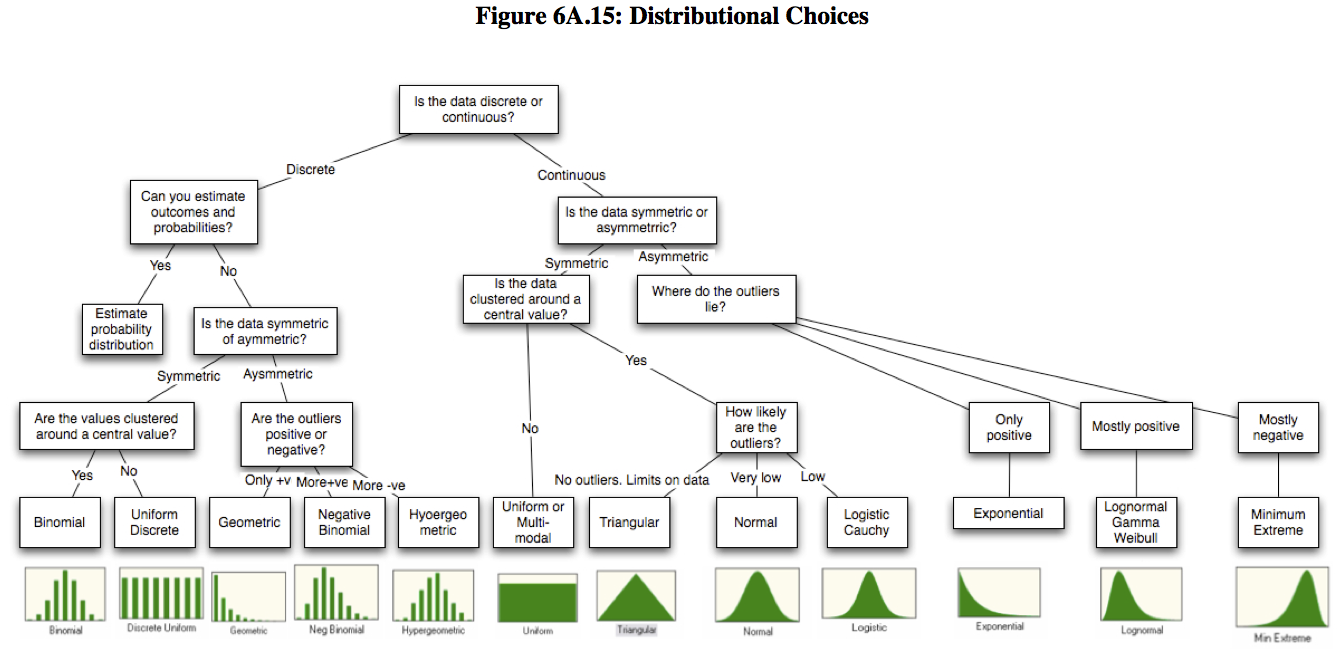
- Überblick über verschiedene Verteilungen im Anhang 6.1 zu Probabilistic Approaches to Risk von Aswath Damodaran, v.a. Figure 6A.15. Die Anwendung solcher Verteilung ist v.a. bei GLM sehr wichtig, wo wir eine nicht gaussche Verteilung unserer Daten bzw. Residuals bei einer Regression annehmen.
- Software für Bayesian Modelling (wird nicht im Kurs genutzt, aber vielleicht interessant)
- xkcd
- Spurious Correlations
- How would you explain covariance to someone who understands only the mean? Besonders schön ist whubers Antwort.
Warum gibt es bei manchen Formlen aus der deskriptiven Statistik $n-1$ und bei anderen $n$ als Nenner?
- Bessel's Correction
- Korrigierte Stichprobenvarianz
- Sample mean and sample covariance
- How exactly did statisticians agree to using (n-1) as the unbiased estimator for population variance without simulation?
- Schools of Statistical Thought as Religion
- Bayesian Modelling of Anscombe's Quartet
- Bayesian or Frequentist, Which Are You? vielleicht die beste holistische Perspektive!
- Positioning Bayesian inference as a particular application of frequentist inference and vice versa
- What is Bayesian / Frequentist Interference? -- auch eine sehr gute, ausgewogene Perspektive
- On Chomsky and the Two Cultures of Statistical Learning
- The Signal and the Noise von Nate Silver
- Gary Marcus, "What Nate Silver Gets Wrong"
- Larry Wasserman, Nate Silver is a Frequentist
- Are there any examples where Bayesian credible intervals are obviously inferior to frequentist confidence intervals
- Why does a 95% CI not imply a 95% chance of containing the mean?
- What does a confidence interval (vs. a credible interval) actually express?
- Why do (a lot) fewer than 95% of my confidence intervals intersect the true parameter value in this simulation?
- What, precisely, is a confidence interval?
- From a Bayesian probability perspective, why doesn't a 95% confidence interval contain the true parameter with 95% probability?
- Binomial confidence interval estimation - why is it not symmetric?
- lmer, p-values and all that
- Tutorials
- Bodo Winter
- Baayen, Davidson und Bates 2008 (und alle anderen Artikel aus der Ausgabe des Journal of Memory and Language)
- Ben Ogorek, Random regression coefficients using lme4
- T. Florian Jaeger
- Jonathan Harrington (Professsor der Phonetik an der LMU). Die zwei Tutorials sind nicht ganz gleich!
- Random Effects: Should I stay or should I go? (vgl. auch Barr et al 2013)
- Going full Bayesian with mixed effects regression models
- Diagnosing collinearity in mixed models from lme4
- Multinomial random effects models in R
- Plotting effects for glmer(, family=”binomial”) models
- Nagelkerke and CoxSnell Pseudo R2 for Mixed Logit Models
- old and new lme4
- Test equivalence of non-nested models
- Entwurf des
lme4Buches von Doug Bates - Nützliche Pakete
lme4: Linear mixed-effects models using Eigen and S4lmerTest: Tests for random and fixed effects for linear mixed effect models (lmer objects of lme4 package)effects: Effect Displays for Linear, Generalized Linear, Multinomial-Logit, Proportional-Odds Logit Models and Mixed-Effects ModelsLMERConvenienceFunctions: A suite of functions to back-fit fixed effects and forward-fit random effects, as well as other miscellaneous functionslanguageR: Data sets and functions with "Analyzing Linguistic Data: A practical introduction to statistics"multcompSimultaneous Inference in General Parametric Modelsblme: Bayesian Linear Mixed-Effects Modelsnlme: Linear and Nonlinear Mixed Effects Modelsglmer2stan: Define Stan models using glmer-style (lme4) formulas
- Beispiele für die Anwendung von gemischten Modellen in der Literatur
This work is licensed under the Creative Commons Attribution-NonCommercial-ShareAlike 3.0 Germany License. To view a copy of this license, visit http://creativecommons.org/licenses/by-nc-sa/3.0/de/.
The programs presented here are mostly so simple as to be trivial, and as such, they should not be able to cause any damage. However, as Murphy once noted, there is always the potential for something to go horribly wrong, and so I hereby explicitly state that
The code here (including but not limited to the code in the pages for the individual sessions) is distributed in the hope that it will be useful, but WITHOUT ANY WARRANTY; without even the implied warranty of MERCHANTABILITY or FITNESS FOR A PARTICULAR PURPOSE.
Think before you type: I’m not responsible if you blindly copy and paste code and something bad happens.
Longer programs are licensed under the GPL v2, as noted in their respective source files.