Repository navigation
High TTFB for NextJs application #3357

Description
Activity
Can confirm this is happening on our Amplify applications as well, starting this morning. Vanilla React is ok but NextJS applications hv high TTFB (sometimes > 20s)
App Id d1bzv6vd8539jw
AWS Region us-east-1Reacted by Akhilesh, ArianHamdi, Daniel Johnston and Ivan CaceresSame here also.
@hloriana - Why are we seeing high TTFB all of a sudden? We didn't make any code changes/deployments. Did something change in AWS Amplify yesterday?
We are looking into this
@ferdingler Please take a look at my discovery. #3359 (comment)
@ferdingler Please have a look at #3211.
Issues for me started since migrating WEB_COMPUTE two days ago.
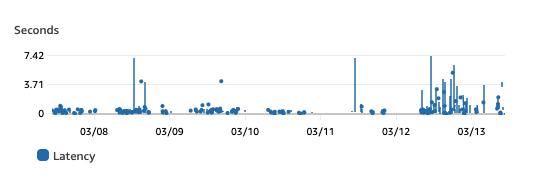
@ferdingler Please have a look at #3211. Issues for me started since migrating WEB_COMPUTE two days ago.
High TTFB in 03/08 & 03/09
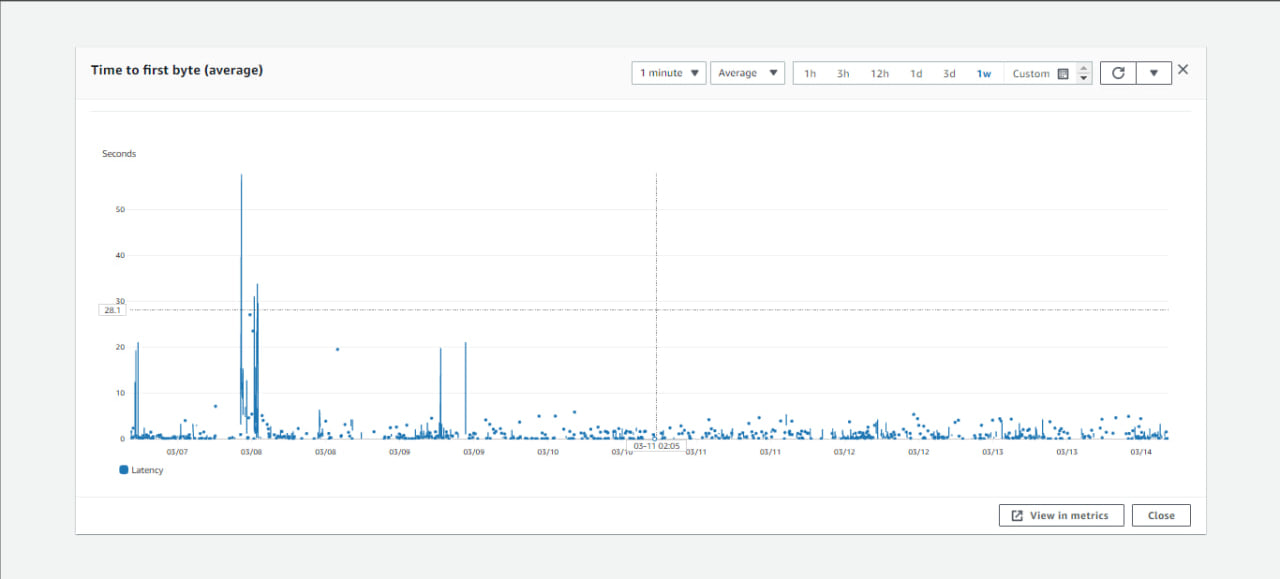 Reacted by vafPER and Ivan Caceres
It's been more than 2 weeks and there is no update here.
This is the support we get for production issues (production system going down)? Or is this the AWS way to make us subscribe to their Support plan?In my company we are also experiencing long load times for our nextjs apps.
I've (temporarily) fixed this by setting up a Cloudwatch Synthetic Canary, which fetches the url of my amplify app(s) every 5 minutes and so keeps the Lambdas warm.
Cloudwatch > Application monitoring > Synthetics Canaries where you can pick the Heartbeat monitoring blueprint.
I've (temporarily) fixed this by setting up a Cloudwatch Synthetic Canary, which fetches the url of my amplify app(s) every 5 minutes and so keeps the Lambdas warm.
Cloudwatch > Application monitoring > Synthetics Canaries where you can pick the Heartbeat monitoring blueprint.
This will only solve the issue if you do not have a high traffic website. If 2 people simultaneously access your website, one of them would still experience a cold start
Same problem here ! ~5s TTFB
Here is around 10s TTFB
Hey everyone 👋 , thank you for your continued patience.
We are actively investigating and are working on narrowing down the root cause of the elevated latencies (high TTFB) with Compute apps. Please rest assured that this is our highest priority and we will keep you posted with any updates.
Apologies for the inconvenience caused due to this behavior with Compute apps.
Reacted by abepuentes and Dominik ScholzReacted by abepuentesHey everyone 👋
We just released some changes to improve how long it takes to serve content from Next.js apps. These changes require a new deploy in your application to take effect. The expected outcome is that your sites should load quicker than before.
If you have comments or questions don't hesitate to reach us via AWS support.
⚠️ COMMENT VISIBILITY WARNING⚠️ Comments on closed issues are hard for our team to see.
If you need more assistance, please open a new issue that references this one.This issue has been automatically locked.
- locked and limited conversation to collaborators
on Jul 27, 2023


Before opening, please confirm:
App Id
dyyv7k61mxhcc
AWS Region
us-east-1
Amplify Hosting feature
Not Applicable
Describe the bug
We have a NextJs application hosted on Amplify. We are seeing high TTFB for our application in production. We are getting this problem without any changes at our end. This is happening since 2:30 AM UTC today.
Expected behavior
TTFB should not take so long. It should be back to normal.
Reproduction steps
Build Settings
Log output
Details
Additional information
No response