# Architecture
*For readers who want to see how CW is put together inside. To use CW, you do
not need this page — start at [Getting Started](Getting-Started.md).*
CW is built like a small operating system: a base system plus userland apps.
The runtime (the base system) owns the machinery for planning, dispatch,
state, verification, and reporting. Workflow apps, model choice, pricing
policy, and vendor wrappers live outside that core.
```text
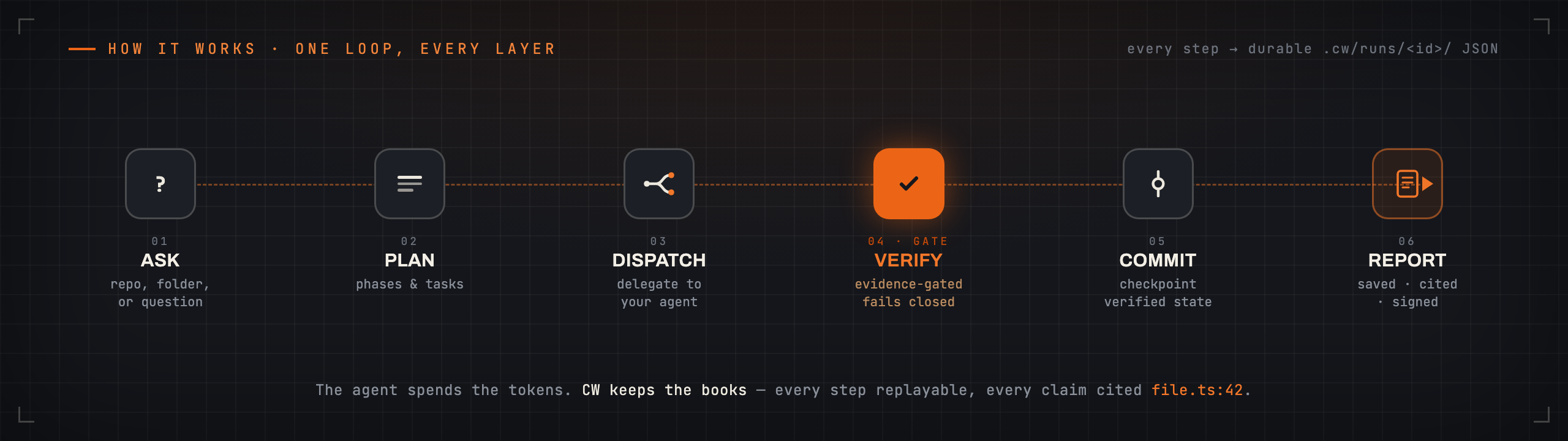
workflow app -> runner -> dispatch -> isolated workers
-> results -> feedback/candidates -> verifier gate
-> commit/checkpoint -> report/trust audit
multi-agent host -> topology -> blackboard/coordinator
-> fanout/fanin -> candidate score/select
```
CW is a small TypeScript tool with **zero runtime dependencies**. It drives
your agent over a repo — or any folder — in saved stages that you can replay,
writing everything to disk as files you can open and read.
```text
ask simple → run simple → verify simple → resume simple
```
## Core Boundary
The runtime lives under `plugins/cool-workflow/src/`. It provides:
| Area | Responsibility |
| --- | --- |
| `orchestrator` | Plans runs, loads workflows, records results, writes reports. |
| `state` | Persists `.cw/runs//state.json` and migration entry points. |
| `dispatch` and `worker-isolation` | Allocate worker scopes, manifests, and result paths. |
| `verifier` and `commit` | Validate outputs and create verifier-gated checkpoints. |
| `capability-registry` | Declares the CLI and MCP surfaces from one source. |
| `run-registry` | Indexes, resumes, archives, exports, and imports runs. |
| `telemetry` and `trust-audit` | Record usage attestations, hash chains, and decisions. |
The project index in the source repo is generated from code and is the best
maintainer map when module ownership matters.
## Delegation Boundary
CW delegates worker execution to an external process or endpoint. The agent
reads the worker input, writes `result.md`, and may report model and usage
metadata. CW records the handle and validates the result envelope, but it does
not import a model SDK or call a model API.
That boundary is why model keys stay with the agent. It is also why telemetry
verification proves *who reported the usage* and *that the record was not
changed later* — it is not a direct measurement of model usage.
## State Layout
A run is stored as plain files:
```text
/.cw/runs//
state.json
report.md
audit/events.jsonl
telemetry.json
workers//
results/
nodes/
candidates/
commits/
```
The per-run `state.json` is the source of truth. Everything else — registry
indexes, summaries, reasoning views, workbench panels — is a view worked out
from it, and can be rebuilt from it.
## CLI And MCP
The CLI is for human speed. MCP tools are for machine context. Both route through
shared capability entries, and declared JSON payloads are parity-checked.
Examples:
- `cw app list` and `cw_app_list`
- `cw report --json` and `cw_report`
- `cw run import` and `cw_run_import`
- `cw telemetry verify` and `cw_telemetry_verify`
The Workbench is a read-only localhost view over the same run files and
capability payloads. It does not own authoritative state.
For more on vendor manifests and MCP boot checks, see
[MCP And Manifests](MCP-And-Manifests.md).
## Failure Discipline
When something is wrong, CW says no clearly instead of quietly working around
it:
- no agent configured -> blocked,
- invalid result envelope -> rejected or parked,
- corrupted archive -> refused or reported failed,
- stale derived index -> reported stale,
- unverifiable audit chain -> failed verification.
stdout is kept for data only. Messages for humans and live agent traces go to
stderr, and only when turned on.
## Related Pages
- [Workflow Apps](Workflow-Apps.md)
- [Trust And Audit](Trust-And-Audit.md)
- [Recovery And Restore](Recovery-And-Restore.md)