This documents describes the basic technical components of the Data Rights Protocol system, with a particular eye on how a company which has implemented 0.5 version of the protocol may look towards a 1.0 protocol implementation. It should also serve as a high-level introduction to the Data Rights Protocol for new implementers.
Covered Businesses may implement the DRP themselves, or partner with a Privacy Infrastructure Provider who will provide API services and privacy rights workflow management. Businesses implementing their own endpoints will be responsible for evaluating and implementing the requirements for PIPs as well.
These are provided in the Authorized Agent's data rights request or informed by the legal regime the request is made under
- information about the authorized agent submitting the request as pulled from the Service Directory or shared out of band including the LoA which the authorized agent verifies identity attributes to.
- identity attributes of the consumer, and whether they are positively verified. A handful of standard claims will be included but there is ongoing discussion in issue 52 about methods to specify which claims a business wishes to see in a data rights request.
- the data rights actions requested: data sale opt-out, deletion, access
- legal regime of the request. the DRP is designed around a legal obligation to communicate with authorized agents, a legal framework which currently only exists under the California Consumer Privacy Act and its amended statutes. Requests made outside of this legal regime are thus made on a voluntary compliance basis until other legal jurisdictions adopt Authorized Agent frameworks.
- important deadline dates (45 days after ack for CCPA, for example)
- Maintain records in the Covered Business Service Directory with the technical and business information used to discover API endpoints and API requirements.
- acknowledge data requests made under DRP and generate and maintain a request ID
- update a request's state with information about the status of a request in progress
- [1.0] request information or verification by providing a URL
- [1.0] if a business has an account server, they may ask a consumer to authenticate against it
in
need_user_verification
- Interoperate with Authorized Agents not only in a technical fashion but at the business/legal consortium layer
- Encouraged to affirmatively respond to voluntary data requests
It is perfectly possible and reasonable for Covered Businesses to "bring their own" PIP and participate in the network as both a business and a technical contributor, and it's also perfectly possible and reasonable for them to out-source PIP functions to a company providing automation services. Businesses which "bring their own" PIP should read any of the PIP requirements as requirements on their technical team and its interface with the Business's privacy legal/policy programs.
- Keep an up to date copy of the Authorized Agent Service Directory
- Maintain records in Covered Business Service Directory with the technical and business information for the Covered Businesses whose requests are managed by the PIP
- Verify the cryptographic trust of incoming requests against Agent public keys in service directories
- Generate and Persist API tokens for each Authorized Agent + Covered Business relationship pairing
- Map DRP request states in to a workflow which the Covered Business's Privacy Program can work with and back out to the workflow states which the Authorized Agents expect to work against
- Review and provide revisions/feedback/approval on revisions to the Data Rights Protocol and Agreements
- Provide within the Authorized Agent directory documentation of the practices the AA follows to
verify identity attributes of Consumers.
- Authorized Agent MUST verify the consumer's email address when the user first registers
- Authorized Agent MAY verify the consumer's phone number and/or physical address when they register as well.
- Authorized Agent MUST only present the "is verified" bits for attributes that have been verified according to this Identity Assurance documentation
- Generate and securely manage an Ed25519 signing key. This signing key is not to be placed on a Consumer's user agent
- Keep an up to date version of the Covered Business Service Directory
- Maintain records in the Authorized Agent Service Directory with the technical and business information used as mechanisms for trusting mechanism the AA, including the "verify key" corresponding to the Ed25519 signing key.
- Interact with the "pair-wise API token" setup endpoint the first time it submits a request to a Covered Business and persist that API token
- Interact with the Data Rights Request endpoints using the Ed25519 signed requests and API bearer token as appropriate
- Authorized Agents must notify a user when the CB communicates a state change to the AA in a timely manner
- [1.0] Authorized Agents SHOULD provide a "status callback" URL pointing to a service they manage which can receive updates to data rights requests without needing to regularly poll from the PIP.
- [1.0] Authorized Agents MUST implement the
need_user_verificationflow allowing the Consumer to verify their identity in a system managed by the CB. - Review and provide revisions/feedback/approval on revisions to the Data Rights Protocol and Agreements
- maintain service directories
- onboarding/offboardings Business + Agents + PIPs
- Facilitate decision making for updates for the Data Rights Protocol and Agreements
Authorized Agents submit data rights requests to Privacy Infrastructure Providers that are signed
using Ed25519 public/private key encryption as implemented by the public domain libsodium. This
signature system is used to issue bearer token authorization keys as defined under the Auth
endpoints section below.
Authorized Agents will be responsible for generating and securely managing signing keys and exporting public verify keys based derived from those signing keys. Implementers should consult for example the PyNaCl "Digital Signatures" documentation.
Verify keys should be presented to the PIPs through an out of band channel (email/signal/etc to
start, eventually transitioning to a service directory model outlined under Discovery) and
encoded in base64 as in nacl.encoding.Base64Encoder for the sake of consistency.
The DRP Security Model technical note describes the rationale for this choice and the move away from JSON Web Tokens.
As part of their onboarding to the DRP, Authorized Agents will present their verify key as well as technical and business contact information.
As part of their onboarding to the DRP, Covered Businesses will present the "base" of the following API endpoints, the rights they support under DRP, and technical and business contacts.
Privacy Infrastructure Providers may also submit a covered business for integration testing purposes with the same information but with no underlying business represented.
Authorized Agents will use the directory of Covered Businesses to submit automated requests to any Covered Business in the directory. Covered Businesses will use the directory of Authorized Agents to establish a cryptographic trust root and to establish communication with Agents in the event that they suspect fraudulent or forged requests.
The exact details of the enrollment and presentation of these directories is still undefined. Businesses may be able to delegate enrollment in the directory to the Privacy Infrastructure Provider which provides their DRP API. AAs and PIPs can be expected to pull these files in to their system when they have been updated, and there may be "web hook" endpoints which can be implemented by the services.
POST /v1/agent/{id}GET /v1/agent/{id}
Data Rights Protocol uses a bespoke machine-to-machine API authentication system based on the same public key cryptography which is used to sign the data rights requests. This was designed so that relationships between Authorized Agents and Covered Businesses can be established using only the public information stored in the service directory which acts as a root of trust between all of the parties of the network. Rather than needing to exchange OAuth2 client tokens before data rights requests can be processed, a new business can simply be advertised in the CB directory and use the AA directory to ensure requests are coming from trusted parties without delay or confusion.
This token is used by PIPs to bootstrap the signature verification steps outlined in Section 3.07 of the spec. Rather than work through a keyring containing every Authorized Agent's keys, the PIP can map from the Bearer Token to a specific Authorized Agent and use that knowledge to pick the key which should verify the incoming message. The can also use these tokens to: to route traffic to particular businesses in multi-tenant scenarios without having to verify and deserialize the requests themselves or keep a global mapping from request ID to business and to implement rate limit, abuse control, etc without paying CPU cycles on cryptography.
PIPs implement handlers for these two endpoints under their api_base.
Authorized Agents will, before making a request to a new Covered Business, create a request to POST /v1/agent/{id} signed by their Signing Key containing the pair of parties the returned key should
be controlling access to. The PIP will respond with a token which shall be used in any future
requests from that authorized agent to that covered business as a Authorization: Bearer <token>
"bearer token". GET /v1/agent/{id} exists to ensure that the generated token is valid but may be
extended to provide other functionality in the future.
Authorized Agents are expected to make calls to these APIs from a trusted back-end rather than a User Agent or uncontrolled device!
The "shape" of the DRP API routes changed in significant ways between 0.6 and 0.7 -- this API pattern is a "REST-ful" pattern with a major-version prefix signaling that these paths and the shape of their requests will remain backward compatible. We believe these APIs will be more-or-less set in stone until and through the DRP 1.0 go-live.
Authorized Agents are expected to make calls to these APIs from a trusted back-end rather than a User Agent or uncontrolled device!
PIPs implement handlers for these endpoints under their api_base.
POST /v1/data-rights-request/ (2.02)
POST /v1/data-rights-request was POST /exercise in 0.6.
The body of the request will be a libsodium signed object with the signature embedded in it; this
is referred to as "combined
mode" as opposed to
"detached mode". The inner JSON document contains information about the consumer making the request,
the specific rights they want to engage in, the authorized agent submitting the request on behalf of
the consumer, and business the request is being sent to.
In version 0.5 the request was a "plain old JSON" request with only the user's identity attributes signed and encoded as a JWT by the Authorized Agent but this design did not confer the sorts of advantage we hoped for earlier in the design.
Section 3.07 of the protocol specification outlines an algorithm which PIPs need to engage in to validate the messages are signed and coming from the expected party. Prior versions relied on a pre-shared symmetric signing key.
The validated request should be persisted and mapped in to a privacy workflow system which the Covered Business uses to process manual or e-mail based data rights requests as well; in theory it should be possible for a Covered Business to "flip a switch" in their Privacy Infrastructure Provider to start receiving DRP requests.
GET /v1/data-rights-request/{id} (2.03)
GET /v1/data-rights-request/{id} was GET /status in 0.6.
This endpoint returns the processing status of a previously submitted request. The critical fields to include in response to this request are a pair of "status" and "reason" fields which represent where in the request processing "state machine" a given request is in, but there are additional fields for when a request may be expected to be delivered, or may be due. By providing an estimate of delivery, Privacy Infrastructure Providers can signal to Authorized Agents when they should next request a status update rather than pinging every hour or day while the request is in queue or in process.
Conversely, Authorized Agents should take care to not cause a "thundering herd" by scheduling many calls to this endpoint simultaneously. Smear requests to this endpoint to maximize resource efficiency. Further gains can be made by implementing the "status callback" pattern described below.
DELETE /v1/data-rights-request/{id} (2.05)
DELETE /v1/data-rights-request/{id} was POST /revoke in 0.6.
The exact semantics of this request are difficult to nail down and depend on the particularities of a particular request type's work flow. Consider a consumer who says "I don't actually care about this access request any more because I got the information I wanted" compared to "actually, I want you to stop deleting my account halfway through the process of clearing out my records". One of these is as simple as terminating a background data-lake aggregation job, where the other may be technically infeasible to say the least. However, even in the case of deletion, many companies' deletion policies include a "cooling off period" where a user may choose not to delete their account by logging in or otherwise signaling that they no longer want to follow through with this request.
Thus, this endpoint is to be seen as a "best effort" action and the success of it largely comes down to processes and policies outside of the scope of the Data Rights Protocol.
1.0: Status callback (2.04)
Authorized Agents may implement a handler for "status callback" requests sent from the Privacy Infrastructure Provider when a request's status is updated.
Privacy Infrastructure Providers need to implement an HTTP client which POST's a GET /v1/data-rights-request/{id} response to the Authorized Agent's server. This is a push model
while the status endpoint above is a pull model.
Authorized Agents which implement this should ensure they are not requesting status updates in the
GET channel more than once every few days for each request.
This load-shedding behavior will become increasingly important as more data rights requests are sent within the data rights protocol consortium.
1.0: in_progress / need_user_verification state (3.02.1)
A covered business may want to integrate their own account verification system, or a PIP may provide
a form-builder or ID card verification system for more sensitive types of data. This
need_user_verification flow exists to allow the PIP to signal to the AA that a user needs to load
a particular URL in their browser to make further progress on the data rights request. This should
only be used to validate identity attributes which the Authorized Agent has not previously
validated.
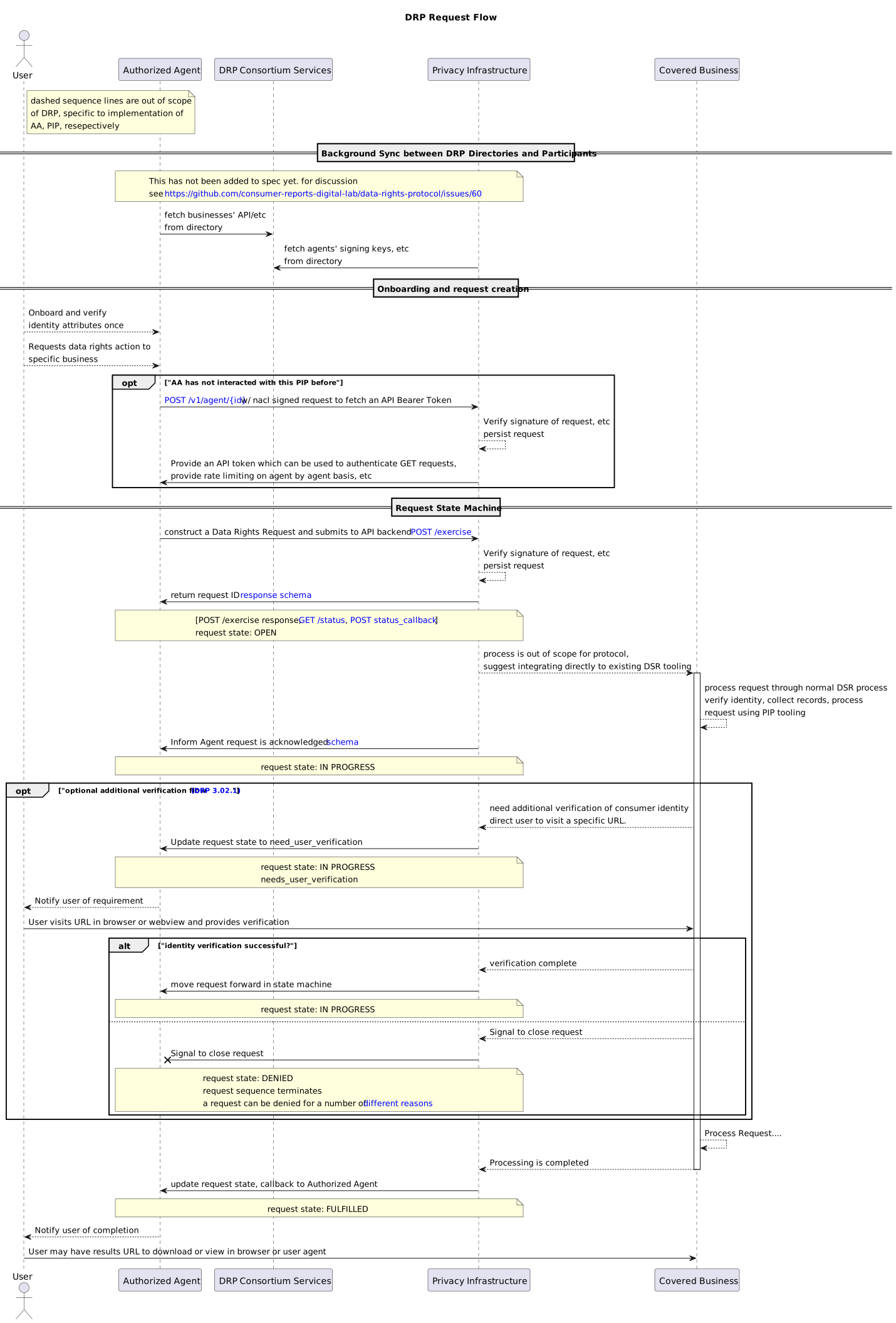
This sequence diagram lays out a sample of the sequence flow between all parties involved from user to business and back.
Ultimately the DRP consortium is not really interested in the workflow that happens "behind the curtain" as long as it exposes the status of a request under the standard's taxonomy. It's up to Privacy Infrastructure Providers and Covered Businesses to design their privacy programs based on business requirements, regulatory regimes, innovative mindsets, etc.
 {width="60em"}
It should be assumed that the PIP and CB more or less "owns" the status of the request, the AA has little agency over a request once it's been submitted. If they need to be amended by the AA the request should be revoked and resubmitted.