Skip to content

Conversation

@OndraMichal
Copy link
Contributor

@OndraMichal OndraMichal commented Apr 25, 2022

all types for surfaces updated
test for all surface types added
+some refurbishment

unit tests: 136 passed, 9 skipped in 170.03s

test for all surface types added
+some refurbishment

unit tests: 128 passed, 9 skipped in 170.76s
…TypesForSurfaces_updated

unit tests: 136 passed, 9 skipped in 170.03s
no (int, optional): Number
offset (float, optional): Offset value
assigned_to_surfaces (str, optional): Eccentricity assignmet
thickness_alignment (_type_, optional): Thickness alignment
Copy link
Contributor

Choose a reason for hiding this comment

The reason will be displayed to describe this comment to others. Learn more.

To be more clear in the documentation, it would be better the change types of enumeration items. I usually use this:
thickness_alignment(enum, optional): Thickness alignment

Copy link
Contributor Author

Choose a reason for hiding this comment

The reason will be displayed to describe this comment to others. Learn more.

Corrected

no: int = 1,
offset: float = 0.1,
assigned_to_surfaces: str = '1',
thickness_alignment = SurfaceEccentricityAlignment.ALIGN_BOTTOM,
Copy link
Contributor

Choose a reason for hiding this comment

The reason will be displayed to describe this comment to others. Learn more.

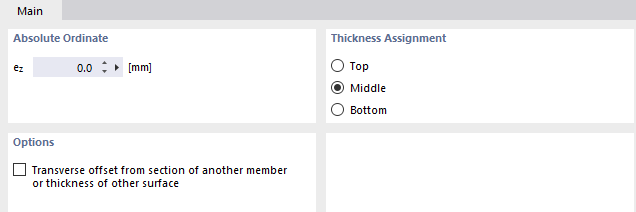
We should use default RFEM values. I recommend changing thickness alignment to ALIGN_MIDDLE
image

Copy link
Contributor Author

Choose a reason for hiding this comment

The reason will be displayed to describe this comment to others. Learn more.

corrected

SurfaceSupport()

# Surface Eccentricities
SurfaceEccentricity()
Copy link
Contributor

Choose a reason for hiding this comment

The reason will be displayed to describe this comment to others. Learn more.

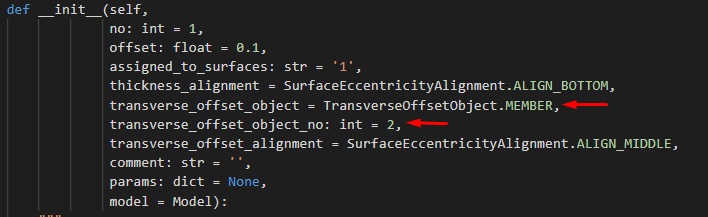
It works with no issues but actually it doesn't work on RFEM. It's because assigning transverse offset to member no.2, but there is no member defined in test.
image
We can change default value to surface or define a member.

Copy link
Contributor Author

Choose a reason for hiding this comment

The reason will be displayed to describe this comment to others. Learn more.

MEMBER -> SURFACE

clientObject.offset = offset

# Assigned to Surfaces
clientObject.assigned_to_surfaces = assigned_to_surfaces
Copy link
Contributor

Choose a reason for hiding this comment

The reason will be displayed to describe this comment to others. Learn more.

clientObject.assigned_to_surfaces = ConvertToDlString(assigned_to_surfaces) would be better in case of several surface assignment.

Copy link
Contributor Author

Choose a reason for hiding this comment

The reason will be displayed to describe this comment to others. Learn more.

corrected

clientObject.no = no

# Assigned to Surfaces
clientObject.surfaces = surfaces
Copy link
Contributor

Choose a reason for hiding this comment

The reason will be displayed to describe this comment to others. Learn more.

ConvertToDlString(surfaces) would be better.

Copy link
Contributor Author

Choose a reason for hiding this comment

The reason will be displayed to describe this comment to others. Learn more.

fixed

@dogukankaratas dogukankaratas self-requested a review April 26, 2022 12:12
@pull-request-quantifier-deprecated

This PR has 350 quantified lines of changes. In general, a change size of upto 200 lines is ideal for the best PR experience!


Quantification details

Label      : Large
Size       : +300 -50
Percentile : 75%

Total files changed: 11

Change summary by file extension:
.py : +300 -50

Change counts above are quantified counts, based on the PullRequestQuantifier customizations.

Why proper sizing of changes matters

Optimal pull request sizes drive a better predictable PR flow as they strike a
balance between between PR complexity and PR review overhead. PRs within the
optimal size (typical small, or medium sized PRs) mean:

  • Fast and predictable releases to production:
    • Optimal size changes are more likely to be reviewed faster with fewer
      iterations.
    • Similarity in low PR complexity drives similar review times.
  • Review quality is likely higher as complexity is lower:
    • Bugs are more likely to be detected.
    • Code inconsistencies are more likely to be detetcted.
  • Knowledge sharing is improved within the participants:
    • Small portions can be assimilated better.
  • Better engineering practices are exercised:
    • Solving big problems by dividing them in well contained, smaller problems.
    • Exercising separation of concerns within the code changes.

What can I do to optimize my changes

  • Use the PullRequestQuantifier to quantify your PR accurately
    • Create a context profile for your repo using the context generator
    • Exclude files that are not necessary to be reviewed or do not increase the review complexity. Example: Autogenerated code, docs, project IDE setting files, binaries, etc. Check out the Excluded section from your prquantifier.yaml context profile.
    • Understand your typical change complexity, drive towards the desired complexity by adjusting the label mapping in your prquantifier.yaml context profile.
    • Only use the labels that matter to you, see context specification to customize your prquantifier.yaml context profile.
  • Change your engineering behaviors
    • For PRs that fall outside of the desired spectrum, review the details and check if:
      • Your PR could be split in smaller, self-contained PRs instead
      • Your PR only solves one particular issue. (For example, don't refactor and code new features in the same PR).

How to interpret the change counts in git diff output

  • One line was added: +1 -0
  • One line was deleted: +0 -1
  • One line was modified: +1 -1 (git diff doesn't know about modified, it will
    interpret that line like one addition plus one deletion)
  • Change percentiles: Change characteristics (addition, deletion, modification)
    of this PR in relation to all other PRs within the repository.


Was this comment helpful? 👍  :ok_hand:  :thumbsdown: (Email)
Customize PullRequestQuantifier for this repository.

@OndraMichal OndraMichal merged commit 4b61c4c into main Apr 26, 2022
@OndraMichal OndraMichal deleted the OndrejMichal_TypesForSurfaces_updated branch April 26, 2022 12:37
Sign up for free to join this conversation on GitHub. Already have an account? Sign in to comment

Labels

Projects

None yet

Development

Successfully merging this pull request may close these issues.

3 participants
