
Damarın olduğu yeri kazar. Başka yere kazma vurmaz.
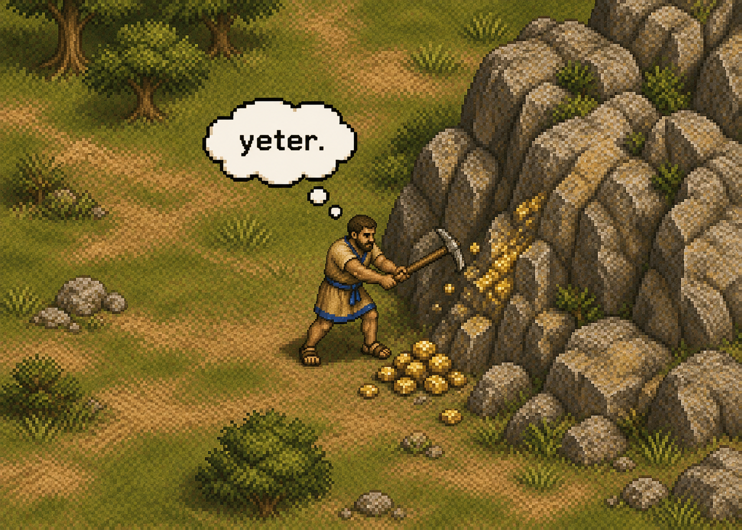


Ona altın kazmasını söylersin, damara gider. Yeni bir maden açmaz, dağı baştan aşağı delmez, istemediğin taşı taşımaz. Çünkü o Age of Empires II'deki madencidir ve her kazma darbesi bir sonraki kişinin okuyacağı, test edeceği, düzelteceği bir satırdır.
Madenci ajanın yazdığı kodu yönetir: görevi çözen en küçük tam değişiklik.
İlk işe yarayan seçeneği alır:
- Gerçekten gerekli mi? İstenmeyen özellik, seçenek, esneklik yok.
- Kod tabanında zaten var mı? Varsa onu, çevresindeki kodun kullandığı gibi kullanır.
- Standart kütüphane veya platform yapıyor mu? Onu kullanır.
- Kurulu bir bağımlılık var mı? Onu kullanır. Üç satır için yeni bağımlılık eklemez.
- Tek satırda okunur mu? Tek satır.
- Hiçbiri değilse: çalışan en az kod.
Soyutlama, sarmalayıcı, "ileride lazım olur" kodu yok. Ama tembellik çözümde, değişikliğin kendisinde değil: kırdığı çağıranlar, testler, fixture'lar tamamlanır.
Asla kesilmez: güven sınırındaki doğrulama, veri kaybını önleyen hata yönetimi, güvenlik, erişilebilirlik, açıkça istenen her şey.
Bilinen bir sınırı olan kestirme kodda işaretlenir:
// shortcut: tek süreçte doğru, birden fazla worker'da kilit gerekir/madenci debt bunları toplar; ertelenen iş sessizce kalıcı olmaz.
/madenci kalk               # aç (varsayılan: açık, full)
/madenci yat                # kapat
/madenci lite|full|ultra    # seviye
/madenci debt               # tüm shortcut: işaretlerinin borç listesi
/madenci audit              # depo denetimi: hata, risk, ölçek, silinecek kod
/madenci help               # komutlar ve mevcut durum
| Seviye | Davranış |
|---|---|
lite |
İsteneni yapar, daha küçük seçeneği tek satırda söyler, seçimi sana bırakır. |
full |
Kuralların tamamı. Varsayılan. |
ultra |
İsteği de sorgular: ihtiyacın haklı çıkarmadığı kısma yapmadan önce itiraz eder. |
debt ve audit mod değil, rapor: çalışır, teslim eder, koda dokunmaz.
oduncu sohbeti yönetir, madenci kodu. Biri az konuşur, öteki az kazar; ikisi birlikte çalışır. Oduncu açıkken madenci'nin kapanış notu ("şunu atladım") düşer — sorarsan cevap gelir. Gerçek bir risk (veri kaybı, güvenlik) yine tek satırla söylenir.
Claude Code'da plugin olarak — hook'larla birlikte, önerilen yol:
/plugin marketplace add erayendes/madenci
/plugin install madenci@madenci
Hook'lar madenciyi oturumlar arasında açık tutar ve alt ajanlara da ulaştırır. Diğer ajanlar için yalnızca skill:
npx madenci install                     # bulduğu her ajana
npx madenci install --only claude,codex # seçerek
npx madenci install --dry-run           # ne olacağını göster
npx madenci where                       # yollar ve mevcut durum
npx madenci uninstall                   # her yerden kaldır
npm i sırasında hiçbir şey yazılmaz; ev dizinine dokunan bir postinstall yok.
| Ajan | Global skill klasörü |
|---|---|
| Claude Code | ~/.claude/skills/ |
| Codex | ~/.codex/skills/ |
| Antigravity | ~/.gemini/config/skills/ |
| Gemini CLI | ~/.gemini/skills/ |
| Cursor | ~/.cursor/skills/ |
| Agent Skills standardı | ~/.agents/skills/ |
Hook'suz kurulumda madenci oturum boyunca açık kalır ama alt ajanlara ulaşmaz.
Üç hook, tek dosya (hooks/madenci.js, ~100 satır). Ağa çıkmaz.
Yalnızca bir durum dosyasını okur/yazar: ~/.config/madenci/state.json (Windows'ta
%APPDATA%\madenci\).
- SessionStart: madenci açıksa kuralları context'e ekler.
- SubagentStart: aynısını her alt ajana.
- UserPromptSubmit:
/madenci kalk|yat|lite|full|ultrakomutlarını durum dosyasına yazar. Başka hiçbir mesaja tepki vermez.
Madenci, ponytail'den (MIT, © DietrichGebert)
türetildi. Kural seti, debt ve audit oradan geliyor; madenci onları budadı, tek skill ve
tek hook dosyasına indirdi, oduncu ile birlikte çalışacak hale getirdi.
Tell it to mine gold and it goes to the vein. It doesn't open a new shaft, doesn't drill the mountain top to bottom, doesn't haul stone nobody ordered. It is the miner from Age of Empires II, and every swing of the pick is a line someone will later read, test and fix.
madenci governs the code an agent writes: the smallest complete change that solves the task.
It takes the first option that fully works:
- Does it need to exist? No unrequested features, options or flexibility.
- Already in the codebase? Use it, the way the surrounding code does.
- Stdlib or platform? Use it.
- An installed dependency? Use it. Never a new dependency for three lines.
- One readable line? One line.
- Otherwise: the minimum code that works.
No abstractions, wrappers or "for later" code. But the laziness is in the solution, never in the change: the callers, tests and fixtures it breaks get finished.
Never cut: validation at trust boundaries, error handling that prevents data loss, security, accessibility, anything explicitly asked for.
A shortcut with a known limit is marked in the code — shortcut: <limit>, <when to upgrade> —
and /madenci debt collects them, so a deferral never quietly becomes permanent.
/madenci kalk               # on (default: on, full)
/madenci yat                # off
/madenci lite|full|ultra    # level
/madenci debt               # ledger of every shortcut: marker
/madenci audit              # repo audit: bugs, risk, scale, code to delete
/madenci help               # commands and current state
| Level | Behavior |
|---|---|
lite |
Builds what was asked, names the smaller option in one line, lets you pick. |
full |
All the rules. Default. |
ultra |
Also questions the request: pushes back on any part the need doesn't justify. |
debt and audit are reports, not modes: they run, deliver, and change no code.
oduncu governs the chat, madenci the code. One talks little, the other digs little; they stack. While oduncu is on, madenci's closing note ("skipped X") is dropped — ask and you get it. A real risk (data loss, security) is still said in one line.
As a Claude Code plugin, with hooks — the recommended path:
/plugin marketplace add erayendes/madenci
/plugin install madenci@madenci
The hooks keep madenci on across sessions and carry it into subagents. Skill only, for every other agent:
npx madenci install                     # every agent found
npx madenci install --only claude,codex # pick
npx madenci install --dry-run           # show what would happen
npx madenci where                       # paths and current state
npx madenci uninstall                   # remove everywhere
Nothing is written during npm i — there is no postinstall touching your home directory.
Without hooks, madenci stays on for the session but does not reach subagents.
Three hooks, one file (hooks/madenci.js, ~100 lines). No network. They
read and write one state file: ~/.config/madenci/state.json (%APPDATA%\madenci\ on Windows).
- SessionStart: if madenci is on, adds the rules to context.
- SubagentStart: the same, for every subagent.
- UserPromptSubmit: records
/madenci kalk|yat|lite|full|ultrain the state file. Reacts to nothing else.
madenci is derived from ponytail (MIT,
© DietrichGebert). The ruleset, debt and audit come from there; madenci pruned them down to
one skill and one hook file, and made them work alongside oduncu.