




When one bad item crashes your loop of 10,000 — don't crash. Set it aside, keep going, fix it later.
pip install quarantine-pyfrom quarantine import quarantine
@quarantine
def process(item): ... # your normal code, unchanged
for item in items:
process(item)That's it. Bad items no longer kill your job. They get saved to a .quarantine/ folder — with their full error and the exact input that caused it — and your loop keeps running.
At the end:
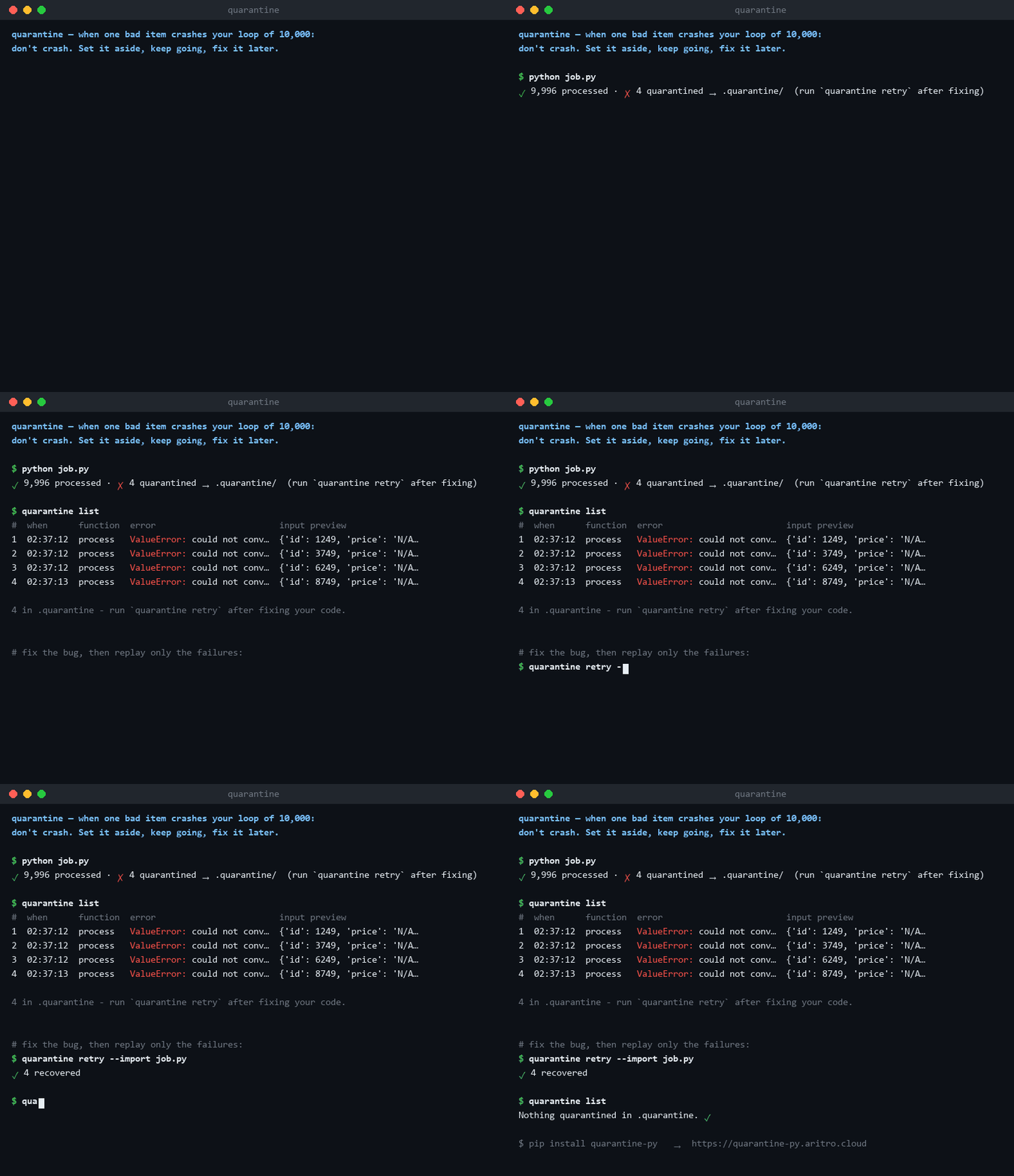
✓ 9,996 processed · ✗ 4 quarantined → .quarantine/ (run `quarantine retry` after fixing)
Imagine you're processing 10,000 records — rows from a CSV, URLs to scrape, images to resize. You write a loop:
for item in items:
process(item)You run it. It works... until item #5,247, which is malformed in some way you didn't expect. Your script crashes. You lost 5,246 items of finished work and 3 hours.
So you fix the bug for that one weird item and rerun from the start. Three hours later it crashes again — at item #7,913, for a different reason.
This cycle is one of the most common, most painful experiences in programming. quarantine ends it.
Yes — try/except is exactly what quarantine uses under the hood. But here's the try/except version once you make it actually safe:
failed = []
for item in items:
    try:
        process(item)
    except Exception as e:
        failed.append(item)  # ❌ lost forever if the script dies later
        print(f"failed: {e}")  # ❌ traceback gone — good luck debugging tomorrow
        # ❌ how do I re-run JUST these failures after I fix the bug?
        # ❌ what if 500 fail in a row because the API is down — keep going?!
        # ❌ how do I save a weird object (DataFrame row? bytes?) to look at later?
Every ❌ is a real problem you'd have to solve yourself, in every script, forever. quarantine solves them once:
try/except by hand |
@quarantine |
|
|---|---|---|
| Loop survives bad items | ✅ | ✅ |
| Failures survive a crash/restart | ❌ in RAM, gone | ✅ saved to disk instantly |
| Full traceback kept for later | ❌ usually just printed | ✅ stored with the item |
| The exact bad input saved | ❌ you'd have to serialize it | ✅ automatic |
| Re-run only the failures | ❌ build it yourself | ✅ quarantine retry |
| Debug with the real bad input | ❌ archaeology in logs | ✅ quarantine debug 2 |
| Detects "everything is failing, stop" | ❌ | ✅ halts on failure streaks |
| Skips already-known-bad items on rerun | ❌ | ✅ |
quarantine is not a replacement for try/except. It's the 200 lines of bookkeeping you'd have to write around it — done correctly, once.
Hospitals don't shut down when one patient has an infection. They quarantine the patient, treat everyone else, and come back with the right medicine.
items ──▶ process() ──▶ ✓ done
              │
              ✗ raises an exception
              ▼
        .quarantine/          ◀── the "sick bay" folder
          ├── item + its data
          ├── the full error traceback
          └── when/why it failed
Your job finishes. The sick items wait for you, with their full medical charts.
Available on PyPI and conda-forge as quarantine-py:
pip install quarantine-pyFrom conda-forge:
# conda
conda install -c conda-forge quarantine-py

# mamba
mamba install -c conda-forge quarantine-py

# pixi
pixi add quarantine-py
uv add quarantine-py # inside a uv project
uv pip install quarantine-py # standalone with uvIf you only want the standalone quarantine command-line tool isolated:
pipx install quarantine-py# Install latest unreleased main directly from GitHub
pip install git+https://github.com/halcyon-past/quarantine
# Or clone for local development
git clone https://github.com/halcyon-past/quarantine.git
cd quarantine
pip install -e ".[dev]" # includes pytest, ruff, mypy, hypothesisRequirements
| Python | 3.10 or newer (CPython; tested on 3.10 - 3.13) |
| Runtime dependencies | none - it is standard library only. (The optional s3:// backend adds boto3: pip install "quarantine-py[s3]".) |
| Operating systems | Linux, macOS, Windows (tested on all three in CI) |
| Type checking | Fully typed, ships py.typed - works with mypy and Pyright out of the box (the codebase itself passes strict mypy) |
Installing also puts a quarantine command on your PATH. Check both halves:
$ quarantine --version
quarantine 1.2.0
$ python -c "import quarantine; print(quarantine.__version__)"
1.2.0
If the command is not found (a common --user install wrinkle), the module
form always works and takes the same arguments:
python -m quarantine listNothing needs configuring. The first time a call fails, .quarantine/ appears
next to wherever you started Python. Add it to your .gitignore -
quarantined inputs are real data, and real data does not belong in git.
.quarantine/from quarantine import quarantine
@quarantine
def process(row):
price = float(row["price"]) # crashes on "N/A"? quarantined.
save_to_db(row["id"], price)
for row in rows:
process(row)$ quarantine list
# when function error input preview
1 09:14:02 process ValueError: could not convert {'id': 8812, 'price': 'N/A', ...}
2 09:31:44 process KeyError: 'price' {'id': 9107, ...}$ quarantine retry
✓ 3 recovered · ✗ 1 still failing (kept in quarantine)No rerunning the 9,996 items that already worked.
(Note: If your function lives in a standalone script rather than an installed package, use -i to tell quarantine where to import it from: quarantine retry -i my_script.py)
$ quarantine debug 2
# opens a Python debugger with `item` set to the exact input that failed
(You can use -i here too: quarantine debug 2 -i my_script.py)
The single biggest time-saver: you never have to reproduce the bug. The bug's exact input is sitting on disk.
If 50 items fail in a row, that's not bad data — that's your database being down. Quarantining 10,000 items would be silly. quarantine halts instead:
✋ 50 consecutive failures — this looks systemic, not bad data. Halting.
   Last error: ConnectionError: db.internal:5432 refused
Tune it: @quarantine(halt_after=100).
@quarantine(
    dir=".quarantine",  # where the sick bay lives - a folder, or s3://bucket/prefix
    only=(ValueError, KeyError),  # only quarantine these; others still crash
    halt_after=50,  # consecutive-failure circuit breaker
    max_items=10_000,  # cap disk usage
    retries=2,  # retry transient failures
    backoff=0.5,  # base delay between retries
    backoff_factor=2.0,  # grow the delay per retry (exponential backoff)
    jitter=0.25,  # randomise the delay so workers spread out
    dead_after=5,  # records failing 5+ retries are skipped by blanket retries
    redact=["api_key", "password"],  # scrub these fields before saving inputs
    on_quarantine=my_alert_fn,  # e.g., send a Slack ping
    on_retry_success=my_metric_fn,  # hooks for the retry lifecycle too
)
def process(item): ...from quarantine import shield
for item in shield(items, using=process):
...Plain files. No database, no magic — you can inspect everything yourself:
.quarantine/
├── 0001/
│   ├── input.pkl        # the exact item (pickle, JSON fallback for simple data)
│   ├── input.txt        # human-readable repr, so you can just *look* at it
│   ├── traceback.txt    # full error, exactly as it would have printed
│   └── meta.json        # function name, timestamp, attempt count, python/pkg versions
└── index.json
Design rules:
- Atomic writes — a crash mid-save never corrupts the folder.
- Redaction before disk — fields you mark as secret never touch the filesystem.
- Dedup on rerun — an item already in quarantine is skipped (no log spam), unless you
quarantine retryit. - Serialization fallbacks — pickle → JSON → repr. Something readable is always saved, even for exotic objects.
Every command takes -d/--dir PATH (default: $QUARANTINE_DIR, else
./.quarantine), and list, show, retry and stats all take --json so
you can pipe them somewhere useful.
| Command | What it does |
|---|---|
quarantine list |
Table of everything quarantined. ls works too. -f/--function NAME, -n/--limit N. |
quarantine show ID [ID...] |
One record in full: metadata, the input, the whole traceback. |
quarantine retry [ID...] |
Re-run records; delete the ones that now succeed. -f/--function NAME, --dry-run, -i/--import FILE.py (for functions that live in a script). |
quarantine debug ID |
Re-run one record and drop you into pdb on the frame that raised. -p/--print to just dump it, --no-post-mortem to skip re-running and get the input in scope, -i/--import FILE.py as above. |
quarantine clear [ID...] |
Delete records. With no ids it clears everything and asks first; -y/--yes skips the prompt. rm works too. |
quarantine stats |
Counts by function and by error type, plus how much disk the folder is using. |
quarantine reindex |
Rebuild index.json from the record folders and sweep up leftover temp files from a hard crash. |
quarantine uispins up a local web dashboard to view tracebacks visually.
Exit codes, for scripts and CI:
| Code | Meaning |
|---|---|
0 |
Everything you asked for succeeded. |
1 |
The command ran, but something is still wrong - a retry failed again, or a record could not be replayed. |
2 |
Bad usage, or the folder could not be read. |
# fail a nightly job if anything is still sitting in quarantine
quarantine retry || echo "still broken - look at: $(quarantine list -n 3)"from quarantine import quarantine, shield, Quarantine, QUARANTINED, records, retryDecorating and looping
@quarantine / @quarantine(...) |
Wrap one function. Options are listed under Options. Works on async def. |
shield(items, using=fn, **options) |
Iterator yielding only the results that worked. |
ashield(items, using=fn, **options) |
Same, for async def work and/or async iterables. |
Return values. A quarantined call returns the QUARANTINED sentinel; an
input recognised as already-bad returns SKIPPED. Both are falsy, so
if process(item): does the sensible thing. Use is_quarantined(result) /
is_skipped(result) when you want to be explicit.
The explicit object, when you would rather pass something around than rely on a decorator:
from quarantine import Quarantine

q = Quarantine("build/bad-rows", halt_after=10, redact=["api_key"])

safe = q.wrap(process)  # same as the decorator
q.call(process, item)  # one-off call, same protection
await q.acall(fetch, url)  # async one-off
q.records()  # list[Record], oldest first
q.retry()  # -> RetryResult(recovered, still_failing, unretryable)
await q.aretry()  # for records from async functions
q.clear()  # empty the folder
q.stats  # Stats(processed, quarantined, skipped, recovered)
q.summary_line()  # the one-line report, or None
len(q), list(q)  # how many records; iterate them
Module-level shortcuts operate on the default folder (or dir=):
records(), retry(), aretry(), clear(), summary().
A Record is what you get back from records():
record = records()[0]
record.id  # 1
record.function  # "process" (qualified name in .qualified_name)
record.error_type  # "ValueError"
record.summary  # "ValueError: could not convert string to float: 'N/A'"
record.attempts  # 2, after one retry
record.redacted  # ["api_key"] - what was scrubbed
record.path  # Path(".quarantine/0001")
record.traceback_text()  # the stored traceback
record.load_call()  # Call(args=({...},), kwargs={}) - the original input
record.load_call().item  # the item itself
Exceptions (all subclass QuarantineError, and none of them are ever
quarantined themselves):
SystemicFailure |
The halt_after circuit breaker tripped. .count, .last_error. |
QuarantineFull |
max_items reached. Nothing is dropped silently - this is raised instead, chained from the original error. |
StorageError |
The folder could not be read or written. |
ResolutionError |
A retry could not import the function a record came from. |
Environment
QUARANTINE_DIR |
Default folder for both the library and the CLI. |
Rendered and searchable at quarantine-py.aritro.cloud, or browse the sources:
| PyPI: quarantine-py | The released package - versions, wheels, and metadata. |
| Conda-forge: quarantine-py | Conda feedstock package for conda, mamba, and pixi. |
| Releases | New versions, with notes. Watch → Custom → Releases on this repo to get notified. |
| docs/installation.md | Installing, verifying, upgrading, uninstalling. |
| docs/usage.md | The full guide: options, async, threads, retry loops, alerting, recipes. |
| docs/examples.md | Practical real-world examples and the file structure behind the scenes. |
| docs/recipes.md | Framework recipes: a pandas ETL job, a web scraper, an Airflow task, a FastAPI background worker. |
| docs/cli.md | Every command, flag and exit code, with output samples. |
| docs/api.md | Complete Python API reference. |
| docs/on-disk-format.md | What is in .quarantine/, and the guarantees about it. |
| docs/remote-storage.md | One shared quarantine on S3 for a fleet of workers: setup, credentials, IAM. |
| docs/observability.md | Wiring the hooks into Prometheus, Datadog, Sentry and plain logging. |
| docs/benchmarks.md | What the decorator costs when nothing fails, with the methodology. |
| docs/troubleshooting.md | "It skipped my item", "retry says it cannot import", and friends. |
| docs/faq.md | Longer answers to the questions below. |
| docs/adr/ | Architecture decision records: why rename-based atomicity, why not JSONL, why pickle-first, and friends. |
| CHANGELOG.md | What changed, and when. |
| ENHANCEMENTS.md | What is coming next - more storage backends (GCS, Azure, Redis, Databricks) - and why. |
| SECURITY.md | Reporting vulnerabilities, the threat model, and the supply-chain posture. |
| CONTRIBUTING.md | Setup, the checks, and the ground rules for changes. |
Honesty section:
- You want the crash. In a bank transfer pipeline, stopping on the first error might be correct. Silently continuing is a choice — make it deliberately.
- You're already on Celery/Kafka/Airflow. Those have dead-letter queues; use them. quarantine is for the 95% of scripts that will never justify that machinery.
- Failures are expected and normal (e.g., "404 means skip"). Handle those with a normal
if/except— quarantine is for unexpected failures you'll want to investigate.
Is this just a dead-letter queue? Yes — that's exactly the pattern, ported from message-queue infrastructure to a plain Python for-loop. No broker, no server, one decorator.
Async?
@quarantine works on async def too.
Threads/processes?
Yes — safe under threading, multiprocessing and concurrent.futures. Writes are atomic, ids cannot collide, and the folder is append-only per item; the test suite proves it with real concurrent processes sharing one folder. Details in docs/usage.md.
Created by Aritro Saha
Made for everyone whose overnight job died at item 5,247.