
Build the next big thing.
Launch full-stack apps in minutes on the VPS provider of your choice. Auth, billing, and AI-guardrails built-in. Automated backup, restore, scale, replication, and failover.





Quick Start · Commands · Benefits · Performance · License
Vibecarbon is a full-stack SaaS starter that combines React 19, Vite, Tailwind v4, Hono, and self-hosted Supabase, with automated DevOps built in.
Skip the choice between vendor lock-in and DIY infrastructure. Ship an application with authentication, billing, teams, email, blog, docs, and i18n already wired up, then put it in production without a dedicated DevOps engineer.
It's built for the way software gets written now: AI agents work inside mandatory guardrails (row-level security on every table, secret scanning before anything is committed, confirmation gates on destructive operations), so building fast never has to mean shipping leaks.
Vibecarbon handles Docker Compose and Kubernetes, high availability with one-command failover, worker scaling, and automated backups. The complete stack stays self-contained under one flag you chose, yours to keep, move, or delete. Choose the provider underneath, and choose again whenever you want: your infrastructure choice stays reversible.

|
Sovereign · Privacy within borders Full-stack self-contained. Infrastructure, code, data, and integrations under your complete control. |

|
Agnostic · Modular and portable Swap components, move hosting providers. All the batteries included, but easily changed. |

|
Grounded · Rooted in transparency Fair Source CLI, Open Source Templates. Everything transparent all the way down. |

|
Agentic · AI-native guardrails Security and governance built in. Architected for software built by agents. |
Prerequisites
- Node.js 24.15+ and Docker for
createand local development (up). - Pulumi CLI is required for any cloud deploy (
curl -fsSL https://get.pulumi.com | sh). It is not bundled. kubectl+helmadditionally for thek8s/k8s-hamodes.- Linux, macOS, or Windows via WSL2. Native Windows is not supported.
Zero → production in five commands:
# 1. Install the CLI globally
npm install -g vibecarbon

# 2. Create a new project
vibecarbon create my-app

# Lost at any point? Run vibecarbon ? (vibecarbon next on zsh)

# 3. Start local development
cd my-app
vibecarbon up

# 4. Deploy an environment
vibecarbon deploy

# 5. Tear down an environment
vibecarbon destroy
Tip
Every command takes -h for detailed usage: try vibecarbon deploy -h.
vibecarbon <command> [options]| Command | What it does |
|---|---|
? / next |
Tell me what to do next, and offer to run it |
create <project-name> |
Create a new Vibecarbon project |
up |
Start the local development environment |
down |
Stop the local development environment |
status |
Show project and deployment status |
reset |
Reset the local environment (removes all data) |
configure |
Configure external services and settings: billing, OAuth, SMTP, CI/CD, globalization, and more |
add <feature> |
Add features (observability, redis) |
remove <feature> |
Remove features from a project |
upgrade |
Upgrade infrastructure files to the latest template |
| Command | What it does |
|---|---|
deploy [environment] |
Deploy an environment (interactive picker for mode and region) |
destroy [environment] |
Tear down a cloud environment |
backup [environment] |
Create, list, or download database backups |
restore [environment] |
Restore the database from a backup |
failover [environment] |
Initiate failover to the standby region |
scale [environment] |
Scale worker nodes and instance sizes |
| Command | What it does |
|---|---|
activate [key] |
Bind a Graphene or Fullerene key to this project (unlocks Kubernetes and HA deploys). Run inside the project. |
deactivate [key] |
Release the key from this project; confirmed by a link emailed to the buyer. -rm removes only the local file |
| Command | What it does |
|---|---|
shell [environment] |
Interactive bash with KUBECONFIG + cloud creds exported |
diagnose [environment] |
Dump full cluster state to ~/.vibecarbon/diag-* |
console <node> |
Open Hetzner's web VNC console for a node |
access [subcommand] |
Manage the SSH + k8s-API operator-CIDR allowlist |
Warning
reset and destroy are destructive. Both are confirmation-gated, but read the prompt before you say yes.
Indie Hackers & Solopreneurs Ship fast and control the whole stack. Launch a production-grade MVP this weekend.
Startup Founders & Small Teams Multi-tenant organizations, auto-scaling, and high availability when you need it, without a dedicated DevOps engineer.
Agencies & Consultancies One stack for every client project. Consistent, production-ready foundation with easy handoff.
If you already self-host with tools like Coolify or Dokploy, Vibecarbon lives in the same world: the stack, the state, and the data are yours, with no platform lock-in. The difference is where it starts.
| You bring | You get | |
|---|---|---|
| Coolify / Dokploy | An app you've already built | A self-hosted PaaS dashboard that deploys it |
| Vibecarbon | An idea | The SaaS codebase itself (auth, billing, teams, admin) plus a CLI that deploys and operates it across Hetzner, DigitalOcean, Linode, Vultr, or Scaleway, from a single Docker Compose server to Kubernetes with one-command failover (mode support varies by provider; see Architecture), switchable per environment |
Same family, different starting point. If your app already exists, those tools are great homes for it. If you're starting a SaaS from zero, Vibecarbon hands you the application and the infrastructure.
- Auth (email, OAuth, magic links, MFA) + brute force protection
- Multi-provider billing (Stripe, Paddle, Polar) with subscriptions, checkout, and plan gating
- Multi-tenant organizations with RBAC
- Admin panel with user impersonation, notifications, jobs, contact, newsletter, and infrastructure dashboard
- MDX blog, changelog, documentation, and legal pages (privacy policy, terms of service)
- Internationalization (i18n) with language switcher
- Background jobs via pg_cron (zero extra infrastructure)
…and 8 more: onboarding, uploads, email, newsletter, search, analytics, SEO
- Guided onboarding flow
- Contact form with admin panel and email notifications
- Newsletter with double opt-in, admin compose/send, and CSV export
- File uploads via S3-compatible object storage (Hetzner Object Storage, DigitalOcean Spaces)
- Transactional email (SMTP)
- Client-side docs search with Cmd+K shortcut
- Product analytics (Plausible, cookie-free and privacy-focused)
- SEO (meta tags, sitemap, RSS feed)
- New environments in minutes, and warm redeploys in seconds (8.6s k8s / 19.2s compose, measured)
- Security hardened from day one, with automatic operator CIDR firewalling
- Automated deployments via CI/CD
- Auto-scaling (2-10+ replicas)
- Multi-region high availability with one-command failover
- VPS-native, with root access on every machine and no hidden control plane
- Privacy within borders: you pick the region, backups included
- Continuous S3 WAL-G backup & point-in-time restore
- Optional monitoring dashboards (Grafana, Prometheus, Loki) via the observability add-on
- Modular and portable, so you can change providers without a rewrite
- Agent rules for Claude Code, Cursor, Windsurf, and Copilot
- AI-native guardrails: security rules in
AGENTS.md, confirmation-gated destroys - 50+ Shadcn UI components
- Full TypeScript across client and server
- Biome linting/formatting, Vitest test suite
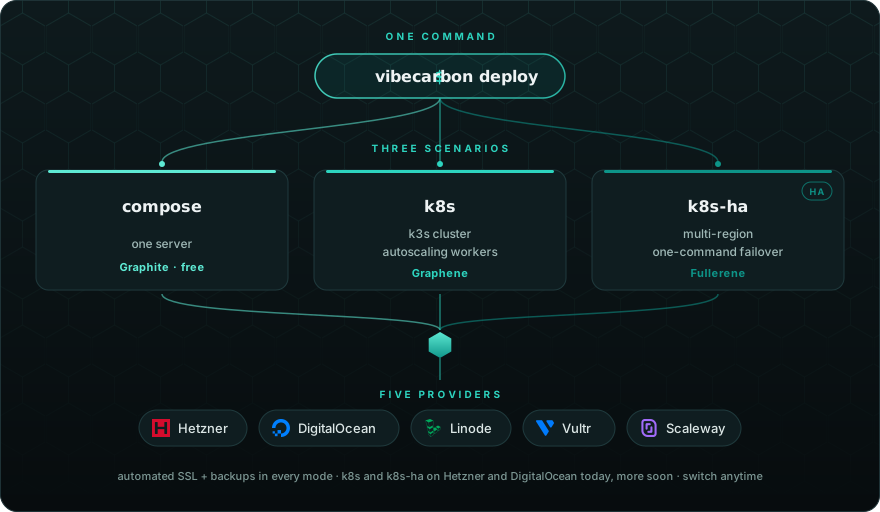
One CLI, three deploy modes, picked per environment. Every mode includes automated SSL and backups; monitoring dashboards are an optional add-on. Compose HA gives the same high-availability architecture as Kubernetes HA without needing a Kubernetes cluster, so it runs on every provider, including ones with no Kubernetes support at all; select it explicitly with -mode compose-ha.
| Document | Description |
|---|---|
| Technical Guide | Architecture, code examples, API patterns, scripts |
| Design Guide | Brand identity, visual design, UX principles |
| Test Suite | Test types, coverage, and how to run them |
| Guide | Best For |
|---|---|
| Hetzner Cloud | Cloud servers and Object Storage, with European (EU data residency) and US regions |
| DigitalOcean | Droplets and Spaces, with Americas, Europe, and Asia-Pacific regions |
| Kubernetes README | K8s autoscaling, worker bounds configuration, HA cluster setup |
DigitalOcean is fully supported for compose, k8s, and k8s-ha with the same CLI, the same lifecycle, and the same e2e gate as Hetzner. Linode, Vultr, and Scaleway are supported for compose, with the same CLI and e2e gate. The remaining tiers aren't built for them yet, though Compose HA is available on every provider regardless (see Architecture above).
| Guide | Description |
|---|---|
| Observability | Prometheus, Grafana, Loki |
Real numbers, not estimates. Every cell is wall-clock time for the CLI command it names, from the latest fully-green CI run of that provider against real cloud infrastructure. Measured from GitHub-hosted runners; methodology in docs/tests.md.
The rows are every provider and deploy scenario the CLI supports. An absent row means that scenario is not offered on that provider yet; pending means it ships but has no measured CI baseline yet. The numbers refresh automatically from each provider's next green CI run.
| Provider | Scenario | Cold deploy |
Warm deploy |
backup |
restore |
scale |
destroy |
failover |
|---|---|---|---|---|---|---|---|---|
| Hetzner Cloud | compose |
5m 43s | 19.2s | 3.6s | 6m 29s | 3m 31s | 30.4s | — |
compose-ha |
7m 18s | 2m 7s | 3.5s | 8m 2s | 4m 48s | 36.7s | 38.4s | |
k8s |
9m 5s | 8.6s | 20.7s | 8m 11s | 1m 52s | 1m 38s | — | |
k8s-ha |
8m 25s | 51.8s | 18.4s | 9m 13s | 4m 11s | 2m 7s | 3m 6s | |
| DigitalOcean | compose |
10m 50s | 24.1s | 5.4s | 9m 12s | 9m 28s | 38.8s | — |
compose-ha |
12m 18s | 1m 6s | 5.6s | 18m 31s | 9m 51s | 44.2s | 2m 54s | |
k8s |
8m 9s | 6.4s | 34.8s | 7m 28s | 4m 26s | 1m 51s | — | |
k8s-ha |
9m 22s | 1m 4s | 27.7s | 12m 29s | 10m 49s | 2m 5s | 7m 41s | |
| Linode | compose |
7m 21s | 13.1s | 3.6s | 7m 36s | 6m 44s | 28.0s | — |
compose-ha |
9m 37s | 49.2s | 3.6s | 9m 46s | 6m 28s | 30.0s | 50.1s | |
| Vultr | compose |
6m 52s | 20.9s | 5.2s | 7m 50s | 7m 42s | 45.4s | — |
compose-ha |
14m 48s | 1m 58s | 4.6s | 11m 52s | 8m 36s | 48.8s | 1m 51s | |
| Scaleway | compose |
6m 30s | 27.1s | 2.9s | 6m 48s | 4m 13s | 41.1s | — |
compose-ha |
9m 23s | 2m 20s | 6.0s | 9m 29s | 5m 5s | 1m 0s | 1m 1s |
Latest green CI runs: Hetzner Cloud 2ed8109 (2026-09-22) · DigitalOcean 48e8713 (2026-09-02) · Linode e3a088c (2026-09-03) · Vultr 7471b45 (2026-09-03) · Scaleway f61829b (2026-09-03) · GitHub-hosted runner · methodology: docs/tests.md.
k8s-ha (pilot-light multi-region with one-command failover) runs on Hetzner and DigitalOcean today.
The CLI is Fair Source under the Functional Source License 1.1 with MIT future license. Building from source is free for any non-competing use, and every release converts to the MIT license two years after publication.
Using the distributed vibecarbon package is a per-project subscription:
| Tier | Tagline | What it is for | Price | Deploy mode |
|---|---|---|---|---|
| Graphite | Go live. | Local dev, all add-ons, GitHub Actions CI/CD, single-server production, and upgrade (free on every tier) |
Free, no key | Compose |
| Graphene | Scale on demand. | Production that needs to scale | $19 per project per month ($190 per year) | Kubernetes |
| Fullerene | Enterprise resiliency. | Production that must survive a region failure | $39 per project per month ($390 per year) | Kubernetes HA |
The subscription is checked on every deploy to a Kubernetes or HA environment. A lapsed subscription keeps deploying for 30 days with a warning, then pauses those deploys until renewed. Backup, restore, failover, and scale never require a subscription. Run vibecarbon activate <key> inside the project; it binds the key to that project on vibecarbon.com and writes .vibecarbon.license, which should be committed and shared with your team. A key is bound to one project at a time: vibecarbon deactivate emails the buyer a release link, after which the key can be activated elsewhere. Every bind and release is announced to the buyer by email. See TERMS.md for full usage terms. Generated project code is MIT, so you own your app outright.
- Discord: join the community for help, showcase, and announcements
- GitHub Issues: Report bugs or request features
- GitHub: github.com/hyperformant/vibecarbon