Bug Report
Prerequisites
- [ X] Can you reproduce the problem?
- [ X] Are you running the latest version?
- [ X] Are you reporting to the correct repository?
- [ X] Did you perform a cursory search?
For more information, see the CONTRIBUTING guide.
Description
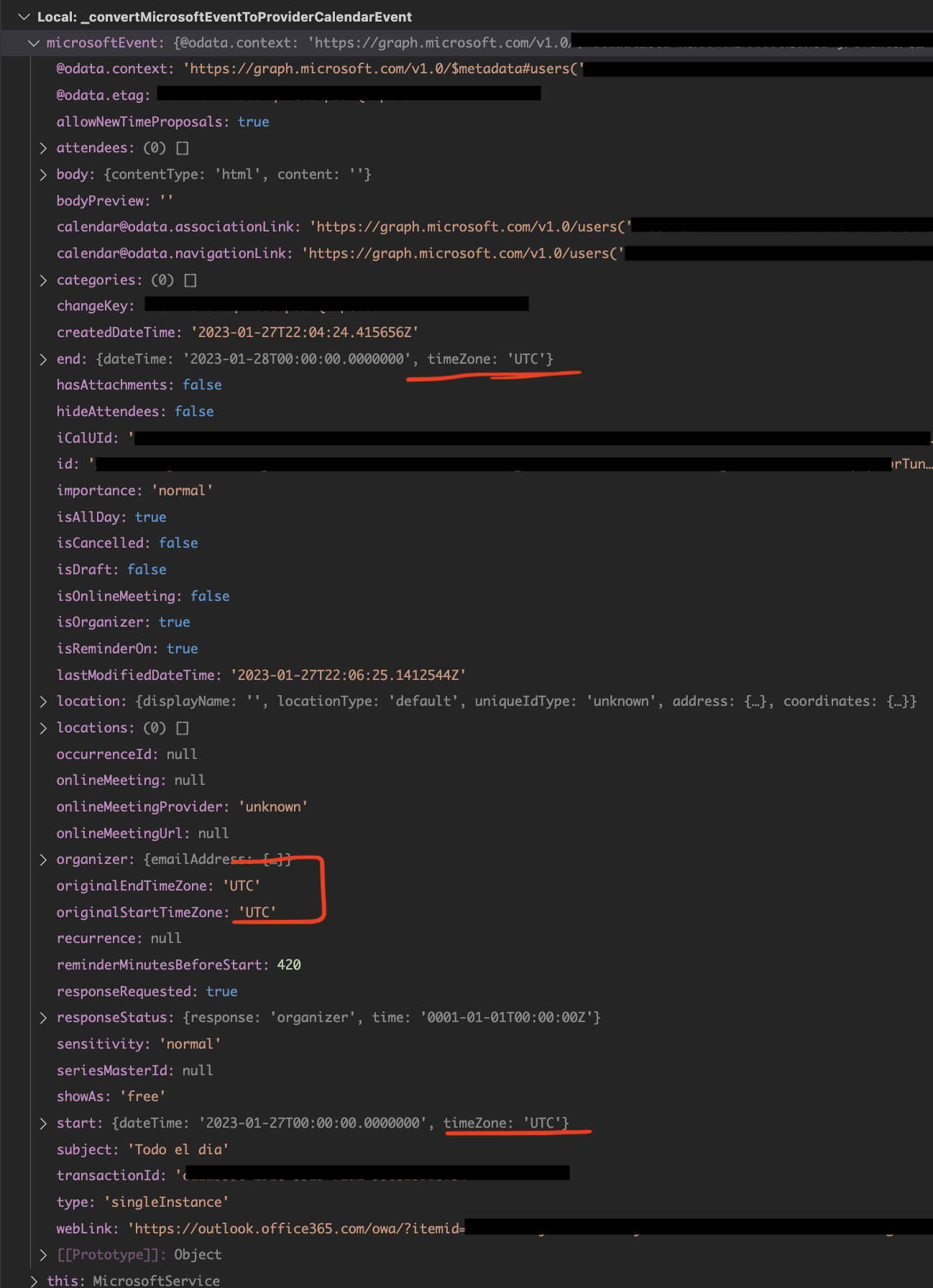
All day events are created and shown in the user's calendar without a problem through outlook.com for example. I'm on America/Sao_Paulo, and when configuring an all day event I see it starts properly at 03:00 UTC and ends at 03:00 UTC the next day. But when I retrieve that same event through the API, I don't see any indicators that this all day event was created in that time zone. I understand that "All day" means a specific date, period but in many cases this is an issue to the client of the API.
Console Errors: Not applicable
Screenshots:
Steps to Reproduce
- A User configures a day off (2023-01-23 through 2023-01-24 midnight to midnight their time zone) that shows them as busy in their calendar, to make it more apparent, let's say they're -6 hours from UTC.
- We, a scheduling platform (kalendme.com) are looking for available times to meet late afternoon 2023-01-22, let's say at 8 pm. So we check against their events we retrieved using MS Graph API, and we see they're busy.
- The issue here comes since all events from the MS graph api come in ISO, and that's ok but they also include the time shift, Except all day events. So we store that busy event from 2023-01-22T00:00:00 UTC until 2023-01-23T00:00:00 UTC (2023-01-22T18:00:00Z-06:00 until 2023-01-23T18:00:00Z-06:00) instead of 2023-01-23T06:00:00 until 2023-01-24T06:00:00.
- If the event had a single reference to the proper time shift of the user, specific all day events would be able to be transformed back without having the need to retrieve the user's mailbox time zone from anywhere else just like we do with regular events.
If a client of the API does not really care about the time zone and just the date of the all day event, that's ok too, they can check the isAllDay flag and move on, but clients that that do need it cannot work without all the information.
Expected behavior: [What you expected to happen]
The all day event should come back from 2023-01-23T06:00:00Z (UTC) until 2023-01-24T06:00:00Z (UTC). While indicating it's al all day event (this already exists) so API consumers can decide whether to use the time portion of the timestamp or not.
Actual behavior: [What actually happened]
All day events come back for this user as if they're from 2023-01-22T00:00:00 UTC until 2023-01-23T00:00:00 UTC
Additional Context
Usage Information
SDK Version - 3.0.1
Node Version - v16.18.1


Bug Report
Prerequisites
For more information, see the
CONTRIBUTINGguide.Description
All day events are created and shown in the user's calendar without a problem through outlook.com for example. I'm on America/Sao_Paulo, and when configuring an all day event I see it starts properly at 03:00 UTC and ends at 03:00 UTC the next day. But when I retrieve that same event through the API, I don't see any indicators that this all day event was created in that time zone. I understand that "All day" means a specific date, period but in many cases this is an issue to the client of the API.
Console Errors: Not applicable
Screenshots:

Steps to Reproduce
If a client of the API does not really care about the time zone and just the date of the all day event, that's ok too, they can check the isAllDay flag and move on, but clients that that do need it cannot work without all the information.
Expected behavior: [What you expected to happen]
The all day event should come back from 2023-01-23T06:00:00Z (UTC) until 2023-01-24T06:00:00Z (UTC). While indicating it's al all day event (this already exists) so API consumers can decide whether to use the time portion of the timestamp or not.
Actual behavior: [What actually happened]
All day events come back for this user as if they're from 2023-01-22T00:00:00 UTC until 2023-01-23T00:00:00 UTC
Additional Context
Usage Information
SDK Version - 3.0.1