Repository navigation
Conversation


Codecov Report
@@            Coverage Diff             @@
##             main    #1298      +/-   ##
==========================================
+ Coverage   92.25%   92.29%   +0.03%
==========================================
  Files          81       81
  Lines        4260     4281      +21
  Branches      358      358
==========================================
+ Hits         3930     3951      +21
  Misses        248      248
  Partials       82       82
Continue to review full report at Codecov.
|


a16799b to
6ef408c
Compare
|
We had discussed whether the addition of elevation wouldn't get too complicated. It seems we could add the |

|
I guess this is somewhat related to #1299, could you clarify what are the differences between the two? |
|
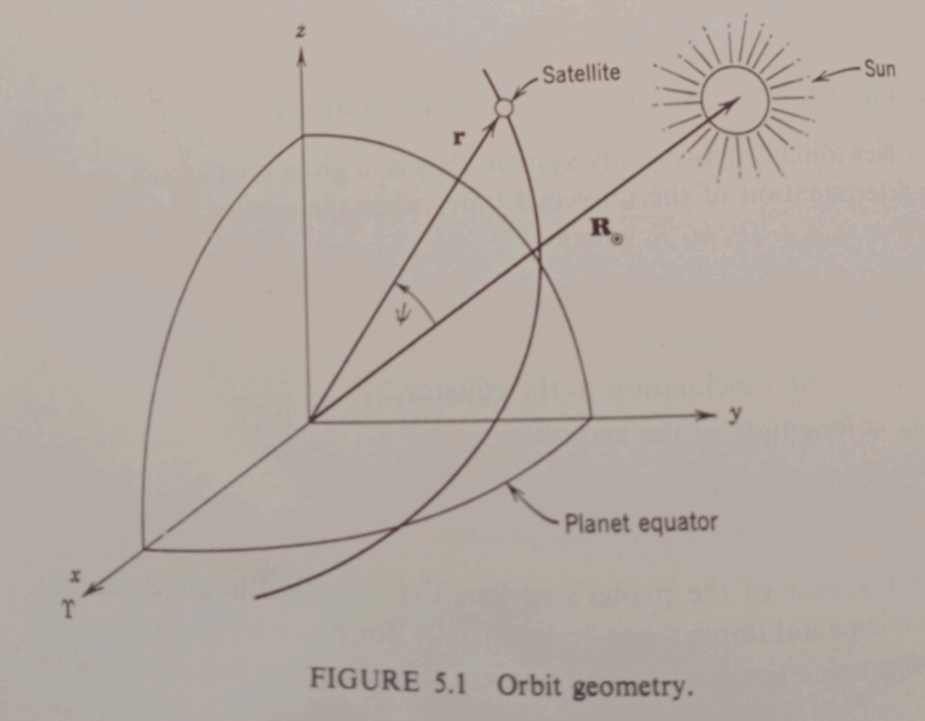
Satellite visibility aims to detect when a satellite becomes visible from a ground station on an attractor whereas satellite view (here) tries to detect the case when a satellite will be able to view the sunlit part of its attractor. So the satellite view event:
From Escobal's book:
Hence, the geometry seems to be almost the opposite of the eclipse event |
3abaa88 to
2735350
Compare
|
As decided earlier, the added test checks eclipse doesn't trigger when satellite view triggers. This might not be as robust as a check since I think there could be situations where neither event is triggered. But such a test could be a good starting point. I think this is ready to be reviewed. |

 astrojuanlu
left a comment
astrojuanlu
left a comment
There was a problem hiding this comment.
I think this is good to go!
|
I did a very short-sighted review and @Yash-10 rightly told me that the tests are incomplete. Removing the approval, sorry for the noise 🙏🏽 |

2735350 to
10eb1b4
Compare
Slight modify event test
10eb1b4 to
c848334
Compare
c848334 to
5dbd677
Compare
2dd174b to
8fe9992
Compare
|
For validating this event, I am trying to use this equation from Escobal's book (Page 155 under Analytics of the Two-body problem):
I believe the variable diff --git a/tests/tests_twobody/test_events.py b/tests/tests_twobody/test_events.py
index 898a568a..08de0603 100644
--- a/tests/tests_twobody/test_events.py
+++ b/tests/tests_twobody/test_events.py
@@ -11,7 +11,7 @@ from poliastro.core.events import line_of_sight
from poliastro.core.perturbations import atmospheric_drag_exponential
from poliastro.core.propagation import func_twobody
from poliastro.twobody import Orbit
-from poliastro.twobody.angles import nu_to_E
+from poliastro.twobody.angles import nu_to_E, E_to_M
from poliastro.twobody.elements import mean_motion
from poliastro.twobody.events import (
AltitudeCrossEvent,
@@ -484,11 +484,11 @@ def test_satellite_view_event():
epoch = Time("2020-01-01", scale="utc")
coe = (
6828137.0 * u.m,
0.0073 * u.one,
87.0 * u.deg,
20.0 * u.deg,
10.0 * u.deg,
0 * u.deg,
)
orbit = Orbit.from_classical(attractor, *coe, epoch=epoch)
@@ -515,7 +515,8 @@ def test_satellite_view_event():
n = mean_motion(orb.attractor.k, orb.a)
# Equation 5.14 from Escobal.
- expected_view_t = t_perigee + (E - ecc * np.sin(E) * u.rad) / n
+ M = E_to_M(E, ecc)
+ expected_view_t = t_perigee + M / n
assert_quantity_allclose(satellite_view_event.last_t, expected_view_t) |


|
Hi @Yash-10, you may also use the logic from the poliastro/src/poliastro/twobody/orbit.py Lines 233 to 244 in 2eb557c |
|
(Renaming this PR for clarity) |
|
I wonder if:
could be used somehow for validation? Also, using the above equation from Escobal was a bit tough for me. Even though one could get the eccentric anomaly and mean motion at the event instance, getting the time of perifocal passage (and not since the perifocal passage) is still confusing. One idea might be to get the time of perifocal passage from the orbit epoch. |


This is an attempt inspired by section 5.2 ("Direct Visibility of a Planetary Surface") of Escobal's book and uses equation 5.5.
As mentioned in the book, this might have application for planetary probes to study some properties of a planet, its composition, atmosphere, etc.
Just added a test to check if it doesn't give any errors.