
The typed API framework where every procedure is also an LLM tool and an MCP server — with zero extra work.


Quickstart · AI / MCP · Architecture · Example app · Compare
Define a procedure once. Get a typed client, a REST endpoint, an OpenAPI schema, streaming, real-time subscriptions — and an AI tool your agents can call and an MCP server Claude can connect to. No decorators, no codegen, zero runtime deps.
export const appRouter = {
  notes: {
    create: route
      .post("/notes")
      .input(s.object({ title: s.string(), body: s.string() }))
      .ai({ description: "Create a note" })        // ← also an LLM/MCP tool
      .handler(({ input, ctx }) => ctx.db.create(input)),
  },
} satisfies RouterRecord;
That one definition is now callable as a typed client method, a REST route
(POST /notes), an OpenAPI operation, and — because of .ai() — a validated
tool for Claude over MCP. Same validation, same auth context, every surface.
The typed-RPC space is crowded (tRPC, ts-rest, Hono, oRPC) and they're all good at
HTTP. dendra's wedge is the part they bolt on or skip entirely: AI- and
MCP-native by construction. A procedure and an LLM tool are the same shape —
a name, an input schema, a validated handler — so dendra treats them as one
thing. Mark a procedure .ai() and it's instantly:
- an MCP tool (stdio for Claude Desktop, or remote HTTP for claude.ai), and
- a tool definition for the Anthropic / OpenAI APIs, executed with the same validation that guards your HTTP endpoints — so hallucinated arguments are rejected and the model inherits the user's permissions, not god mode.
Everything else — zero deps, no decorators, no codegen, runtime-agnostic — is table stakes it also happens to get right.
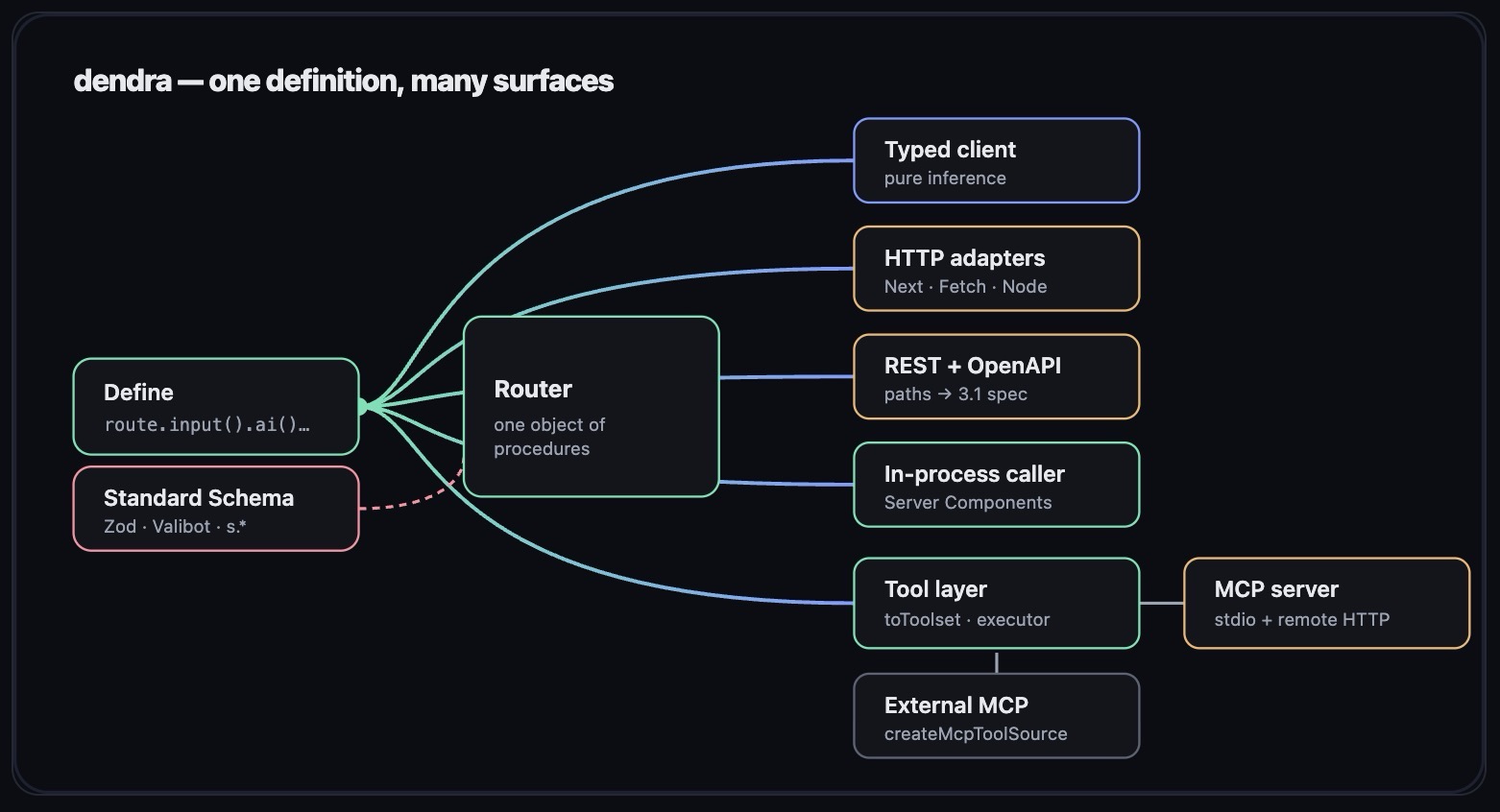
The router is used twice from one definition: as a type that flows to the client (erased at build — zero runtime), and as a value the adapters dispatch against.
Scaffold a working Next.js app in one command:
npm create dendra-app@latest my-app      # pick: minimal | mcp
cd my-app && npm run dev
Or add it to an existing project:
npm i dendraThe core is zero-dependency. The optional helpers pull their own peers only if you
use them: npm i @anthropic-ai/sdk for dendra/anthropic, react for dendra/react,
next for dendra/next.
Define once:
import { initDendra, s, type RouterRecord } from "dendra";

interface Ctx { userId: string | null }
const { route } = initDendra<Ctx>();

export const appRouter = {
  add: route
    .input(s.object({ a: s.number(), b: s.number() }))
    .ai({ description: "Add two numbers" })
    .handler(({ input }) => input.a + input.b),
  chat: route
    .input(s.object({ prompt: s.string() }))
    .stream(async function* ({ input }) {          // streaming = async generator
      for (const token of llm(input.prompt)) yield token;
    }),
} satisfies RouterRecord;

export type AppRouter = typeof appRouter;
Serve (Next.js App Router — app/rpc/[...path]/route.ts):
import { toNextHandler } from "dendra";
import { appRouter } from "@/server/router";

export const { GET, POST } = toNextHandler(appRouter, {
  createContext: (req) => ({ userId: getSession(req) }),
});
Other runtimes use the same router: toFetchHandler (Hono/Bun/Deno/Workers),
toNodeHandler (node:http).
Call — the client type comes straight from typeof appRouter, no generated files:
import { createClient } from "dendra";
import type { AppRouter } from "@/server/router";

const api = createClient<AppRouter>("");
const sum = await api.add({ a: 40, b: 2 });            // number, inferred
for await (const t of api.chat({ prompt: "hi" })) ...  // streaming, inferred
api.chat({ prompt: "hi" }, { signal });                // abort a call or a stream
Calls are real Promises (.catch, .finally, Promise.race all work) and stay
lazy: nothing is sent until you await or iterate one. Results are typed as what
survives JSON (Jsonify<T>): a handler returning a Date gives the client a
string, and undefined props come back optional.
In a Server Component, skip HTTP entirely with an in-process caller — no
serialization, so results keep their real types (a Date stays a Date; the
type is Caller<AppRouter>). createServerCaller from dendra/next builds
ctx from the incoming request with your route handler's createContext, once
per request however many layouts and pages ask; orPage turns errors into pages:
// server/caller.ts
import { createServerCaller } from "dendra/next";
export const serverCaller = createServerCaller(appRouter, createContext);

// app/notes/[id]/page.tsx
import { orPage } from "dendra/next";
const api = await serverCaller();
// NOT_FOUND / BAD_REQUEST → notFound(); UNAUTHORIZED → redirect("/sign-in")
const note = await orPage(api.notes.get({ id }), { signIn: "/sign-in" });
createContext gets a Request carrying the incoming headers (cookies too),
with the request's origin as its URL. Outside Next, createCaller(appRouter, ctx)
takes a ctx you build yourself.
import { toToolset, createToolExecutor, mcpToolDefinitions } from "dendra";

// LLM tool definitions (Anthropic/OpenAI shapes) from your .ai() procedures:
const tools = toToolset(appRouter, { format: "anthropic" });

// Execute a tool the model chose — validated, scoped to the user's ctx:
const execute = createToolExecutor(appRouter, ctx);
await execute("add", modelProvidedArgs);   // bad args rejected like any input

// MCP: the same procedures become tools Claude can call.
const defs = mcpToolDefinitions(appRouter);
Streaming procedures can be tools too — when an LLM/MCP calls a .stream() tool,
its chunks are collected into the tool result (string chunks are joined; other
chunks become an array), so you can expose streaming work without a special path.
The Next.js example ships a working MCP server both ways: a stdio server for Claude Desktop and a remote HTTP endpoint for claude.ai (with optional OAuth 2.1) — so Claude can list, create, and delete your app's data through the exact procedures you already wrote.
.noAi() marks a procedure as never-a-tool: adding .ai() too throws where it's
defined. .ai({ confirm: true }) makes it a tool that only proposes: the call
is validated and passes its .use() guards, then waits for a person.
const appRouter = {
  approve: authed.noAi().handler(/* … */),
  publish: authed
    .input(s.object({ postId: s.string() }))
    .ai({ description: "Publish a post", confirm: true })
    .handler(({ input, ctx }) => ctx.db.posts.publish(input.postId)),
};

const approvals = createApprovals<Ctx>(appRouter, {
  scope: (ctx) => ctx.tenantId,   // who may see and decide it
  proposer: (ctx) => ctx.user.id, // recorded as action.proposedBy
});
const execute = createToolExecutor(appRouter, ctx, { approvals });
await execute("publish", { postId: "p1" });
// → { status: "pending_approval", actionId, message } — the handler hasn't run

// Later, from the person's own request (e.g. an "Approve" button):
await approvals.list(ctx);                 // pending actions in their scope
await approvals.approve(actionId, ctx);    // guards re-run with *their* ctx, then the handler
await approvals.reject(actionId, ctx, "wrong post");- Without
{ approvals }, a confirm tool fails closed — it never runs. approveruns with the approver's ctx, by design: the guards re-run against the approver (if they reject, the action stays pending), and the handler sees the approver as the caller. The proposer's ctx can't be stored (it holds sessions and db handles), soproposer(ctx)records who the model was acting for asaction.proposedBy, for your handler and audit log. Each action is decided once.scope(ctx)(e.g. the tenant) is recorded with the proposal; other scopes getNOT_FOUND. Set it in multi-tenant apps.- After-hooks see the proposal and the decision, with
approval: { id, status: "pending" | "approved" | "rejected", reason? }; a rejection is aFORBIDDENfailure. - The store is pluggable (
ApprovalStore:add/get/take/list;takemust be atomic). The default is in memory — use your own across instances or restarts. - The tool description tells the model it needs approval; MCP gets
destructiveHint: true(and.get()toolsreadOnlyHint: true).runAgentsetsapprovalIdon the tool part so your UI can show approve / reject. - Only tool calls wait. The same procedure called over RPC, REST, or the caller — by a person — runs directly.
The reverse direction too: pull tools from another MCP server (GitHub's,
Linear's, a filesystem server, your own) and merge them into the same toolset
your model already uses. dendra stays zero-dependency — it needs only the
two-method McpClientLike shape, which the official SDK's Client satisfies, so
your app owns the transport (stdio / HTTP) and dendra owns the tool plumbing.
import { toToolSource, mergeToolsets, createMcpToolSource } from "dendra";

const local = toToolSource(appRouter, ctx, { format: "anthropic" });
const external = await createMcpToolSource(mcpClient, {
  format: "anthropic",
  prefix: "gh.",            // optional: namespace to avoid name clashes
});

// One flat toolset; each call routes back to the source that owns the name.
const { tools, execute } = mergeToolsets(local, external);
Treat an external server like any untrusted input: its tool descriptions and
results go to your model as written, so they can carry instructions. Connect only
servers you trust, keep only the tools you need with filter, and use a prefix.
A remote tool's error reaches the model as BAD_GATEWAY with the server's text.
Core stays zero-dependency, but two optional subpath exports remove the
boilerplate of a tool-using chat. They exchange one shared AgentPart type, so
they snap together — the loop emits parts, the hook renders them:
// server — dendra/anthropic (peer dep: @anthropic-ai/sdk)
import { runAgent } from "dendra/anthropic";
const { tools, execute } = mergeToolsets(toToolSource(appRouter, ctx), external);
yield* runAgent({ client, model, tools, execute, prompt, system });
// client — dendra/react (peer dep: react)
import { useAssistant } from "dendra/react";
const { items, input, setInput, busy, send } = useAssistant({
stream: (prompt) => api.ai.assistant({ prompt }),
onPart: (p) => { /* act on a tool as it arrives */ },
onDone: (parts, { spoken }) => { /* speak the reply */ },
});Neither is required — bring your own loop/UI and just use mergeToolsets.
runAgent, useAssistant and the context layer (createContextManager, memorySource, lazyToolSource, lazyToolset, dendra/memory) are experimental: outside the 1.0 stability guarantee, so they may change in a minor release as model APIs move. The tool-shaping core (.ai(), toToolset, createToolExecutor, MCP, approvals) is stable. See the versioning policy.
Amazon Bedrock: runAgent's client type is structural, so Claude on Bedrock
drops in with no cast — pass an AnthropicBedrock client from
@anthropic-ai/bedrock-sdk:
import { AnthropicBedrock } from "@anthropic-ai/bedrock-sdk";
yield* runAgent({ client: new AnthropicBedrock({ awsRegion: "us-east-1" }),
  model: "anthropic.claude-3-5-sonnet-20241022-v2:0", tools, execute, prompt });
For non-Claude Bedrock models, use toToolset(router, { format: "plain" }) and map
it to the Converse API's toolSpec (a dendra/bedrock helper is on the roadmap).
Run logic before a handler — authentication, logging, rate-limiting — and enrich
the context. One .use() runs across every transport (RPC, REST, the
in-process caller, WebSocket, and AI/MCP tool execution).
const authed = route.use(({ ctx }) => {
  if (!ctx.token) throw new DendraError("UNAUTHORIZED", "Sign in required");
  return { userId: lookup(ctx.token) };   // merged into ctx, typed downstream
});

export const appRouter = {
  me:     authed.handler(({ ctx }) => ctx.userId),          // ctx.userId is typed
  delete: authed.input(s.object({ id: s.string() }))
                .ai({ description: "Delete an item" })        // tool is auth-guarded too
                .handler(({ ctx, input }) => db.remove(ctx.userId, input.id)),
} satisfies RouterRecord;
Middlewares stack and throw a DendraError to reject. Because an AI/MCP
tool runs through the same dispatch path, a procedure behind .use(auth) is
authorization-guarded for the model too — it inherits the user's permissions, it
can't bypass them.
What callers see of an error. A DendraError's code and message reach the
client (and, for tools, the model) as written. Any other error, such as a
database driver's, reaches them as INTERNAL: Internal error, because its message
can carry SQL, hostnames or credentials; the original is logged with
console.error, and after-hooks get it as error. Throw a DendraError for
anything a user or model should read.
A .use() sees the input declared above it, already validated. So a guard
declares the fields it checks once, and later .input() calls extend that
input rather than replacing it:
const inWorkspace = authed
  .input(s.object({ workspaceId: s.integer() }))
  .use(({ ctx, input }) => {                       // input: { workspaceId: number }
    if (!ctx.memberships.has(input.workspaceId)) throw new DendraError("FORBIDDEN", "Not a member");
    return { workspaceId: input.workspaceId };
  });

export const appRouter = {
  rename: inWorkspace
    .input(s.object({ title: s.string() }))        // input: { workspaceId; title }
    .handler(({ ctx, input }) => db.rename(ctx.workspaceId, input.title)),
} satisfies RouterRecord;- Every schema in the chain validates the call, and all issues come back in one 400. Chained schemas must produce objects; libraries can be mixed.
- If two schemas declare the same key, the earlier one wins, so the handler sees exactly the value the guard checked.
- OpenAPI and tool schemas show one combined object. Two built-in
s.objects merge into one, so.strict()checks the combined keys. Zod 4, ArkType and Valibot (wrapped intoStandardJsonSchema) parts appear there too; a part without JSON Schema (Zod 3) is left out. Don't make a non-s.*base schema strict, since it would reject the later fields.
.use() runs before the handler; .after() runs once the call settles and
sees the outcome. Same reach: every transport, including AI/MCP tool calls.
const audited = authed.after(({ ctx, path, transport, input, ok, result, code, durationMs }) =>
  ctx.db.audit.insert({ user: ctx.userId, path, transport, ok, code, durationMs }),
);
ok: truecarriesresult(undefined for streams, which settle when they end);ok: falsecarries the thrownerrorand itscode("INTERNAL"for non-DendraErrors).transportis"rpc" | "rest" | "caller" | "ws" | "tool".- Hooks are awaited before the response goes out (safe on serverless), run in the order added, and a hook that throws is logged — it never changes the result.
- Position matters: a hook only runs for calls that passed the
.use()s before it, and sees that ctx — soctx.userIdabove is typed and real. Put a hook before the auth guard to also record rejected calls. Input that fails validation never reaches the chain, so it doesn't trigger hooks. - Confirm tools (
.ai({ confirm: true })) addapproval— see Keeping a model away from risky procedures.
Name a middleware (or let it use its function's name), tag procedures with
typed .meta(), then walk the router and fail the build when a guard is missing:
const { route } = initDendra<Ctx, { restricted?: "approver" }>();

const scoped = route.use(tenant);                       // listed as "tenant"
const publish = scoped
  .use(requireRole("approver"), { name: "role:approver" })
  .meta({ restricted: "approver" })
  .handler(/* … */);

// test/guards.test.ts
for (const p of inspectRouter<{ restricted?: "approver" }>(appRouter)) {
  expect(p.middlewares, p.path).toContain("tenant");
  if (p.meta.restricted) {
    expect(p.middlewares, p.path).toContain(`role:${p.meta.restricted}`);
    expect(p.ai, p.path).toBe(false);
  }
}
Each entry is { path, kind, method, restPath?, middlewares, ai, confirm, noAi, meta }, class
controllers included. An unnamed inline middleware is listed as "anonymous";
.meta() calls merge, and only inspectRouter reads them.
A file route is just a procedure, so the tenant check in .use() and the audit
trail in .after() cover it like any other call.
import { file, s } from "dendra";

export const covers = {
  upload: tenant
    .input(s.object({
      workspaceId: s.integer(),
      image: s.file({ types: ["image/png", "image/jpeg", "image/webp"], maxBytes: 8_000_000 }),
    }))
    .handler(({ input, ctx }) => ctx.storage.put(input.workspaceId, input.image)), // input.image: File

  get: tenant
    .get()                                  // a read: reachable by GET / urlFor
    .input(s.object({ workspaceId: s.integer(), draftId: s.integer() }))
    .handler(async ({ input, ctx }) => {
      const obj = await ctx.storage.get(input.draftId);
      return file(obj.stream, { type: obj.type, filename: "cover.webp", inline: true,
                                cacheControl: "private, max-age=300", etag: obj.hash });
    }),
};
await api.covers.upload({ workspaceId: 3, image: fileFromInput }); // sent as multipart
const blob = await api.drafts.exportMarkdown({ draftId: 9 }); // Blob
<img src={urlFor(api.covers.get, { workspaceId: 3, draftId: 9 })} />- Uploads:
s.file({ types, maxBytes })sits in an ordinarys.object. PNG, JPEG, GIF, WebP, PDF and ZIP are checked against the file's leading bytes, not just the browser's header; other types match by MIME type or extension (".csv"). Request bodies are capped bymaxBodyBytes(default 10 MB), enforced while reading →413 PAYLOAD_TOO_LARGE. Files live at the top level of the input and go direct (never batched). A file-input procedure can't be.ai(). - Downloads: return
file(body, opts). Every file response carriesX-Content-Type-Options: nosniff; the filename is sanitized;Cache-Controldefaults toprivate, no-store;etagenables304. HTML, SVG and XML are always sent as attachments unless you setallowUnsafeInline— an uploaded file must never run script on your origin. Tool, batch and WebSocket calls can't return files. urlForneeds.get(). Only procedures declared.get()(path optional) answer GET, andurlForwon't type-check for anything else — so a link or<img>on another site can never trigger a mutation.- Audit hooks see metadata, never bytes: for a file result,
.after()gets{ file: { type, filename, size } }. Loginput.image.name/type/size, not the File.
dendra's client sends X-Dendra: 1 on every request. Because a cross-site page
can't send a custom header (or a JSON body) without a CORS preflight, the server
requires: GET/HEAD only for .get() reads, other methods besides POST
never (405); POST as JSON (else 415), or multipart carrying X-Dendra
(else 403). Plain HTML form posts are
off unless you pass allowFormPosts: true — then CSRF protection is your job
(e.g. a token checked in .use()). This assumes you don't enable
CORS-with-credentials for untrusted origins.
WebSockets are the exception: browsers apply no CORS to them, and any site
can open one to your server with the user's cookies. Serve them with
attachWsServer, which requires allowedOrigins and refuses a foreign or
missing Origin with 403 before the socket opens. The low-level pieces
(attachWs, connectWs, createWsSession, createWsClient) are for runtimes
without the ws package (Bun, Deno, Workers): they have no Origin check, size
limits, heartbeats or reconnect, so on a socket you accepted yourself, those are yours.
Next.js route handlers can't accept WebSocket upgrades, so run one small Node
server in front of Next. Next attaches its own upgrade listener on the first
request (that's how dev hot reload works), and it closes any upgrade whose path
matches one of your routes. So give the socket a path outside your Next
routes (/ws, not under an app/rpc/[...path] handler), and leave other
upgrades to Next's own listener:
// server.ts — run with `node server.ts` instead of `next start`
import http from "node:http";
import next from "next";
import { WebSocketServer } from "ws";
import { attachWsServer, DendraError } from "dendra";
import { appRouter } from "./server/router";

const app = next({ dev: process.env.NODE_ENV !== "production" });
await app.prepare();
const handle = app.getRequestHandler();

const wss = new WebSocketServer({ noServer: true, maxPayload: 1_000_000 });
const live = attachWsServer(wss, appRouter, {
  path: "/ws", // outside every Next route
  allowedOrigins: ["https://app.example.com"],
  createContext: async (req) => {
    const user = await getSession(req.headers);
    if (!user) throw new DendraError("UNAUTHORIZED", "Sign in required");
    return { user };
  },
  revalidate: { everyMs: 5 * 60_000, check: (ctx) => sessionStillValid(ctx.user) },
  onClose: (ctx) => presence.leave(ctx.user.id),
});

const server = http.createServer((req, res) => handle(req, res));
// Other paths return false and are left to Next's own upgrade listener.
server.on("upgrade", (req, socket, head) => live.handleUpgrade(req, socket, head));
server.listen(3000);

process.on("SIGTERM", async () => {
  await live.close(); // refuse new sockets (503), close open ones with 1001
  server.close();
});
Sign someone out everywhere with live.closeWhere((ctx) => ctx.user.id === id).
In the browser, createWsConnection keeps the socket up: it reconnects with
backoff (0.5 s doubling to 10 s, with jitter), retries as soon as the browser is
back online, and resubscribes open subscriptions, so a for await loop survives a
dropped connection. Anything published while it was down is missed, so refetch
when the status turns connected again.
import { createWsConnection } from "dendra";
import type { AppRouter } from "@/server/router";

const conn = createWsConnection<AppRouter>(`wss://${location.host}/ws`);
conn.onStatus((status) => setBanner(status)); // connecting | connected | reconnecting | stopped | closed
for await (const ev of conn.api.notes.watch()) render(ev);
A close with code 4401 (signed out) stops it with status stopped; call
conn.reconnect() after signing in again. Calls made while disconnected fail at
once with code UNAVAILABLE rather than being replayed later.
| Option | Default | |
|---|---|---|
maxPayload |
1 MB | Startup throws if the ws server allows more |
heartbeatMs |
30 s | A socket that misses a pong is dropped (0 disables) |
maxBufferedBytes |
1 MB | Unsent backlog before a slow client is closed |
maxSubscriptions |
100 | Per connection; more get TOO_MANY_REQUESTS |
closeGraceMs |
1 s | Wait for the close handshake, then terminate |
allowMissingOrigin |
false |
Only for non-browser clients without cookie auth |
| Close code | Meaning |
|---|---|
1001 |
Server shutting down (close()) |
1009 |
Message over maxPayload |
1013 |
Client too slow to read |
4401 |
revalidate said no, or closeWhere (default) — sign in again |
.stream() procedures answer NDJSON by default. Behind proxies, CDNs or
corporate networks that buffer or mangle it, switch the client to Server-Sent
Events. Iteration, typed errors and cancellation stay the same:
export const api = createClient<AppRouter>("", { prefix: "/rpc/", streamFormat: "sse" });
for await (const ev of api.notes.watch()) render(ev); // break → server's signal aborts
The server picks the format from Accept: text/event-stream gets SSE, anything
else NDJSON, so nothing changes on the server side. Each value is a data: event.
A failure is an error event with { code, message }, which the client throws as
a DendraClientError. A normal end is a done event. While the handler is idle,
a : ping comment goes out every 15 s; set heartbeatMs in the server options
(0 turns it off).
A browser EventSource works too, but it can only send GET, so the procedure
needs .get(). Close it on done, or it reconnects and runs the subscription
again:
const es = new EventSource("/rpc/notes.watch");
es.onmessage = (e) => render(JSON.parse(e.data));
es.addEventListener("done", () => es.close());
es.addEventListener("error", (e) => {
  // `data` is set on a server error event; a dropped connection has none
  // and EventSource retries by itself.
  if ((e as MessageEvent).data) { showError(JSON.parse((e as MessageEvent).data)); es.close(); }
});A stream that works locally can stall behind a proxy or arrive in one chunk. Check these, in order:
- Next.js route:
export const runtime = "nodejs"andexport const dynamic = "force-dynamic"on theapp/rpc/[...path]/route.tshandler. On Vercel and similar hosts a stream also ends at the function's time limit; raise it withexport const maxDuration = …and have the client reconnect. - Proxy buffering. Both stream formats are sent with
Cache-Control: no-cacheandX-Accel-Buffering: no.- nginx honours
X-Accel-Buffering: nounless you setproxy_ignore_headers; otherwise addproxy_buffering off;to the stream location. Keepproxy_read_timeout(60 s by default) above the heartbeat. - Caddy flushes
text/event-streamat once and streams responses of unknown length. If NDJSON still arrives late, addflush_interval -1to thereverse_proxyblock.
- nginx honours
- Compression buffers. A gzip layer can sit on a stream until enough bytes
arrive.
- Caddy's
encodestreams SSE as it's written. - nginx's
gzip_typesdoesn't includetext/event-streamorapplication/x-ndjsonunless you add them; leave them out. next startgzips route handler responses. If streams arrive in one chunk there, setcompress: falseinnext.configand compress at the proxy.toNodeHandlercallsres.flush()after each chunk, so Express'scompression()middleware passes streams through.
- Caddy's
- Idle timeouts. Load balancers drop quiet connections, often after 60 s (AWS ALB's default). SSE's 15 s heartbeat keeps a connection alive. NDJSON has no heartbeat, so behind a short idle timeout use SSE or raise the timeout.
- WebSockets need the proxy to forward the upgrade. In nginx:
proxy_http_version 1.1; proxy_set_header Upgrade $http_upgrade; proxy_set_header Connection "upgrade";. Raise its read timeout too. Caddy forwards upgrades by default. Next.js itself can't accept upgrades; see WebSockets with Next.js for the Node server in front.
Long work (an AI call, an export) shouldn't hang off a request or vanish in a deploy. Define a job, enqueue it from a procedure, and stream its status:
import { createJobs, createPgJobStore } from "dendra";

const store = createPgJobStore(pool);     // or createInMemoryJobStore() in dev
export const jobs = createJobs({
  store,
  pubsub,                                 // status events go out here
  context: () => ({ db }),                // the ctx jobs run with — never the request's
});

export const summarize = jobs.define("summarize", {
  input: s.object({ docId: s.string(), workspaceId: s.integer() }),
  key: (input) => input.docId,            // one queued-or-running job per doc
  retries: 3,                             // backoff 1 s, 2 s, 4 s … (capped at 60 s)
  concurrency: 2,                         // per process
  run: async ({ input, ctx, job }) => {
    await job.progress({ step: "reading" });
    return ctx.db.summaries.create(input, { signal: job.signal });
  },
});

jobs.start(); // in each process that should run jobs (await jobs.stop() on shutdown)

const appRouter = {
  summarize: inWorkspace                  // the guard from the section above
    .input(s.object({ docId: s.string() }))
    .background(summarize, ({ input, ctx }) => ({ docId: input.docId, workspaceId: ctx.workspaceId })),
  // → { jobId }, right away, after validation and the guards.

  job: inWorkspace
    .input(s.object({ jobId: s.string() }))
    .use(async ({ input, ctx }) => {
      const job = await store.get(input.jobId); // the full record, input included
      if ((job?.input as { workspaceId?: number })?.workspaceId !== ctx.workspaceId)
        throw new DendraError("NOT_FOUND", "No such job");
    })
    .stream(({ input, signal }) => summarize.watch(input.jobId, { signal })),
  // → the job's state now, then each change, ending at "succeeded" or "failed".
};- Named, not path-bound. A queued job finds its handler by name, so renaming a route doesn't orphan it.
- Own ctx. After a crash another process runs the job, so it gets
context(), not the request's ctx. Pass what it needs (workspace, user id) throughmap. watchshows each state once, in order. Every snapshot carries aversionthat goes up with each change, so a client can also drop stale ones.watchdoesn't check access. Job ids are random UUIDs, but guard the procedure anyway, as above:store.get(id)returns the job's input to check.- Survives crashes. A worker holds a lease on a running job and renews it.
By default, an expired lease allows retry, and
stop()abortsjob.signaland requeues running jobs without using an attempt. SetonInterrupt: "fail"for work that must not replay after a crash, shutdown or execution deadline.
useJob from dendra/react follows a job until it settles, with no polling:
import { useJob } from "dendra/react";

const { job, connection, error } = useJob(jobId, (id, signal) =>
  api.summarize.watch({ jobId: id }, { signal }),
);
if (error) return <p>{error.message}</p>; // e.g. NOT_FOUND: following stopped
if (!job) return <Spinner />;
if (job.status === "failed") return <p>Failed: {job.error.message}</p>;
if (job.status === "succeeded") return <Summary text={job.result.summary} />;
return <Progress value={job.progress} reconnecting={connection === "reconnecting"} />;
job is the typed snapshot (status, progress, result, error) and updates as it
changes. The watch stops when the job succeeds or fails, when jobId changes, or
on unmount; a null id is "idle". If the stream drops (network error, a
WebSocket UNAVAILABLE, or a proxy closing it early), it reopens after a backoff
(0.5 s doubling to 10 s, with jitter), or at once when the browser comes back online. A new watch starts with the current state,
so nothing is missed, and version drops states already shown. Any other coded
error (NOT_FOUND, UNAUTHORIZED, …) stops it and sets error.
Outside React, followJob from dendra does the same:
const f = followJob((signal) => api.summarize.watch({ jobId }, { signal }));
f.subscribe(({ job, connection }) => render(job, connection));
const final = await f.done; // the succeeded/failed snapshot; f.stop() to give up- Snapshots:
{ id, name, status, attempt, maxAttempts, progress, result, error }, wherestatusis"queued" | "running" | "succeeded" | "failed"anderroris{ code, message }. A retrying job is"queued"with the last error. - Postgres store:
await store.setup()createsdendra_jobs(or copystore.schemainto a migration). Workers claim withFOR UPDATE SKIP LOCKED, so any number of processes share the queue. Finished rows stay until you delete them.
Use explicit policies for work that charges an external provider:
const generate = jobs.define("generate-v2", {
  retries: 0,
  timeoutMs: 20 * 60_000,
  onInterrupt: "fail",
  concurrency: 2,
  run: ({ input, job }) => generateImage(input, { signal: job.signal }),
});

const stopped = await jobs.stop({ graceMs: 6_000, timeoutMs: 8_000 });
if (!stopped.drained) console.error("Unfinished jobs", stopped.pending, stopped.errors);
The deadline is persisted when an attempt is claimed. Late progress and results
cannot overwrite its terminal outcome. A handler that ignores cancellation keeps
its local concurrency slot until it actually exits. JavaScript cannot cancel a
provider's completed charge or guarantee exactly-once external side effects;
use provider idempotency keys where available. onInterrupt: "fail" prevents
automatic replay of an interrupted job; ordinary error retries still follow
retries.
stop({ graceMs, timeoutMs }) stops taking work, allows the grace period, aborts
remaining handlers and waits only within the total budget. Its result reports
unfinished work or failed settlement instead of claiming a successful drain.
The no-argument stop() keeps immediate cancellation and its Promise<void>
signature, but rejects if work does not drain within 30 seconds.
Apply the updated store.schema as the database owner before deploying workers;
it adds policy columns to existing tables. Stop old workers before enabling new
policies, since 0.9 workers do not understand them. Custom stores must advertise
and implement capabilities.executionPolicies to accept these options.
await sync.schedule("daily-search-sync", { workspaceId: 13 },
  { kind: "daily", hourUTC: 2, minuteUTC: 0 });
await rankCheck.schedule("weekly-rank-check", { workspaceId: 13 },
  { kind: "weekly", weekdayUTC: 1, hourUTC: 3, minuteUTC: 0 });
await jobs.unschedule("weekly-rank-check");
Schedules use UTC; weekdays run from Sunday (0) through Saturday (6). Input
is validated using the job's schema. Re-registering an unchanged schedule keeps
its next occurrence. Updating or removing a schedule invalidates stale scheduler
reads. Removing a schedule does not cancel work already enqueued.
Workers atomically enqueue each occurrence and advance its cursor, so concurrent workers cannot create duplicate occurrences. Missed occurrences coalesce into one catch-up job, followed by the next future occurrence; a restart does not replay the entire backlog. Existing active-key deduplication still applies. Arbitrary cron expressions and local-time/DST scheduling are not supported.
The Postgres schema adds a companion schedules table and revision sequence.
After owner-run migration, grant the runtime role table DML and sequence USAGE.
Custom stores need capabilities.schedules and the JobScheduleStore methods.
Prefer classes for grouping and dependency injection? A controller is just a
class whose fields are procedures — put an instance in the router. NestJS
structure and constructor DI without decorators, reflect-metadata, or
experimentalDecorators.
export class UsersController {
  #db: Db;                                        // #private: not part of the
  constructor(db: Db) { this.#db = db; }          // public (procedures-only) type

  list = route.get("/users").handler(() => this.#db.users.all());
  create = route
    .post("/users")
    .input(s.object({ name: s.string() }))
    .ai({ description: "Create a user" })         // still an LLM/MCP tool
    .handler(({ input }) => this.#db.users.insert(input));
}

export const appRouter = {
  users: new UsersController(db),                 // an instance = a sub-router
};| NestJS | dendra |
|---|---|
@Controller() class |
plain class with procedure fields |
@Get() / @Post() decorators |
.get() / .post() on the builder |
@Injectable() + DI container |
constructor injection (new Ctrl(deps)) |
@Module() |
compose the router object |
decorators / reflect-metadata |
none |
| tRPC | ts-rest | Hono | dendra | |
|---|---|---|---|---|
| Typed client, no codegen | ✅ | — | ✅ | ✅ |
| REST URLs + OpenAPI | plugin | ✅ | plugin | ✅ |
| Streaming | links | — | ✅ | ✅ |
| Real-time / WebSocket | subs | — | ✅ | ✅ |
| LLM tools from procedures | — | — | — | ✅ |
| MCP server (stdio + HTTP) | — | — | — | ✅ |
| Consume external MCP servers | — | — | — | ✅ |
| Decorators / codegen | none | none | none | none |
| Runtime deps | few | few | 0 | 0 |
Not trying to out-tRPC tRPC on HTTP — winning on the AI/MCP seam.
tRPC is excellent — for a plain typed HTTP API, use it. The difference shows up when you want your API callable by an LLM or Claude over MCP: with tRPC you bolt on a parallel tool layer and keep it in sync by hand; with dendra the same definition is the tool.
// tRPC + MCP: define once, then hand-build a separate tool layer…
const caller = appRouter.createCaller(ctx);
server.setRequestHandler(ListTools, async () => ({
  tools: [{ name: "createNote", description: "…",
    inputSchema: zodToJsonSchema(CreateNoteInput) }],   // keep in sync by hand
}));
server.setRequestHandler(CallTool, async (r) =>
  wrap(await caller[r.params.name](r.params.arguments)));  // route + re-validate yourself
// …repeat the schema→format work per provider; consuming other MCP servers is DIY.

// dendra: one definition is the tool.
createNote: route
  .input(s.object({ title: s.string(), body: s.string() }))
  .ai({ description: "Create a note" })     // ← becomes an LLM + MCP tool
.handler(({ input, ctx }) => ctx.db.create(input));| Making your API usable by an LLM / Claude | tRPC + MCP | dendra |
|---|---|---|
| Tool JSON Schema | hand-convert from Zod | same schema, automatic |
| Which procedures are tools | maintain a separate list | .ai() on the procedure |
| Validation + auth on tool calls | re-wire yourself | same path as HTTP |
| Anthropic + OpenAI formats | convert per provider | one format option |
| MCP server (stdio + HTTP) | write with the SDK | built-in bridge |
| Consume external MCP servers | DIY client + merge | createMcpToolSource + mergeToolsets |
| Drift risk | high — two sources of truth | none — one definition |
Choose tRPC for the largest ecosystem, its React Query integration, or an existing tRPC codebase. Choose dendra when your API should be callable by agents with no parallel tool layer, kept to one source of truth, and able to both expose and consume MCP. Full side-by-side on the site.
- REST + OpenAPI — give a procedure
.get("/users/:id")and.output(schema)(type-checks the handler's return and documents the response);toRestHandlerserves it,toOpenApiDocumentemits a 3.1 spec (file uploads as multipart)..get()with no path marks an RPC read — the only procedures that answer GET. - Files —
s.file()uploads,file()downloads,urlFor()for<img src>; see Files in and out. - Background jobs —
jobs.define()+.background()→{ jobId }, with retries, a per-key lock, and status over the pub/sub; see Background jobs. - Real-time — a subscription is a streaming procedure fed by a
PubSubinterface:createInMemoryPubSub()for dev,createRedisPubSub(client)orcreatePgPubSub(pool)(Postgres LISTEN/NOTIFY, see below) for multi-instance fan-out. Another broker (NATS, …) is acreatePubSub({ publish, subscribe, unsubscribe })transport away. Stream handlers get asignalthat aborts when the client goes away (disconnect, cancel, unsubscribe) — pass it tosubscribe(topic, { signal }). - Postgres pub/sub —
createPgPubSub(new pg.Pool(…))holds one LISTEN connection per process (reconnecting with backoff) and sends every message as{ topic, message }JSON on one channel ("dendra"by default), so a trigger can publish too:pg_notify('dendra', json_build_object('topic', 'notes', 'message', row_to_json(NEW))::text). NOTIFY payloads must be under 8000 bytes — publish an id, not the row, when it can be large;publishthrows on oversize messages before sending. - External MCP tools —
createMcpToolSource(client)+mergeToolsets(...)blend remote tools into your agent loop. - WebSocket —
attachWsServeraccepts sockets with an Origin check, a per-connection context and resource limits;createWsConnectionkeeps the browser side connected and resubscribes; calls and subscriptions share one socket, same router. - Request batching —
createClient(url, { batch: true })collects unary calls made in the same tick into one HTTP round-trip (__batch?p=a,b, so logs and mocks see the names). Results stream back as each call settles, so a slow call never holds up a quick one;{ batch: false }sends a call alone, and streaming stays direct. - Standard Schema — Zod (3 and 4), Valibot, ArkType — each type-checked in
the test suite — or the built-in
s.*validators:string/number/integer/boolean/literal/enum/union/null/nullable/array/record/object/file, with fluent constraints (s.string().min(1).max(200).email(),s.integer().min(1),s.object({…}).strict()). Constraints flow straight into OpenAPI and AI tool schemas, so the model sees enums, bounds, and formats.
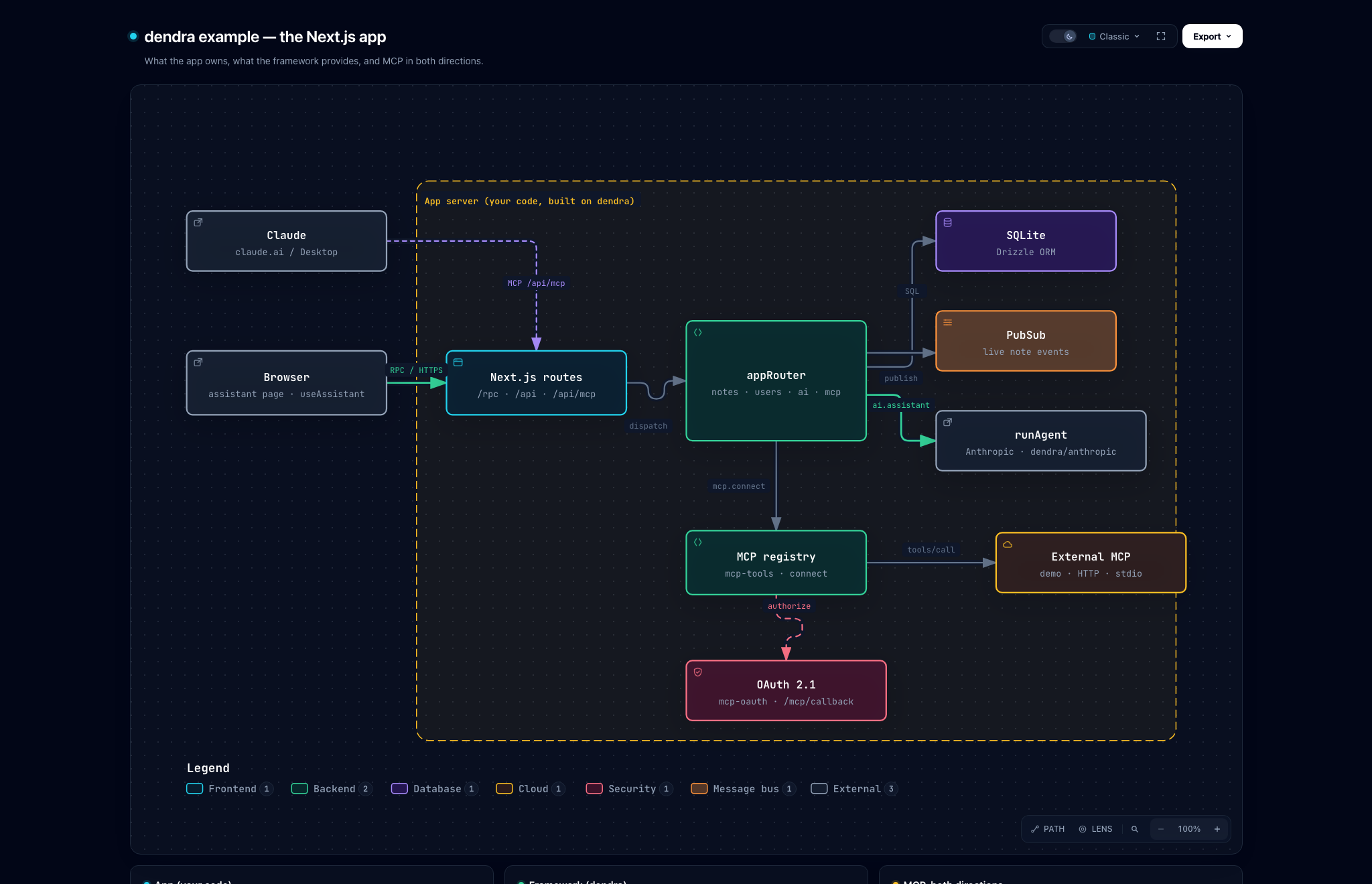
ARCHITECTURE.md explains the split between the framework
(dendra, in src/) and the app (the Next.js example) — and why auth,
navigation, voice, and MCP connection/OAuth management are app concerns while only
the typed-procedure and tool-shaping primitives live in the framework.
Building an app with dendra? Two aids ship in the repo:
AGENTS.md— a compact cheat sheet (install, the define→serve→call pattern, conventions, and the framework-vs-app rule) that any coding agent can read.- A packaged skill at
.claude/skills/dendra/— available automatically when this repo is opened in Claude Code; it teaches an agent to scaffold and extend a dendra app idiomatically.
(Consuming a running dendra app's tools at runtime needs no skill — that's just
MCP; point any MCP client at its /api/mcp or stdio server.)
examples/demo.ts— caller, unary, validation, streaming, AI tools, pub/sub.examples/rest-ws-demo.ts— REST, OpenAPI, WebSocket transport.examples/nextjs-app/— full Next.js app: RPC + REST, Server Components, generative-UI chat with voice, real LLM, subdomain multi-tenancy, resilient real-time notes, a NestJS-style class controller, MCP both ways (serve to Claude and connect out to external MCP servers with OAuth 2.1).
npm install
npm run build      # tsup → ESM + CJS + .d.ts in dist/ (core + /anthropic + /react)
npm test           # vitest: runtime + type-level inference tests
npm run demo       # boots a server + typed client, exercises everything
npm run demo:restws
Releasing is automated: bump the version and push the tag, and CI publishes to
npm (with provenance) via .github/workflows/publish.yml
— requires an NPM_TOKEN repo secret.
npm version patch   # or minor / major — bumps package.json and tags
git push --follow-tagsPre-1.0 — experimental, but broad. Implemented and tested
(over 390 tests, runtime + type-level, plus Postgres integration tests in CI): builder/router/dispatch, a batteries-included
Standard Schema validator set (literals, enums, unions, nullable, record, and
fluent string/number/array constraints), Next/Fetch/Node adapters, REST +
OpenAPI, inferred client (unary + streaming), NDJSON streaming with cancellation,
WebSocket transport, middleware (.use()), typed .output(), request batching,
in-memory, Redis and Postgres pub/sub, class controllers, AI tools, MCP (stdio + remote
HTTP, consume external MCP servers), a unified context layer
(createContextManager — memory recall + lazy tool loading under one token
budget), and optional dendra/anthropic + dendra/react helpers. Also after-hooks
(.after()), files in and out (s.file(), file(), urlFor), background jobs,
and a WebSocket server and browser connection with safe defaults.
Breaking in 0.9.0 (types, and chained
.input()): client results are typed as what survives JSON (aDateis astring;createCallerkeeps real types asCaller<R>), and a second.input()extends the first instead of replacing it. See the release notes.
Published on npm as dendra. Docs:
products.techfoundry.io/dendra, with
an API reference for every
export and an upgrade guide
for each major version. What changed in each version is in the
release notes. Before 1.0,
breaking changes ship in minor releases, and deprecated names keep working for at
least one; see the versioning policy. What's planned next is in ROADMAP.md.
MIT