Repository navigation
Can't trace sys_execve inside a c program #2523
Description

I write a C program to make system call, I want to use bpftrace to trace it. But when I use it, it can't print out the thing I want.
Here is the C program.
#include <stdio.h>
#include <unistd.h>
int main(){
    char * path = "/usr/bin/id";
    char *argv[] = {"/usr/bin/id","root", NULL};
    char* envp[] = { NULL };

    execve(path, argv, envp);
    return 0;
}
Left window command:
gcc test.c -o foo
./foo
Right window command:
bpftrace -e 'tracepoint:syscalls:sys_enter_execve { printf("%-6d %-8s", pid, comm); join(args->argv);}'
but when I use strace strace ./foo, everything works well. I got the line 14074 foo /usr/bin/id root
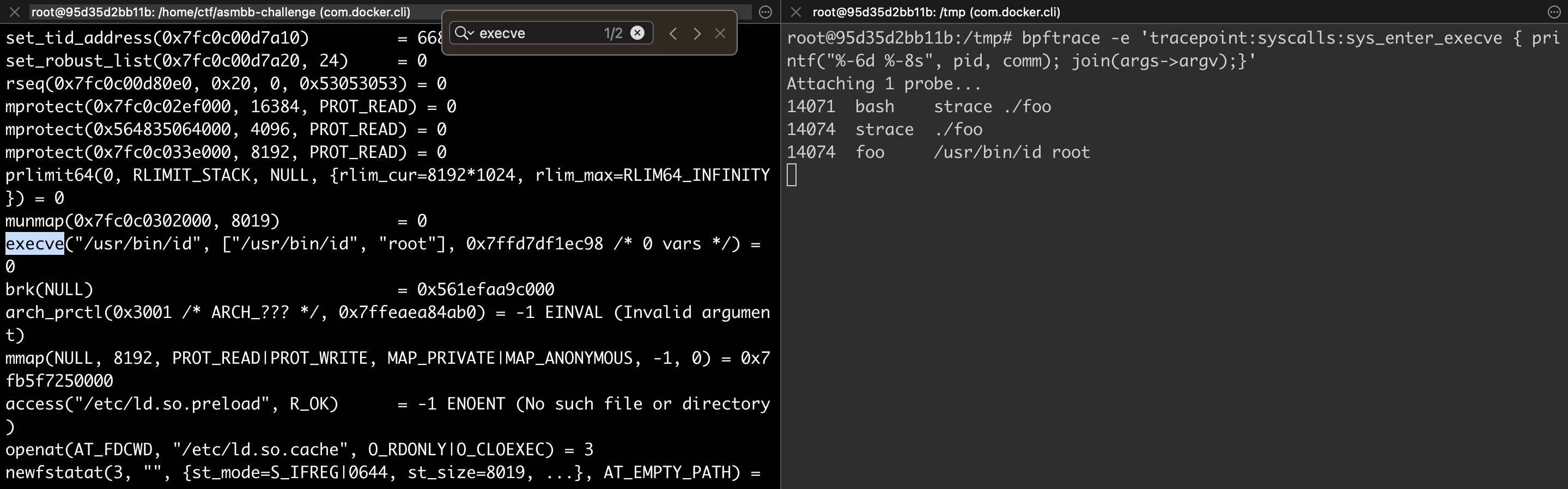
where is the problem?
Activity
fbs commentedon Mar 13, 2023
Can you run with
-kk? Its probably because the path isn't faulted into memory yet so the bpf read fails and you get an empty stringgodspeedcurry commentedon Mar 13, 2023
Hello, when run with '-kk', it give the following message, by the way, the test environment is in docker (on mac)
fbs commentedon Mar 13, 2023
Can you try to loop over and printf your argv from your code and see if it works after?
godspeedcurry commentedon Mar 13, 2023
could you show me the code, I am a beginner in kernel.
fbs commentedon Mar 13, 2023
It has nothing to do with the kernel, its your own C code
Should be enough
godspeedcurry commentedon Mar 13, 2023
Hi, I found another problem, If I print something before, I can get the thing I want...
godspeedcurry commentedon Mar 13, 2023
I tried what you mentioned, also works very well, but I can't explain it.
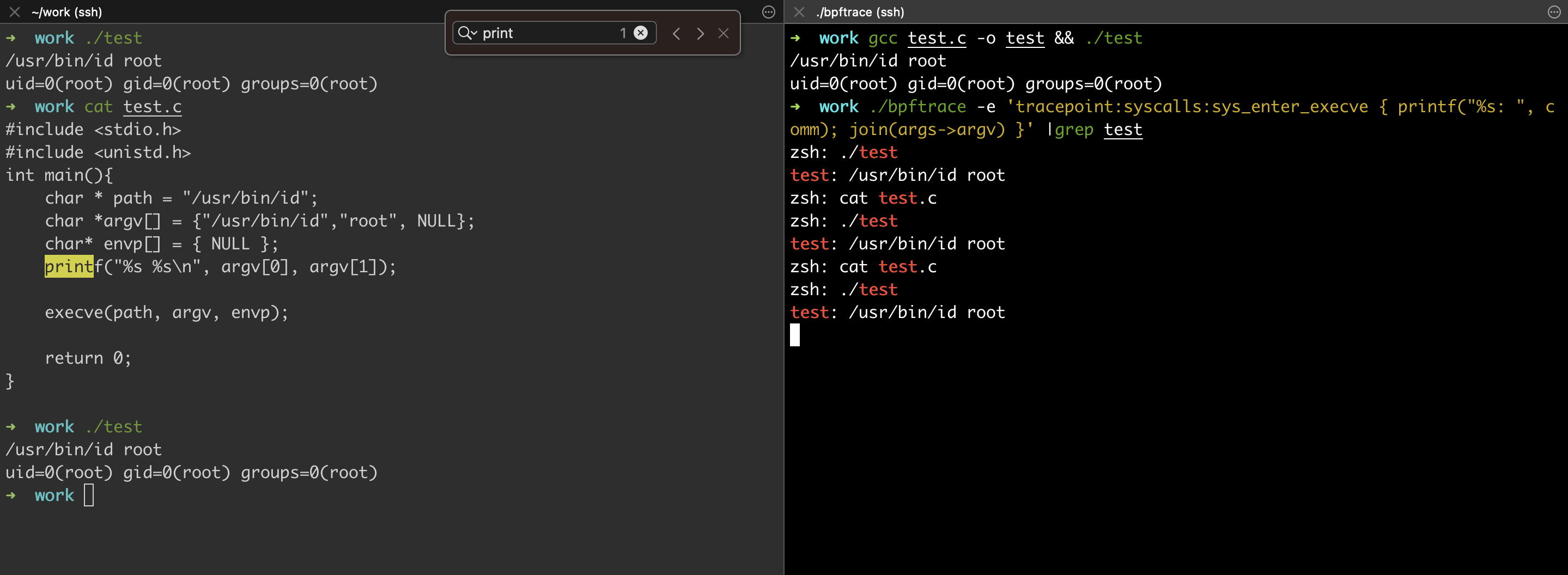
godspeedcurry commentedon Mar 13, 2023
also I found that if the binary is statically linked, the program compiled by the original source code works very well.

ValdikSS commentedon Mar 13, 2023
This is by design. Read this
https://research.nccgroup.com/2021/08/06/some-musings-on-common-ebpf-linux-tracing-bugs/
fbs commentedon Mar 13, 2023
@ValdikSS what part of that doc are you referring to?
Like I said earlier, the data you're using isn't in memory yet. These static strings are compiled in and are not actually faulted into memory until they're accessed. The access won't happen until its read, which is after your bpftrace probe ran. BPF won't pull the data in so you get an EFAULT/-14.
By printing the values or just a random print of a constant string you pull the small amount of data into memory (as it goes by page, not by var) and then it works
ValdikSS commentedon Mar 13, 2023
@fbs,
viktormalik commentedon Mar 30, 2023
Looks like this is not a bpftrace bug. Can we close?
Add execsnoop plugin to capture execve system calls
Add execsnoop plugin to capture execve system calls
Add execsnoop plugin to capture execve system calls
Add execsnoop plugin to capture execve system calls
Add execsnoop plugin to capture execve system calls