Optional method of better rendering ischrones for accessibility using nodes + edges #4
Comments
 kuanb
changed the title
kuanb
changed the title

|
@kuanb nice. How did you parameterize |

|
Those are both buffered at 25 (meters). In the final example at the bottom of http://kuanbutts.com/2017/12/16/osmnx-isochrones/ |
|
I like how the blocks are filled-in in your example image above. But, I'm not seeing the same results when I parameterize your sample code that way: def make_iso_polys(G, edge_buff=25, node_buff=50):
isochrone_polys = []
for trip_time in sorted(trip_times, reverse=True):
subgraph = nx.ego_graph(G, center_node, radius=trip_time, distance='time')
node_points = [Point((data['x'], data['y'])) for node, data in subgraph.nodes(data=True)]
nodes_gdf = gpd.GeoDataFrame({'id': subgraph.nodes()}, geometry=node_points)
nodes_gdf = nodes_gdf.set_index('id')
edge_lines = []
for n_fr, n_to in subgraph.edges():
f = nodes_gdf.loc[n_fr].geometry
t = nodes_gdf.loc[n_to].geometry
edge_lines.append(LineString([f,t]))
n = nodes_gdf.buffer(node_buff).geometry
e = gpd.GeoSeries(edge_lines).buffer(edge_buff).geometry
all_gs = list(n) + list(e)
new_iso = gpd.GeoSeries(all_gs).unary_union
isochrone_polys.append(new_iso)
return isochrone_polys
isochrone_polys = make_iso_polys(G, edge_buff=25, node_buff=25)
fig, ax = ox.plot_graph(G, fig_height=8, show=False, close=False, edge_color='k', edge_alpha=0.2, node_color='none')
for polygon, fc in zip(isochrone_polys, iso_colors):
patch = PolygonPatch(polygon, fc=fc, ec='none', alpha=0.6, zorder=-1)
ax.add_patch(patch)
plt.show()
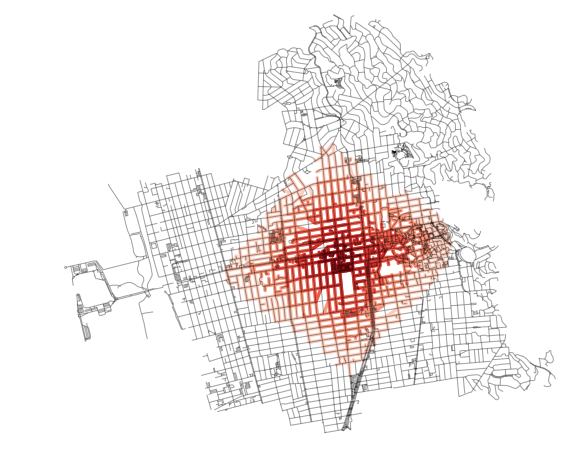
Does it make sense for 25-meter buffers to fill in the blocks, as seen in your image? They are much larger than 25x25 meters, so this output I'm seeing makes sense with those parameters. |
|
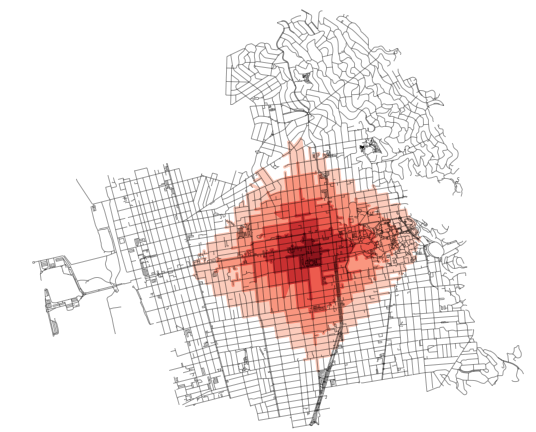
So sorry and thanks for pointing this out. I updated the post and also am including the fixed script here. I forgot to add on step to the method. I acknowledge this won't always work if you have a "donut" situation. Would need to think about a better way to handle such situations... |
|
Here's the result of the following script:
|

|
thanks @kuanb I've added a demo of this to the notebook! |


Regarding this example:
https://github.com/gboeing/osmnx-examples/blob/master/notebooks/13-isolines-isochrones.ipynb
I propose a new method,
make_iso_polys, outlined below. This, rather than a convex hull, might best demonstrate coverage area while preserved nuances ("inlets" or areas of inaccessibility not captured when creating a convex hull around a point cloud).Example of what improved plot looks like:
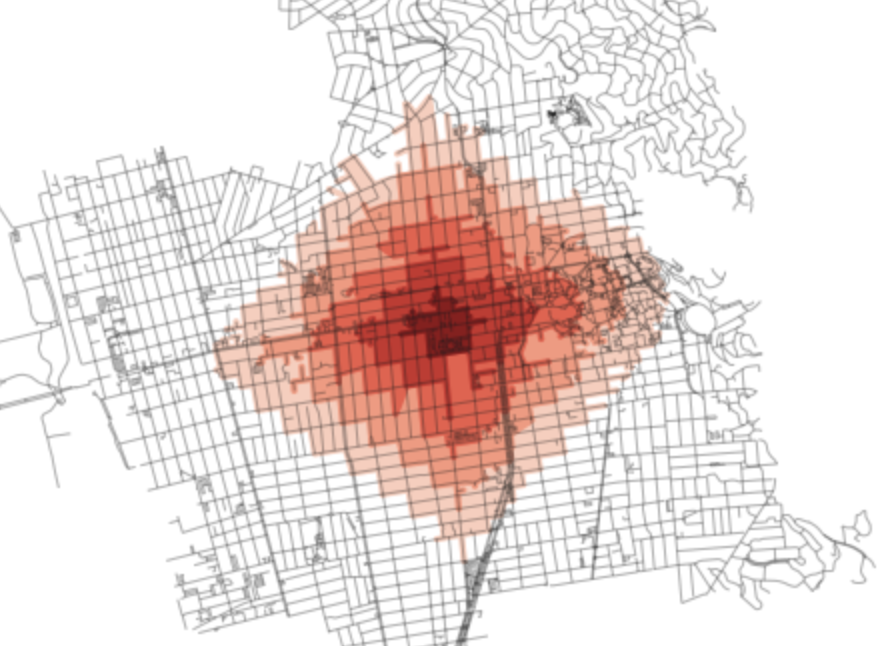
Ful function defintion.
Further elaboration available here: http://kuanbutts.com/2017/12/16/osmnx-isochrones/
The text was updated successfully, but these errors were encountered: