
Every cyclist and stage of the Tour de France in four CSV files.
🟡 Explore the data live: camminady.dev/LeTourDataSet — interactive charts and a rider lookup, reading these CSVs directly.
Data coverage
- Men's Tour de France: 1903 - 2026 (all 113 editions)
- Women's Tour de France (Tour de France Femmes avec Zwift): 2022 - 2026 (all editions since the relaunch)
If you use pandas, just get the data via:
import pandas as pd

# Men's Tour de France data
df_men_riders = pd.read_csv("https://raw.githubusercontent.com/thomascamminady/LeTourDataSet/master/data/men/TDF_Riders_History.csv")
df_men_stages = pd.read_csv("https://raw.githubusercontent.com/thomascamminady/LeTourDataSet/master/data/men/TDF_Stages_History.csv")

# Women's Tour de France data
df_women_riders = pd.read_csv("https://raw.githubusercontent.com/thomascamminady/LeTourDataSet/master/data/women/TDFF_Riders_History.csv")
df_women_stages = pd.read_csv("https://raw.githubusercontent.com/thomascamminady/LeTourDataSet/master/data/women/TDFF_Stages_History.csv")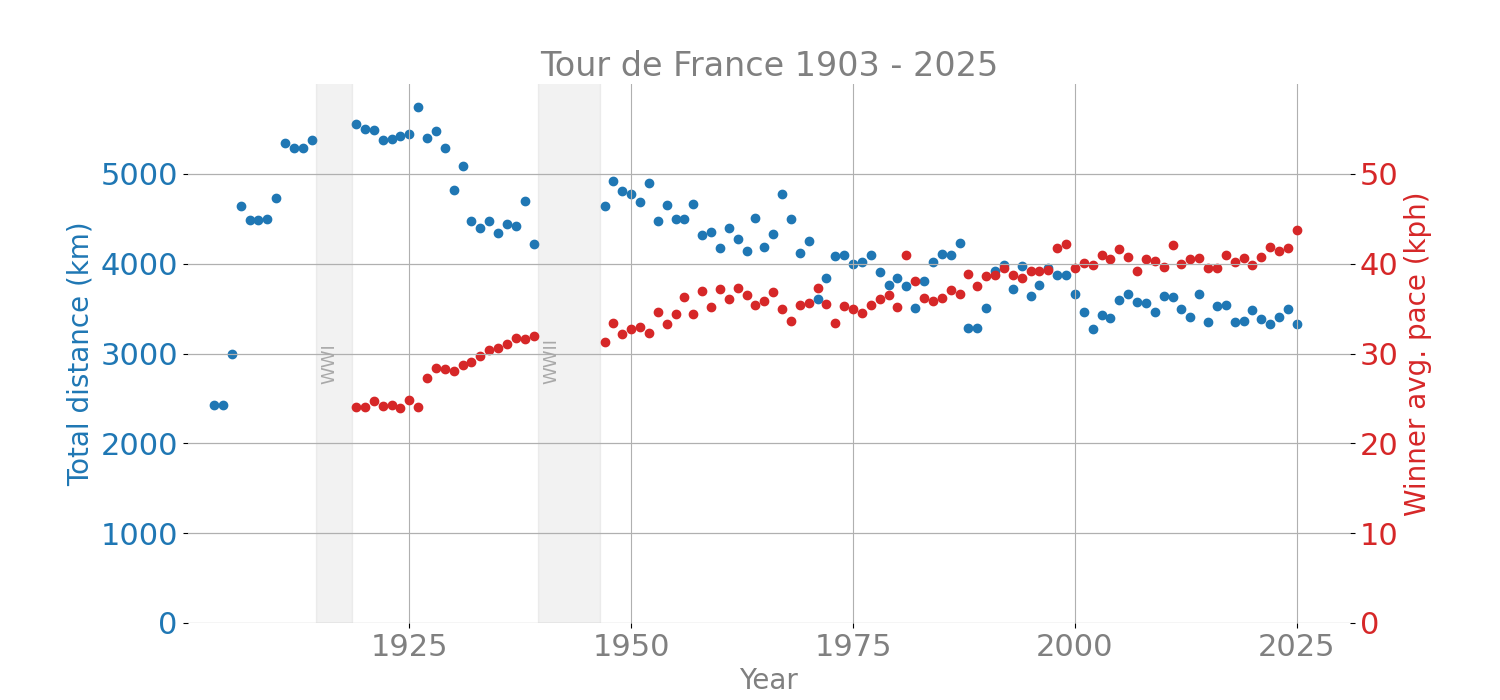
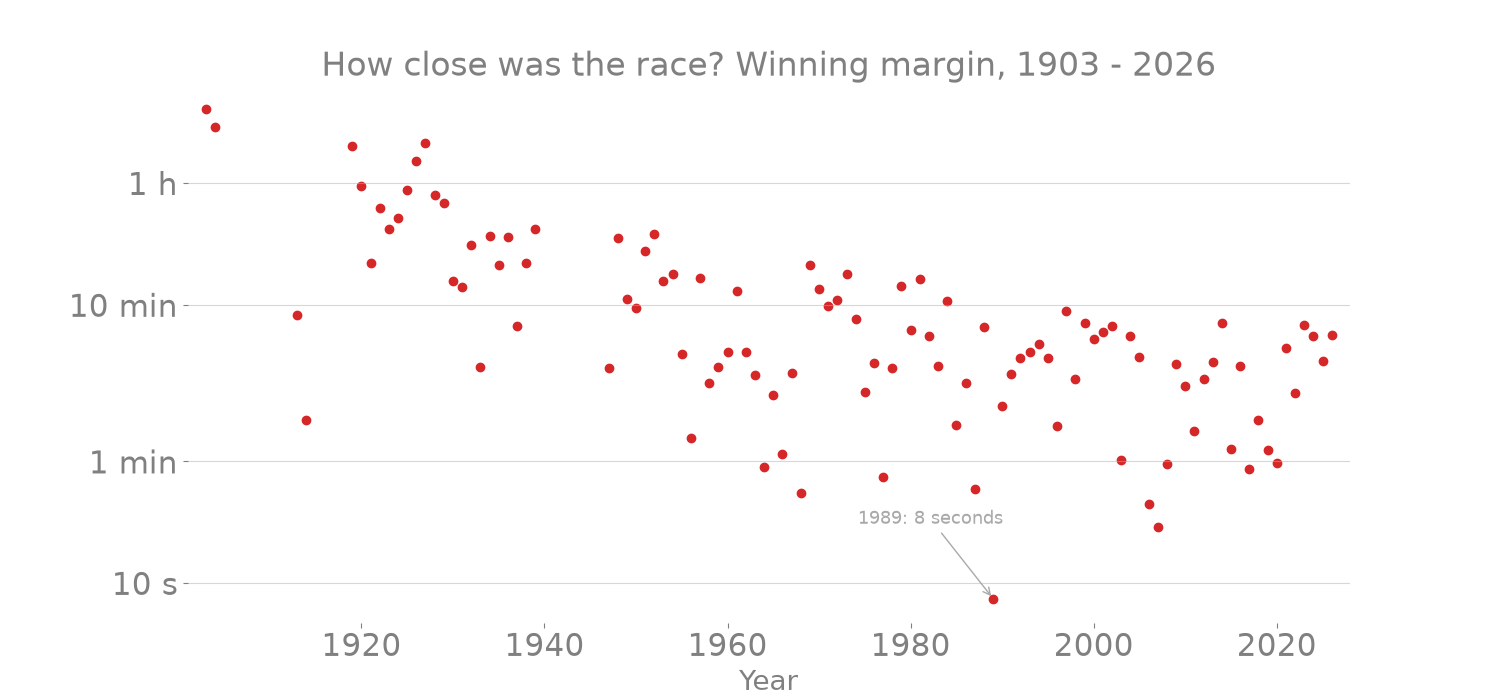
If you use R instead of python, you can run:
library(readr)

# Men's Tour de France data
df_men_riders <- read_csv("https://raw.githubusercontent.com/thomascamminady/LeTourDataSet/master/data/men/TDF_Riders_History.csv")
df_men_stages <- read_csv("https://raw.githubusercontent.com/thomascamminady/LeTourDataSet/master/data/men/TDF_Stages_History.csv")

# Women's Tour de France data
df_women_riders <- read_csv("https://raw.githubusercontent.com/thomascamminady/LeTourDataSet/master/data/women/TDFF_Riders_History.csv")
df_women_stages <- read_csv("https://raw.githubusercontent.com/thomascamminady/LeTourDataSet/master/data/women/TDFF_Stages_History.csv")data/
├── men/ # Men's Tour de France data
│ ├── TDF_Riders_History.csv # one row per rider and edition (final GC)
│ └── TDF_Stages_History.csv # one row per stage
├── women/ # Women's Tour de France data
│ ├── TDFF_Riders_History.csv
│ └── TDFF_Stages_History.csv
└── plots/ # Generated visualizations
├── TDF_Distance_And_Pace.png
└── TDFF_Distance_And_Pace.png
Running the update pipeline additionally produces
TDF_All_Rankings_History.csv / TDFF_All_Rankings_History.csv
(per-stage rankings for every classification). These files are large and
are not committed to the repository; run make update to generate
them locally.
ResultTypein the riders files istime(normal editions),points(1907-1912, when the race was decided on points), orno-results(1905, 1906, 1908, for which the source has no usable values).TotalSeconds/GapSecondsare 0 for non-timeeditions. TheTimesstring is still kept verbatim for those years even though the source prints placeholders there (1907 runs 47h, 66h, 74h, ... for a race that actually took some 158 hours).Bis the rider's total time bonus andPthe total time penalty. Both are in seconds, but the history pages print the bonus with a minute mark, so 52 seconds shows up as52'; penalties use theMM' SS''form. No bonus in the data exceeds 52, which matches the seconds reading. See #14.- Stage numbers are integers; split stages of early editions appear as
e.g.
13.1and13.2, and a prologue is stage0. - Some early editions genuinely had very small classified fields (e.g. 10 finishers in 1919).
The data mirrors letour.fr / letourfemmes.fr, including some flaws of the source itself:
- 1966 only lists the podium (3 riders); the full classification is not available on letour.fr (verified against all its ranking endpoints).
- 1967 rank 78 and 1982 rank 86 each list two riders with different times; ties with identical times (e.g. 1958, 1959, 1975) are real.
- A few stages have no recorded stage winner, and the
Leadercolumn of the men's stages file is only populated for some editions. - 41 editions skip at least one rank — the source lists e.g. ranks 39 and 41 for 1928 but no 40. The gaps are in the source, so the dataset reproduces them rather than renumbering. Affected years run from 1909 to 2012; 1985, 2006 and 2009 miss four or five ranks each. See #3.
- 1981 gives Bernard Hinault
91h 34' 14'', which implies about 41 kph and disagrees with other sources; letour.fr still serves that value, so it is kept verbatim. See #2.
For other issues, see the Issues tab.
Requires uv.
make install    # Install dependencies (uv sync)
make update     # Complete data update workflow (recommended for annual updates)
make plot       # Generate plots from existing data
make docs       # Sync the documented year ranges to the data
make test       # Run the test suite (pytest, offline)
make lint       # ruff + ty
make format     # ruff format
make check-csv  # Check CSV data integrity against origin/master
make diagnose   # Manual checks against the live letour.fr pages
make help # See all available commandsmake updateThis will:
- 📥 Download the latest Tour de France data from the official sites
- 🔧 Post-process and sort all data files
- 🩹 Reconstruct the newest general classification if the site does not publish one yet (a stopgap that excludes time bonuses; replace it with official data once available)
- 🛡️ Report CSV integrity (informational locally)
- 📝 Sync the documented year ranges to the data
- 📊 Regenerate the plots
There is no year to bump anywhere. The scraper discovers the editions
from the source sites, and the CSVs are then the single source of truth for
which years the dataset covers: letourdataset.coverage derives the first
year, the latest year and the edition count per race from the riders files,
and everything that names a year reads from it — the coverage list at the
top of this README, the <title> and description of the docs page, and
every plot title. Adding an edition is therefore just make update.
The generated prose sits between <!-- coverage:start --> and
<!-- coverage:end --> markers in README.md and docs/index.html; don't
edit it by hand, run make docs. CI runs make check-docs, so a README
that drifts from the data fails the build.
A freshly finished edition keeps an empty general-classification table on its year page for a while. The scraper then falls back to the general ranking after the final stage, which is the official result including time bonuses, so step 3 only has to reconstruct anything if that is missing too.
Then review the changes and commit. The individual steps are available as
make download-only, make postprocess, make fix-riders-history,
make check-csv, make docs, and make plot.
A GitHub Actions check compares every data CSV against the base branch and fails when existing rows or columns disappear or change. Rows are compared order-independently with normalised values, so re-sorting or reformatting does not trip it, and modifications are detected even when rows are added at the same time.
Genuine corrections (e.g. the source site fixed a result) are allowed:
put the marker [data-fix] in the commit message together with an
explanation. See .github/INFOS.md for details.
As of 2022, the women's Tour de France was relaunched as "Le Tour de
France Femmes avec Zwift". The data comes from the official
letourfemmes.fr site and is complete
since the relaunch. (Note: the source site reports a total distance of
0 km for 2025; the dataset carries the official route total of 1169 km
instead, via DISTANCE_OVERRIDES in src/letourdataset/scraper.py.)
Some entries may be incorrect due to source data issues on the official websites. When discrepancies are found, they typically stem from the original letour.fr or letourfemmes.fr data. If you spot one, please open an issue.
This code has been completely rewritten. The previous code and output are available in the legacy repository.
- Fork the repository
- Create a feature branch
- Make your changes (CI runs linting, tests, and the data-protection check)
- Submit a pull request