Repository navigation
Home

Species identification from genome assemblies (fasta) or raw sequencing reads (fastq) with Mash.
mashID runs mash screen for every sample against a sketch database, keeps the best hits, names the
organism from the database metadata, and flags results that deserve a second look: possible
mixtures, ambiguous calls, low coverage. It works with Illumina (paired-end or single-end),
Ion Torrent, Nanopore and PacBio reads, and with assemblies; inputs may be gzipped.
- Installation
- Usage
- Example
- Interpreting results
- Pipelines
- FAQ
- Comparison
- Outputs
- Databases
- Development
conda create -n mashID -c conda-forge -c bioconda mashid
conda activate mashID
mashID_download_db mycobacteriaceae
mashID -i /path/to/reads -o results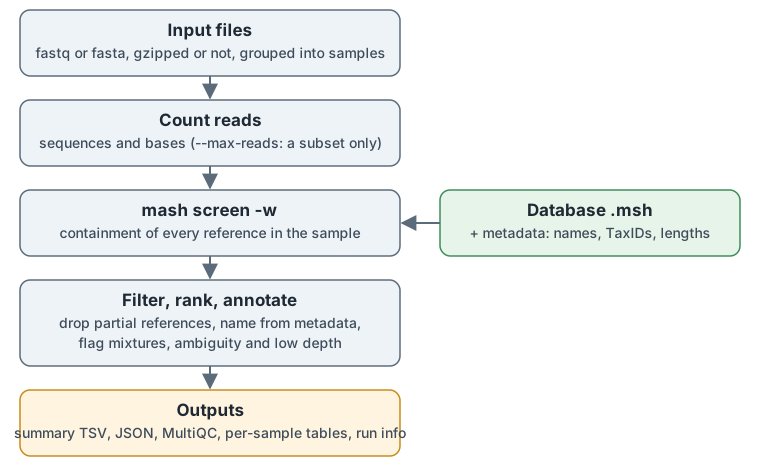
- Input files are grouped into samples by name; R1/R2 pairs and multi-lane files belong to one sample.
- Reads and bases are counted (pure Python, optionally accelerated by
python-isal). -
mash screen -westimates, for every reference in the database, how much of its sketch is contained in the sample. Winner-take-all credits shared hashes to the best reference. - Hits to references shorter than 100 kb are ignored (partial records), the rest are ranked, and the organism name, TaxID and reference length are read from the database's metadata sidecar.
- Notes are added from the hit list, and the summary (TSV, JSON, MultiQC), per-sample tables and a run-provenance file are written.
These pages are generated from
docs/wikiin the repository. Edit them there; a workflow publishes changes to this wiki.