Repository navigation
Can I specify the potential on embedded boundaries using a MultiFab instead of an analytical function? #6550

Replies: 1 comment 6 replies

|
How many parts do you have? Is the potential time dependent? One thing you could do it to save |

|
Oh, if there are a few thousand terms in the Parser expression, there is not much we can do to make the Parser fast enough. The amrex function you mentioned above is actually from a different class. Nevertheless, it's easy to add a similar function to the class used by WarpX. But WarpX also needs to be modified to use the new amrex function |

|
OK. Following the same approach, would it also be possible to add a similar function to modify the potential on the domain boundaries ([lo/hi]_[x/y/z])? This would be helpful. (,,・ω・,,) |
|
Just wanted to make sure I understand. You really have a few thousand distinct values, not just a few distinct values on a few thousand EB nodes. |
|
The Dirichlet domain boundaries are under the application's control. Whatever you set on the Dirichlet boundary nodes will be used the amrex solver. But I am not sure how you fill that in WarpX. That's a question for @RemiLehe. |
|
Yes. |


Uh oh!
There was an error while loading. Please reload this page.
Uh oh!
There was an error while loading. Please reload this page.
Dear WarpX Community,
I am developing a 2D RZ code with floating potential on embedded boundaries (EB). The potential values differ across the cut cells (cells that intersect the EB). As far as I know, one way to update the EB potential is by using
set_potential_on_eb()with an analytical function. Currently, I update the potential by constructing a lengthy function that includes the calculated potential for each cut cell. The function I use to generate this analytical expression is shown below:The generated function consists of parts like
c5*(sqrt(x*x+y*y)>=c1 and sqrt(x*x+y*y)<c2 and z>=c3 and z<c4). While this does correctly update the potential, parsing such a long function is very time-consuming. Therefore, I am looking for alternative approaches.In the Amrex documentation, I found the following information:
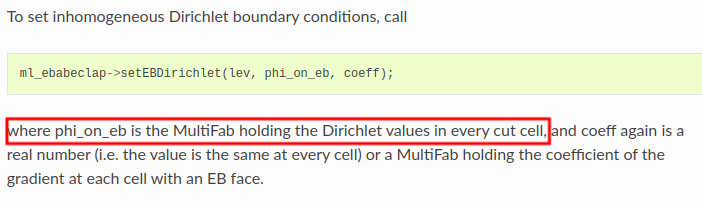
This suggests that a MultiFab can be used to specify Dirichlet values on EB faces. My question is: Can I specify the potential on embedded boundaries using a MultiFab in WarpX? Alternatively, is there a Python interface to access the underlying
setEBDirichletroutine?Any guidance would be greatly appreciated.
Thank you.
All reactions