Repository navigation
Home
Shift, Tone, Decode. Software in testing. Version 0.1.2. Around the shack it also answers to Sending Transmittal Disease.
The real expansion is Shift, Tone, Decode. The other one is the joke. STD is a 64-bit Windows application, a Qt 6.11.1 MSVC digimode console for a TCI radio, currently in the contagious stage: it keys on the bench, it has not finished making the rounds, and the recommended treatment is another shot of bourbon while the modes get proved on the air.
STD: Help keep the infections spreading and buy us a shot of bourbon.
Copyright (C) 2026 Rick Langford (N8SDR). License: GPL-3. Source: N8SDR1/STD. Web: n8sdr1.github.io/STD.
STD is GPL v3.

Lyra is the transceiver. SDRLogger+ is the logbook. STD is the digimode console on the same TCI desk. CW stays in Lyra.
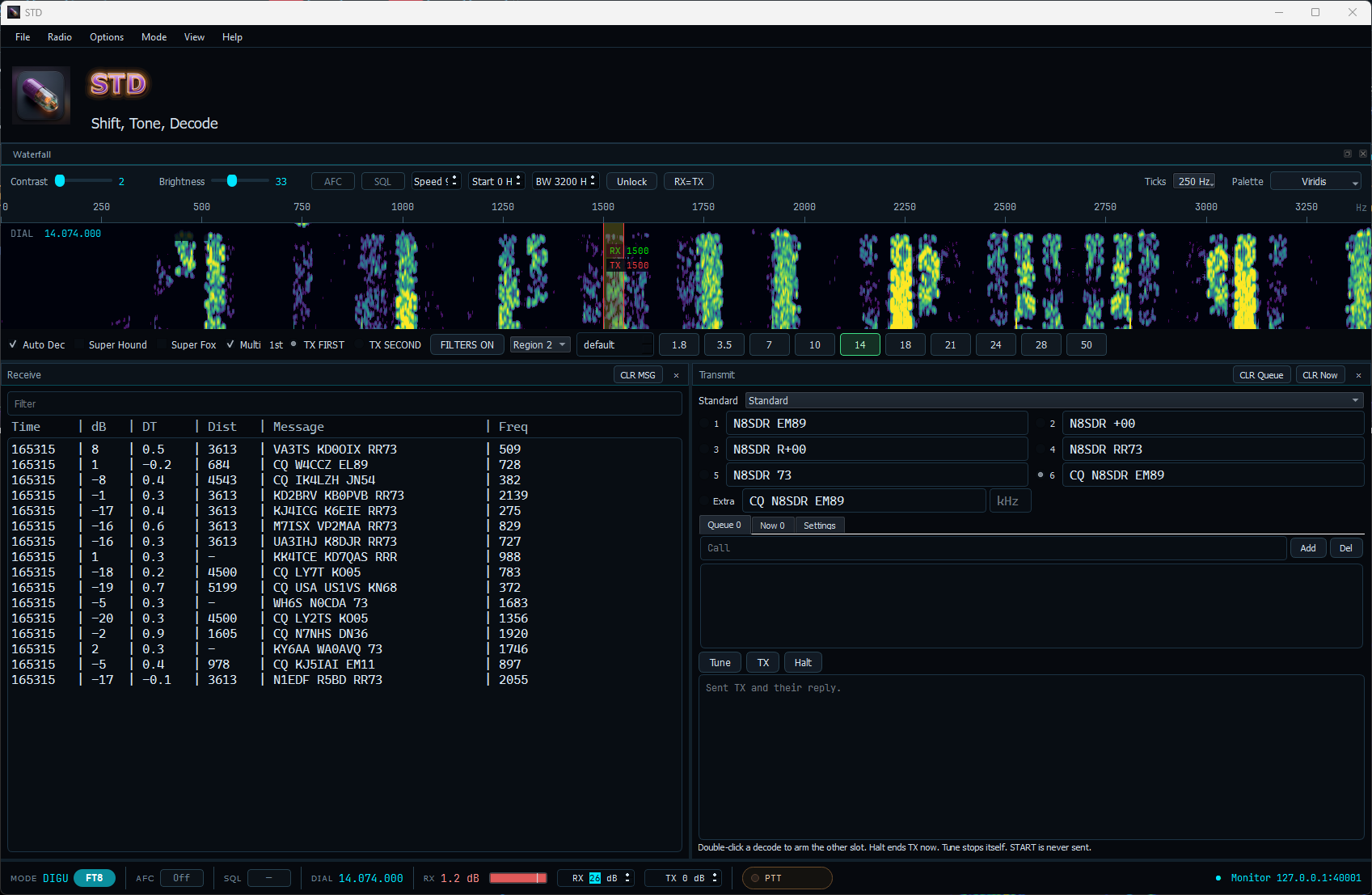
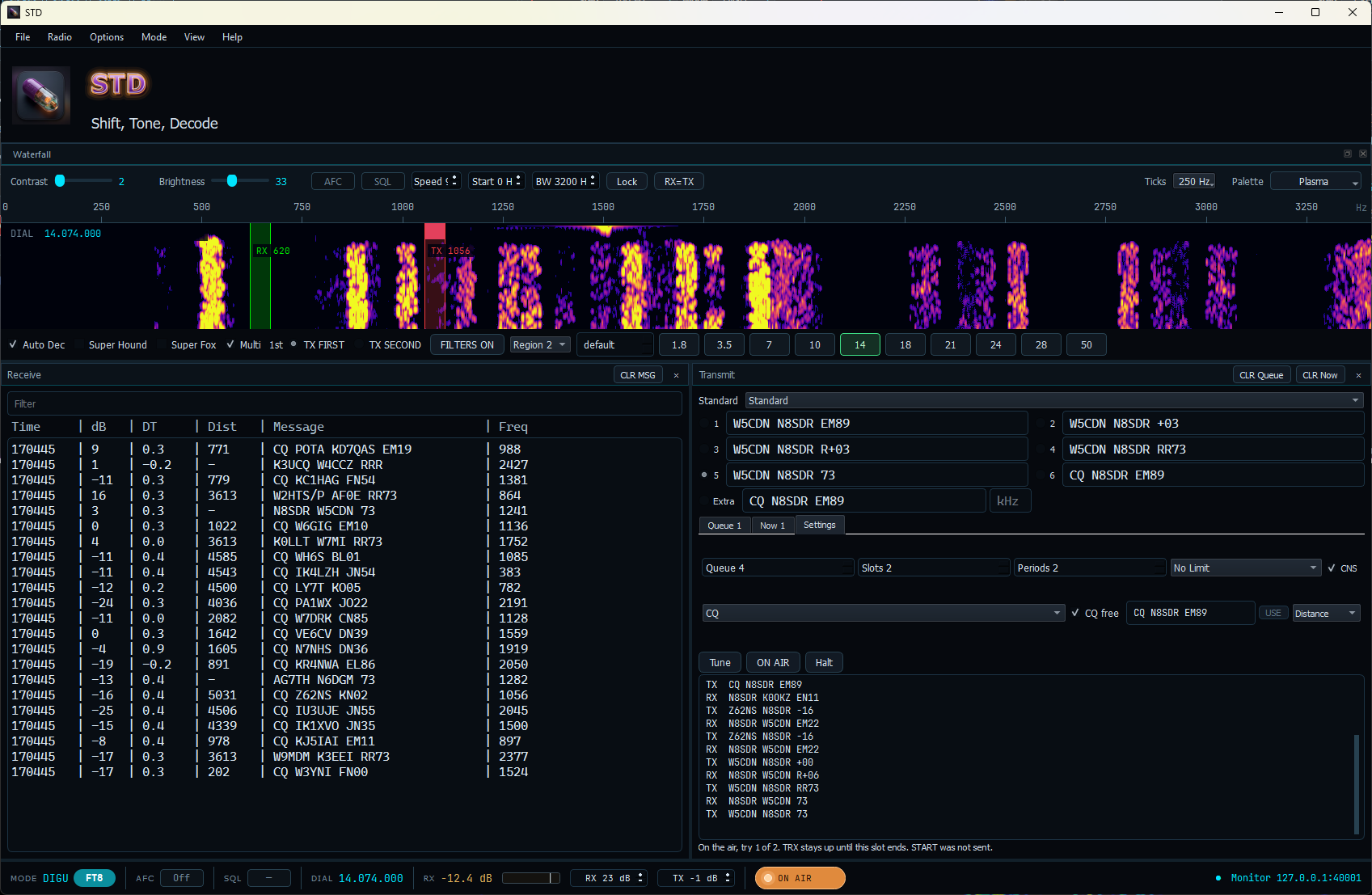
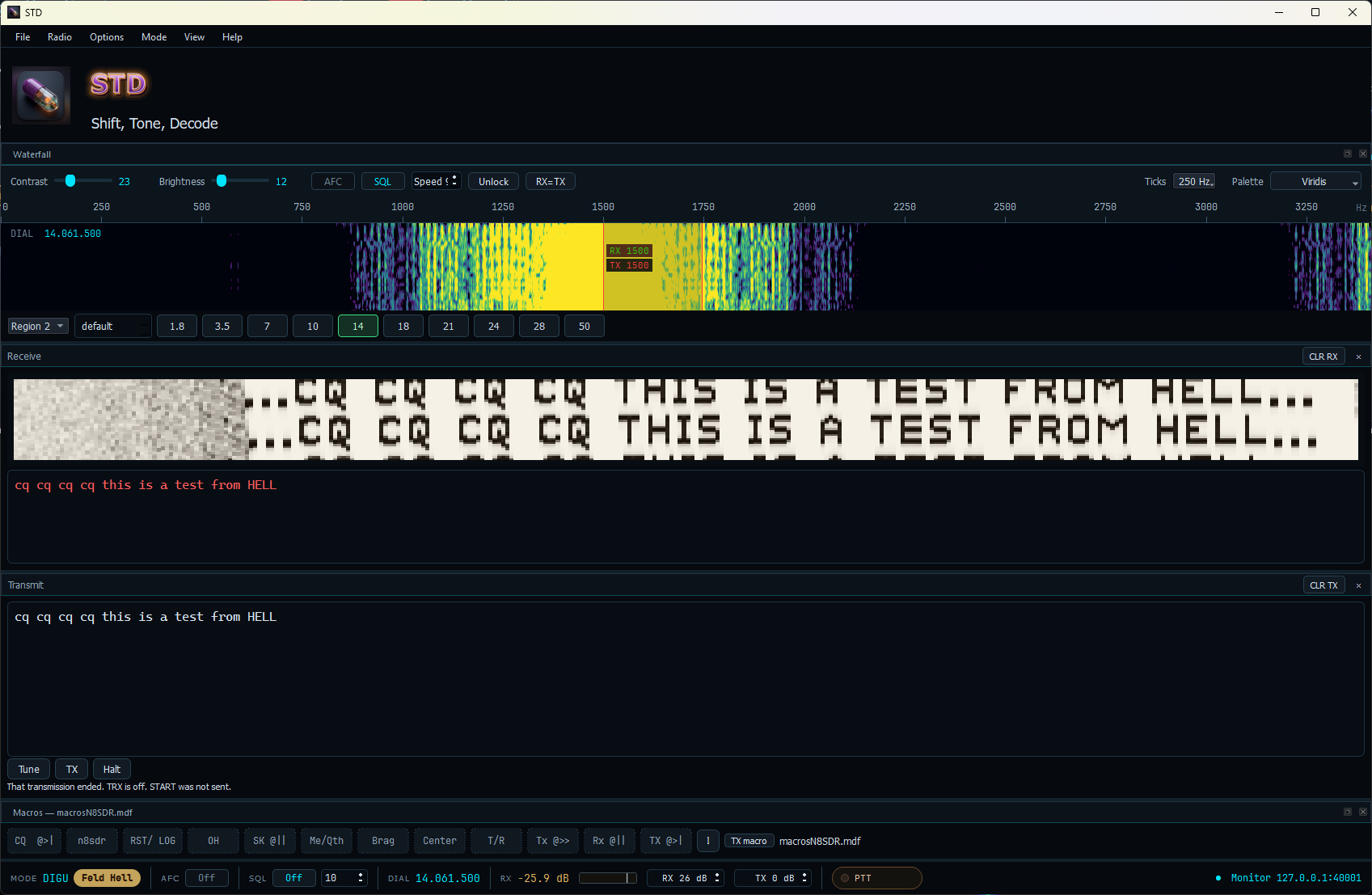
TX sends one of these when the operator presses TX or Tune. Opening the radio does not key. The text command START is never sent. The full list is on the Modes page.
| Mode | What this build sends |
|---|---|
| FT8, FT4, FT2 | 15 s, 7.5 s, and 3.75 s. DIGU. MSHV generator. The Tx line that goes out next is a green biohazard sign. |
| JT65 | JT65A, JT65B, and JT65C. 60 s. Tone 0 stays near 1270 Hz. DIGU. |
| Q65 | Q65A, Q65B, Q65C, and Q65D. 30 s. The tone follows the cursor. DIGU. |
| Hell | Feld, Slow, X5, X9, FSK, FSK-105, and Hell 80. Feld Hell's raised-cosine edge is then limited to the 245 Hz channel. The marker is centered on the carrier. Reverse video flips the tape. See Hell. |
| RTTY | One row. Shift, baud, shaped keying, Reverse, and ITA-2 are on the transmit pane. 45.45 baud and 170 Hz are selected. Mark is high unless Reverse is on. |
| BPSK | PSK31, 63, 125, 250, 500, 1000. |
| QPSK | QPSK31 through QPSK500. K=5. 8PSK is not in this build. |
| Olivia and Contestia | 4/250, 8/250, 8/500, 16/500, 16/1000, 32/1000. |
| MFSK | 4, 8, 11, 16, 22, 31, 32, 64, 64L, 128, 128L. The L rows use the long interleaver. |
| DominoEX | Micro, 4, 5, 8, 11, 16, 22. FEC off. Micro is 2 baud. |
| Thor | 4, 5, 8, 11, 16, and 22 are K=7. 25x4, 50x1, 50x2, and 100 are K=15. Thor Micro is not in this build. |
| MT63 | 500S, 500L, 1000S, 1000L, 2000S, 2000L. 64 carriers, Walsh code. |
| JS8 | JS8Call-improved Normal. 15 s, 50 Hz. Band activity, the conversation, and call activity, with HB, CQ, Reply, SNR?, INFO?, STATUS?, GRID?, Directed, and Deselect. Heartbeat, CQ, and directed frames go out at the next 15 s UTC period, one frame each. A longer message continues on the following periods. Reply and Deselect do not key. Receive searches a fraction of a symbol, corrects the frame with the LDPC code, and prints every JS8 signal in the passband. |
| WSPR | WSPR-2 from WSJT-X and JTDX. Even UTC minutes. The locator is Options → User. Column titles stay above the scrolling rows. Decodes stay in the receive colour, and a rule separates the periods. Heard stations can be posted to WSPRnet, and those messages show only while WSPR is the mode. |
JS8 receive follows the 15 s period, searches a fraction of a symbol and a couple of hertz, corrects the frame with the LDPC code, and prints every JS8 signal it hears in the passband. Olivia and Contestia find the FEC block on their own and look a few tone spacings either side of the cursor. DominoEX and Thor still print when the cursor is a fraction of a tone off. MFSK ignores a carrier that sits on one tone. Olivia, Contestia, MFSK, DominoEX, and Thor keep a received line break and print Latin-1. SQL and AFC for those modes are on the status row. AFC stays off until you turn it on. Start tones on the transmit row sends the Olivia, Contestia, and MT63 tuning tones and stays on until you turn it off. MT63 keeps a line break and prints Latin-1. The waterfall uses Floor, Range, Auto, and Flatten. START is never sent.
WEFAX-576 receives (IOC 576, 120 lines per minute). Stations are listed by ITU region, with NOAA hours on the frequencies that have them. A click sets the dial 1.9 kHz under the assigned frequency, USB, marker 1900 Hz. Start opens a chart already running, a click sets the left edge, and Fit, Auto save, and Open folder are on that screen. A 300 Hz start tone opens the picture, a 450 Hz stop tone saves it, and Slant corrects the clock in parts per million, 10 ppm a step. It does not key, and it does not send START.
In this build. The map uses the callsign already saved under Options → User. Upload after a decode stays off until Enable is checked under Options → Network Configuration. Antenna is the description sent with each spot. Also send WSPR spots to PSK Reporter stays off until checked. There is no second callsign. It does not send START.
In this build. Options → WSPRnet reports opens the page of stations reported by the callsign already saved under Options → User. Options → Network Configuration can post each WSPR station STD decodes. That post stays off until WSPRnet is set to On. WSPRnet does not ask for a password or a key. There is no second callsign or locator. It does not post your own transmission. It does not send START, and it does not key.
File → Backup settings saves layouts and the callsign and locator already stored under Options → User. It does not copy the TCI host or port. File → Import settings restores that file. File → Backup logbook copies the ADIF file. File → Export ADIF writes a copy another logger can import. Halt ends a transmission immediately and does not key when nothing is on the air. Tx1 through Tx6 stay as they are. Options → Decode → JT65 and Q65 holds averaging, auto clear, Clear Averaging Now, Q65 single signal, EME delay, drift correction, JT65 VHF/UHF, deep search against the ADIF log, and the JT65 signal cap. Fast, Normal, Deep, and AP reach Q65, and AP reaches JT65. DIST is miles or kilometers from Options → Decode List Options. None of this sends START.
8PSK is not on the menu, and it does not key. CW stays in Lyra.
FLD-88 is queued. JS8 Fast, Turbo, Slow, and Ultra are not on the menu. Thor Micro is not in this build.
Supports importing Fldigi custom macros. Name, QTH (the station city), Antenna, and Power under Options → User fill the matching tags. An empty box erases the tag. Details are on the Macros page.
STD is a 64-bit Windows application. The kit is Qt 6.11.1 MSVC (C:\Qt\6.11.1\msvc2022_64).
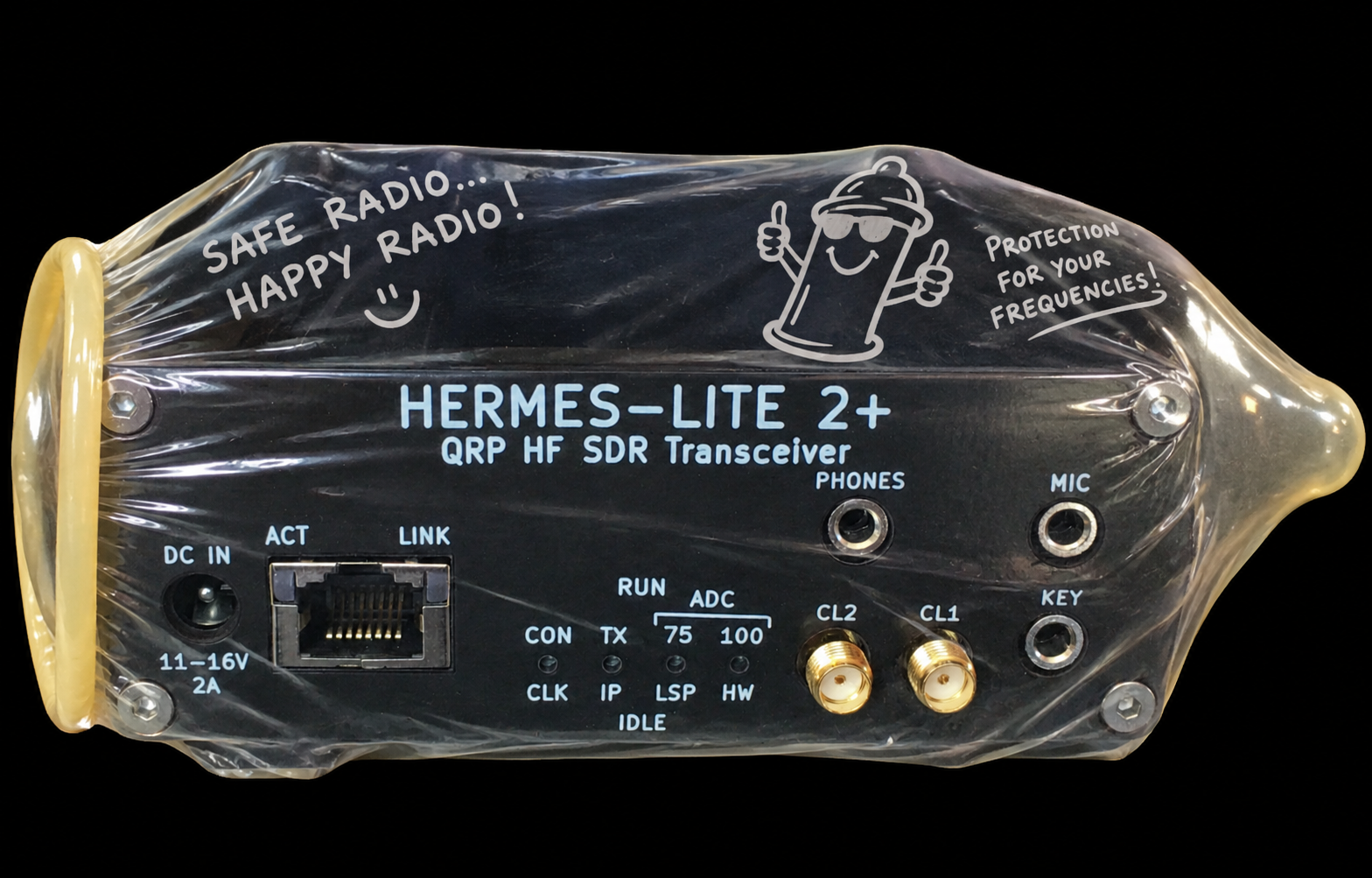
Practice safe radio. Wrap your connectors.