Repository navigation
Handling memory with a memory pool
Using a single-source memory manager provides significant advantages for both static and dynamic memory allocation. In Loom, a memory pool safely allows efficient dynamic allocation of memory chunks for handling sensor data and data transmissions.
Traditionally, these data types are managed using a large statically allocated buffer, combined with bounds checking to prevent overflow into adjacent memory. While effective, this approach requires careful sizing upfront and can either waste memory or risk overflow if underestimated.
With a memory pool (mempool), this constraint is largely eliminated. Memory can be allocated dynamically as needed, reducing the need to predict buffer sizes in advance and minimizing the risk of overflow-related issues. This leads to more flexible and safer memory usage, especially in systems with variable data loads.
The mempool manager, MemPool.hpp, is responsible for all memory pool operations. It is designed to be both easy to use and highly transparent for debugging, providing insight into allocation behavior and memory usage.
Although static allocation outside the mempool is still possible, it is discouraged for large buffers (greater than 500 bytes). The mempool reserves a substantial portion of SRAM at compile time (~10KB [8KB arena + 2KB Metadata]), so excessive static allocation can quickly exhaust available memory.
For more detailed information: (https://en.wikipedia.org/wiki/Memory_pool)
The following video demonstrates a LoomJsonDocument and automated resource destruction for a lease that has gone out-of-scope. Skip to ~30s for outputs.
Read more about RAII here, https://en.cppreference.com/cpp/language/raii
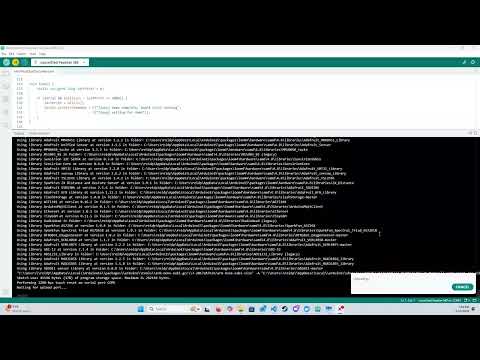

The above test has been ran for 72 hours with mock sample data and a broken RTC. We use an ArduinoJsonDoc allocated with the mempool to perform the R/W ops.
I chose to not import any additional Arduino or embedded dependencies to keep MemPool.hpp compact and easily transferable. This means developers have the freedom to choose how they implement the API based on their own project requirements. All examples shown below demonstrate ways the API has been integrated into Loom and serve as reference use-cases.
The pool is configured at compile time before including MemPool.hpp.
| Macro | Default | Meaning |
|---|---|---|
MEMPOOL_BLOCK_SIZE |
64 |
Bytes per allocation block |
MEMPOOL_BLOCK_COUNT |
128 |
Total blocks in the arena |
MEMPOOL_MAX_LEASES |
64 |
Maximum active lease records |
MEMPOOL_ZERO_ON_ALLOC |
1 |
Clear memory when allocated |
MEMPOOL_ZERO_ON_FREE |
1 |
Clear memory when released |
MEMPOOL_TAG_MAX_LEN |
16 |
Debug tag storage per lease |
MEMPOOL_DUMP_LINE_BYTES |
128 |
Temporary line buffer for dumps |
SYSTEM_RAM_TOTAL_BYTES |
32768 |
Total RAM value reported in stats |
With the defaults, usable arena capacity is 64 * 128 = 8192 bytes. Each
allocation is rounded up to whole blocks.
Owns the fixed arena, lease metadata, counters, and diagnostics.
MemPool pool;A lightweight identifier for an allocation.
MemPool::Handle h = pool.alloc(100, "sample");A handle contains a lease slot and generation number. Generation checking helps detect stale handles after release/reuse.
Use MemPool::Handle::invalid() to produce an invalid handle.
RAII wrapper around a handle. It releases the allocation automatically when the lease goes out of scope.
{
    MemPool::Lease lease = pool.allocLease(100, "sample");
    if (lease) {
        snprintf(lease.chars(), lease.capacity(), "hello");
    }
} // memory is released here
Lease is movable but not copyable, so ownership cannot accidentally be shared.
Snapshot of pool usage, counters, failure counts, and optional system RAM data.
MemPool::Stats s = pool.stats();Resets the arena, lease table, and runtime counters.
pool.init();init() preserves the registered free-RAM provider callback.
Registers a function used by stats() and dumpStats() to report free system
RAM.
pool.setFreeRamProvider(freeMemory);The callback signature is:
typedef int (*FreeRamProviderFn)(void);If no provider is registered, reported system free RAM is 0.
Allocates at least bytes bytes and returns a handle.
MemPool::Handle h = pool.alloc(128);
if (pool.valid(h)) {
    // use h
}
Requesting 0 bytes is normalized to 1 byte. Failed allocations return
Handle::invalid().
Allocates bytes and records a short debug tag.
MemPool::Handle h = pool.alloc(256, "packet");Tags are useful in dumpActiveLeases().
Allocates and returns an RAII lease.
MemPool::Lease packet = pool.allocLease(256, "packet");
if (!packet) {
    return;
}
This is the preferred API for scoped temporary buffers.
Allocates one block.
MemPool::Lease block = pool.allocBlock("scratch");Releases a valid handle.
bool ok = pool.release(h);Returns false if the handle is invalid, stale, already released, or if internal
ownership metadata is inconsistent.
Manually releases a lease before it goes out of scope.
lease.release();After release, the lease becomes invalid.
Releases the active allocation that starts at ptr.
pool.releasePointer(buffer);This is mainly for allocator-style integrations. The pointer must be the exact start of a mempool allocation.
Returns the logical requested size.
size_t requested = pool.size(h);Returns the physical capacity reserved in whole blocks.
size_t usable = pool.capacity(h);Example: with 64-byte blocks, a 100-byte request has 100 bytes of logical size and 128 bytes of physical capacity.
Changes the logical size if newSize <= capacity(h).
pool.resize(h, 120);This does not move memory or allocate new blocks.
Bounds-checked copy into the lease's logical size.
const char msg[] = "hello";
pool.write(h, 0, msg, sizeof(msg));Bounds-checked copy out of the lease's logical size.
char msg[16];
pool.read(h, 0, msg, sizeof(msg));Fills the full physical capacity of the lease with value.
pool.clear(h);
pool.clear(h, 0xFF);Returns a raw byte pointer to the lease start, or nullptr if invalid.
uint8_t *buf = pool.bytes(h);Returns the same pointer cast as a character buffer.
char *text = pool.chars(h);Raw pointer access is deliberately low-level. The caller must stay within the lease's lifetime and capacity.
Returns true only when the slot is active and the generation matches.
if (!pool.valid(h)) {
    return;
}Finds the active handle whose allocation starts at ptr.
MemPool::Handle h = pool.handleFromPointer(ptr);Returns an invalid handle if the pointer is null, outside the arena, not block aligned, not at an allocation start, or no longer active.
Returns the debug tag for a valid handle, or nullptr for an invalid handle.
Serial.println(pool.tag(h));Returns a snapshot of current usage and counters.
Important fields include:
| Field | Meaning |
|---|---|
freeBlocks, usedBlocks, totalBlocks
|
Block usage |
bytesFree, bytesUsed, bytesTotal
|
Byte usage |
activeLeases |
Current active allocations |
highWaterBlocks |
Peak used block count |
failedAllocs |
Total allocation failures |
allocCalls, releaseCalls, readCalls, writeCalls, clearCalls
|
Operation counters |
bytesRequested, bytesGranted, bytesReleased
|
Allocation/release byte counters |
failedTooLarge, failedNoContiguousRun, failedNoLeaseSlot
|
Allocation failure causes |
failedReleaseInvalid, failedReleaseCorrupt
|
Release failure causes |
maxContiguousFreeBlocks |
Largest currently free contiguous block run |
lastAllocFailureReason |
Last allocation failure enum value |
Returns the largest currently allocatable contiguous byte span.
size_t maxNow = pool.maxAllocBytes();Iterates active leases and optionally emits one formatted line per lease.
void printLine(const char *line, void *ctx) {
    (void)ctx;
    Serial.println(line);
}

size_t count = pool.dumpActiveLeases(printLine, nullptr);
The callback signature is:
typedef void (*LeaseDumpCallback)(const char *line, void *userCtx);Each line includes slot, generation, starting block, block count, logical size, and tag.
Emits a self-contained stats report through a callback.
pool.dumpStats(printLine, nullptr);If cb is nullptr, nothing is emitted.
lastAllocFailureReason uses MemPool::AllocFailureReason.
| Value | Meaning |
|---|---|
ALLOC_FAIL_NONE |
No failure |
ALLOC_FAIL_TOO_LARGE |
Request needs more blocks than the pool contains |
ALLOC_FAIL_NO_CONTIGUOUS_RUN |
Enough total space may exist, but not as one contiguous run |
ALLOC_FAIL_NO_LEASE_SLOT |
No lease metadata slot is available |
Include MemPoolJson.hpp to use the mempool-backed ArduinoJson allocator.
#include <MemPool.hpp>
#include <MemPoolJson.hpp>

MemPool pool;

void example() {
    LoomJsonDocument doc(512, MemPoolJsonAllocator(&pool));
    doc["type"] = "mempool-json";
}Allocator used by BasicJsonDocument.
MemPoolJsonAllocator allocator(&pool);Methods:
| Method | Behavior |
|---|---|
allocate(size_t size) |
Allocates a mempool lease tagged json_doc and returns its bytes |
deallocate(void *ptr) |
Releases the allocation starting at ptr
|
reallocate(void *ptr, size_t new_size) |
Resizes in place when capacity allows; otherwise allocates, copies, and releases old storage |
Alias for an ArduinoJson document using MemPoolJsonAllocator.
using LoomJsonDocument = BasicJsonDocument<MemPoolJsonAllocator>;When the document goes out of scope, ArduinoJson calls the allocator's
deallocate(), returning the backing storage to the pool.
Prefer scoped leases for temporary buffers:
MemPool::Lease lease = pool.allocLease(256, "message");
if (!lease) {
    return;
}

snprintf(lease.chars(), lease.capacity(), "value=%d", 42);
Use raw handles when ownership must cross a function boundary:
MemPool::Handle makeBuffer(MemPool &pool) {
    return pool.alloc(128, "owned");
}
For JSON documents, construct LoomJsonDocument with a MemPoolJsonAllocator
bound to the active pool:
LoomJsonDocument doc(1024, MemPoolJsonAllocator(&pool));- The allocator requires contiguous free blocks.
-
write()andread()are checked against logicalsize(), not physicalcapacity(). -
clear()fills physical capacity, not just logical size. -
bytes()andchars()return borrowed raw pointers; they become invalid after release. -
releasePointer()only works for pointers that exactly match the start of a live allocation. -
Leaseownership is automatic; do not store raw pointers beyond the lease's scope.