Repository navigation
celery-manager 0.1.0a4
Pre-release
Fourth alpha of celery-manager: a redesigned dashboard, pausing whole schedules (indefinitely or until a set time), Insights, workers and queue controls, and versioned schema migrations.
pip install --pre -U celery-manager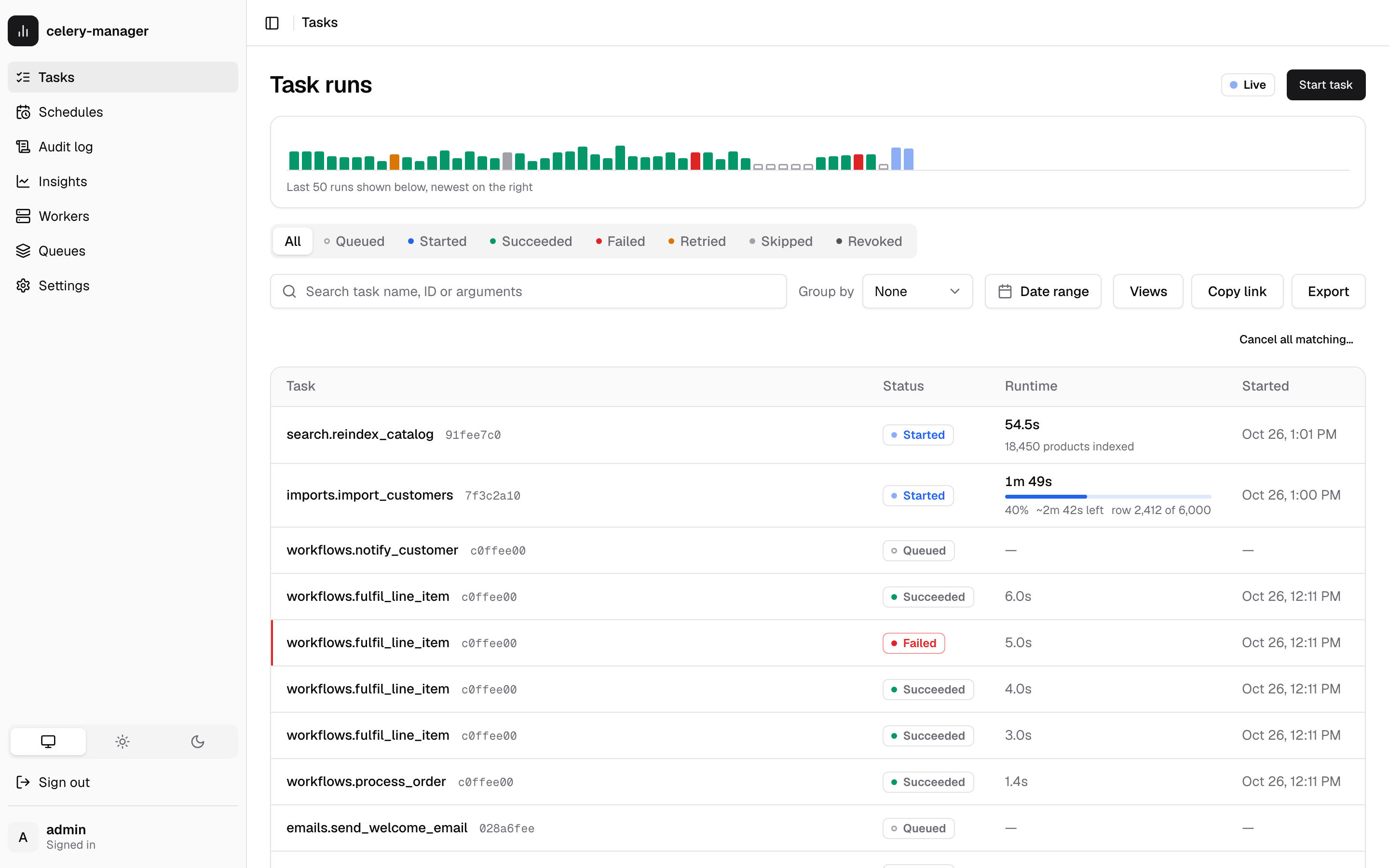
Upgrading: this release adds schema migrations
0002–0005. By default they run automatically at startup, and that needs a database user with DDL rights. To run them as a deploy step instead, setauto_migrate=Falseand runcelery-manager migrate --db-url .... Databases from 0.1.0a1–0.1.0a3 are adopted automatically and keep their data.
Not yet verified against real infrastructure: workers, rate limits and queue controls (tested against stand-ins plus a throwaway Redis); the workflow tree from a live chord; and the MySQL migration lock.
Added
-
Pause and resume a whole schedule.
POST /api/schedules/{name}/pause
andPOST /api/schedules/{name}/resume(also
celery_manager.control.schedules.pause_schedule/resume_schedule).
While a schedule is paused, every firing is recorded as askippedrun and
the task body does not run — the same mechanism as an occurrence skip.
Both endpoints are idempotent, return404for an unknown schedule, and
writepause_schedule/resume_scheduleaudit rows.GET /api/schedules
items gainpaused,paused_atandpaused_by; each occurrence from
GET /api/schedules/{name}/occurrencesgainspaused. The frontend API
client gainspauseSchedule()/resumeSchedule(). Limitations:- only
@track-decorated tasks are affected — celery-manager does not
own beat, so beat keeps firing and an undecorated task still runs; - resume waits for the next regular beat firing. It doesn't run the task
now, doesn't reset beat's interval clock, and doesn't catch up firings
missed while paused (they were recorded asskipped).
The pause survives restarts: the startup sync from
beat_scheduleleaves
it alone. - only
-
Pause/Resume in the dashboard. Each schedule on the Schedules page has
a Pause button (with a confirm step) or a Resume button and a Paused badge.
A paused schedule's page shows who paused it and when, and marks upcoming
runs as "Will be skipped". -
Task list filters in the URL, saved views, copy link. Status tab,
search, group-by, date range and history-mode page are reflected in the
hash-route query string (#/?status=failed&q=smtp), restored on load and
on back/forward. Discrete choices push a history entry; typing in search
replaces. Copy link copies the view URL. Views saves named filter
sets per browser inlocalStorage(rename/delete supported; no backend).
Filter state moved intouseTaskFilters. -
Export task runs.
GET /api/tasks/export?format=csv|jsonstreams every
run matching the list filters, capped at the new
CeleryManagerConfig.export_max_rows(default 50000) with an
X-Export-Truncatedheader, CSV formula-injection escaping, a timestamped
filename, and anexport_tasksaudit row. The task list gains an Export
menu. -
Insights: trends, per-task pages and grouped failures. New Insights page
with 1h/24h/7d/30d ranges, KPIs, SVG charts (runs by status, p50/p95
runtime, each with a text summary and table fallback) and a Failures tab
that groups failed runs by a normalised exception signature, with open,
show-runs and retry-all-in-group actions. A task page at
/task-types/:taskName(linked from the task detail title and the Insights
top-task lists) shows the same trends for one task plus recent runs and top
errors. Backed byGET /api/analytics/overview,/api/analytics/failures
and/api/analytics/tasks/{task_name}, computed at query time (no schema
change; scans are capped, see Insights). -
Start a task from the dashboard. A Start task button on the Task
runs page opens a sheet with a searchable task picker, args/kwargs JSON
editors prefilled from the task's signature with live validation, and an
optional queue and countdown/ETA; submitting opens the new run. New
GET /api/tasks/registeredlists registered tasks (excludingcelery.*)
with best-effort signature, queue and docstring summary.
POST /api/tasks/startnow accepts optionalqueue,countdownandeta,
and seeds aqueuedrun row so the run's page exists straight away. -
Retry with changed arguments.
POST /api/tasks/{id}/retrytakes an
optional{"args", "kwargs"}body (no body behaves as before); retry
lineage is recorded as usual and the audit row notes the edit and the
arguments sent. The task detail page gains Retry with changes. -
Workflow tree for chains, groups and chords. Runs now record Celery's
parent_id,root_idand group id (schema revision0003; captured from
task events and from@track's request).GET /api/tasks/{id}/workflow
returns the whole tree (capped at 500 nodes), the task detail payload gains
parent_id/root_id/group_id, and the task detail page shows a
Workflow card: an indented, collapsible tree with a status summary. -
Workers page. A new Workers page lists every worker that answers the
broker: status, PID, uptime, pool, processed count, active/reserved/
scheduled counts (active tasks link to their run), and consumed queues. It
refreshes every 10 seconds while the tab is visible. From each worker card
you can shut the worker down (with a confirm step), add or remove a pool
process, and start or stop consuming a queue. Backed byGET /api/workers
andPOST /api/workers/{worker}/shutdown,.../pool/grow,
.../pool/shrink,.../queues/addand.../queues/cancel(also
celery_manager.control.workers). Every control is audited. If the broker
can't be reached the endpoints answer503with a readable message, not a
500. New config fieldinspect_timeout_seconds(default1.0) caps how
long each broadcast waits for replies. See Workers. -
Runtime rate limits.
POST /api/tasks/rate-limitchanges a task's rate
limit on running workers (all, or adestinationlist) through
control.rate_limit. The rate format (10/s,10/m,100/h, or""to
remove the limit) is checked before anything is sent, and the change is
audited.GET /api/workers/rate-limitslists registered tasks with the
limit declared in code. On the Workers page a Rate limits table lets you
edit a limit inline and shows which workers confirmed it. These limits are
not persisted: a worker that restarts goes back to the limit declared
in code. -
Queue depth.
GET /api/queueslists every queue celery-manager knows
of (default,task_queues,task_routes, queues seen on runs, and
queues live workers consume). For each one it gives the broker's message
count and consumer count, read with a passivequeue_declare, next to the
number of runs recorded asqueuedthere. It always answers200: an
unreachable or slow broker (3s deadline) or amemory://broker gives
depth: nulland a reason. A new Queues page in the dashboard shows
this, refreshes every 5 seconds (paused while the tab is hidden) and draws
a sparkline of depth over the session. See Queues. -
Purge a queue.
POST /api/queues/{name}/purgeremoves the ready
messages from one queue and returns how many. If it removed any, runs
recorded asqueuedin that queue without an ETA are markedrevoked,
since no event will ever arrive for them. Audited aspurgewith both
counts. In the dashboard you confirm by typing the queue name. -
Bulk cancel.
POST /api/tasks/cancel-bulkrevokes a list of
task_ids, or everyqueued/started/retriedrun matching the task
list's filters. It is capped at 1,000 (above that it's refused, not cut
short), has adry_runcount and an opt-interminate, and writes one
cancel_bulkaudit row. The task list gains Cancel N selected on the
Queued, Started and Retried tabs, and Cancel all matching… with the
count shown before you confirm. -
Pause a schedule until a set time.
POST /api/schedules/{name}/pause
takes an optional{"until"}(future, UTC; past is a422) and the
schedule resumes by itself afterwards, with no background job: readers
clear the stale pause lazily and write one automaticresume_schedule
audit row. Re-pausing with a newuntilupdates it.paused_untiljoins
the schedule payloads, and each occurrence'spausedis now per occurrence.
The dashboard's pause button becomes a menu (indefinitely, 1 hour, until
tomorrow 9:00, custom time). Schema revision0004.
Changed
- Dashboard redesign. shadcn/ui-style look (zinc theme, Geist fonts) in
light and dark. The sidebar collapses to icons (Ctrl/Cmd+B, remembered per
browser) and slides in over the page on phones. The task list gains a run
strip (one bar per run, coloured by status), status tabs and a search and
filter bar. Task detail puts the failure and logs first with execution
details alongside. Tables stack on narrow screens. - Schema migrations with Alembic. celery-manager's tables are now
versioned, and the migrations ship inside the package (noalembic.ini
needed). By defaultinit_db()upgrades the database at startup, under a
lock so the API, workers and listener can start together. Databases from
0.1.0a1–0.1.0a3 are adopted automatically and keep their data. The new
auto_migrateconfig field (defaultTrue) turns this off for teams that
migrate as a deploy step with the newcelery-manager migrate --db-url ...
command (--checkreports status and exits 1 if an upgrade is needed).
The version is kept incelery_manager_alembic_version, so it doesn't
clash with a host app's own Alembic history. New dependency:alembic.
This release's schema changes are migrations0002–0005: schedule pause
(paused_at,paused_by), workflow lineage (parent_id,root_id,
group_id),paused_until, andtask_runs.updated_at. The database user needs DDL
rights when a release includes a migration, or runmigratewith a user
that has them. See Schema and upgrades. - Live updates now work when the events listener runs as a separate
process. Previously/api/streamconnected and then sent nothing in the
documented deployment, and the dashboard only kept up by polling. Each API
process now polls a change feed in the database: a new indexed
task_runs.updated_atcolumn that every write path bumps (migration
0005, backfilled from each run's latest timestamp). Changes made by the
listener,@track,report_progress()and retry/start reach the browser
within about a second, with several API processes too, and no new
infrastructure. Polling happens only while a dashboard is connected; the
newlive_poll_interval_secondsconfig field (default1.0) sets the
interval. Stream events are now{"type": "task-updated", "task_id", "status", "updated_at"}, one per changed run. The task list and task
detail pages poll only while the stream is down, and the header indicator
shows Live only while it is actually connected (Reconnecting
otherwise).EventListenerno longer publishes events itself; its
event_busargument is ignored.
Full changelog: v0.1.0a3...v0.1.0a4