Repository navigation

Replies: 2 comments

|
Hi, Thank you for sharing your thoughts. This is a complex topic and I am not sure we can fix this in Agama. Instead, I wonder whether we should has this conversation at distribution level. Based on patterns, not packagesWhen it comes to software handling, Agama uses the patterns as its minimal unit1. Actually, it does not offer all the patterns, but a curated list of them. Talking about KDE, the maximum granularity Agama could offer is: At this point, Agama only offers installing Individual packagesWe would like to avoid individual packages selection/installation at UI level because. IMHO it adds quite some complexity with little benefit: if you want to install an individual package, you can do it after you finish the system installation. Moreover, the main complain (as you made clear) is usually the opposite: getting software you do not want (e.g., games). I can understand that. The concept of "desktop"IIRC, in the version with shipped with openSUSE Leap 16.0, Agama did not have the concept of "desktops". You simple had a list of patterns to select from. The downside was that many people did not select a desktop and they end up without graphical environment. For that reason, we introduced the concept of "desktops", warning the users if they do not selected a desktop pattern2. It solves the original problem, but it has nothing to do with the "amount" of software that gets installed when you select a pattern. About your proposalThe "Software profile" concept you propose, in my opinion, should not be implemented directly in Agama. As said before, Agama just asks the software management library ( Actually, the case you mention in the "Explicit deselection should persist" is a clear symptom that Agama should work in collaboration with ConclusionAgain, thanks for bringing up this topic. The software selection is something that still needs more work and having an open discussion at distribution level might help to move the things forward. We (the Agama team) will be happy to participate in such a discussion. But, most probably, in a different place (openSUSE forums or mailing lists). Footnotes |

Just a note: Selecting individual packages would add a lot of complexity. Do not forget that for example the Tumbleweed OSS repo contains more than 52.000 (!) packages. The problem is how to present and manage that huge amount of packages. You need some grouping, filtering, paging (you cannot load/show them all at once).... I'd like to avoid that, it's too much work for a little benefit.
Ideally selecting the KDE desktop pattern should select the Games pattern which you could manually deselect. That actually already works, currently the only problem is that the Games pattern is not listed in the displayed patterns so you cannot change it. I have manually added it to the list and then after selecting the KDE desktop... 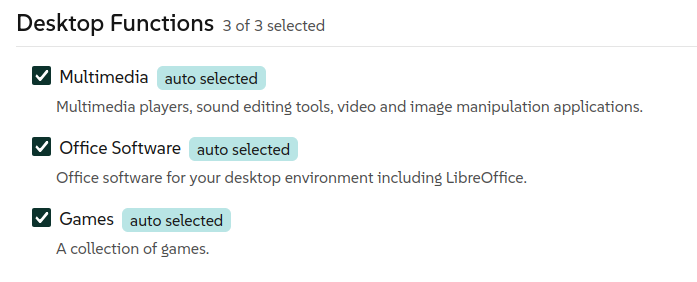
...you can manually remove it from installation: 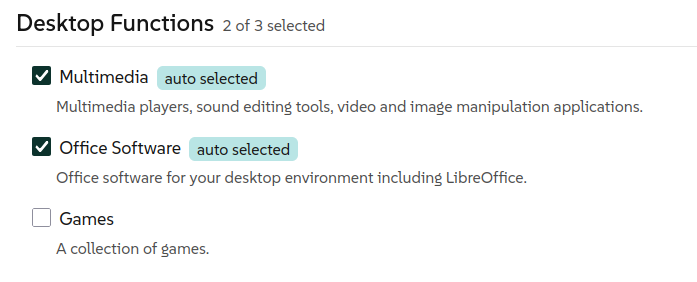
|


Uh oh!
There was an error while loading. Please reload this page.
Proposal: Make Tumbleweed a Modular Base OS with Truly Minimal Installation Options
I'd like to propose a change to the way openSUSE Tumbleweed is presented and installed through Agama.
The basic idea is simple:
Separate the operating system, desktop environment, and applications into independent choices.
Tumbleweed is already an excellent rolling-release operating system, and Agama's current product definition appears to be moving in this direction: the base system is separated from selectable desktop patterns such as KDE Plasma, GNOME, Xfce, LXQt, Hyprland, etc.
I think this architecture should be taken one step further and exposed explicitly to the user.
Proposed installation model
The installer could present three independent choices:
1. System
2. Desktop
3. Software profile
The important part is the definition of Minimal.
If I select KDE Plasma + Minimal, I should receive:
I should not automatically receive games, KDE PIM, an office suite, multimedia applications, graphics applications, or other software simply because somebody decided those applications constitute a typical Plasma installation.
Those applications could remain available through the Standard or Full profiles.
Explicit deselection should persist
There is also a more subtle issue with the current pattern system.
There is already a recent openSUSE forum discussion from a Tumbleweed user who wanted a minimal GNOME installation but found that applications such as games could return during subsequent
zypper dupoperations because of the dependency/recommendation chain surrounding the GNOME patterns.This suggests that simply providing checkboxes in the installer isn't sufficient.
If the user explicitly says:
then that decision should remain respected during subsequent distribution updates unless the user explicitly reverses it.
Otherwise the installer gives the user an apparent choice that isn't actually persistent.
Why I think this matters
This isn't primarily about saving disk space or removing a few games.
It's about the philosophy and positioning of Tumbleweed.
One of the things that attracts technically sophisticated users to distributions such as Arch Linux is the feeling that the distribution provides a clean foundation while allowing the user to decide what their system becomes.
Tumbleweed could provide a similar experience while offering substantial advantages:
In other words:
Give users the control and minimalism they like about Arch, while giving them the infrastructure and safety that openSUSE provides.
What about Aeon and Kalpa?
I don't think this proposal needs to replace or eliminate Aeon or Kalpa.
Quite the opposite.
Aeon and Kalpa could continue to exist as curated, opinionated experiences built around an immutable Tumbleweed foundation.
For example:
Users who want an opinionated desktop would still have that option.
Users who simply want:
would have that option too.
That seems like a healthier distinction between a base operating system and a curated desktop product.
Why Agama seems particularly well suited to this
Agama already appears to be moving toward a modular installation architecture.
The current Tumbleweed product definition has a mandatory base pattern and separate user-selectable desktop patterns. That suggests much of the underlying architecture required for this approach already exists.
Rather than adding more distribution variants, I think openSUSE could simplify the user-facing model by making Tumbleweed itself the common foundation.
The goal
Ultimately, I'd like to see the installer allow something as straightforward as:
Install.
Done.
No games to remove afterward.
No unwanted application bundles.
No pattern archaeology.
No need to learn which distribution variant happens to provide the system architecture I actually want.
Just a clean Tumbleweed system that I can make my own.
I think that could make openSUSE considerably more attractive to experienced Linux users who currently gravitate toward Arch and similar distributions specifically because of their emphasis on user control and minimalism.
All reactions