Repository navigation
0.7.0

Install: npm install @ambionframework/ambion@0.7.0
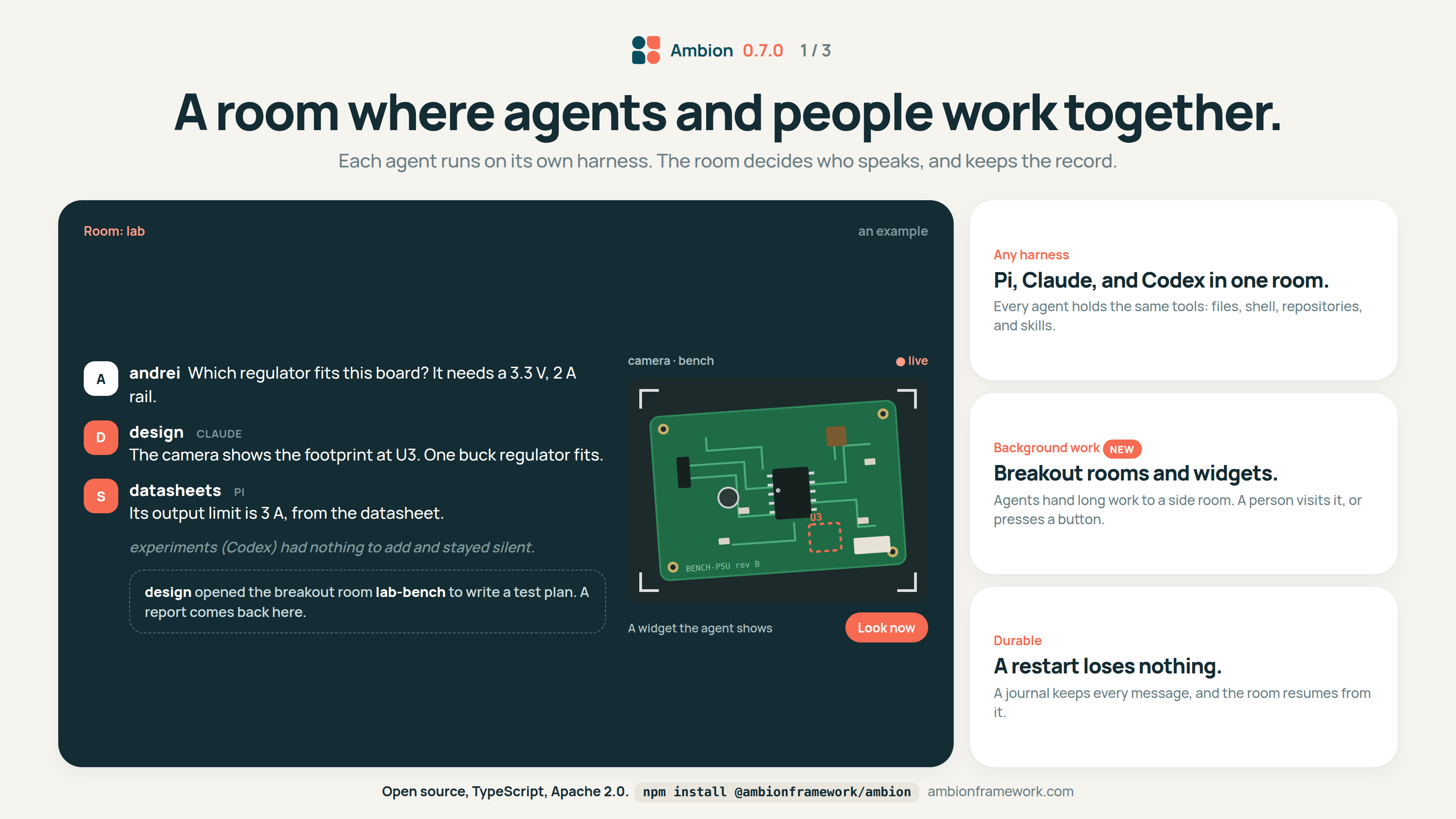
0.7.0 brings the canvas, breakout rooms, and widgets. A canvas holds
the rooms of a deployment, and one stored row describes each room. An agent
opens a breakout room for background work, and the room reports back to the
agent. An agent shows named widgets, and a person sees them and acts on
them. See The canvas and Widgets.
The canvas decides nothing. The canvas adds no journal entry kind and
no kernel operation. Each breakout room has its own journal. The host
composes startRoom, resumeRoom, and the visit of a person. The journal
keeps every act after a lost canvas, because each act is a message.
The workbench and camera chat host the canvas. The workbench keeps its
root rooms on the canvas, delegates work to breakout rooms, and pins files
as widgets. Camera chat shows each camera as a viewfinder with a "Look now"
action.
A room operation requires a runtime, and a runtime requires its
storage. startRoom, resumeRoom, and readRoom require runtime, and
createRuntime requires storage. defaultRuntime is removed. A host
passes an execution, such as piExecution(), to createRuntime,
startRoom, or resumeRoom. See Breaking changes.
The release hardens the record and the rules. The room derives its
notifications from journal transitions. A close decision carries its
outcome. Scheduled returns, names, and control calls each have one owner.
The workstation bounds a file read, and a Pi seat reports a session
fallback in the trace.
No journal body changes. The golden journals keep their form. The
canvas adds two SQLite tables, and the workbench drops one. See
Journal and stored data.
Packages
The twelve packages of 0.6.0 ship at 0.7.0, and one package joins.
@ambionframework/canvas is the thirteenth publishable package. The
examples examples/workbench and examples/camera-chat stay private.
Every library package needs Node 22.19 or newer.
- Canvas.
@ambionframework/canvashas two entry points. The root
exportsopenCanvas,memoryCanvas,sqliteCanvas,NAME_LIMIT, and
the types of the store and the host interface. The/conformanceentry
exportscanvasStoreConformance. It depends on@ambionframework/ambion,
@ambionframework/journal,@ambionframework/workspace, andtypebox. - Ambion.
@ambionframework/ambiongains the entry point./names. - Workstation.
@ambionframework/workstationmoves
@ambionframework/ambionfrom its development dependencies to its
dependencies, for the name syntax. - Other packages.
@ambionframework/assistant,
@ambionframework/pi,@ambionframework/simulator, and
@ambionframework/workspacegain@ambionframework/journalas a
development dependency, for the storage that a runtime requires. No other
package adds or removes an entry point or a dependency.
New
Canvas
A new package, @ambionframework/canvas, holds the canvas store.
It exports the CanvasStore port, memoryCanvas, and sqliteCanvas.
sqliteCanvas writes the table canvas_rooms through the Sql of
sqliteJournals. The /conformance entry exports canvasStoreConformance.
openCanvas runs the lifecycle of the rooms. The calls are resume,
open, start, stop, archive, and close. The canvas serializes the
calls on one room name, attaches the workspace mirror of each room, and
reports failures to onError. NAME_LIMIT is the limit of a room name and
a widget name. The canvas emits started before it attaches the mirror.
Breakout rooms
An opener holds three tools and a reminder. canvas.tools() is the
opener bundle: breakout, tell, archive, and a reminder that lists the
breakout rooms of the seat. canvas.workerTools() is the worker bundle:
report. breakout is idempotent by name, checks the worker team and
perOpener, and posts its first message under breakout-start:<name>.
The bridge carries each finished exchange to the opener. A breakout room
sends a report, or else one close notice under the key
breakout:<name>:<from>. Each resume and start replays the retained
journals, stopped rooms included, and posts each missing notice once.
report and the notices share one ordered chain for each parent.
The opener guidance and a live delegation test. The breakout tool says
when a breakout room is valuable: parallel work, or a narrow task that would
distract the room. The opener guidance sends a delegated task to the room
alone, and on the report the opener archives the room and answers the
person. AMBION_EXECUTOR=codex runs the assistant and the workers on Codex,
and a live file runs the delegation on Pi or Codex, on a key or a host
login.
pnpm chaos crashes a canvas at each point of the canvas crash table.
One case covers each row of the table in docs/canvas.md, and one covers a
crash between the archive row and the stop. Each case resumes a second
canvas on the same storage and checks the rows and the notices. The
consistency sweep allows one error for each disk fault on a lease entry.
Widgets
The canvas holds widget views. openCanvas takes
widgets: WidgetOptions, a closed catalog of kinds. A process source is
{ type: 'process', handle, path }: the handle of a process of the author
and a path that the process serves. canvas.widgetTools() is the widget
bundle: show, hide, and a reminder that lists the shown widgets of the
room, ten at most. A show of equal content writes nothing, and a show of
a hidden widget always writes. The store keeps every revision:
CanvasStore gains revisions() and appendRevision(), and sqliteCanvas
writes the table canvas_widget_revisions. canvas.widgets(room) and
canvas.revision(id) read the revisions that resume loads. CanvasEvent
gains widget, and CanvasOperation gains show, hide, and widget.
The widget calls of one room run in their own queue. Widgets
holds the contract.
A person can act on a widget. show takes actions and for. An action
has an id, a label, an optional once, and a form of at most eight fields:
text, number, boolean, and choice. WidgetKind gains actions, and
a kind with actions: false refuses actions and for. CanvasWidget gains
actions and for, so the content of a revision includes them.
canvas.act(person, act) sends a press as a message of the person. It
checks the press in the widget queue of the room: the room runs, the widget
is shown, the revision is current (otherwise the result is stale), and the
action, the person, and the values fit. It then sends the press through the
visit of the person as a message with the ref
ambion-canvas://<canvas>/room/<room>/widget/<name>/revision/<id>. The
message goes to the author when the author sits on the roster at an
attention other than none.
A retried press lands once. The key is act:<revision> for a once
action and act:<revision>:<press> for any other. A second act on a once
revision is answered, with the seq of the first. canvas.answers(room)
derives the answers from the keys of the journal, read once at each room
start and at each act. CanvasEvent gains answered, CanvasOperation
gains act, and the widget reminder names the person and the answer of each
widget. WidgetAct, WidgetActResult, WidgetAction, and WidgetField are
new exports.
Workbench
The workbench keeps its root rooms on the canvas. The canvas owns the
room rows, the resume at the start, the mirror, and the stop. A failed stop
leaves the room stopped, and a failed start of one room no longer stops the
host. The table workbench_rooms is dropped.
The workbench delegates work to breakout rooms. The worker team is
scout and maker, and no root room seats them. The assistant holds the
opener bundle, and each worker holds the worker bundle with the workspace
tools. The host opens the canvas before it defines the agents. The room
view carries the parent of a breakout room, and /room shows it.
The workbench pins a file for people. The host declares the widget kinds
markdown, table, and image, and each takes a file source. Every seat of
a root room and every worker holds canvas.widgetTools(). An agent calls
show with a file path, and the terminal draws the shown files of the open
room in a side area, each with its title and kind. The host reads each file
as its author, after each widget event, each room start, and the end of
each activation, and polls nothing. A hidden widget and a widget of an
archived room draw nothing. The files panel and the side area share the file
views in file-view.ts. readFile takes the agent that reads, and
Workbench gains pins(room).
The workbench presses the actions of a pin. The kinds markdown,
table, and image take actions. The side area draws each action as a
button under its pin, with the for of the widget, and draws a widget that
holds an answer as answered by <person> in #<seq> with its once actions
done. Tab, then a, takes the keys. Up and Down choose, Enter presses an
action or sends its form, and Esc leaves. A form takes a text, a number, a
boolean, and a choice, and shows the first problem before it sends.
A press in the workbench is safe to retry. The host saves the act of each
call until it gives a result, and sends it again as it was on a retry. A
refusal shows its reason alone, and a button is inactive when for names
another person or the room is stopped. A stale result redraws the new
revision, and the answered event adds the answer to the pins.
canvas.answers(room) gives the seq and the person of each answer.
Workbench gains act(person, act). The pure state is ActionPad in
action-state.ts, and ActionsView in widget-actions.ts draws its rows,
so another host can reuse both.
The sensor and actuator pages and rules belong to the workbench example.
The pages sit in examples/workbench/docs, with the sensor protocol and its
rules. Ambion knows long-running processes that serve HTTP on $PORT, read
with fetch.
Camera chat
Camera chat keeps its room on a canvas. The host opens the root room
camera through openCanvas and sqliteCanvas on the file room.db, and
a restart resumes the room from its row. The observer holds no canvas
tools.
Camera chat shows each camera as a named viewfinder widget. The host
declares the widget kind frame. The agent gives each camera a short widget
name, starts the process with bash, and takes the handle from the result.
It calls show with a process source that holds the handle and the path.
Several cameras run at once. The host loads the observe macro of the camera
template, and the agent runs it with the handle. A stop cancels the process
and leaves the widget, and a new process needs a new show.
The preview binds one widget to one process. The preview keeps one
binding for each shown frame widget, four at most. A binding checks once
that the author runs the handle, reads by handle, and binds again on the
room start and on each widget event. A hide or the end of the process clears
only its binding. The terminal draws one labelled box for each camera. The
preview stops all timers while the person hides it, and rejects a frame body
over 16 MiB.
Camera chat presses the actions of a viewfinder. The widget kind frame
takes actions. The agent shows each viewfinder with a look action,
"Look now", and the terminal draws the action as a button under the preview
of that camera. Ctrl+L takes the keys, and Up and Down choose, Enter presses,
and Esc leaves. A press calls canvas.act as the person you. The agent
receives it as a message and observes that camera. The host reuses
ActionPad and ActionsView from the workbench.
Camera chat registers the camera templates on every start. The local git
backend registers templates/camera and the second template through
registerRepositories, as justGitBackend and the workstation do. A
template that differs from the source of the host takes a commit of that
source on its tip, and a data directory that an earlier start filled no
longer keeps an older template. The guidance tells the agent to run
git pull --no-rebase <template url> main in an existing clone.
The workstation, the trace, and the mirror
A workstation read has a size limit. The workstation reads at most
10 MiB of one regular file. A larger file, a device file such as
/dev/zero, and a FIFO fail with invalid. A read on a session that ends
answers unknown.
The trace reports a Pi session fallback. The trace carries a warning
notice with the error when the disk refuses to create a session, cannot
read it, or the harness cannot resume it. CreatedSession gains the
optional fallback, and PiSessions.open rejects for a session it cannot
read.
The room mirror writes no reading preferences. An arrived message
holds the reading preferences of a person. The mirror leaves them out, as
the room view does. @ambionframework/ambion exports withoutPreferences.
The workbench shows a failed mirror attach in the activity of the room.
Simplification
Execution configuration is explicit. Pass an execution, such as
piExecution(), to createRuntime, startRoom, or resumeRoom.
Importing an executor package no longer configures rooms. Room executions
precede runtime executions, and the first matching execution serves each
seat. Custom executor packages build their execution values with
localExecution.
Notifications follow each journal transition. The room derives lease
and close notifications from the projection before and after each entry.
The separate notification caches and their replay initialization are gone.
Recovered entries publish once, in order, and initial replay stays silent.
A close decision carries its outcome. One verified rule returns
admitted, obsolete, or replan. Planning and commit validation use that
rule. The runtime follows the queued outcome without reconstructing it.
Concurrent control calls share one operation. Cancellation, departure,
and stop use one promise lifecycle. Failed operations permit a retry.
Cancellation and departure keep their own keys across uncertain writes.
Arrival keeps its name and identity checks.
Names have one syntax. @ambionframework/ambion/names exports
isName and NAME_SYNTAX. The core, workspace, workstation, canvas, and
workbench use that syntax. The workbench keeps its limit of 48 characters.
Scheduled returns use one verified rule. Planning and commit validation
call returnable with due time, current time, and roster membership.
The contracts state eligibility and its preservation as time advances.
Shared room snapshots have read-only types. Collections and nested
records reject mutation through typed access. Only replay can select the
private step that mutates its own containers. Public reads keep detached
values. These changes preserve the journal format and runtime behavior.
Resource contracts have one documentation owner. resources.md states
resource lifecycle, tool bundles, and provenance. workspace.md states
workspace behavior and backend details.
Terms name one concept. The documentation uses limits and fold cost,
journal entry, and proof scope. The limits page is docs/limits.md, and
its benchmark is scripts/projection-cost.mjs. The text and the tests
describe the current state, and the vocabulary check refuses history
phrases.
Fixes
A workstation read of a large file or a device no longer exhausts the
host. The read checks the file type and the size before it opens the file,
and it counts the bytes that arrive. See the limit in
The workstation, the trace, and the mirror.
A started camera chat finds the current camera template. A data
directory that an earlier start filled no longer keeps the older template
that the host's observe macro refuses.
A failed start of one workbench room leaves the host running. A failed
stop leaves the room stopped.
The mirror keeps reading preferences private. The mirror no longer
writes them, and a failed attach shows in the activity of the room.
A Pi session that falls back shows in the trace. The activation runs on
with a fresh session, and the warning keeps the cause.
The Cloudflare seat object passes a memory storage. configure builds
its runtime with memoryJournals(), because a seat object keeps no record.
Breaking changes
What to change
Each bullet names an action.
- Pass
runtimetostartRoom,resumeRoom, andreadRoom. Build it
withcreateRuntime. Remove each use ofdefaultRuntime. - Pass
storagetocreateRuntime. A test or a quickstart that wants
memory passesmemoryJournals()from@ambionframework/journal. - Pass an execution. Give
createRuntime,startRoom, orresumeRoom
an execution such aspiExecution(),claudeExecution(), or
codexExecution(). A room with no execution for the kind of a seat fails
the activation withno_execution. - Drop
defineExecution. A custom executor package builds its execution
values withlocalExecutionfrom@ambionframework/ambion/hosting. - Start the workbench on a new data directory, or recreate its rooms.
The workbench no longer reads the tableworkbench_rooms. Its root rooms
live in the canvas tablecanvas_rooms. - Read the sensor and actuator pages in
examples/workbench/docs. The
pages and the sensor protocol left the maindocs/directory. - Expect an error from a read over 10 MiB on the workstation. The read
fails withinvalidfor a larger file, a device file, and a FIFO. - Expect names that reject a trailing line terminator. The shared syntax
matches the whole value. - Expect no reading preferences in the mirror. Read them from the
journal. - Expect a failure from
PiSessions.open. A custom store of Pi sessions
rejects for a session that it cannot read. The executor records the cause
in the trace and starts a fresh session. - Fix the types that mutate a room snapshot. A shared snapshot has
read-only collections and records, and a write through typed access no
longer compiles. - Install
@ambionframework/ambionwith the workstation. It is now a
dependency of@ambionframework/workstation, and a package manager
installs it.
Journal and stored data
No journal body changes. The golden journals keep their form. A journal
of 0.6.0 opens on 0.7.0.
The canvas adds two SQLite tables. sqliteCanvas writes canvas_rooms
and canvas_widget_revisions. The widget revisions keep every show,
including the actions and for of each.
The workbench drops the table workbench_rooms. The workbench reads no
older database of its rooms.
Exports
@ambionframework/ambion. AddswithoutPreferences. Removes
defaultRuntime.@ambionframework/ambion/names. New entry. ExportsisNameand
NAME_SYNTAX.@ambionframework/ambion/hosting. RemovesdefineExecution.@ambionframework/canvas. New package. ExportsopenCanvas,
memoryCanvas,sqliteCanvas,NAME_LIMIT,PACKAGE_NAME, and the types
BreakoutStart,CanvasClose,CanvasRoom,CanvasStore,
CanvasWidget,RootStart,WidgetAction,WidgetField,WidgetKind,
WidgetSource,BreakoutOptions,Canvas,CanvasError,CanvasEvent,
CanvasOperation,CanvasRoomOptions,OpenCanvasOptions,WidgetAct,
WidgetActResult, andWidgetOptions.@ambionframework/canvas/conformance. New entry. Exports
canvasStoreConformanceand the typesCanvasStoreFixture,
ConformanceCase, andOpenedCanvasStore.