Repository navigation

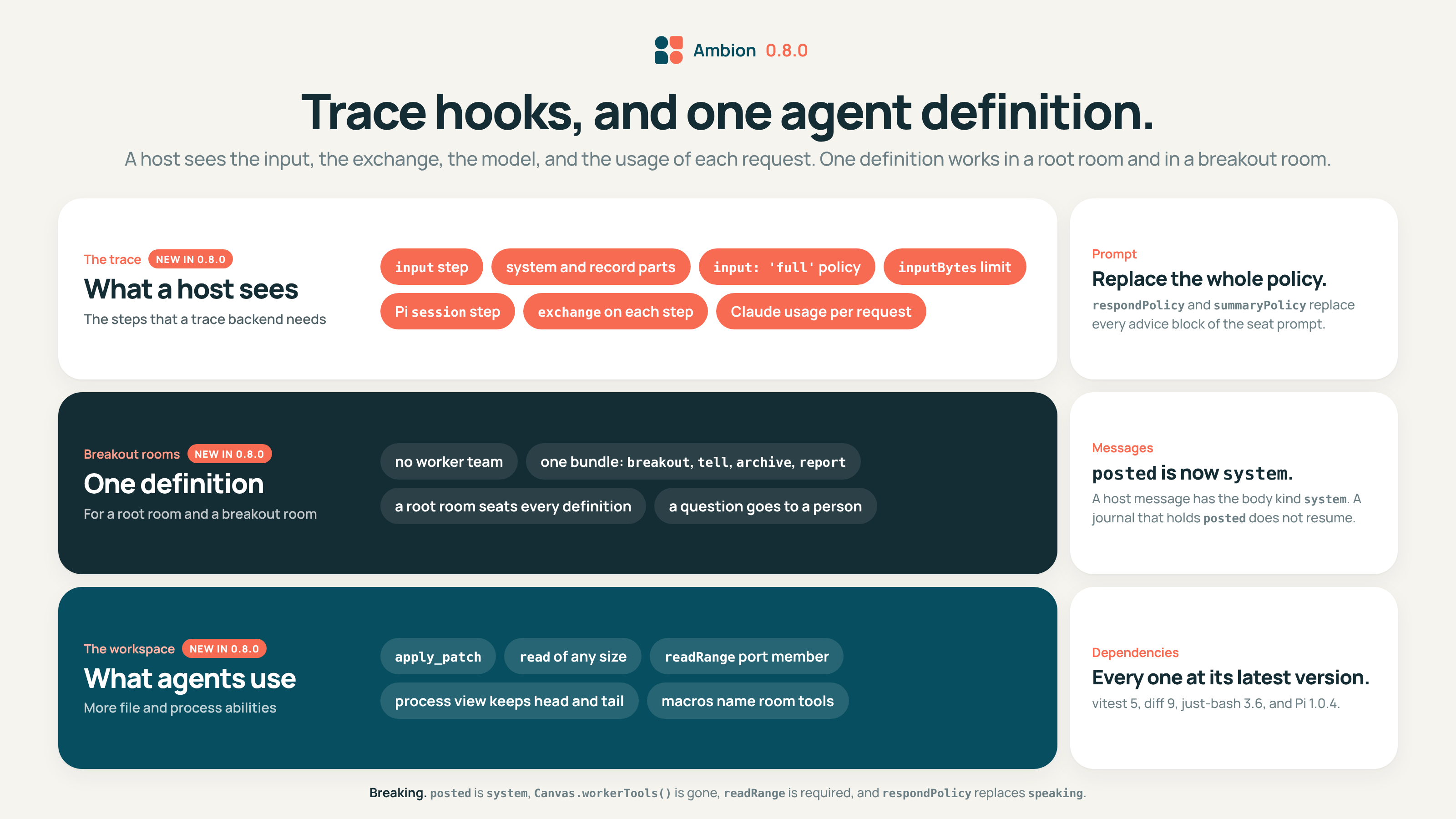
0.8.0 gives a host the trace hooks that a trace backend needs, and one
agent definition for root rooms and breakout rooms. A TraceLogger can
receive the input of each pass, the exchange of each step, the session of
a Pi activation, and the usage of each Claude request. One definition
seats in a root room and in a breakout room, and the room decides how the
agent behaves. apply_patch changes several files in one call, and read
has no size limit. See Executors and
The canvas.
The trace hooks are the first part of the road to a trace backend. The
journal records what a room decided. The trace records how a seat got there.
This release adds four hooks:
- The
inputstep. It holds the text that the driver renders for a pass:
the system part and the record. The trace policy fieldinput: 'full'
turns it on, andlimits.trace.inputBytescuts the text. - The Pi
sessionstep. It opens each Pi activation with the model, the
session id, and the tools. Claude and Codex already recorded it. - The exchange on each step.
TracedStep.exchangeholds the seq of the
message that opened the exchange of the activation. - Claude usage for each request. The Claude trace has one
usagestep
for each model request, as Pi and Codex do.
One agent definition works in a root room and in a breakout room. The
canvas keeps no worker team. canvas.tools() gives one bundle with
breakout, tell, archive, and report. A root room seats every
definition by default, and breakout seats any definition that resume
took. See Breaking changes.
The workspace edits files by patch and reads a file of any size.
apply_patch adds, deletes, updates, and moves several files, and writes
only when every operation succeeded. read scans a text file in ranges
through the new readRange member of the port. A process view keeps the
start and the end of a long output.
A host can replace the respond and summary policies. respondPolicy
replaces the whole respond policy, and summaryPolicy replaces the summary
policy. A macro can name any room tool.
The dependencies are at their latest versions. vitest is at 5.0,
diff at 9.0, just-bash at 3.6, and the Pi packages at 1.0.4.
The message kind posted is now system. A stored journal that holds
posted does not resume. See Journal and stored data.
Packages
The thirteen packages of 0.7.0 ship at 0.8.0. No package joins, and no
package adds or removes an entry point. The examples examples/workbench
and examples/camera-chat stay private. Every library package needs Node
22.19 or newer. The dependencies move as follows:
- All packages.
typeboxmoves to 1.3.36 where a package uses it. The
development dependenciesvitestand@vitest/coverage-v8move to 5.0. - Claude.
@anthropic-ai/claude-agent-sdkmoves from 0.3.284 to
0.3.291. - Codex.
@openai/codexmoves from 0.159.2 to 0.160.1. - Pi.
@earendil-works/pi-ai,@earendil-works/chord, and
@earendil-works/pi-durablemove to 1.0.4. - Just-bash.
just-bashmoves to 3.6 andjust-gitto 1.9. The
directory backend runscreateExclusiveas trusted code of just-bash. - Workspace.
diffmoves from 8.0.4 to 9.0.0. - Cloudflare.
@ambionframework/cloudflarekeepsvitestat 4. The
range of@cloudflare/vitest-pool-workersaccepts no later major.
New
The trace
The trace can record the input of the model. A new input step holds
the text that the driver renders for a pass. The part field says system
or record. The driver records one record step for each pass that reads a
record, and one system step in the first pass, right after the pass
step. The system text is the mechanism and the agent part of the prompt,
joined by a blank line. An executor can send more than the step holds: the
seat note of Codex, and the resumed note of a Claude query.
A trace policy turns the input step on. The new field
input: 'omit' | 'full' of the trace policy defaults to omit, so no host
changes. The policy full copies the record to the logger, secrets
included. limits.trace.inputBytes cuts the text of the step and defaults to
1 MiB. The scripted executor reads the record of each pass, so a scripted
activation records the input step too.
The Pi executor records a session step. The step opens each
activation, before the first model step. It holds the name pi, the model
string of the executor options, the session id, and the names of the tools.
An activation that closes while its session opens records none.
A traced step names its exchange. TracedStep has a new optional field,
exchange. It holds the seq of the message that opened the exchange that the
activation works on. A summary activation names the exchange that it
summarizes. The field is absent when the activation works outside an
exchange, or ends before its first pass. TraceSink.startPass takes the
exchange as a third argument, and the sink stamps it on every step of the
activation.
The Claude trace has one usage step for each model request. The step
comes from the usage of the message_start event, the message_delta
events, and the assistant messages of a top-level request. It comes before
the tool results of the request and before the next request. The step of
the last request carries the cost of the result and the tokens that the
requests did not report, so the steps sum to the totals of the results.
Breakout rooms
One agent definition works in a root room and in a breakout room. The
composition of the room decides how an agent behaves: who is present, and
whether the room has an opener in a parent. The worker team is gone, so no
product builds a twin of each specialist. breakout seats any name that
resume took, and a root room defaults to every definition.
OpenCanvasOptions.breakout is optional.
canvas.tools() returns one bundle. It holds breakout, tell,
archive, and report. The row of the room still refuses a call: report
in a root room, and breakout, tell, and archive at depth one.
The guidance has one rule for a question. A question for a person goes
to a person who is present in the room, with say({ to }). When nobody is
present and the room has an opener, the agent reports the question. In a
breakout room, the reminder names the opener, the parent room, and the goal.
The close notice of an exchange that closed awaiting names the awaited
person.
The workbench staffs breakout rooms with specialists. The workbench
drops scout and maker, and every seat holds the one canvas bundle. An
operate above the limit with no person in the exchange records the request
and tells the seat to report it to the opener.
The workspace
Every workspace has an apply_patch tool. One call adds, deletes,
updates, and moves several files with a patch in the envelope of the Codex
tool of the same name. The tool parses the envelope, runs every operation in
memory, and writes only when each one succeeded. A hunk matches exactly, then
with the whitespace at the end of each line dropped, then with both ends
dropped. The tool keeps the line endings, the byte order mark, and a missing
final newline. The result lists each operation, and details.patch holds the
unified diff. The text work derives from applyDiff of the OpenAI Agents SDK
(MIT License). Every seat that has the workspace bundle gets apply_patch
beside edit, and the note on the file tools names it.
A process view keeps the start and the end of a long output. A new part
of more than 2000 lines or 50 KB shows its first and its last 1000 lines or
25 KB, with a marker line between them. The marker names the lines that the
view leaves out in the terms of read: offset and limit. The result
details hold the same range in omitted. A cut view reads the first 50
KB and the last 50 KB of the new part, and the 200 KB read is gone.
read of a text file has no size limit. WorkspaceEnv has a new
member, readRange(path, start, length, signal?). It gives at most length
bytes from the byte start, and it has no size limit. FileOperations has
the same member. The directory backend, the workstation, and the local
backend of camera-chat read the range from the file. The memory backend cuts
the range from the whole file. read scans a text file in ranges of 1 MiB
and keeps the lines of the view. So a file of any size gives a view, and an
offset and a limit read past 10 MiB. details.lines is present only when the
scan reached the end of the file. When it is absent, the notices omit the
line count. A whole-file read keeps the limit of its backend. So do an
image, edit, apply_patch, and a snapshot. workspaceConformance has a
case for readRange.
The seat prompt and macros
An application can replace the respond and summary policies of the seat
prompt in full. respondPolicy replaces the whole respond policy: the
speaking text, the paragraph on arrivals and departures, the paragraph on
hand-off, and the closing reminder of the respond ask line. A new
summaryPolicy option replaces the summary duties and the advice in the
summary ask line. The main entry exports DEFAULT_RESPOND_POLICY and
DEFAULT_SUMMARY_POLICY. The kernel keeps the mechanism of the protocol. A
replaced respond policy reads one mechanism line in the ask line: what the
[new] prefix means. The default prompt changes in one place: the hand-off
paragraph no longer says "Seat them first if they are in the reserve",
because DEFAULT_RESPOND_POLICY already states that seating a colleague is
the hand-off.
A macro can name a room tool. The check of a macro reads the compose
catalog that compose binds, so a macro that uses say, recall, or any
other room tool passes. The room tool list has one owner in define.ts.
The scripted executor runs dismiss and recall. A script calls every
room tool of the activation. dismiss commits, and recall gives the text
of its result.
Simplification
The message kind of the system has one name. The body kind system
covers a host post with room.post and a say that the room returns. The
agent prompt reads [system → ...], and the opening line of an exchange
reads "A system message reports an event". The labels of the simulator and
the workbench read system. room.post and PostInput keep their names.
The canvas keeps one bundle and no team. workerTools(),
BreakoutOptions.team, and the worker guidance are removed.
The room tools have one list. define.ts holds the ordered list. The
names, the compose catalog, the commit set, and the scripted calls derive
from it.
Fixes
A macro that names a room tool no longer fails its check. A macro that
used say or recall failed at definition with "which the compose catalog
does not hold".
A scripted call of dismiss or recall no longer fails. The script
failed with "The seat has no tool".
Breaking changes
What to change
Each bullet names an action.
- Read the body kind
system. A host message and a returned say have
the kindsystem. ReplacePostedMessagewithSystemMessageand
isPostedwithisSystem. A record rendered for a model reads
[system → ...]. - Start on a new journal. A stored journal that holds the kind
posted
does not resume, and no reader accepts it. - Drop
Canvas.workerTools()andBreakoutOptions.team. Give every
seatcanvas.tools(). PassbreakouttoopenCanvasonly for
perOpener. - Name the agents of a root room that you want seated. A stored root row
with noagentsnow seats every definition, the former worker team
included. - Keep every definition that a breakout row names. A breakout row that
names a removed definition fails to start atresume. The canvas reports
the error toonError, and the row staysrunning. - Implement
readRangein a custom backend.WorkspaceEnvand
FileOperationsrequire it. It gives at mostlengthbytes from the byte
start, and the result is empty at the end of the file. Run
workspaceConformanceto check it. - Rename
speakingtorespondPolicy. The option replaces the whole
respond policy. Add the paragraphs on arrivals and departures and on
hand-off to a text that held only the speaking text.DEFAULT_SPEAKINGis
nowDEFAULT_RESPOND_POLICY, and it holds all three paragraphs. - Handle the
inputstep. AswitchoverStepneeds a case for it. - Expect no
details.linesfor a long file.readleaves it out when
the view ends before the end of the file.
Journal and stored data
The body kind posted is now system. The golden journal
scheduled.journal.json changes in one line. The other golden journals keep
their form. A journal of 0.7.0 opens on 0.8.0 only when it holds no entry of
the kind posted.
No SQLite table changes. The canvas rows keep their form. A root row
with no agents reads as every definition.
Exports
@ambionframework/ambion. AddsSystemMessage,isSystem,
DEFAULT_RESPOND_POLICY, andDEFAULT_SUMMARY_POLICY. Removes
PostedMessage,isPosted, andDEFAULT_SPEAKING.Stepgains the
memberinput,TracedStepgainsexchange,TracePolicygainsinput,
andLimits['trace']gainsinputBytes. The executor options and
ExecutorreplacespeakingwithrespondPolicyand addsummaryPolicy.@ambionframework/canvas.CanvaslosesworkerTools().
BreakoutOptionslosesteam, andOpenCanvasOptions.breakoutis
optional.@ambionframework/workspace.WorkspaceEnvandFileOperationsgain
readRange.