Repository navigation
Releases: JustVugg/colibri
Release list
colibri v2.1.0

Huge open models on the machine you already have: on the CPU, on any GPU through Vulkan, on NVIDIA cards through CUDA. Pure C, one file per model family.
387 pull requests since v2.0.0, 208 of them from 35 contributors. GGUF files now run natively on every engine, read exactly as published. Four new models arrive, Mistral-Large-4 (1T) among them. CUDA gets device chains of its own and a routed-expert tier for every engine. Qwen3.8-Flash-Next runs a 256k context at the speed of 64k, an agent's turns read only what is new, and there is a new chat UI.
Highlights
- GGUF on every engine.
coli importtakes a GGUF where it lies and every engine runs it as published: no conversion, no second quantization, from IQ1_S to Q8_0, F16, BF16 and MXFP4, the same blocks and the same tokens on the CPU, Vulkan and CUDA. unsloth's Dynamic UD quants run as they are (docs/gguf.md). - New models. Mistral-Large-4 (1T, 52B active: text, pictures, reasoning, tools), Muse Spark Open (816B), Flint (40B, 2.5B active), LFM3-VL-2B with its vision tower, and the published DeepSeek V4.1 Flash and Kimi K3 GGUFs.
- CUDA. Every layer of Qwen3.6, Qwen3.8 and OLMoE as one chain on the card, a routed-expert tier on the card for every engine, the dense matrices on the card for DeepSeek V4, V4.1, Kimi K3, GLM-5.3 and MiMo, and a GGUF's blocks on CUDA with the prompt on the tensor cores.
- Vulkan. A model larger than the card keeps the experts the card cannot hold in a host pool in RAM, and the CPU computes them inside the device's frame while the card computes its own. Prompts on the matrix units, flash attention with windows and sinks, float16 KV mirrors.
- Long contexts and agents. Qwen3.8-Flash-Next at 262,144 tokens: decode 9.6 to 45.7 tok/s, prompt 15.6 to 149. A short request between two turns (a title, a summary) parks the conversation instead of taking its state, on every engine: a Hermes Agent turn went from 86 s to 4.9 s.
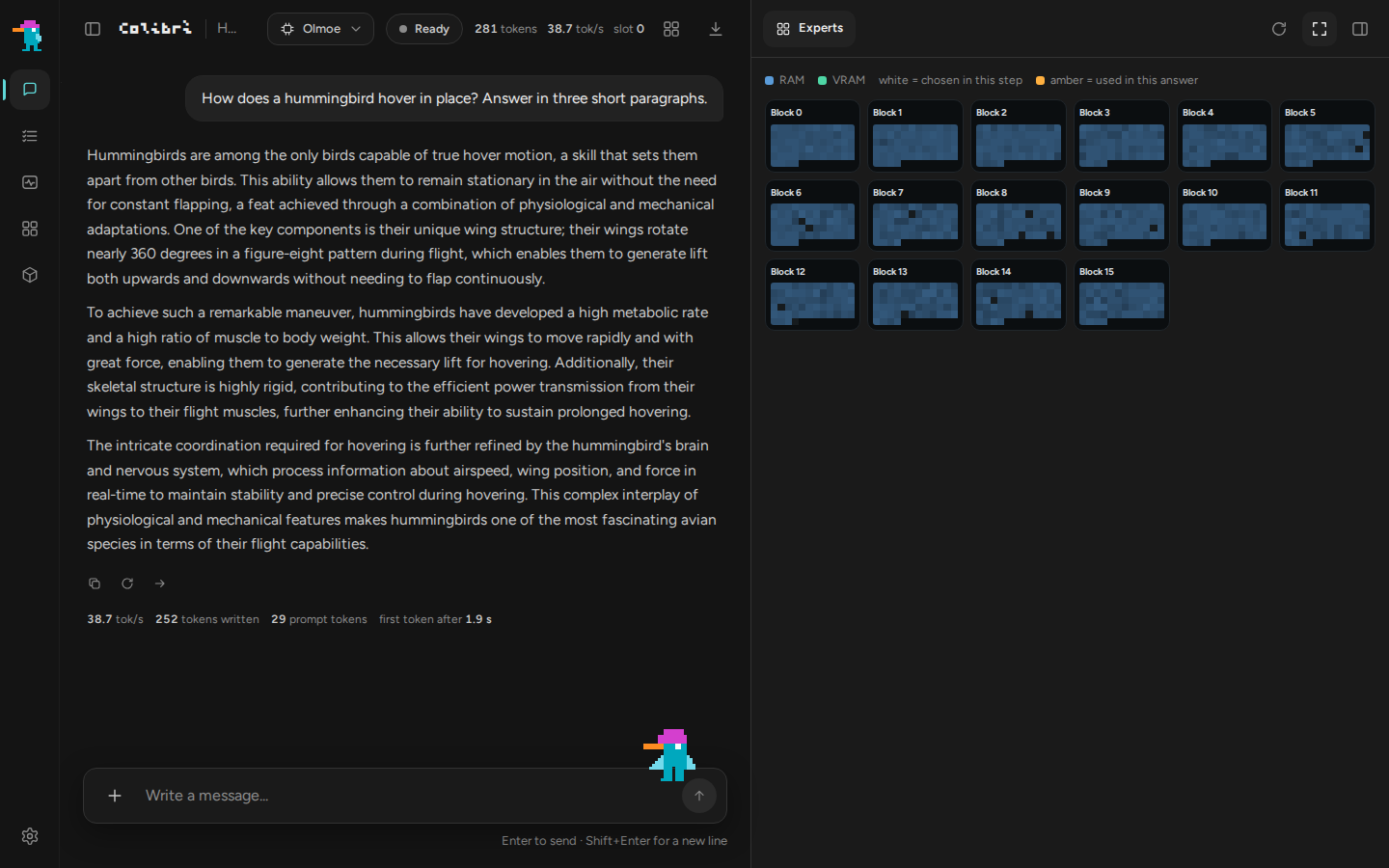
- A new chat UI.
coli ui: reasoning in its own block, pictures, web search, a live map of the experts as they fire, a monitor, your models, and coding agents already pointed at colibri. Seven languages. - Speculative decoding. Qwen3.6's MTP head on every backend (
Q36_MTP=1): decode 99.7-104.5 to 115.8-120.1 tok/s on CUDA, 83.2-83.8 to 99.9-109.3 on Vulkan; DeepSeek V4.1's DSpark head drafts as deep as its confidence says, behind a gate that skips the drafts that cannot pay. - Memory. KV caches in float16: GLM-5.3 at 131,072 tokens in 11.9 GB instead of 23.9.
Measured on one 24 GB card
An i5-13500 with 62 GB of RAM and an RTX PRO 4000 Blackwell SFF (24 GB, 70 W), each model served by coli serve: a fresh 450-token prompt, then a 128-token streamed answer, the request's HTTP included; the better of two runs, tok/s.
| GGUF | CUDA prompt | CUDA decode | Vulkan prompt | Vulkan decode | CPU prompt | CPU decode |
|---|---|---|---|---|---|---|
| Qwen3.6-35B-A3B UD-Q4_K_M | 3,491 | 104.8 | 2,076 | 92.9 | 122.6 | 13.9 |
| LFM3-VL-2B Q4_K_M | 12,317 | 235.1 | 8,174 | 214.1 | 286.5 | 34.5 |
| OLMoE-1B-7B-0125-Instruct Q4_K_M | 10,418 | 354.6 | 6,867 | 299.4 | 279.9 | 47.4 |
| LFM3-VL-2B F16 | 11,524 | 103.4 | 7,767 | 99.3 | 49.7 | 6.4 |
| Qwen3.8-Flash-Next IQ2_XS (68 GB: the experts the card cannot hold stay in RAM) | 217.1 | 51.4 | 214.3 | 50.6 | 38.3 | 9.3 |
Bigger than the RAM, on the same machine
Each model from its published GGUF; what neither the card nor the RAM holds comes from two NVMe drives. Tokens per second, from each model's page in docs/.
| GGUF | size | backend | prompt | decode |
|---|---|---|---|---|
| Inkling-Small UD-IQ2_XXS | 77 GB | Vulkan | 15.1-33.1 | 10.92-11.53 |
| MiMo-V2.6-Flash Q2_K_S | 106 GB | Vulkan | 8.2 | 7.8 |
| DeepSeek V4 Flash 0731 UD-IQ2_XXS | 85 GB | Vulkan | 19.7-20.4 | 6.18-6.25 |
| DeepSeek V4.1 Flash UD-IQ1_S | 233 GB | Vulkan | 31.8 over 3,403 tokens | 5.01-5.29 |
| GLM-5.3-Flash UD-IQ2_XXS | 95 GB | Vulkan | 9.3 | 2.92-3.40 |
| Muse Spark Open UD-IQ1_S | 176 GB | Vulkan | 5.0-5.3 | 1.55-1.58 |
| Mistral-Large-4 UD-IQ1_S | 233 GB | CUDA | 240 tokens in 66-82 s | 1.34-1.36 |
| GLM-5.2 UD-IQ1_S | 202 GB | Vulkan | 0.633-0.658 | |
| Kimi K3 UD-IQ1_S | 594 GB | Vulkan | 31 tokens in 46.5 s | 0.349 |
Run a GGUF
coli import model.gguf                    # the first part of a split file, its other parts next to it
coli chat --model model.colibri           # or coli serve, then coli ui
unsloth's DeepSeek V4.1 Flash, for example:
hf download unsloth/DeepSeek-V4.1-Flash-1017-GGUF --include "UD-IQ1_S/*" --local-dir v41
cd v41/UD-IQ1_S
coli import DeepSeek-V4.1-Flash-1017-UD-IQ1_S-00001-of-00005.gguf
COLI_VULKAN=1 coli chat --model DeepSeek-V4.1-Flash-1017-UD-IQ1_S.colibri
Downloads
| file | for |
|---|---|
colibri-v2.1.0-linux-x86_64.tar.gz |
Linux x86-64 (AVX2), every engine with Vulkan built in |
colibri-v2.1.0-windows-x86_64.zip |
Windows x86-64 (AVX2), every engine with Vulkan and the AMD NPU lane; coli.cmd to start |
colibri-v2.1.0-windows-x86_64-cuda.zip |
NVIDIA cards on Windows (compute 8.0 and newer): unpack it over the Windows archive |
colibri-v2.1.0-macos-arm64.tar.gz |
Apple Silicon; colibri, inkling and kimi_k3 with Metal |
SHA256SUMS.txt |
the checksums of the archives |
The one-step setup (START-HERE.bat on Windows, ./start-here.sh on Linux and macOS) picks the archive for your machine, or builds from source when a compiler is there. Every archive was unpacked and checked by CI before publishing: every engine present, coli dispatching to each one, the Vulkan engines finding their shaders, the dashboard and the chat UI loading.
What changes by default
- The KV caches are float16: colibri.c's MLA latent cache (GLM-5.2/5.3, Mistral-Large-4;
KV16, not with CUDA or Metal), qwen36's (Q36_KV=f32keeps float32) and qwen38's when serving (Q38_KV). Half the RAM of float32. - A short request between two turns parks the conversation on every engine serving one conversation (
COLI_PARK=0never parks).
Thank you
To the 35 people whose pull requests are in this release: @rudycelekli, @CoTi1938, @bobsummerwill, @Avicennasis, @appleguy, @Stamina9, @kreuzzelg, @simaotwx, @Altroo, @benmaster82, @namespaceMarcello, @JackKnifeAI, @leonwieser2009-oss, @Ontahm, @Varshith-Kali, @djairjr, @neerajdad123-byte, @dajiaohuang, @mfranzon, @huppiflupp, @seanfalling, @jameswitney, @KhalidAlnujaidi, @HyperionBurn, @TyrionV8, @kflirik, @bherald, @Anionex, @mfethe1, @ZacharyZcR, @ggeorgovassilis, @neoo69, @crichalchemist, @enitimeago and @pavolbauer. And to everyone who opened an issue with numbers from their own machine.
Everything in 2.1.0
New models
- #2493, #2500, #2503: Mistral-Large-4, the text model from every
published GGUF and from the FP8 release, on the CPU, the Vulkan chain and CUDA,
and its pictures (the Pixtral tower, from the GGUF's mmproj or our containers). - #2489, #2491: LFM3-VL's text model (from its GGUFs or the converted
checkpoint) and its pictures. - #2292, #2297, #2310, #2316: Flint, its safetensors and every
unsloth GGUF, on the CPU, Vulkan and CUDA; its sliding layers keep their K/V in
a ring. - #2293, #2324: Muse Spark Open from the unsloth GGUFs, CPU, Vulkan and
CUDA. - #2143, #2269: DeepSeek-V4.1-Flash-1017 as it is, and the published
DeepSeek V4.1 GGUFs with their DSpark head. - #2274: the published Kimi K3 GGUFs, on the CPU, the Vulkan chain and the
tier. - #2102: Qwen-Image gets a single-frame CPU VAE encoder.
GGUF on every engine
- #2130: GGUF models read natively, the CPU kernels interleaved by 16 rows.
- #2140, #2141: DeepSeek V4, Inkling, GLM-5.3 Flash, GLM-5.2, MiMo,
DeepSeek V4.1 and OLMoE read GGUFs too. - #2182, #2185, #2195, #2228, #2237, #2238: a GGUF's
dense matrices and routed experts on the Vulkan chain, its prompt on the
device's tiled and grouped GEMMs and on the matrix units; IQ1, IQ2, IQ3 and
K-quant block decoders. - #2252, #2254, #2255, #2491: a GGUF's block formats on CUDA,
Qwen3.6's and Qwen3.8's CUDA chains on a GGUF, the prompt GEMM on f16
mma.sync. - #2239, #2248: on an NVIDIA card a GGUF runs on Vulkan where CUDA does
not cover its work (GLM-5.2, DeepSeek V4, Kimi K3, Inkling). - #2503, #2515: colibri.c's GGUF experts and dense matrices on CUDA, and
F16 and BF16 matrices on the GPU as block formats (Qwen3-0.6B F16 on CUDA:
prompt 137 to 15,921 tok/s). - #2198, #2280: IQ2_S and IQ3_S rows in one gather; expert reads without
readahead (Kimi K3 decode +30 %).
CUDA
- #1992, #2089: every layer of Qwen3.6 and of Qwen3.8 as one chain on the
CUDA device (COLI_CUDA_CHAIN). - #2209, #2231, #2232, #2233: the routed experts in the chain's
frame, a prompt chunk's attention and GEMMs on the tensor cores, the experts
outside VRAM staged from the RAM cache. - #2276, #2277, #2278, #2279: a routed-expert tier on a CUDA
device for every engine (cu_tier), and the dense matrices on the card
(cu_dense.h) for DeepSeek V4, V4.1, Kimi K3, GLM-5.3 and MiMo. - #2257, #2332, #2377, #2395, #2416, #2417, #2423:
the card's residents follow the conversation, promoted from the host pool. - #2335: the Vulkan and CUDA chains serve several conversations at once, each
one's state on the device. - #2459, #2461: the decision engines (Laya, GLiNER2.5-Decide) and OLMoE,
every layer with its experts, on a CUDA card. - #2462, #2497, #2385, #2392, #2408, #2418, #2421,
#2453: progra...
Contributors


Assets 7
colibri v2.0.0
169 pull requests since v1.12.1, 88 of them from contributors. Every MoE
engine now runs on any GPU a Vulkan driver can see: the routed experts on a
shared device tier, the dense layers on a device chain (all of them, or the
first N that fit), and a second GPU for more experts. Three model families
arrive (MiMo-V2.6, Qwen3-Coder, Qwen-Image-2.1) and one dense checkpoint
(Qwen3.8-27B). Qwen3.8 Flash Next gets int4 experts and speculative decoding
that is on by default. Every text engine serves up to 16 conversations at once.
The release archives carry the GPU backends. Setup is one step, and there is one
decision API (System One).
Several conversations at once
- #1955: every text engine serves several conversations at once (
coli serve --kv-slots N, up to 16), as GLM-5.2 and GLM-5.3 Flash did: qwen36 (Qwen3.6,
Qwen3-Coder, Qwen3.8-27B), qwen38, OLMoE, Inkling, Kimi K3, MiMo-V2.6,
DeepSeek V4 and V4.1. Each slot keeps its own conversation's state, and every
decode step takes the next token of each active request as one batch, so the
weights and experts a step reads serve all of them. A request gets the tokens
it gets alone, checked frame for frame on every engine, on the CPU and with
the expert tier. With more than one slot nothing drafts and the dense chain
stays off.
Vulkan on every engine
- #1830: every engine's resident matrices run on any Vulkan GPU (fmt 10, 11
and 12 added), each configuration checked against the engine's own CPU run on
Lavapipe (tests/vulkan_engines.sh). - #1834: tiled GEMMs for prefill in every weight format, and a
cooperative-matrix GEMM where the device has one. - #1840, #1843: a shared routed-expert tier (
vk_tier.c). It holds a
cache of experts in device memory, filled from the expert history and adapting
while you chat, and computes the resident experts of each step as one async
batch while the CPU computes the rest. First on qwen38 and qwen36, then on
every MoE engine: GLM-5.2, GLM-5.3 Flash, Inkling, OLMoE, Kimi K3, MiMo-V2.6,
DeepSeek V4 and V4.1. - #1844, #1848, #1849, #1851, #1857: the dense chain
(vk_chain.c), a layer's dense part in one submission, on qwen36, qwen38,
MiMo-V2.6 (sliding window and sinks on the device), OLMoE, Inkling (and
OLMoE's PILOT race fixed), GLM-5.2 and GLM-5.3 Flash (shared MLA, DSA, KDA and
mHC ops), Kimi K3, DeepSeek V4.1 and DeepSeek V4. - #1871: staged device-local uploads for cards without Resizable BAR, where
the mapped path failed or spilled to system RAM. - #1901: expert streaming for big prompt steps, memory budgets and
speculative verification on the device. - #1909, #1913, #1916, #1918: a partial dense chain. The first N
layers that fit go to the device, the CPU runs the rest, and nothing is
uploaded that the chain will not use, so an 8 GB card with a larger trunk keeps
the chain and its expert tier instead of losing both.COLI_VK_CHAIN_LAYERS
forces N,coli planpredicts it. DeepSeek V4, qwen36 and olmoe, qwen38,
GLM-5.2 and GLM-5.3 Flash. - #1920: a second GPU for the expert tier (
COLI_VK_DEV2=auto|<index>) on
every MoE engine: the experts after the primary device's, each step one batch
per device, both in flight at once. A failing second device gives its experts
back to the CPU and the tier goes on with the first. - #1942: the dense chain's layers on two GPUs. With
COLI_VK_DEV2, the
layers a partial chain leaves go to the second device instead of the CPU, on
every chain engine (qwen36, qwen38, OLMoE, MiMo-V2.6, Inkling, GLM-5.2,
GLM-5.3 Flash, Kimi K3, DeepSeek V4.1 and V4).COLI_VK_CHAIN_LAYERS2forces
how many,COLI_VK_CHAIN_DEV2=0keeps them off. A lost second device leaves
the CPU to run its layers, the recurrent state rebuilt where it was held.
Checked on Lavapipe opened twice; two real GPUs not measured yet. - #1933:
COLI_VK_KV_COLD=device(opt-in): with the KV cache split past the
device's budget, the host's part of the attention runs on the device too, from
host memory it reads in place, so a step runs in one frame. The prompt gains
4-6% on a Radeon 780M, decode is slower there (hence off by default); a
dedicated GPU has not been measured. - #1948: several conversations at once on the dense chain. colibri's
multiplexed decode (KV_SLOTS, one row from each active conversation) runs on
the device: the batch's matrices as one, each row's attention over its own
conversation's KV mirror (up toCOLI_VK_CHAIN_MUX, default 16, beside the
chain's own) with its own DSA list; two devices and the partial chain too.
Every frame checked against the CPU's on Lavapipe; not measured with a real
checkpoint yet. - #1934, #1935, #1936, #1937, #1938, #1939 (@huppiflupp):
the matrix units for prompt attention and int8/int4 prompt GEMMs on the
chain, a step's experts as one grouped GEMM (decode: one grouped GEMV per
phase), qwen36's routing in parallel, and int8 decode GEMVs sized by the
matrix. On a Radeon 780M with Qwen3.6-35B-A3B the first token of a
1000-token prompt comes in 9.3 s instead of 12.6, decode 6.1 tok/s instead
of 5.7, perplexity unchanged. - #1954: on an Intel GPU the dense chain decoded garbage (Qwen3.6 on an Iris
Xe, the default there). Its pipelines now run at the subgroup size the device
reports; the device compiles at 8 to 32 lanes, and the chain's GEMVs had run
at another width than the one they read. On Windows the chain also finds its
optional shaders (MLA, KDA, mHC, DeepSeek V4, the split KV cache), and the
split cache frees its host memory with the matching call. - #1911:
COLI_VK_DEV=<index>picks the device on a machine with two GPUs of
the same kind; the cooperative GEMM's epilogue stride is aligned to 16 bytes, a
validation error on some drivers (#1908). - #1846 (@crichalchemist): correct expert-batch results under MoltenVK's
default mode. - #1762, #1763 (@Kenneth-Javier): the Vulkan loader linked on Windows
under-static, and the Vulkan objects linked into every engine-including
test rule.
Models
- #1813, #1819, #1820, #1827, #1835: MiMo-V2.6 (Flash and
Pro): the engine, the vision tower, tool calling and Brio mode with logprobs,
read as released; Pro verified against Xiaomi's reference on the real
checkpoint, andcoli servenames the loaded variant. - #1828, #1829: Qwen3-Coder-30B-A3B (
qwen3_moe) on the qwen36 engine. - #1777, #1779: dense checkpoints of the Qwen3.6 family on the qwen36
engine (Qwen3.8-27B), text and images. - #1780: Qwen-Image-2.1, text to image: a C engine, pictures in the
terminal, the web app and the OpenAI images API. - #1951: Qwen-Image on the GPU and a faster start. The weights load in
7.5 s instead of 34 (four layers at once, quantized straight from bf16, the
same int8 bytes). With Vulkan every block of a denoising step runs on the
device, its attention included, and the VAE decodes there too; a card that
does not hold the 7.1 GB transformer keeps the blocks that fit and streams
the others each step. On a Radeon 780M a 512x512 image takes 61 s instead of
112 and a 1024x1024 step 38 s instead of 67; every stage checked against the
diffusers reference. - #1831: Qwen3.8 Flash Next's routed experts as int4-g64: 1.4 to 1.56x
decode. - #1832, #1917: speculative decoding with the checkpoint's MTP head,
lossless, +12-14% on the release; with #1917 it is on by default with prompt
lookup on every engine that has it (Q38_MTP=0,COLI_LOOKUP=0turn them
off), andcoli plancounts the MTP head's memory. - #1814: Inkling reads the embedding norm under the name transformers 5.18
writes.
System One: one decision API
- #1856:
POST /v1/systemone, one decision API, and the Laya decision
engine;/v1/briois removed. - #1868: GLiNER2.5-Decide as a native decision engine (DeBERTa-v3 and
GLiNER2's head). - #1872: Clef as a native decision model on qwen36, a joint head over
Qwen3.8-27B, with a 16-bit dense mode. - #1743: the brio serve gates run in CI against the converted fixture.
- #1753 (@tarazum): brio normalizes to sum by default and warns when a mean
mixes option token counts.
Setup and the CLI
-
#1953: the release archives carry the GPU backends: every Linux and
Windows engine built with Vulkan and its shaders, the macOS engines with
Metal, and a Windows CUDA package (coli_cuda.dllfor compute 8.0 and newer,
with colibri, qwen36 and kimi_k3 built to load it). The Vulkan loader is
opened at run time, so these engines still start on a machine without one,
on the CPU.coli setupuses them without a Vulkan toolchain. -
#1842: one-step install and start (
start-here,coli setup), the
AI_SETUP.mdguide and an MCP server. -
#1850, #1896: setup picks the backend that works on the machine: on an
integrated GPU, Vulkan only where it was measured faster; CUDA only when the
toolkit builds for the card, Vulkan otherwise, and a failed build falls back. -
#1903: an engine already built is brought up to date with
makebefore it
is used (agit pullused to keep running the old binary), andcoli logs
says where a foreground server prints (#1852). -
#1919: a fresh install of Qwen3.6-35B-A3B or Qwen3.8 Flash Next gets a
starting expert history, so its first run fills the GPU tier from the start:
on a Radeon 780M Qwen3.6's first run went from about 6 to 11 tok/s. -
#1817: in
coli chat, a line that starts with a picture's path is a
message, not a command. -
#1959 (@rudycelekli):
coli setupcounts a server on its port as a running
colibri only when/healthanswers as colibri does; another program's HTTP 200
no longer passes for one, and the setup starts its own on the next free port. -
#1315 (@Avicennasis): resuma...
Contributors


Assets 7
colibri 1.12.1

96 pull requests since v1.12.0, 80 of them from contributors. Two tokenizers
brought back to the reference, brio on the ninth engine, coli chat working
again at the default context on two families, and a placement decision that
is now measured on the card in front of it instead of predicted.
Tokenizers, measured against the reference
- #1654: qwen36 tokenized differently from HF
tokenizersin two ways.
An added token right after punctuation was encoded as text (X.<|im_end|>
was 7 tokens instead of 3, every chat turn ending in punctuation paid +4,
#1653), and a whitespace run followed by a non-space was one piece where
the regex's\s+(?!\S)leaves the last char to the next one, so every
indented line of code tokenized differently. Measured on the real
vocabulary: 2,803 lines and blocks of code, Markdown, Chinese and
Japanese went from 757 identical to 2,803, with 5.4% fewer tokens. - #1656: OLMoE's
tokenizer.jsonhas no Split, a bare ByteLevel with
use_regex, for which HF runs the original GPT-2 pattern;tok.happlied
cl100k. A GPT-2 family intok.h: 1,560/1,708 identical before, 1,708/1,708
after. The same measurement on GLM-5.2/5.3/5.3-Flash, DeepSeek V4 and V4.1,
Inkling and Qwen3.8 came back identical on every case.
Brio and the serve contract
- #1662:
POST /v1/systemone, the request and the reply of TypeSafe's
Jev API, served by the brio channel: a client written for it points at
colibri and changes the base URL.noulis a yes/no question,choice
scores the labels with their descriptions in the text,scorethe level
numbers with the expected value and the legend;confidenceby their
documented formula. Anymodelname is accepted on that route. Measured on
the real Qwen3.6: the three-question example of the docs in 1m46 with the
state read once. - #1655: the DeepSeek V4 engine speaks the numeric channel (
logprobs=k,
pin=1,max_tokens=0), so/v1/brioworks on the ninth engine instead
of answering 500 (#1648). The head that used to keep only its argmax now
returns the whole row;ECHOper prompt position during prefill, the
prompt-end scores kept with a state snapshot onpin, and a logprob tail
on everyDATAframe during generation. The tiny fixture pins that the
bestECHOtoken equals the greedy token from the same prefix, and that
the pinned predictor equals a cold prefill's. - #1659: qwen36 and qwen38 refused a request when
prompt + max_tokens
exceeded the context, and the gateway's default budget for these two
families is 8192, the whole default context: every request without
max_tokensand everycoli chatmessage answered 400 on a two-token
prompt (#1641).max_tokensis now a ceiling, clamped to the room the
prompt leaves, as GLM and DeepSeek V4 already did; only a prompt that does
not fit is refused.docs/api.mdstates the rule,docs/qwen38.mdnames
Q38_MAXTas the variable--ctxbecomes.
The dense trunk in VRAM, measured before it is placed
- #1657: qwen36 offers the rest of its dense trunk to the VRAM placer:
the DeltaNet out_proj (dnout), the attention q/k/v/o (attnproj) and
the shared expert (shexp), about 650 MB more of int8 on the 35B beside
lmheadanddnproj. Measured on four Tesla M10 by the reporter of
#1652, every placed component ran slower than the CPU (lm_head 68.8 ms
against 41.7), so the engine now times one GEMV both ways at startup and
withdraws the whole automatic placement when the GPU loses, giving the
VRAM back to the experts:autoequalsoffon that box, byte-identical
output. A hand-writtenCOLI_PLACEstands;COLI_TRUNK_PROBE=0trusts
the placer.
Performance
- #1664: qwen36's dense trunk and routed experts multiply with integer
dot products. The activation is quantized to int8 once per call and the
weights, int8 rows or int4 planar blocks, meet it with maddubs / vpdpbusd
instead of a float conversion per weight; the integer kernels move from
quant.hintoidot.h, shared by every engine. Measured on the 35B, 8
threads, every expert resident: decode 6.71 to 8.23 tok/s (+22.6%), lm_head
12.6 to 10.1 ms/token, the expert compute 22.7 to 15.6, for +1.3%
perplexity on 4 x 512 tokens. Both are the default (COLI_DENSE_IDOT=0,
QWEN_EXPERT_ACT=f32restore the f32 kernels).COLI_DENSE_BITS=4with
COLI_DENSE_INT4=<components>stores part of the trunk as int4 in blocks
of 64: opt-in, with the perplexity it costs per component in the docs
(lm_head alone +2.4%, everything +10%). - #1668: qwen38's dense trunk (553 matrices, 3.6 G weights, 8 GiB of
BF16 read on every token, more than the ten routed experts) is kept on the
CPU as int8 rows with the BF16 copy released, and multiplied with the same
integer kernels; the routed experts' e4m3 blocks are decoded eight at a
time in registers and multiplied with FMA instead of one table lookup per
weight. Measured on the released Qwen3.8-Flash-Next-FP8, 8 threads, RAM
LRU 96 per layer: decode 0.61 to 1.42 tok/s, the trunk 434 to 85 ms/token,
lm_head 76 to 13, the expert GEMVs 388 to 140, peak RSS 32.2 to 28.5 GB;
prefill of 512 tokens 495 to 149 s. Perplexity on 4 x 512 tokens +0.5%
(two chunks lower, two higher); the vector FP8 kernel alone reproduces the
BF16 run to four decimals. Both are the default (Q38_TRUNK_CPU_INT8=0
keeps the BF16 trunk,Q38_FP8_KERNEL=scalarthe table kernel).
Performance, from contributors
- #1606: the K1b grouped int4 family gets a multi-row tile and AVX-512
and AMX arms, and is no longer switched off on AVX-512 builds; exact on
all eight engines on a 16-core AVX-512 host. - #1239: an SSE4.1 tier for the olmoe and qwen36 int8 GEMV, for hosts
with SSE4.1 but no AVX2; on the Sandy Bridge of #1652 decode went from
2.45 to 3.54 tok/s. - #1313:
matmul_fp8computes four output rows per pass under clang,
where the contraction makes it bit-exact; GCC keeps the one-row kernel. - #1612: qwen36 gains the GLM engine's
CACHE_ROUTElever, with the
VRAM tier as the first residency level, opt-in. - #906:
DEGRADE_ZERO, an opt-in policy that zero-fills a missed
expert slot below a gate-weight threshold instead of blocking on the
load (#865). - #1677: qwen36 projects a prompt's DeltaNet inputs (qkv and z) on the
card in blocks of up to 256 rows instead of one row at a time; a 259-row
prefill makes 2 projection calls instead of 259, with the convolution
history and the recurrent state checked against the CPU run. The paired
microbenchmark on an RTX 4070 read 4 to 10x per projection. - #1674: qwen36's attention projections the tier placed in VRAM answer
a whole prompt batch with one call per matrix; a failed call turns only
that handle off and the prompt continues on the CPU. - #1676: Kimi K3's streaming CUDA expert keeps the gate, up and SiTU
intermediates on the device and applies down there (one fused entry
point, optional in the DLL: an older backend keeps the three-call path). - #1673: the streaming MXFP4 matmul reuses one grow-only device scratch
per card instead of allocating and freeing weights and scales on every
call. - #1559 (kreuzzelg):
convert_qwen36.py --down-bits 8writes the mixed
expert layout, int4 gs64 gate/up and int8 down in one slab (5.7 bits per
weight against gs64's 4.5); the engine tells it apart by size and reads
each matrix in its own format on the CPU path, and refuses the VRAM tier
with a line. It is the knob behind the #1370 numbers: on wikitext-2 the
int8 down alone recovers a quarter of the gap between gs64 and all-int8,
the rest sits in gate/up. A measurement tool and a middle step, not the
answer to the gap. - #1730 (mfethe1): DeepSeek V4's FP4 expert kernels, the prefill batch
and the decode matvec, get a NEON arm; arm64 used to take the scalar
arm, which is why Apple Silicon prefilled at decode speed (#1696). Bit
identical to the scalar arm, and the ARM CI job now checks that on every
change; 17 to 22x on the kernel at the V4 expert shapes on an M-series
Mac, as measured by the author. - #1716 (jtinbergen): qwen36 quantizes its dense weights to int8 while
loading instead of keeping an f32 copy first, and converts f16/bf16 with
SIMD. On the 35B the resident set after load goes from 9.2 to 4.8 GB;
the generated text and the perplexity are identical to before. - #1286 (cameron): the grouped int4 GEMV and the fused gate/up GEMV get
an SSE4.1 arm for CPUs without AVX2 (Ivy Bridge and older). It vectorizes
across output rows, so each lane runs the scalar row's exact sequence and
the result is bit-identical; forced-SSE4.1 tests at -O1, -O3 and without
FP contraction pin it. 2.2 to 2.7x on the isolated kernel on a dual
E5-2680 v2. - #1686 (DebugSultan): qwen38's prefill chunk (
Q38_PREFILL_BATCH_ROWS)
and workspace (Q38_PREFILL_WORKSPACE_MIB) are runtime knobs, the expert
load batch is no longer capped at top-k, and the QSA ranking and
attention run per position in parallel at prefill. Measured on the
released checkpoint on top of the int8 trunk: output byte-identical at
every chunk width, no speed change on our 16-core server; the knobs are
there for hardware where the chunk binds.
Fixed
- #1650 (bokiko): a Qwen3.8 pin snapshots the recurrent and PLE state
but reuses the live attention and indexer rows; after an unrelated prompt
overwrote those rows, returning to the pin could change brio logprobs
without a warning. The engine now records the token identity of the live
rows (kv_prefix.h) and refuses a stale pin or prefix restore; image rows
are tainted. Wire regressions run on the BF16 and FP8 fixtures. - #1626:
SNAPis the model directory for every non-GLM engine, so
coli runstops handing them a leftover environment (#1600). - #1604: glm53 honours `Mat...
colibri 1.12.0
colibri 1.12.0
81 pull requests since v1.11.0. A new way to ask a model a closed question,
a redesigned dashboard and landing page, and a long run of small failures
that used to answer 500 or die on a locale.
Brio mode: score a closed set instead of generating
- #1632: brio mode, on all nine engines. Hand the engine the options an
answer is allowed to take and it reports the probability of each one
instead of writing the answer: the option tokens are read, not sampled,
socompletion_tokensis 0 and no reply can fall outside the list. It is
opt-in per request through twoSUBMITkeys,logprobs=kandpin=1;
without them every frame is byte-identical to before, which is asserted
per engine rather than claimed.max_tokens=0became legal, but only
together withlogprobs>0. - The shared contract is three headers:
decode_batch.hfor the logprob
tail,serve_codec.hfor the wire, andpin_pool.hfor nested state
snapshots, so a request can keep one photograph of the shared
instructions and a deeper one of the instructions plus the question. With
one level the question is re-read once per option; with two, four items
cost 176 tokens instead of 496. kv_prefix_holds()is the guard that makes the snapshots safe: a
snapshot is reused only when the prefix record still holds the same ids,
because a K/V bank can be dropped between two options.- Exactness is measured, not asserted: the logprobs read from a snapshot
match a cold recomputation to 0.00e+00 on all nine tiny fixtures, and on
the two real checkpoints available (qwen36 at 22 GB and DeepSeek V4.1
Flash at 476 GB). - Three clients:
POST /v1/brioon the gateway,/brioincoli chat,
and a page in the dashboard.docs/brio.mdhas the request, the reply,
the normalisation choice and the cases where the mode does not help. - The endpoint takes three forms.
optionsis one closed question.
questionsis many questions on one state, each with its own options,
with the state photographed once and the snapshots ordered by the server.
schemais an object of field to allowed values: the server writes the
JSON skeleton and fills it one field at a time, so the object is valid by
construction and every value is one the caller allowed, each with its own
probability and entropy. Both were measured before they were exposed: the
5.7x and the 2.4x above are these two forms.
The dashboard and the landing page
- #1633: the web dashboard is redesigned around a workspace and a
navigation dock, with a brio page that reads a document once and asks it
several questions, each with its own option set, and a light and dark
theme. - #1635: the landing page lists the models as a searchable list instead
of a card grid, gains a brio section, and gets a light and dark theme
built on the mechanism proposed in #1551. The shipping version and the
family names are generated fromc/version.pyandc/family_registry.py,
so the page cannot claim eight families again while nine are running.
The hero plays a recorded session rather than a mock-up.
Performance
- #1477: one routed-expert kernel,
expert_ffn.h, shared by the MoE
engines and used by qwen36 first: int4 kept planar in RAM instead of
unpacked to int8, and two OpenMP regions per layer instead of three per
expert. 12.8 to 15.7 tok/s with the resident set down from 29 to 17 GB,
output identical. - #1424: a CUDA VRAM tier for Qwen3.8-Flash-Next, 43 % on one 8 GB card
and 60 % on two. - #1553 and #1558: the previous turn's KV is reused instead of
re-prefilling the transcript, on qwen36, olmoe and DeepSeek V4.1, with a
resumed prefill that is exact. - #1521 and #1524: the mHC mix and the KDA convolution and head
loops run in parallel, bit-identical, for 3.9 % and 3.0 %. - #1517: the four engines that never sized their OpenMP team now do.
- #1522: the DeepSeek V4.1 expert stream can be read from more than one
drive; #1455 weights glm53 expert reads by disk and honours
COLI_MODEL_MIRROR; #1543 fixes the V4 mirror cache on unified memory. - #1495: less overhead in the sparse router's top-K selection.
Fixed
- Requests that answered
500 engine failedand now answer properly:
a non-objectjson_schema(#1587), an unpaired surrogate escape
(#1589), a non-objecttool_choice.function(#1598), and a tool
call whose arguments are not an object. - #1595: the grammar draft walker switched itself off after about sixty
repetitions. #1596: a nested array schema doubled the compiled
grammar at every level. - #1483 and #1514: olmoe, inkling and glm53 refuse an over-long
prompt withCONTEXT_EXCEEDEDinstead of failing late. - #1549: the lazy shard-mapping table in
st.hwas published without
synchronisation and glm53 reached it from an OpenMP region. - #1557: a truncated multibyte tail made the qwen36 tokenizer read past
the prompt. #1530: an integer overflow check inkimi_k3.c. - #1631:
coli servereaches the expert-history save when it is stopped
with SIGTERM, not only on Ctrl-C. #1628: the expert grid is resent
after every turn, so the dashboard stops showing the cold snapshot
forever. - #1608:
coli doctormatches core tensor roles by component instead of
by one family's spelling. - #1526, #1584, #1585, #1536: the planner, the auto-tuner
and the registry agree about which engine is running, and stop advising
GLM-only knobs on every family. - #1489:
coli benchran the GLM engine on any model. #1503: every
engine is handed its model directory throughSNAP. #1486 and
#1488: a directory withoutconfig.jsonnames no engine, and
coli convertrefuses an output directory that already holds one.
Windows, macOS and locales
- #1515, #1560, #1561, #1562, #1516: the chat,
coli run,coli tuneand the datapoint harness no longer die when an engine
line, a prompt or a dash does not fit the console code page. - #1537, #1579, #1535: the qwen36 CUDA_DLL build on Windows gets
its tier, is recognised, and the device probe loads the backend before
counting devices. #1563: the Inkling dense int4 converter finishes. - #1599: MacPorts libomp built every macOS engine single-threaded.
#1548: Metal falls back toMTLCopyAllDeviceswhen there is no
system default device. #1504: olmoe measures available RAM on macOS
and Windows too.
Diagnostics
- #1494, #1506, #1512:
PROFreports block time, head time,
matmul, attention and lm_head, at microsecond resolution, on deepseek_v4,
olmoe and qwen36. #1555:CONSIST=1checks prefill against decode. - #1482: configurable generation statistics in
coli chat, with exact
token throughput when the server reports it. - #1468, #1487, #1480: a failure in the MoE step, a missing core
tensor and duplicate tensor names are diagnosed by name instead of by a
generic message.
Docs and licence
- #1540 and #1541: the copyright holder is named and a
NOTICEfile
is added. - #1294: a reproducible benchmarking protocol; #1508: a GPU-backend
datapoint needs a correctness line to be accepted. - #1471 and #1473: the expired Discord invite is replaced in all
four READMEs and on the site.
Builds for Linux x86_64, macOS arm64 and Windows x86_64 are attached below by the release workflow, with SHA256SUMS.txt.
colibri v1.11.0
56 pull requests since v1.10.2. A ninth model family, five real bugs closed
across four engines, and the two platforms the C tests never built on now
building them in CI.
A ninth engine: DeepSeek V4.1 Flash
- #1453: DeepSeek V4.1 Flash (552B, 510 GB on disk) runs on a CPU box
streaming experts from an SSD, with no conversion: the released checkpoint
is read natively, fp8 dense with 32x32 ue8m0 tiles and fp4 experts whose
layout is byte-identical to the mxfp4 the Kimi K3 engine already reads.
Everything in the architecture that is not V4 is in: Engram (two n-gram
memories of 384M rows, 203 GB, that never enter RAM), the DSA indexer with
its two-level candidate source, hyper-connections, the compressor, the
32-layer vision tower with its aligner, DSpark speculative decoding (3
stages, blocks of 5, verified in one batched forward with a rollback for
the rejected rows) and tool calling in the checkpoint's own DSML format. - Held token-exact in CI against a torch-only CPU reference
(c/tools/dsv41_ref.py, written because the vendor's own forward needs
tilelang GPU kernels), at three cache capacities, on a short and a
40-token prompt, under all three speculative modes; the vision tower is
matched to 5e-06. The CI also asserts that the vendor's index-key
republication policy and the tidy reading disagree, so the shipped default
cannot be "corrected" by accident (V41_INDEX_OWNER). - Measured on the released checkpoint, cold, caches dropped before every run,
same prompt and seed: a turn went from 78.7 s to 25.1 s during the work
(0.305 to 0.957 tok/s) through batched expert reads (V41_READ_DEPTH,
default 8 is the measured knee), attention matrices read once per block of
positions instead of once per token, and an expert-major MoE. Every step
is bit-exact against what it replaced. A five-turn chat session runs at
1.14 to 1.58 tok/s; animage_urlpart goes through the gateway into the
vision tower on the same engine. - Two ways of hiding the expert reads behind the matmuls were built,
measured worse, and removed; both are written up indocs/deepseek-v41.md
with the numbers, so the next attempt starts from them. coli chat,coli serveandcoli webwork;coli runis deliberately
unwired for this family, as for qwen36 and qwen38. Per-turn accounting is
behindV41_STATS, off by default, so the chat stays clean.
Fixed
- #1390 (@crichalchemist): the qwen36 GPU tier's
qt_fill_waitreturned
when the upload queue was empty, but the uploader frees the ring slot at
dequeue, before the backend copies anything, so the warmstart freed the RAM
int8 copy of experts still in flight. An in-flight count that the uploader
decrements only once the slot is resident (#1360). - #1434 (@njloof):
fmt=0is raw f32 and has no scale array, but the
Metal sizing helper returned a per-row scale size for it, so
coli_metal_matmulwrapped a NULL pointer and segfaulted inside
newBufferWithBytes, or silently produced all-zero output when the size
happened to be a page multiple. The kernel no longer applies a scale for
fmt=0, and a fail-closed guard sized off the same helper falls back to
the CPU path for any format that needs scales and got none. - #1389 (@bherald): GLM-5.3 teardown leaked the lazily allocated dashboard
HITS table. - #1461:
coli cluster workercould never start without an explicit
--cap: the default isNone, andstr(None)reached the engine's
argument check as the literal"None"(#1452). The worker now resolves the
cap the way every other launcher does. - #1460: olmoe's serve-mode
PROFline published five literal zeros, so
/profilereportedexpert_disk_s = 0.0on turns where the expert reads
were the workload. The disk phase is measured now; the other four fields
stay zero because they are unmeasured, not because a guess would look
better (#1449, half of it). - #1445: olmoe's
--ramwas inert and "no--cap" meant a constant eight
slots per layer regardless of memory; the cap is derived from the RAM budget
(#1443). On the reporter's box a 2,291-token prompt went from 675 s to 353 s
with no flags (#1442). - #1377: available RAM is measured on every platform (glm53 read
/proc/meminfounconditionally, so on Windows and macOS it read 0 and the
expert budget collapsed to 1 GB, which is howcoli tunewent OOM in
#1375), and the Windows commit limit is respected. - #1381: the context ceiling is announced, a request that cannot be
honoured is refused up front, and the number reported is the right one
(#1376). - #1393: GLM-5.3 replies always start inside the think block (#1278).
- #1414 (@dajiaohuang): the GLM-5.3 serve loop honours
CANCELwhile the
turn is still running (#1332). - #1423 (@kreuzzelg): the lazy HITS table is built privately and published
under a lock in qwen36, kimi_k3, glm53 and qwen38; the parallel warmstart
segfaulted on first touch about one run in twelve (#1422). - #1404 (@Petsku01): the qwen36 tier offers int8 experts on the decode
path (#1391). #1388 (@crichalchemist):QT_MAX_ROWSreplaces seven
literal 32s that had to agree, and the int8 copy is freed by ownership
rather than by format. - #1421 (@bherald):
colino longer overwrites an explicit
CUDA_EXPERT_GBwhen it decides to place the dense trunk on the card. - #1244 (@Unknown-Findout): the CUDA expert tier is charged real VRAM, not
logical bytes (#687). #1394: the VRAM prefix is priced per row, not at
the container's widest (#1351). #1410, #1411: on a single GPU the
VRAM prefix is sized from the VRAM budget and the measured headroom, not
from the RAM pin plan capped by the LRU reserve (#1409, #1405). - #1447 (@trigger2k20):
coli mirror verifyaccepts a complete mirror
copied by other means, with no receipt, and fails closed on a short or
corrupt shard. - #1456 (@trigger2k20): the planner reports
memory.unifiedfrom the
host, not from whether the selected engine has a placement-capable GPU, so
a CPU-only engine on Apple Silicon no longer reads as non-unified; and
coli tunestops suggestingDRAFT/PIPE/PIN/NUMAto glm53, which
ignores them. - #1396 (@dmoraesrs): the web reasoning selector drops "Medium" for
GLM 5.3, which the engine renders identically to "High". - #1428, #1435 (@iiEliJas), #1433 and #1432 (@texasich),
#1440, #1459, #1458 (@trigger2k20), #1463:setenvvisible
togetenvin-process on Windows,malloc_trimguarded to glibc so the
engines build on musl, a missing bench recipe restored, the per-test
_putenv_shelpers dropped, tests includingcompat.hdirectly, and
Clang warnings cleaned up.
Added
- #1462 (@trigger2k20): an opt-in Metal path for GLM-5.3-Flash's routed
experts on Apple Silicon (COLI_METAL=1): gate, up, clamped SwiGLU, down
and the route-weighted scatter on the GPU, CPU path unchanged when Metal
is off. Validated against the CPU implementation to 2.8e-09 and measured
on an M4 Max: 0.469 to 0.621 tok/s at 32 tokens, up to 2.15 tok/s with
the expert cache tuned. Also fixescoli run --cap Nbeing silently
ignored on the glm53 one-shot path. - #1457 (@trigger2k20): GLM-5.3-Flash feeds the shared routing telemetry
and writes.coli_usage, so usage-driven placement and partial-mirror
planning have data for it. - #1454 (@yuripourre): the qwen36 GPU tier compiles with
HIP=1. - #1399 (@SebaWag):
TRUNK_RESIDENT_LAYERS=Nstreams the dense trunk
through mmap (#826). - #1361, #1374 (@kreuzzelg): the qwen36 dense trunk places itself
(COLI_PLACE=auto, priced in bytes saved per byte of VRAM), fp8 streaming
mode, VRAM accounting at allocator granularity, thread affinity,COLI_GPU. - #1383, #1385, #1386, #1387: Brain and Profile tabs (EMAP,
HITS, PROF) on every engine. #1382 (@dmoraesrs): a reasoning depth
selector in the web UI (#1311). - #1407, #1408, #1406: CI builds the portable Windows CUDA DLL and
publishes it as an artifact; the Makefile refuses the 32-bitcl.exebefore
nvcc runs (#1405). - #1436: CI builds against musl (Alpine) and compiles the environment
tests on Windows, the two holes that let #1430 and #1420 ship. - #1360 (@kreuzzelg): tier invariants on the fake backend, and the
reservation leak they found. #1419, #1415, #1418
(@dajiaohuang): the V4 and fp8 test harnesses build on Windows. - #1439 (@bherald): the planner tests no longer materialise four 3 GB
zero-filled payloads. #1358 (@monotophic): a raw-evidence adapter for
the scoring corpus. #1238 (@ZacharyZcR): reproducible performance
records are validated.
Docs
Contributors


Assets 6
colibri 1.10.2
Patch release. Three of these fixes answer reports made against 1.10.1 in the days after it shipped. No new engine; one behaviour change, opt-in.
If you hit one of these on 1.10.1, this is the fix
coli convert produced a GLM-5.3-Flash container the engine refused (#1368). It ran GLM-5.2's converter on everything; Flash nests its language model under the vision wrapper, so the embedding matched no rule, fell through to the generic fallback, and was quantized. The engine was right to refuse it, hours later, inside coli web. coli convert now reads the checkpoint's config.json and picks the converter from it. GLM-5.2's path is unchanged. An option the target converter does not take is refused, not silently dropped (#1369). And tools/convert_glm53.py, the right tool for Flash, is in the archive for the first time (#1364).
coli doctor said two core tensors were missing from a healthy GLM-5.3-Flash (#1365). The check held three literal tensor names taken from GLM-5.2. It now matches roles, prefix-agnostically, so it holds for any family that nests, including ones not written yet (#1366). Nothing was ever missing from those downloads.
The archive was missing files coli reaches (#1359): iq3_pack.py and its grid, reachable only through a subprocess-launched script. The packer follows that edge now, and data files next to a module (#1364).
Also fixed
-
RSS guard counts the memory the process owns, not page cache the kernel can reclaim, so a mapped container no longer evicts experts to free memory it was not using (#1350)
-
servehonors CANCEL mid-turn (#1336); the disconnect scenario is built, not hoped for (#1329) -
Metal: bit-exact fp8-e4m3 decode (#1346)
-
Qwen3.6: tokenizer merges in both spellings (#1319)
-
macOS: Homebrew prefixes found when
brewis off the PATH (#1320); DeepSeek V4 reports real CPU and memory on macOS (#1308) -
doctoromits the GPU plan for a CPU-only engine (#1322); a missing core tensor explains itself on every fatal path (#1318) -
GLM-5.3-Flash
--no-thinkis the template's lowest effort level, not a prompt shape of ours (#1327) -
The converter refuses a checkpoint it cannot serve, with a per-family pointer (#1305)
-
GLM-5.3-Flash
servecan use the 16 KV slots the engine has; the registry declared 1 (#1283) -
Security:
image_urllocal reads refuse.., and withCOLI_IMAGE_ROOTset the path must resolve inside it, so an authenticated client of a non-loopback server cannot read arbitrary files through the image API; errors no longer confirm a path exists (#1354, dmoraesrs). CI runs withcontents: readand third-party actions are pinned by SHA
Supported checkpoints, stated plainly
- GLM-5.3 (744B-class) runs on the
colibriengine. It is the same base model as GLM-5.2 (Z.ai say so; the configs differ only by the transformers version that wrote them), so the family is now namedGLM-5.2/5.3rather than announcing one as the other (#1367). - DeepSeek V4 Flash REAP-150B (
puwaer/DeepSeek-V4-Flash-0731-reap-150b, 85 GB, 132 of 256 experts) loads with the same engine and no conversion (#1310), confirmed by a second user. It is documented, and the banner reports it by its measured geometry,43L x 132E, not as 284B (#1371).
Changed
- qwen36 VRAM tier promotes int8 experts instead of reserving for nothing (#1334)
- ...and the three tier bugs that surfaced with it are fixed: an
is_xoverrun with two or more GPUs, a shutdown that could hang, and a use-after-free on int8 containers (#1339, #1340, #1341; fix #1344 by crichalchemist) - Kimi K3 stops loading a DSA indexer nothing reads (#1335)
- Opt-in
COLI_MAP_EXPERTS=1: experts served through a per-shard file mapping (#1325). Off by default; output byte-identical either way
Docs
- Windows DeepSeek V4 users are led to the release launcher,
coli.cmd, instead of a source build (#1291)
Build
colibri v1.10.1
Packaging repair for the prebuilt archives. No engine changes: if you build from source, v1.10.1 is v1.10.0.
What was wrong
The v1.10.0 prebuilt archives were missing seven Python files, which broke four coli commands (#1296, thanks to simongonzalezdc for the report):
coli convert,coli eval,coli mirrorand the benchmark fetch died with "No such file or directory"- images sent to Qwen3.8 through the server failed claiming Pillow and numpy were missing, when the real problem was a file we had not shipped
What changed
The release workflow no longer lists the Python files by hand. A packing script computes everything coli reaches, through imports and subprocess calls alike, and the same computation runs a second time as a check on the extracted archive before publishing. The old check only confirmed the one file the copy step had just written, which is why v1.10.0 went out green.
Each archive now carries 14 Python files, verified by opening the archives rather than trusting the build log.
Also in this tag
- Engines now reject numeric arguments they can only read half of:
./qwen38 3x2errors out instead of silently running with a cache of 3 instead of 32 and looking slow. - The CI Python job now builds the engines its tests need, so seven tests that had been silently skipped run again.
Upgrading
Replace the extracted directory with the new archive. Models, containers and flags are untouched.
colibri v1.10.0
Qwen3.8-Flash-Next
The eighth family, and the first that arrives complete: engine, tool calling and vision together, rather than as follow-ups.
125B ordinary plus 51B hashed n-gram. 48 layers, as twelve blocks of three Gated DeltaNet and one QSA. 512 experts, top-10, plus a shared one. Resident 9.2 GiB; with cap 32, 16.5 GiB in total.
SNAP=/path/to/Qwen3.8-Flash-Next-FP8 ./qwen38 32
./coli chat --model /path/to/Qwen3.8-Flash-Next-FP8
The engines take the snapshot directory in SNAP and the per-layer cache as a positional argument. coli is the launcher and takes flags.
Qwen3.8 is not converted: there is no int4 container for this family and no converter. Download the official FP8 checkpoint (Qwen/Qwen3.8-Flash-Next-FP8, 185.5 GB) and run it directly; the engine reads FP8 natively and quantizes experts into its RAM cache at load time. An earlier revision of these notes named the directory qwen38_flash_next_i4, which wrongly implied a converted container -- if that sent you looking for a conversion step, see #1304.
Tool calling. Qwen3.8 does not use the JSON tool dialect the other families speak. Its format is closer to XML:
<tool_call>
<function=get_weather>
<parameter=city>
Rome
</parameter>
</function>
</tool_call>
Handled end to end through the OpenAI-compatible server, so existing clients work unchanged.
Vision. Images work through the same server. Preprocessing is pinned against the official Qwen2-VL processor, including dynamic resolution: a 1080p frame becomes 2040 tokens. The tower is 27 blocks with learned positions bilinearly interpolated and 2D RoPE on top, verified token by token against the upstream reference.
Fixes
- Qwen3.6 int4 expert unpack is now vectorised. 2.10x faster CPU decode, bit-exact output. Thanks to @lornecodes.
- Qwen3.6 buffer widths and size_t casts corrected. Thanks to @Petsku01.
- Mirror stripe chunks are sized by measured bandwidth instead of split evenly, so a slow leg no longer holds back the fast ones. Thanks to @Unknown-Findout.
- A reasoning family was given the same output budget as a non-reasoning one, so on GLM-5.3, Inkling and Kimi the reasoning could consume the whole allowance before the answer began. The interactive budget is now 16384.
- The pilot prefetch worker could outlive the model it was reading from.
- A malformed container whose two config files disagree could overflow the heap in
load_meta.
Those last two were found because make clean was not removing two engines, which meant the sanitiser job had been re-running an old binary with no instrumentation in it. The job was green and empty. Both bugs predate this release.
Benchmarks
Twelve community hardware datapoints are now in the benchmark tables.
Known issues
#1278: GLM-5.3-Flash chat can end on thinking with --no-think. Open, cause not yet identified, not a regression in this release. If you hit it, that issue is the place to say so.
Upgrading
Nothing to change. Existing models, containers and flags keep working.
Contributors

Assets 6
colibrì v1.9.0
colibrì v1.9.0
GLM-5.3-Flash, and it sees
A seventh family: GLM-5.3-Flash, 321B parameters across 45 layers plus MTP, with a vision tower. It runs on 25 GB of RAM with its routed experts streamed from disk, and it reads images.
prompt:  "trascrivi esattamente il testo che vedi" + a PNG
answer:  COLIBRI SUPPORTA VISION CON GLM 5.3
That is the real 195 GB checkpoint on a laptop, transcribing a banner exactly, both lines. Asked to describe a red square on black it answers Un quadrato rosso su sfondo nero — in Italian, because the question was.
Every mechanism was validated in isolation against a transformers oracle before assembly, which is why the first full forward was token-exact rather than nearly right: KDA, the k-pooled DSA indexer, mHC shared with DeepSeek V4, the ViT, then the whole model, then the whole model with an image.
MLA is absorbed. Caching expanded keys costs 1.39 MB per token across the DSA layers, which is 11.9 GB at 8192 positions on an engine that exists to fit in small memory. Folding kv_b_proj into the two ends leaves the 512-wide latent in cache instead: same arithmetic, an identity rather than an approximation, 33 KB per token.
Where the speed stops, measured
resident weights at GLM53_BITS=4 |
~12 GB |
| KV state | 33 KB per token (1.1 GB at 32k) |
| prefill workspace | flat, ~60 MB at any context |
| decode | ~44 s/token cold, ~20 s/token with a warm cache |
One token touches 42 sparse layers × 8 experts × 14.2 MB = 4.8 GB. Measured with O_DIRECT, the reference disk gives 72 MB/s at queue depth 1 and saturates near 200 MB/s from QD4. That puts a floor of 24 seconds per token on that hardware: what the disk takes to deliver the bytes, with any CPU and any GPU. Faster silicon does not move it; fewer bytes would. Anyone benchmarking this should know it before starting rather than after.
Vision that is reachable
Paste a path in coli chat, attach or drop a file in coli web, or send an OpenAI image_url part. Windows paths work from WSL, and when an image fails to attach the turn is refused rather than sent — silence there means waiting minutes for an answer about nothing.
Preprocessing is pinned against the official processor: identical geometry on every shape, bit-identical pixels wherever no resampling happens, 0.03 worst case where it does. Images travel in their own IMAGE frame (docs/serve_protocol.md). GLM53_MAX_IMAGE_TOKENS caps how large a picture may become — the checkpoint's own ceiling of 8000 is 2691 tokens for an ordinary 1080p photo.
Tool calling is complete and pinned byte for byte against chat_template.jinja. Reasoning can be switched off (--no-think) or dialled (--effort); both are time controls on this engine, not matters of taste.
tools/convert_glm53.py downloads and converts in one pass, one shard at a time, so peak disk is the output plus a single 5 GB shard rather than the repository's 328 GB. 62 shards, 194.7 GB out, 25 hours.
Distributed inference: Segment and Edge
An engine-neutral runtime ABI, with range-native adapters for all seven engines and a conformance gate that is all-or-nothing across the family set. Segment runs a range of layers on activations; Edge is the two ends, turning tokens into state and state back into tokens, now including full final-head logits so sampling policy stays with the caller instead of inside model math.
Fixes and improvements
Windows. The release archive now has something to double-click (#1241), and the check suite got the timeout it had outgrown rather than being cancelled at the line.
CUDA. Speculative verification pins its expert kernel family so it cannot switch into row-count-gated Tensor Core paths mid-verification; the default path is unchanged. NVCC_ALLOW_UNSUPPORTED makes a host compiler newer than VS2022 reachable. Qwen3.6's CUDA tier decays heat periodically, so a long session can replace an old workload's hot set instead of freezing it, and its admission threshold no longer overflows a saturated counter.
Correctness. Qwen3.6 escapes literal quotes in OpenAI output, which was producing invalid JSON. Vulkan expert residency is reported truthfully in TIERS, HWINFO and EMAP. Two hardcoded /tmp paths are gone.
Planner. It emits evidence-backed next actions instead of silently enabling optimizations it has not measured, and it counts dense weights as they will sit in RAM rather than as they sit on disk — a family that requantizes at load was being told it had no room for a single expert slot per layer when seventeen fit.
Performance. The DeepSeek V4 indexer no longer allocates per batch, and a hot SIMD loop drops a libm call that clang would not inline.
Docs. A Mintlify site with an OpenAPI reference, docs/glm53-flash.md, the GLM53_ environment table, and the IMAGE frame written into the protocol specification.
Thanks
@ZacharyZcR, @Unknown-Findout, @hamedrabah, @bherald, @iam-saiteja, @TechPizzaDev, @Petsku01 and everyone who filed an issue this cycle. The GLM-5.3 oracle contracts are @ZacharyZcR's, delivered as the infrastructure half of a larger proposal after review — and regenerating that fixture with his tool produces byte-identical results to the one this work was developed against, which is worth more than either oracle alone.
Contributors


Assets 6
colibri v1.8.0
60 pull requests since v1.7.0. The cycle's spine: every engine now finds a
resident expert in one probe instead of a scan, prefill stopped re-reading
bytes it already had, and the DeepSeek V4 CUDA floor dropped from Ampere to
cards from 2016. Everything risky is opt-in; every default path is covered by
token-exact oracles.
Expert lookups: O(1) on every family
- #1164, #1174 — DeepSeek V4 resident-expert lookup made O(1), and miss
cost made independent of the configured cache size. - #1193, #1215 — the same expert-to-slot index extended to Inkling and
Kimi K3, then to GLM, OLMoE and Qwen3.6: a resident hit is 1 probe where
the legacy worst case was 44 to 219, validated by model-free tests with a
deterministic probe counter. Every lookup revalidates the slot identity, so
stale bookkeeping can only become a miss, never wrong weights. - #1180 — V4 prefill reuses the expert cache across layers and batches
shared-expert work; the LRU used to re-read the same experts several times
per layer under prefill's expert-major sweeps. - #1162, #1166, #1171, #1178 (@TheOptik) — duplicate concurrent expert
loads coalesced; FP4 expert matmuls batched for prefill and specialized per
phase; fp8 attention weights decoded with SIMD instead of per-element
gathers. - #1197, #1200 — Inkling and Qwen3.6 batch dense and shared-expert prefill.
DeepSeek V4: a wider GPU tier
- #1181 (@8PotatoChip8) —
CUDA_ARCH=portable-pre-ampere NO_TC=1brings
the whole CUDA tier to Pascal and Turing (GTX 10 / RTX 20 series); the
loader floor drops accordingly. - #1202, #1203 — opt-in
DSV4_HYBRID=1: on a VRAM-tier miss the missing
experts are split between the GPU fill branch and the CPU branch, sized by
bandwidths measured at runtime, with the fill DMA overlapped against host
compute and host slabs pinned on Linux. - #1213 — opt-in
COLI_CUDA_MOE_DOUBLE=1: a second full-layer expert
bank is prefetched on a dedicated stream while the current layer computes,
and the banks swap at the layer switch. Falls back to single-bank when VRAM
is short. - #1211 — the shard index is built once per engine open instead of six
times, the config parsed once instead of three, and the fp8 row transpose
vectorized bit-identically; av4_openstderr line reports the split. - #1141 (@dcutugno) — measured guidance for
V4_LOADER_LANESwith and
without the GPU tier.
Both DSV4_HYBRID and COLI_CUDA_MOE_DOUBLE are experimental: defaults are
byte-identical with the envs unset, and they are looking for community
numbers on real cards.
Kimi K3: checkpoints, a vendor oracle, tool calling
- #1188 — a tiny independent oracle validates the engine's KDA and MLA
paths token-exact against Moonshot's reference implementation, in CI,
without torch or network. - #1192, #1194 — opt-in recurrent-state checkpoints (
COLI_K3_CKPT=N,
disk-parked viaCOLI_K3_CKPT_DIR): an edited or follow-up prompt restores
the deepest surviving checkpoint and re-prefills only the tail instead of
replaying the whole conversation through the SSM layers. - #1208 —
K3_VK_UP=autosizes the Vulkan expert-tier upload from
measured bandwidth instead of a fixed guess. - #1144 (@ZacharyZcR) — tool calling wired up with XTML rendering per
Moonshot's reference renderer.
KV cache quantization (@ZacharyZcR)
- #1151 — CPU KV cache quantization lands: KV8 (fp8 e4m3) and KV_TQ.
- #1155, #1207 — the flash and gather kvb arms became KV8/KV_TQ aware,
andKV8_GSadds grouped latent scales following FlashMLA's fp8 cache
geometry. - #1142 — prefill k/v reconstruction tiled past a size ceiling
(cause 2 of #768).
coli tune: measured, for every engine
- #1196 — tune measures every engine through the serve protocol, not
just GLM. - #1209 — tune measures safe RAM and cache caps on the machine instead
of deriving them from totals. - #1195, #1201, #1175 — cap resolved from the plan when
--capis
absent; rotating workloads persisted and V4 loaders tuned; Metal reported
correctly in the plan label on Apple Silicon. - #1198 (@Mr-Neutr0n) — an explicit
RAM_GBis clamped to the memory
actually available (#759).
Fixes across the fleet
- #1220, #1222 — since the V4 CUDA tier landed, the launcher's --gpu and
--vram check only knew the Windows DLL and refused every valid Linux
make deepseek-v4 CUDA=1build (#1219, a 1.7.0 regression); detection now
reads the binary's actual CUDA linkage, rejects lookalikes, and names the
right build per platform. Reported by @ANBAL534. - #1134 (@tonnthuir) — RSS guard measurement and reclamation fixed under
Linux. - #1167 — io_uring expert reads now honor the mirror replica (#1165).
- #1152, #1153, #1156 — Inkling Metal MoE
qgsat the callsites; the web
UI renders the reasoning stream instead of dropping it (#1148). - #1186, #1187 (@waizuichougou) — Qwen3.6 discovers visible CUDA devices
for the default tier and skips the discarded final decode. - #1170 (@jerome-benoit) —
make installbuilds qwen36 first. - #1133 (@QQSHI13) —
compress_ratioslonger thannum_hidden_layers
accepted. - #1185 — the GLM banner labels bit widths as compute, not storage.
Tools, bench, CI, docs
- #1105, #1107 (@monotophic) — full-family FP8 e4m3 container mint with
content-validated resume; a per-token logprob channel, echo prefill
read-out, and token-ID prompt intake. - #1205, #1206, #1131, #1132, #1138, #1145 (@ZacharyZcR) — per-record
layout census for rANS containers; datapoint fixes for Windows 11 labeling
and win32 RAM probing; the tok/s bound split out of the determinism test;
V4 docs cross-references. - #1139 (@SyedYousufFaizan) — datapoint.py parses DeepSeek V4 logs.
- #1182 (@Unknown-Findout) — datapoint checks temp free space before the
eviction write. - #1184, #1161, #1127 (@view321) — datapoint survives slow engine
teardown; persistent rotating-prompt bench datapoints; iobench sub-MB
blocks and a Windows[threads]fix. - #1160 — macOS CI compiles every Metal-capable engine with
METAL=1. - #1216 — the README caught up with what already runs: the V4 CUDA floor,
the six families, K3 checkpoints, and the experimental V4 GPU levers.


