Repository navigation
Releases: mido4499/rolediary
Releases · mido4499/rolediary
Release list
Role Diary v1.0.0

The first public release of Role Diary: a work diary that turns your everyday wins into tailored, one-page resumes.
Try it live at rolediary.com
What's in 1.0
Your diary
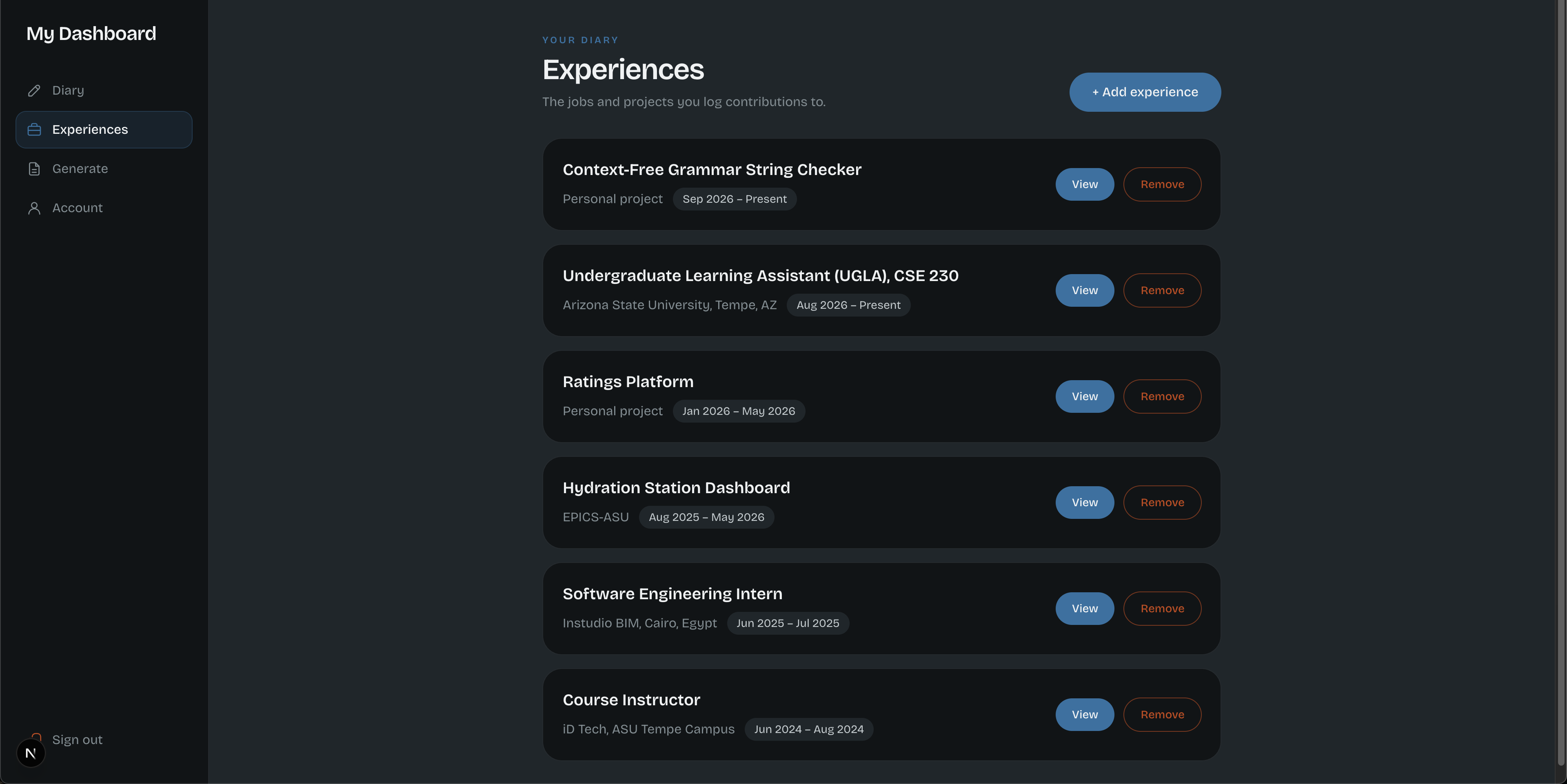
- Add your jobs and projects as experiences, each with a role, a place, and dates. Ongoing ones show as "Present".
- Log short, timestamped diary entries against any experience whenever you achieve something.
- Add your education (school, major, minor, GPA, achievements) once and reuse it on every resume.
Resume generation
- Paste a job description and get a tailored, ATS-friendly, one-page resume as a Word (.docx) file.
- Claude picks the most relevant experiences, writes achievement-focused bullets, uses the posting's own keywords where your diary supports them, and sorts your skills into the template's categories.
- No made-up facts: every employer, date, metric and skill comes from your diary.
- A bullet budget for each template keeps the resume on one page.
- Optionally add relevant coursework for each application.
- Up to 10 resumes per day. A failed generation doesn't count toward the limit.
Bring your own template
- Export your whole diary as a ready-to-paste AI prompt (copy or download) and use it with any AI chat and any resume layout.
Accounts & privacy
- Sign up with email and password, verify your email, and reset a forgotten password by email.
- Change your email address or password at any time.
- Download all your data as JSON, or delete your account and everything in it.
- Terms of Service and Privacy Policy pages.
Under the hood
- Next.js 16, React 19, TypeScript, Tailwind CSS 4
- PostgreSQL with Prisma 7, and Auth.js v5
- Anthropic Claude API with structured JSON output
- Rate limits stored in Postgres, covering sign-in, sign-up, password-reset emails and generations
- Only hashes of verification and password-reset tokens are stored
See the README for the architecture and how to run it locally.