Repository navigation


cuPhoton 0.1.3 is a source-only release for CPython 3.12–3.14 on Linux. It adds one FITS reader across the imaging workflows, spatially varying image subtraction in xPois, GPU-resident results in xPois and xFit, a reusable xPois → xFit → xScan device pipeline, and optional MPI and Dragon executors with persistent workers. xRay gains iterative fitting and compact detector spectra, and xDR fixes GPU buffer lifetimes and Gzip tile decoding.
For a hands-on walkthrough of cuPhoton’s GPU imaging workflow, read our NVIDIA Technical Blog post, Faster Scientific Image Analysis with NVIDIA cuPhoton.
cuPhoton 0.1.3 brings together 193 commits across 71 merged pull requests, adding 122 files and 82,553 net lines since v0.1.2 (86,231 added; 3,678 removed).
Contents 🔗
- Highlights
- Performance
- Install
- Upgrading from 0.1.2
- What changed
- Known limitations and errata
- Contributors
Highlights 🔗
- One FITS reader for every imaging workflow.
cuphoton.core.fits_ioserves xPois, xRep, xFit, and xScan with a shared--fits-reader auto|astropy|xdrpolicy, header-first inspection, and read receipts. xFit fits candidate stamps straight from FITS manifests, and xScan scores FITS candidates throughpredict_fits. #61, #62, #63, #64 - Spatially varying image subtraction.
solve_spatial_als(--solver spatial-als) fits separable kernels whose profiles vary across the image, in NumPy or CuPy FP64, alongside an experimental Gaussian-polynomial model. #25, #26, #27, #28, #29 - Results that stay on the GPU.
solve_constant_kernel_deviceandfit_dipoles_devicereturn CuPy results, andcuphoton.xscan.device_pipelinechains constant-kernel xPois, Gaussian xFit, and triplet xScan inference in oneDeviceWorkerContextthat loads the model once. #31, #12, #13, #42 - Persistent distributed workers. Shared MPI and Dragon executors run xPois image pairs, xFit candidate chunks, xScan inference minibatches, and the complete pipeline (
xscan run-pipeline), keeping CUDA contexts, inputs, and models across warmup and measured rounds. #10, #54, #56 - More xRay fitting options. Damped-cosine iterative fitting (
--fit-method iterative), batched detector FFTs, status-aware diagnostics with optional P2 ridge, and a losslesstile-rowsartifact layout. #9, #22, #23, #75 - xDR correctness fixes. Buffers remain owned until GPU work completes on success, error, and cancellation paths; unaligned Gzip tile payloads are repacked before DEFLATE decoding; independent reads proceed during GDS waits. #36, #81, #39
Measured timings for these changes are collected under Performance.
Performance 🔗
Each figure is a measured speedup for the configuration and timing boundary stated in its pull request. Most compare whole workflows against a named baseline, so amortized startup, I/O, and transfer costs contribute as much as computation. Expect different factors on other hardware, data, and batch sizes.
- Persistent pipeline versus separate stages. On one RTX PRO 6000 Blackwell with synthetic 1024×1024 pairs (nine candidates each), warm
xscan benchmark-pipelinerounds had medians of 0.884–0.901 s, against 8.211–8.407 s for freshly started xPois, xFit, and xScan stage processes (9.3×). The stage figure includes process startup and intermediate files. #55 - xDR reads in xPois and xRep. Reading a registered image pair for constant-kernel xPois took 0.133 s with xDR instead of 2.20 s with Astropy (16.5×), and xRep on an HSC coadd went from 0.973 s to 0.211 s (4.6×). #62
- FITS candidate manifests in xFit. For 16 stamps from a retained image subtraction on one GPU, median ingress, crop, and validation fell from 0.764 s to 0.107 s (7.1×). #63
- FITS inputs in the device pipeline. On registered FITS inputs with 32 candidates, the one-GPU batch median fell from 15.65 s with Astropy to 10.76 s with xDR (1.45×); two-worker MPI and Dragon batches gained 1.26× and 1.30×. #64
- Dragon control plane. In a two-node, 64-worker control experiment, consumer-local command queues reduced later-round control medians from 47.2/45.3 ms to 33.6/28.1 ms under Python TCP (1.4–1.6×), and native HSTA TCP reached 2.4–3.1 ms (9–20× below Python TCP, depending on queue layout). At 256 GPUs the per-batch coordination remainder fell from 210–357 ms to 24–33 ms with consumer queues (6–15×) and 8.1–8.6 ms with HSTA (24–44×). On eight GB200 GPUs, whole-pipeline batch medians stayed at 7.5–7.7 s under every layout and transport. Dragon execution guide
Install 🔗
Install from the v0.1.3 checkout with uv:
git clone --branch v0.1.3 https://github.com/NVIDIA/cuPhoton.git
cd cuPhoton
Choose a profile for your workflow:
# CPU data inspection and NumPy/SciPy workflows
uv sync --locked
# GPU FITS I/O runtime dependencies only
uv sync --locked --extra io
# GPU workflows: I/O, photometry, PyTorch, Numba-CUDA
uv sync --locked --extra gpu
# GPU workflows with visualization
uv sync --locked --extra gpu --extra viz
uv sync installs an editable Python package. The io and gpu extras supply runtime dependencies; native xDR requires a separate build with a C++17 compiler, CUDA 13 and cuFile development headers, and reentrant CFITSIO. Prepare the prerequisites in the xDR source build instructions, then run bash src/cuphoton/xdr/src/build.sh. The shared FITS reader can use Astropy without that extension. GPU execution needs a CUDA 13-compatible NVIDIA driver; GPUDirect Storage also needs a compatible host and storage configuration.
Extras compose: use uv sync --locked --extra gpu --extra viz --extra mpi for distributed GPU workflows with visualization. Include every extra you want to retain when changing profiles.
| Extra | Adds |
|---|---|
io |
CuPy, the CUDA 13 runtime with cuFile, KvikIO 26.6, and nvCOMP 5.2 for native FITS I/O (Linux) |
photometry |
Photutils background estimation, source detection, and aperture photometry |
torch |
PyTorch for CPU-capable workflows |
gpu |
io and photometry, plus PyTorch and Numba-CUDA on Linux |
viz |
Bokeh, Pillow, and Tornado |
cutile |
Experimental cuTile backend; needs an external CUDA 13.2 or newer compiler with tileiras, ptxas, and NVVM |
mpi |
mpi4py; the MPI implementation and launcher come from your environment |
dragon |
DragonHPC on Linux with CPython 3.12 or 3.13 |
dev |
Development, testing, formatting, and type-checking tools |
See the packaging guide for runtime requirements and native source builds, and optional runtimes for MPI, Dragon, and the cuTile PyTorch/compiler constraint. ARM64 caveats for PyTorch and Photutils are under Known limitations.
Upgrading from 0.1.2 🔗
- Python. CPython 3.12, 3.13, or 3.14 is required; 3.11 is no longer supported. #51
- Photutils is optional. The base package no longer installs it. Select
photometrywithuv sync --locked --extra photometry;gpuincludes it. #51 - HDF5 loader removed. The Legate-backed
cuphoton.xdr.load_hdf5API and thehdf5extra are gone; useh5py, a base dependency. xRay's HDF5 workflows are unchanged. #7 - Source builds.
CUPHOTON_XDR_BUILD_EXT=autois gone; use0(Python-only, the default) or1(native). Build native xDR explicitly after preparing its development dependencies. #24, #51 - Distributed runs. Use
uv sync --locked --extra gpu --extra mpioruv sync --locked --python 3.13 --extra gpu --extra dragon, then pass--executor mpior--executor dragonunder that runtime's launcher. xFit and xScan default to local execution;xscan run-pipelinerequires an executor. #56 - xPois NPY masks. With masking enabled, every NPY reference or target needs an explicit mask path, or select
--mask-policy none. #34 - xRay manifests. Version 1 linear-prediction manifests are recomputed once on resume and rewritten as version 2, whose resume identity includes diagnostics and ridge settings. Iterative fitting writes version 3. xRay guide
- The spatial, device-result, and iterative-fitting APIs are opt-in. Constant-kernel xPois and xRay linear prediction remain the defaults.
What changed 🔗
FITS reading 🔗
cuphoton.core.fits_ioinspects headers before reading pixels, preserves HDU order, native-endian dtypes, and integer mask bits, and returns NumPy or CuPy arrays with reader provenance. The default is Astropy and host arrays. #61autouses xDR for supported inputs and Astropy for FITS scaling, null values, unsupported compression, and uncompressed section reads;xdrrequires compatible inputs and the native GPU dependencies. Receipts record the requested and actual reader, HDUs, output location, and decoded bytes. Reader contract- xPois and xRep accept
--fits-readerindependently of the numerical backend. Standalone xPois copies xDR-decoded pixels back to the host; CuPy xRep consumes device arrays directly. WCS and target-grid setup read metadata only. #62
xPois 🔗
- Spatial ALS.
solve_spatial_alsandSpatialALSConfig, or--solver spatial-als, fit separable kernels whose profiles vary along both image axes, with a local kernel of rank at most one and a polynomial background. Optional flux conservation holds the signed kernel sum constant while fitting a global photometric scale. NumPy and CuPy FP64 implementations return host arrays and record convergence. #25, #26, #27 - Gaussian-polynomial model (experimental).
solve_spatial_gaussian_polynomial_kernelincuphoton.xpois.spatial_gaussian_polynomialjointly fits kernel shape, photometric scale, and background fields on CPU or CuPy; explicit pixel-coordinate domains keep coefficients comparable across cutouts. #28, #29 - Device results.
solve_constant_kernel_devicereturns aDeviceConstantKernelFitResultwith the kernel, matched image, and residuals on the active GPU. Scalar diagnostics stay on the host; callers control synchronization and lifetimes. #31 - cuTile normal equations.
backend="cutile"forms constant-kernel normal equations with fused FP64 matrix operations, reuses compiled kernels across fit-pixel counts, and caches up to four padded basis uploads keyed by basis values, shape, padded width, and device. #30, #46 - Residual diagnostics.
standardize_constant_kernel_residualpropagates reference noise through the fixed kernel to per-pixel marginal variance;summarize_standardized_residualsadds per-stamp and pooled RMS, centered standard deviation, and spatial lag correlations weighted by valid pixels. #32, #33 - Reviews and benchmarks.
--no-reviewskips review artifacts; hotspot and mask-component summaries group pixels once. Backend benchmarks apply the same masks, variance, crops, and fit-pixel selection as the fit commands and time loading separately from solving. #14, #15, #34
xFit 🔗
- cuTile Gaussian fitting.
fit_dipoles(..., backend="cutile")uses analytic derivatives and fused normal-equation assembly, with analytic-Jacobian rank and covariance diagnostics, batched final diagnostics, and sturdier fallbacks for stalled fits and failed finite differences. #11 - Numerical fixes. Overflowing normal equations fall back to the analytic Jacobian without changing termination decisions or diagnostics; cuTile width derivatives follow the analytic model's arithmetic order at extreme widths. #80, #88
- Device results.
fit_dipoles_devicereturns aDeviceDipoleFitResultwhose arrays stay on the GPU;fit_dipolesstill returns NumPy. Model evaluation skips derivative work when only values are needed. #12, #65 - FITS candidate manifests. A JSON manifest selects image HDUs, integer zero-based
(x, y)centers, odd stamp sizes, and optional variance and mask HDUs, with paths relative to the manifest.fit-dipoles --fits-readeris independent of--backend; GPU fits keep stamps on the device; artifacts record source hashes and read receipts. #63 - Input export. The exporter accepts variance and inclusion-mask planes (nonzero includes a pixel; variance in squared image units), preserves dtype and row order, and records source hashes with an optional image-unit label. #21
xScan and the device pipeline 🔗
- Feature adapters and tensor inference.
transform_xfit_result_featuresand its_devicevariant incuphoton.xscan.xfit_featuresbuild the canonical feature matrix from xFit results;cupy_to_torchshares CuPy arrays with PyTorch through DLPack;predict_tensorsscores float32 image tensors plus optional fit features on a CUDA device and returns logits and probabilities there. FP32 subnormals survive feature conversion. #13, #35 - Inference policies. Checkpoints apply their saved inference performance policy before compilation; persistent callers can override it.
infer-real-bogus --num-workersoverrides the checkpoint's loader count (zero disables loaders). #41, #19 - Device pipeline.
cuphoton.xscan.device_pipelineruns constant-kernel xPois, Gaussian difference-mode xFit, and triplet xScan inference for complete image pairs in aDeviceWorkerContext. It requires CUDA 13, CuPy, Torch, a triplet fusion checkpoint with its feature schema, unmasked and unweighted Gaussian difference fits, and matching stamp dimensions; variance and fit-mask inputs are optional. Results carry predictions and compact per-stage evidence. #42 - Direct FITS inference.
cuphoton.xscan.fits_inference.predict_fitsscores caller-selected candidates from aligned FITS search and template images and an optional difference image, cropping float32 stamps on the GPU and returning host logits, probabilities, and receipts in candidate order. Supply the checkpoint's pixel normalization and integer zero-based(y, x)centers. Raw DES and LSSTComCam builders accept reader policies, andrun-pipelineandbenchmark-pipelinetake--fits-readerto override manifest policies. #64 - Pipeline comparison.
xscan benchmark-pipelinetimes the persistent GPU pipeline against separate xPois, xFit, and xScan processes exchanging files, with matching APIs, inputs, batches, and checkpoints, and reports repeated batch timings, initialization, and complete invocation times. #55, benchmark guide
Distributed execution 🔗
- Shared executors. Dragon and MPI executors in
cuphoton.coreown worker placement, dispatch, and lifecycle; components initialize once and keep input or model state across tasks and rounds. Dragon places command queues on their consumer's host and reads launch descriptors from the shared filesystem. #54, #40 - xPois batches.
xpois fit-batch --executor mpi|dragondistributes complete image-pair fits with per-item results, run summaries, explicit GPU placement, and failure reporting.--warmup-roundsand--measure-roundsrepeat a manifest in persistent workers that keep CUDA contexts and caches; repeated MPI runs use--aggregation-mode mpi. #8, #10, #50 - xFit and xScan.
xfit fit-dipoles --executor dragon|mpi --chunk-size Ndistributes candidate chunks (NPZ input stays on the host, FITS stamps on the device; merged artifacts restore IDs and order).xscan infer-real-bogus --executor dragon|mpidistributes inference, with--task-batcheskeeping minibatch boundaries intact and--num-workersdefaulting to 0. #56 - Complete pipeline.
xscan run-pipelinedistributes xPois / xFit / xScan image-pair jobs from JSON descriptors with one device and model context per worker;run_dragon_device_pipelineis the Python adapter. Dragon inference now starts local DataLoader processes with ordinary spawn queues and reuses them across rounds. #43, #56, #91 - Timing and guides. Run summaries separate worker-round timing from coordinator processing. See the Dragon execution guide, the cluster launch guide for Slurm and SSH, and the xFit and xScan launch sections. #49, #73
xRay 🔗
- Diagnostics and ridge. Detector artifacts keep status-aware per-row diagnostics (traces and reconstructions in full mode), linear-prediction diagnostics add residual ratios and P1/P2 conditioning, and
--p2-ridge-alphaenables P2 ridge regularization. The default dense NPY layout repeats each row result across its tile's columns. #9 - Batched detectors. Eligible linear-prediction tiles batch artifact assembly, FFTs, and output transfers across rows; root extraction and least squares stay row-wise. #22
- Iterative fitting.
cuphoton.xray.iterative_fit.iterative_fitfits a fixed number of damped cosine modes plus an offset, with frequency bounds, iteration limits, and amplitude regularization, on CPU by default or withbackend="gpu".--fit-method iterativeruns the small row fits on CPU with CuPy normalization and FFTs; linear prediction remains the default, and P2 ridge applies only to it. Frequencies are cycles per input time unit;angular_frequencyis radians (divide by 2π). #23 - Compact spectra.
--artifact-layout tile-rows(orartifact_layout="tile-rows") stores each row's spectrum once per tile;load_detector_arrayexpands pixel slices, and comparison, visualization, and shard merging handle both layouts. Changing layout invalidates shard resume. #75 - Detector parity tests now allow bounded float64 roundoff between batched and serial outputs; this changes only test tolerances. #90
xDR and xRep 🔗
- Buffer lifetimes. Pinned host and GPU work buffers stay owned until copies and decompression complete on their stream, on success, error, and cancellation paths; gzip header bounds and decoded tile layouts are validated. #36
- Gzip tiles. Unaligned compressed payloads are repacked before DEFLATE decoding; native reads supply the output buffers nvCOMP 5.2 requires and retain decoder inputs and scratch through asynchronous work. #81
- Concurrent reads. With an explicit CUDA stream, independent reads submit while another waits on GDS I/O, and opening a second loader no longer resets a matching KvikIO pool during another read. #39
- Builds and benchmarks. Native builds select and report the requested interpreter; FITS benchmarks write JSON reports with
--output-json. #16, #18 - Target-grid reprojection.
xrep reproject-stack --target-wcs destination.fitsmaps a stack onto an existing image's dimensions and celestial WCS (--target-hduselects the HDU), preserving rotation, reference-pixel offsets, and SIP distortion;--mapping-grid-step 1evaluates the full mapping per pixel. #20
Documentation and examples 🔗
- A synthetic imaging walkthrough (script and notebook) runs FITS loading, WCS alignment, kernel subtraction, dipole fitting, and plotting with recovery diagnostics; set
KERNEL_SIGMA = SEEING_SIGMAfor a matched-kernel comparison. #47, #67 - A workflow chooser, component guides, and an architecture guide following the optical data flow; the refresh updates installation and artifact contracts, standardizes component names, and replaces the roadmap with issue tracking. #48, #53, #87
- The cluster launch guide ships host files, a pipeline JSON template, and a CPU preparation script in the source archive. #73
Packaging, CI, and tooling 🔗
- Versions come from Git tags through
setuptools-scm(v0.1.3builds0.1.3; later commits get development versions).make buildproduces the source archive;make wheelsandmake condaremain available for local binary builds. Build commands preserve each other's outputs, whilemake clean-distclears them. Packaging guide - Native xDR source builds require reentrant CFITSIO and use the KvikIO 26.6 and nvCOMP 5.2 ABI families. Retained wheel build tooling bundles CFITSIO 4.7.0; Conda build tooling requires HDF5 2.1 or newer. These recipes remain available for local builds. #51, #57, #70
vizrequires Tornado 6.5.10 or newer;devrequiresvirtualenv>=21.7.12. #44, #89- Development checks add mypy, C/C++/CUDA formatting, and ShellCheck alongside Ruff through
make hooks; vetted PR revisions run the L40G GPU checks before the merge gate. #68, #66 - Public repository templates, 0.1.3 release metadata, both maintainers as code owners, and corrected license and Dragon dependency notices. #6, #38, #45, #69
Known limitations and errata 🔗
- xRay linear prediction can drop lightly damped modes when traces contain noise. This predates 0.1.3; see issue #1.
- ARM64 dependency check. On Linux ARM64, installs that include PyTorch through the
gpuortorchextra makepython -m pip checkreportnvidia-cusparselt-cu13 0.8.1 is not supported on this platform: the wheel is namedaarch64but taggedmanylinux2014_sbsainternally. PyTorch imports and the tested GPU workflows pass on GB200; PyTorch 2.13 and 2.14 both pin 0.8.1. - ARM64 Photutils. Photutils 3.0.0 has no Linux ARM64 wheel, so selecting the
photometryorgpuextra builds it from source and requires a C compiler and Python headers. The base package andioextra are unaffected.
Contributors 🔗
Thanks to everyone who contributed to this release.
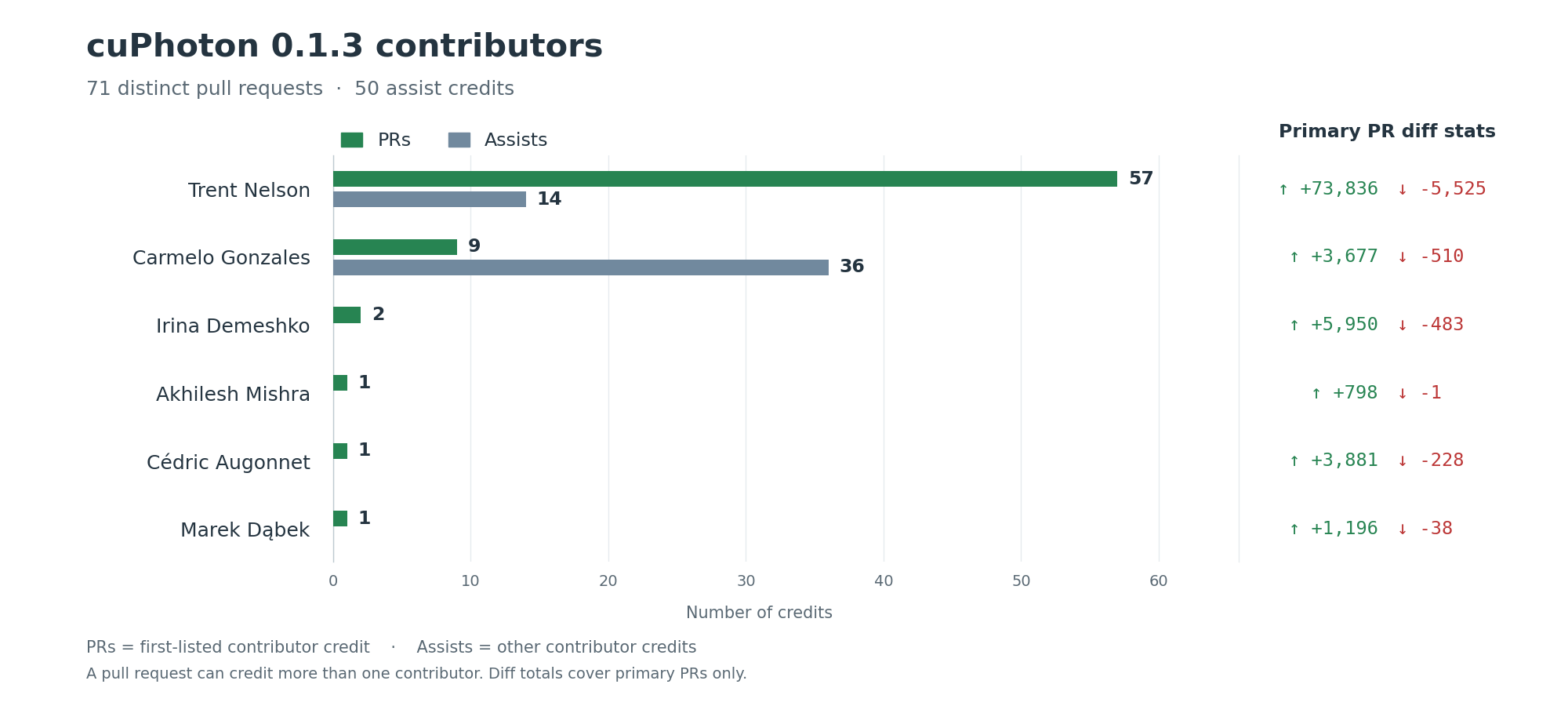
| Author | PRs | Assists | Primary PR diff stats |
|---|---|---|---|
| Trent Nelson | 57 | 14 | +73,836 -5,525 |
| Carmelo Gonzales | 9 | 36 | +3,677 -510 |
| Irina Demeshko | 2 | 0 | +5,950 -483 |
| Akhilesh Mishra | 1 | 0 | +798 -1 |
| Cédric Augonnet | 1 | 0 | +3,881 -228 |
| Marek Dąbek | 1 | 0 | +1,196 -38 |
PRs counts first-listed credits in the pull request table below; Assists counts all other credits. Diff stats sum additions and removals for each author’s primary PRs.
Pull requests 🔗
| PR | Component | Change | Contributors | Diff stats |
|---|---|---|---|---|
| #5 | - | Add CPU checks and opt-in code reviews | Trent Nelson | +140 -2 |
| #6 | - | Prepare public repository templates and source archives | Trent Nelson; Carmelo Gonzales | +169 -4 |
| #7 | xDR | Remove the Legate-backed xDR HDF5 loader | Trent Nelson | +25 -316 |
| #8 | xPois | Add Dragon-backed xPois image-pair batches | Trent Nelson; Carmelo Gonzales | +5,431 -114 |
| #9 | xRay | Add xRay fit diagnostics and optional P2 ridge | Trent Nelson; Carmelo Gonzales | +2,392 -44 |
| #10 | xPois | Unify MPI and Dragon xPois batch execution | Trent Nelson; Carmelo Gonzales | +11,797 -309 |
| #11 | xFit | Add optional cuTile Gaussian fitting to xFit | Trent Nelson; Carmelo Gonzales | +1,640 -84 |
| #12 | xFit | Keep xFit results and diagnostics on the GPU | Trent Nelson; Carmelo Gonzales | +1,224 -96 |
| #13 | xFit, xScan | Add device xFit features and tensor inference to xScan | Trent Nelson; Carmelo Gonzales | +2,410 -34 |
| #14 | xPois | Allow xPois fits without review artifacts | Carmelo Gonzales; Trent Nelson | +241 -94 |
| #15 | xPois | Group xPois review component pixels once | Carmelo Gonzales; Trent Nelson | +289 -8 |
| #16 | xDR | Select the intended Python for native xDR builds | Carmelo Gonzales; Trent Nelson | +204 -4 |
| #17 | - | Clarify CPU test skips and expected FITS warnings | Trent Nelson | +31 -57 |
| #18 | xDR | Export xDR benchmark results as JSON | Carmelo Gonzales; Trent Nelson | +550 -22 |
| #19 | xScan | Allow xScan inference worker overrides | Carmelo Gonzales; Trent Nelson | +227 -2 |
| #20 | xRep | Reproject stacks onto an existing FITS WCS | Carmelo Gonzales; Trent Nelson | +488 -46 |
| #21 | xFit, xScan | Export variance and inclusion masks with xFit inputs | Carmelo Gonzales; Trent Nelson | +758 -22 |
| #22 | xRay | Batch xRay detector artifacts and FFTs | Trent Nelson; Carmelo Gonzales | +919 -68 |
| #23 | xRay | Add optional iterative fitting to xRay | Trent Nelson; Carmelo Gonzales | +2,120 -74 |
| #24 | - | Make package builds deterministic and verify distributions | Trent Nelson | +222 -36 |
| #25 | xPois | Add a spatial ALS image-matching solver | Irina Demeshko; Trent Nelson; Carmelo Gonzales | +3,578 -46 |
| #26 | xPois | Accelerate spatial ALS with CuPy | Irina Demeshko; Trent Nelson | +2,372 -437 |
| #27 | xPois | Enable spatial ALS in xPois image-pair batches | Trent Nelson; Carmelo Gonzales | +1,010 -169 |
| #28 | xPois | Add an experimental spatial Gaussian-polynomial model | Trent Nelson; Carmelo Gonzales | +3,239 -0 |
| #29 | xPois | Accelerate the Gaussian-polynomial model with CuPy | Trent Nelson; Carmelo Gonzales | +1,232 -128 |
| #30 | xPois | Fuse xPois cuTile normal equations with FP64 MMA | Trent Nelson; Carmelo Gonzales | +295 -149 |
| #31 | xPois | Keep constant-kernel xPois results on the GPU | Trent Nelson; Carmelo Gonzales | +901 -43 |
| #32 | xPois | Propagate fixed-kernel residual variance | Trent Nelson | +952 -12 |
| #33 | xPois | Summarize standardized residual structure | Trent Nelson; Carmelo Gonzales | +995 -1 |
| #34 | xPois | Match xPois benchmark preprocessing to fitted masks | Carmelo Gonzales; Trent Nelson | +790 -305 |
| #35 | xScan | Preserve subnormal values in device xFit features | Trent Nelson | +119 -6 |
| #36 | xDR | Retain xDR buffers until GPU work completes | Cédric Augonnet; Trent Nelson; Carmelo Gonzales | +3,881 -228 |
| #37 | - | Clarify cuPhoton distribution contents | Trent Nelson | +19 -5 |
| #38 | - | Prepare cuPhoton 0.1.3 release metadata | Trent Nelson | +2 -3 |
| #39 | xDR | Allow independent xDR reads during GDS waits | Marek Dąbek; Trent Nelson; Carmelo Gonzales | +1,196 -38 |
| #40 | xPois | Reuse Dragon coordination for package workloads | Trent Nelson | +591 -44 |
| #41 | xScan | Allow explicit xScan checkpoint inference policies | Trent Nelson; Carmelo Gonzales | +264 -6 |
| #42 | xPois, xFit, xScan | Reuse a device context across xPois, xFit and xScan | Trent Nelson | +4,950 -0 |
| #43 | xPois, xFit, xScan | Run the xPois, xFit and xScan device pipeline through Dragon | Trent Nelson | +2,528 -0 |
| #44 | - | Require Tornado 6.5.10 for visualization | Trent Nelson | +10 -6 |
| #45 | - | Add Carmelo as a repository code owner | Trent Nelson | +2 -2 |
| #46 | xPois | Reuse padded cuTile basis uploads across fits | Carmelo Gonzales; Trent Nelson | +130 -7 |
| #47 | xDR, xRep, xPois, xFit | Add a synthetic imaging pipeline walkthrough | Akhilesh Mishra; Trent Nelson; Carmelo Gonzales | +798 -1 |
| #48 | - | Explain cuPhoton workflows and simplify public documentation | Trent Nelson; Carmelo Gonzales | +763 -590 |
| #49 | Documentation | Document Dragon transport, persistent execution, and timing | Trent Nelson; Carmelo Gonzales | +248 -0 |
| #50 | xPois | Measure repeated batches in persistent Dragon and MPI workers | Trent Nelson; Carmelo Gonzales | +2,485 -63 |
| #51 | Packaging, xDR | Ship native xDR wheels and tag-driven Python releases | Trent Nelson; Carmelo Gonzales | +3,877 -489 |
| #53 | Documentation | Update documentation for cuPhoton 0.1.3 | Trent Nelson; Carmelo Gonzales | +921 -546 |
| #54 | Core executors | Share persistent Dragon and MPI execution across components | Trent Nelson; Carmelo Gonzales | +4,595 -570 |
| #55 | xPois, xFit, xScan | Compare persistent pipeline and separate stage execution | Trent Nelson; Carmelo Gonzales | +2,574 -5 |
| #56 | xFit, xScan | Run fitting, inference, and the device pipeline through Dragon or MPI | Trent Nelson; Carmelo Gonzales | +3,437 -20 |
| #57 | Packaging, xDR | Build native Linux conda packages | Trent Nelson; Carmelo Gonzales | +936 -41 |
| #61 | Core, xDR | Add a shared FITS reader for CPU and GPU workflows | Trent Nelson | +579 -0 |
| #62 | xPois, xRep, xDR | Use xDR in xPois and xRep FITS workflows | Trent Nelson; Carmelo Gonzales | +633 -269 |
| #63 | xFit | Fit candidate stamps directly from FITS images | Trent Nelson | +1,199 -45 |
| #64 | xScan, xPois, xFit | Read FITS inputs directly in xScan and the device pipeline | Trent Nelson; Carmelo Gonzales | +2,273 -67 |
| #65 | xFit | Skip unused Gaussian derivatives during model evaluation | Trent Nelson | +29 -0 |
| #66 | CI | Require L40G GPU checks for vetted PR revisions | Trent Nelson | +119 -3 |
| #67 | xDR, xRep, xPois, xFit | Restore visible fit diagnostics in the imaging walkthrough | Trent Nelson | +206 -60 |
| #68 | Developer tooling | Add type checking and native style hooks | Trent Nelson | +1,362 -727 |
| #69 | Packaging | Correct license formatting and clarify Dragon dependency notices | Trent Nelson | +22 -3 |
| #70 | Packaging | Require HDF5 2.1 or newer in Conda environments | Trent Nelson; Carmelo Gonzales | +9 -0 |
| #73 | Documentation | Document MPI and Dragon cluster launches | Trent Nelson; Carmelo Gonzales | +409 -1 |
| #75 | xRay | Add optional compact tile-row storage for detector spectra | Trent Nelson; Carmelo Gonzales | +840 -74 |
| #80 | xFit | Preserve solver behavior when normal equations overflow | Trent Nelson; Carmelo Gonzales | +116 -3 |
| #81 | xDR | Fix DEFLATE alignment and nvCOMP output buffers | Trent Nelson; Carmelo Gonzales | +396 -100 |
| #87 | Documentation | Refresh cuTile setup and 0.1.3 release documentation | Trent Nelson | +13 -15 |
| #88 | xFit | Align cuTile Gaussian width derivatives with the analytic model | Trent Nelson | +96 -8 |
| #89 | Developer tooling | Require patched virtualenv for development tooling | Trent Nelson | +10 -7 |
| #90 | xRay tests | Allow bounded float64 roundoff in detector parity checks | Trent Nelson | +17 -6 |
| #91 | Core executors, xScan | Fix Dragon inference with local loader processes | Trent Nelson | +43 -1 |
Commit counts describe the pull requests before squash merging. Release line and file totals compare v0.1.2 with v0.1.3; individual PR stats show each PR’s diff, including code, tests, documentation, and supporting files.