 Qodo Hackathon
Day 4: Automate your factory’s first job #6

Replies: 33 comments 5 replies

|
Trigger and workflow/source link:
The agent's tools are an allow-list: it can push only to its own branch, and merge, force-push, checkout and reset are denied. The runner also stops if Ticket and PR (or partial work): What happened, including checks, Qodo review and retries:
What still needed me, or where it stopped:
Everything is in the factory ledger. CI on main is green with 188 tests. |

🤖 Day 4: I let a robot do my ticket and it did⏰ Trigger 🔁 Workflow 🎫 Ticket & PR 📜 What happened
🙋 What still needed me
💡 Lesson learned: The wait on Qodo review makes the development loop longer and slower, but seems absolutely to be worthwhile, finding holes in the agent-generated plan |

|
@Terhi-L the wait time for a full review obviously varies based on the contents of the PR, of course. But, you do get to watch a pretty neat animation in the process! |

|
Trigger and workflow/source link: Ticket and PR (or partial work): What happened, including checks, Qodo review and retries: What still needed me, or where it stopped: |

|
Trigger and workflow/source link: Ticket and PR (or partial work): What happened, including checks, Qodo review and retries:
I opened the PR from the bot's link. Qodo found one rule violation within a minute: the test helper patched What still needed me, or where it stopped:
Lesson: three of the four failures returned green or silent, not red. The evidence is the trail (comment, commit, review), not the workflow status. Journal: https://github.com/UBayouski/tracenotes/blob/main/journal/day-04.md |

|
🤖 Day 4: I labelled a ticket and the robot opened the PR (on the second try) ⏰ Trigger 🔁 Workflow 🎫 Ticket & PR 📜 What happened Run 1 failed. The agent hit the 60-turn limit before opening a PR, because it had to build a test setup that lived in a PR I hadn’t merged. The runner stopped cleanly and relabelled the ticket agent-needs-help. 🙃 🙋 What still needed me Writing the ticket with testable acceptance criteria 💡 Lesson learned: Qodo caught a test that couldn’t fail, which “CI green” alone would have missed. The agent’s first run also showed me that tickets need their dependencies merged first. |

Trigger and workflowFor pasokh, my explainable Persian answer checker, a one-shot 15-second timer starts a local Claude Code worker on one selected GitHub issue. The host reads the ticket/acceptance criteria, creates a separate Git worktree, supplies the project rules, verifies changes, runs checks, opens the PR and requests Qodo review. Merge stays a human decision.
The repository is public. This is an actual run, an initial stop, and a resumed review/fix run; the intervention is recorded below. Ticket → branch → PR
Only Actual run and review outcomeTimestamps are UTC on November 6, corresponding to the evening of November 5 Eastern:
Qodo caught a requirement gap: the first implementation let The final 63 passing host/local tests, plus typecheck, cover standalone help's stdout/stderr/exit status, literal The retained resume result is: {
"status": "ready_for_human",
"pr": "https://github.com/TheNickRubin/pasokh/pull/8",
"head": "57693f50daff4fe60c12c838cba7ebfdb7f5327a",
"repair_cycles": 1,
"merged": false
}What still needed human interventionI selected the ticket and armed the timer. Between the first trigger and PR creation, no implementation intervention was needed. The first run stopped because Qodo was not installed yet. I completed the repository-only Qodo setup, integrated earlier stacked fixes, clarified the acceptance criterion, and explicitly resumed review. The repair and re-review then completed automatically. A daemon restart also exposed a logging weakness: the original stop event exists, but its final result file was absent. A closed-output-stream reproduction showed how this could happen; that attribution to the historical run remains an inference. The runner now saves its result before best-effort terminal output, with regression coverage. Original evidence was preserved without inventing a missing result. Qodo also reviewed the runner. Findings about review freshness/progress handling, edit scope and live PR revision checks led to fixes in PR #7. The latest runner ( Each agent phase has a ten-minute limit; review waiting is capped at five minutes; at most two repairs are allowed. Missing or stale review cannot become ready. The host validates allowed changes and owns publication. These are workflow controls, not an OS sandbox: npm still executes task code, and PR checks are snapshots. No automatic merge is implemented. The PR remains open for human acceptance. Lesson: automatic PR creation was only the first milestone. The useful factory behavior was stopping when review was missing, then investigating a concrete requirement gap and producing a verified correction after an explicit resume. Assistance: Codex for runner/integration and independent checks; Claude Code for the triggered implementation and resumed repair. |

|
Trigger and workflow/source link:
Ticket and PR (or partial work):
What happened, including checks, Qodo review and retries:
What still needed me, or where it stopped:
|

|
Trigger and workflow/source link: T3 scheduled job that disabled itself at startup. Workflow source Ticket and PR: Ticket #7 → PR #8 accessible Clear search button. What happened: The agent implemented the ticket automatically. Formatting, 10 unit tests, 28 browser tests, and build passed. Qodo raised two low-priority findings; both were addressed in one repair cycle, within the two-attempt limit. Final CI and Qodo review passed. What still needed me: Initial setup and the final merge decision. No intervention was needed during implementation or repairs. |

|
Trigger and workflow/source link: a ticket tag. A local poller, Ticket and PR: ticket iwerksom/ngo-factory#13 (cache the project page's GitHub label read for 60 seconds, with acceptance criteria and a failure case), PR iwerksom/ngo-factory#14. Not merged; that is my decision. What happened, including checks, Qodo review and retries:
What still needed me, or where it stopped: nothing during the run. Before it, I wrote the poller, created the labels and the ticket. After it, I read the log, the checks and Qodo's comments; I have not yet reviewed the diff line by line. Still manual: filing and tagging tickets, the merge, and the board updates. The agent did not check its work against live GitHub, so that is still open before a merge. |

|
Trigger and workflow/source link: Ticket and PR (or partial work): What happened, including checks, Qodo review and retries: What still needed me, or where it stopped: |

|
Hey everyone! Here’s my solution for Day 4 👇 I’m building my Formula 1 app, and I’ve connected my Linear tickets to Codex. I set up a recurring job that checks for work: when I move a ticket from Triage to To Do, Codex picks it up and starts working on it. Now I get to focus on deciding what I want to build next. How did Day 4 go for you? Share your solution in this thread if you haven’t yet! Day 5: Make your factory self-improve is already live. Today, we’re looking back at code and review feedback to find a useful rule for our factories. See you there! qodo-day-4-edited-v2.mp4 |
|
No hat game?!?! |

|
Trigger and workflow/source link: a Ticket and PR (or partial work): issue 30 to pull request 33, from the schedule. Later, issue 66 to pull request 67, from one tick I started by hand; the schedule wasn't loaded that day. What happened, including checks, Qodo review and retries (UTC, from the factory's logs for 30 and 66):
Neither run needed a fix round: Qodo found nothing on the first review both times. The fix loop has run once, on ticket 4, started by hand: the agent's fix missed what Qodo meant, round 3 hit its 20-minute deadline, and the ticket stopped at What still needed me, or where it stopped: I wrote the tickets and added the labels. A clean review doesn't show a ticket is done, so I reran each one's criteria before merging: on pull request 67, all six held on a fresh clone, with 515 tests passing and 366 of 366 undone fixes caught. I've authorised merges for this repository. Each run in detail, and what the first tests missedTicket 30, from the scheduleThis is a shared machine, so I loaded the job for one run and unloaded it by 18:13.
That's 7 minutes 20 seconds from label to result, with no retries used of the 2 allowed. Before merging, 348 tests passed, and undoing the agent's two lines made 2 of its tests fail. CI was green on Python 3.11 and 3.15. The guard had no entry in the mutation check, and Ticket 66, from a tick started by handTicket 66 asked for On a fresh clone of the branch: two manifests print in order, a blank line apart, with one label note, exit 0. One manifest prints exactly what Ticket 4, the run that hit its limitBefore the schedule was loaded, I started the same script by hand on a harder ticket: issue 4, and pull request 19. The agent wasn't prompted, but the trigger didn't fire on its own. Its log:
It stopped at round 3 of 3, as designed, with two findings open. What the agent had left unfinished was an elaborate fix for a timing race nobody had asked about, so I threw it away. A different agent finished the two findings from the pushed commit, and both left Qodo's comment on the commit with the fix. A separate review then found that a comment version the parser can't read was being skipped, which could give a finding the wrong category, and that's fixed too. It merged with 286 tests passing and 119 of 119 undone fixes caught. My tool read Qodo's last review as What the first tests missedMy first tests, which used fakes, showed neither of two problems. A real probe found that Codex's sandbox keeps The factory won't merge, mark ready or force-push. It also won't treat Qodo's moved commit marker as a review: a round that shows nothing open and no new finding stops for a person. Assistance and third-party materialAI coding agents did the work from my brief: Claude Code designed and wrote the factory and this post, Codex was the agent inside all three runs and a second reviewer, and a Claude builder agent finished ticket 4. Qodo did its own reviews. I chose the project and set the direction. No collaborators. |

|
In short: two unattended runs went from label to a PR ready to merge in 8 and 14 minutes. In one, the agent fixed a Qodo finding on its own. Trigger and workflow/source link: After the agent stops, the runner does its own checks before it believes anything:
Any surprise means Ticket and PR:
What happened, including checks, Qodo review and retries:
(Those numbers come from the summary line that run 2 built.) Stop paths, shown live with logs: nothing labelled → idle · run in progress → busy · ticket missing its sections → refused, Qodo on the factory itself: 29 findings on 5 PRs, all real; 28 fixed, 1 left failing closed on purpose. It found a way past my command-blocking hook five rounds running: a script, a symlink, a fake hook entry, a repo-wide endpoint, a line continuation. That changed the design: the hook stays as a seatbelt, and the guarantee is the after-run audit. What still needed me, or where it stopped:
Full Day 4 entry, with every PR and finding: decision log |

Day 4 — Show your automation (tardis, autonomous backlog pickup)Trigger and workflow/source link
Ticket and PR (or partial work)
What happened, including checks, Qodo review and retries
What still needed me, or where it stopped
|

Day 4: mellonTrigger and workflow/source linkI ran mellon’s first live issue worker on Neon. [Schedule configuration](https://github.com/randoneering/mellon/blob/f7f45f98911ba901a958a9381fb1b99ff24b300e/neon.ts) · [Worker source](https://github.com/randoneering/mellon/tree/f7f45f98911ba901a958a9381fb1b99ff24b300e/src/automation/worker) Ticket and PR (or partial work)Ticket: [#21, guided CLI for personalized detector training](randoneering/mellon#21). The worker claimed the ticket and started generating tests. It stopped before creating a branch or PR. Getting there also produced two merged fixes: [#25, database TLS verification](randoneering/mellon#25), and [#27, GitHub App commit verification](randoneering/mellon#27). What happened, including checks, Qodo review and retriesThe scheduled request reached the worker, approval checks passed, and the worker made one successful Sol model call: 10,436 input tokens and 607 output tokens. Then it stopped with No pilot commit means no pilot CI or Qodo review. The setup PRs passed CI, and Qodo caught an IP-address TLS edge case that we fixed before activation, which was nice. What still needed me, or where it stoppedI set up the GitHub App, approved credentials and deployment steps, signed commits, merged fixes, and changed Qodo’s draft/bot settings. I also approved the pilot with known Qodo gaps: clean results arrive as comments, and updated commits need an explicit review trigger. The next investigation is why the agent didn’t hand back a proposal. It may need another step after reading files...but I have not confirmed that was the case yet. This ended up taking alot of time and probably over complicated things. I still want to continue with this method because its trying something out that I have not done ever! And I really want to see this work.. |

ChallengeDay 4, 5 Nov 2026: Automate your factory's first job ProjectProject name: ghostcheck What I completedFACTORY.md defines the loop. Trigger: a schedule every 30 minutes (08:00-23:00 IST) picks the oldest open issue labelled Evidence
What I learned / what is blockedThe loop's own design needed review more than the first ticket did: the ticket passed clean on the first try, the process had five holes. Keeping all state in GitHub (labels, branch names, PR body) is what makes a scheduled agent safe to restart. Still open: branch protection on main (recommended in FACTORY.md, not yet switched on). Assistance and third-party materialAI coding agent runs the job; Qodo reviews; I own the merge. |

|
For Day 4, I chose a repeating Codex task that checks GitHub Issues. I was already using GitHub Issues as my backlog on Day 3, so I kept that as the queue. Codex checks it on a schedule, and I use the The workflow can pick up any open Particle Viz issue with that label. It handles at most one ticket per run. On each check, the task should:
The part I cared about was what happens on the following run. I might leave the label on a ticket while I look at its PR. The next run should find that PR and leave it alone if it's ready, instead of treating the label as an instruction to start over. That gives me one place to see the work and keeps the merge decision with me. I used issue #9 as the first example. PR #10 gives Undertow the full FFT spectrum so different frequencies can move different parts of the scene. Two test tones landed in the expected bins in the browser, and the tests and build passed. Qodo reported no findings, so there were no review fixes to retry. To end, the PR is open for my final decision on whether or not to merge. |

It runs in my sleep now!If you haven't seen my other posts, I'm building Commet, a gamified code-mapper that turns a git repo into a star system for a real reason to investigate the code your agents make for you 
Trigger and workflow/source link: a launchd job on my Mac ticks every 15 minutes. launchd is macOS's built-in scheduler, like cron, and a LaunchAgent is a job it runs for one logged-in user. Mine (
Example of it working goodTicket and PR (or partial work): #24 → PR #69. It's a small scanner bug where if a filename contains one invisible character (U+0001), the scanner for some reason ignores that commit's changes. The ticket has 4 acceptance criteria. What happened, including checks, Qodo review and retries:

What still needs me, or where it stopped:
Other progress on my project!Commet shows which commits the agent wrote. The agent committed under my account, so GitHub shows me as the author. Commet compares each commit with the agents' session logs. Both of the runner's commits (below) match the agent's session ("agent 100%"), and across the repo, 36 commits made under my name were written by an agent: 
|

|
Day 4 A Three decisions carried the weight. The runner owns the state machine; the agent owns the code — picking, claiming, counting rounds and pushing are bash, because a retry limit a model is asked to respect is a hope and one a script counts is a fact (2 check attempts, 3 review rounds, 2 fix rounds, 45 min of reviewer silence). State lives on GitHub, never in the agent's memory: every pass starts cold and rebuilds where it is from labels and a marker the runner writes on the PR. The agent talks to nothing — no Ticket and PR: #7 → PR #10. Qodo: 0 bugs, 0 rule violations, 0 requirement gaps. Merged. What happened, including checks, Qodo review and retries: No tests in this project, by an explicit product decision. Checks are The clean run was the fourth. One stalled 18 minutes because The third refused the ticket, and was right. My acceptance criterion asked it to wrap a Firestore bound in Qodo reviewed the runner itself and found 17 bugs, every one real. The sharpest shared a shape — things that read as safe and are not: What still needed me, or where it stopped: The merge, and deploying the Firestore rules — credentials this machine does not hand to agents. Running it on a screen: this project's "done" also wants a hand run and a manual emulator checklist, so the PR carries a Not verified section saying, in as many words, that nobody saw the screen. Writing the ticket, and fixing it when the agent turned out to be right about it. And fixing the runner, which cannot edit itself — |

I add a label and the factory takes the ticketI redrew the art after Day 3. The alien faces right in a cleaner line style and the next characters will match him. Trigger and workflowI put a Source: https://github.com/CamDuncalfe/agent-pfp/tree/main/factory Limits: 2 fix rounds, 20 minutes per agent call, 15 minutes waiting on a review. Then it stops with 
Ticket and PRCamDuncalfe/agent-pfp#10 → CamDuncalfe/agent-pfp#11 (lock a trait so Randomize leaves it alone) CamDuncalfe/agent-pfp#12 → CamDuncalfe/agent-pfp#13 (line up the locks) Up there: cowboy hat and heart shades locked, Randomize picked the rest! What happened
What still needed me
What I learnt: the agent finishes a ticket without me, but it can't see the page. #12 exists because I opened the builder and looked. AssistanceA coding agent (Claude Code) writes the code from my tickets and Qodo reviews it. The art starts in Midjourney and I cut it into layers |

Automating the first job meant not trusting the agent's wordI add one label to a ticket. Within ten minutes my laptop has picked it up and an agent has written the test and the fix. Then Qodo reviews the PR. I don't open a session or type a prompt. That sounds great until you think about what it means: an agent working on my laptop while I'm not watching. Most of this development wasn't about making it work. It was about making sure I could believe it when it said it had. Earning trust.
Trigger and workflow/source linkTrigger: I add the Source:
The one decision everything else hangs off: the agent writes code and the runner does everything else. The agent can't push, open the PR, change a label or even reach GitHub. It reads the ticket from a file and works in its own copy of the repo. The runner pushes, labels and decides when a run is done. So the agent's word never moves a ticket on. The runner's checks do. flowchart LR
subgraph You
L[Add ready-for-agent]
A[/agent retry or /agent change this/]
M[Check by hand and merge]
end
subgraph Laptop[This laptop]
T[Timer, every 10 min] --> C{Can it be worked?}
C -- blocked or not my ticket --> R[agent-refused]
C -- yes --> W[Agent: test, then fix]
W -- not sure --> H[agent-needs-help]
W --> K{Runner checks: tests pass and the test failed on its own}
K -- no --> H
end
subgraph GitHub
P[Push agent/* and open PR] --> Q[Qodo reviews the head commit]
Q -- findings --> W
Q -- none open --> D[agent-done]
end
L --> T
K -- yes --> P
H --> A --> K
D --> M
Ticket and PR (or partial work)Ticket: #41 · Tapping a print already on your screen says to drag it there. That's the UX bug my iPhone found on Day 3. PR: #52, opened by the factory. Two Before I trusted the go, I tested the stops. I gave it two tickets that should stop. #19 is blocked by #24. It was refused before anything started. #49 says "Make joining a room feel friendlier" and nothing else. I wrote it vague on purpose. The agent stopped in under 30 seconds, both times: "'Feel friendlier' isn't something a test can check". Then it told me what a ticket it could work would look like. Honestly, that was the moment I started to trust it. An agent that says "I can't check this" is worth more to me than one that always says yes. What happened, including checks, Qodo review and retries
The runner checks the agent, not the other way round. The agent says "this test fails on the old code". The runner doesn't take its word for it. It checks out every And it audits every run. After each agent run the runner asks three questions: did anything change on GitHub, did it touch a file the factory guards, did it leave anything uncommitted? Any yes is a stop. The agent isn't allowed to touch GitHub, so if something moved, I want to know why before anything else happens. About 20 ways to stop, one way to finish. Every stop path
Every stop was the safe kind. The 08:05 stop was the runner being wrong: the test's name was split over two lines and it only read one. My first reaction was annoyance. Then I realised it was exactly the failure I wanted: a false alarm, not a false pass. Same for the next three: a flaky test the agent wouldn't guess about, an old stop note left from the run before and a crash in 
The agent can't touch GitHub. Its tests run in a container with no access to my home folder. It can only read and edit inside its own copy of the repo. I didn't take that on trust either: I checked both (read boundary and test permission logs). Only Qodo's findings and my The runner's log for #41 (events.log, trimmed to the key lines)What still needed me, or where it stopped
Qodo reviewed the factory tooBefore the runner ran on its own, I had Qodo review it like any other code. I'm glad I did. 26 findings across the six runner PRs, and the ones that mattered most were about trusting it alone with my laptop:
24 fixed, 2 dismissed with a reason. "Mixed requests silently lose retry checks" (#53): the runner's checks run after every agent round anyway, so nothing is skipped. "Stop-file clearing has no test on the runner wiring" (#58): the helper it calls is unit tested and the wiring got its real test on #41's next retry, which cleared the old note and carried on. What I learnedThe agent was the easy part. Checking it was the work. I expected to spend the day on the ticket. Instead almost every hour went on the runner, because that's where I'd been least careful. The agent never once claimed something it hadn't done. The bugs were all in the code that was meant to catch it. A stop is a feature. Five stops on one small ticket felt slow at the time. Looking back, each one was the factory refusing to call something done that it couldn't prove. I'd rather it stop five times than mark something done once that isn't. Qodo earned its place on the risky code. 1 finding on #41. 26 on the runner. That makes sense: a tap handler can only break a tap. A runner that pushes, labels and runs tests on my laptop can break a lot more. Anything I build to run unattended now gets reviewed before it gets trusted, not after. |


|
Hi @researchsite ! I think this was meant as its own comment in the thread so the organisers see it as your Day 4 entry 🙂 |

|
Sorry @jtbinith , You are right , I have removed and moved to own comment |
|
all good 😁 👌 |

|
Trigger and workflow/source link: Ticket and PR (or partial work): What happened, including checks, Qodo review and retries:
What still needed me, or where it stopped: |

|
Trigger and workflow/source link:
Ticket and PR (or partial work):
What happened, including checks, Qodo review and retries: The successful run, step by step:
The runs before it failed three ways, and each became a fix:
Qodo also reviewed the runner changes themselves and found 5 real issues (pin the reference, a fetch time budget, repeated lines, workflow variables, practice scripts). All were fixed and resolved in separate commits. What still needed me, or where it stopped:
Learnings:
|

|
Update, Nov 22: redone on Keynes, the project I moved to (see Day 1). The original Nightrune post is folded at the end. Trigger and workflowA launchd job on my Mac runs Per ticket,
What ran#41: cancelling a load is reported as an
#42, claimed by the poller right after: What still needed me
Not verified
Assistance and prior workKeynes is a pre-existing project (since Aug 2026), built with a collaborator, HkingAuditore, who agreed to its use here. Only my commits and the factory's count. Codex implements inside the factory, reviews are by Qodo, and this post was drafted by Claude Code under my direction. Original Day 4 submission (Nightrune, Nov 19)I joined on Nov 18 and am catching up in order; this is Day 4. Two labelled tickets ran through the factory with no session open. Both stopped at Trigger and workflowA launchd job on my Mac runs
Tickets and PRs
The numbers come from the run records via What still needed me
Logged in Not verified
AssistanceThe code and this post were drafted by Claude Code (Opus) under my direction. Codex (gpt-6-luna) implemented #25. Reviews are by Qodo. Libraries: TypeScript, Vite, Vitest, ESLint, Playwright. |
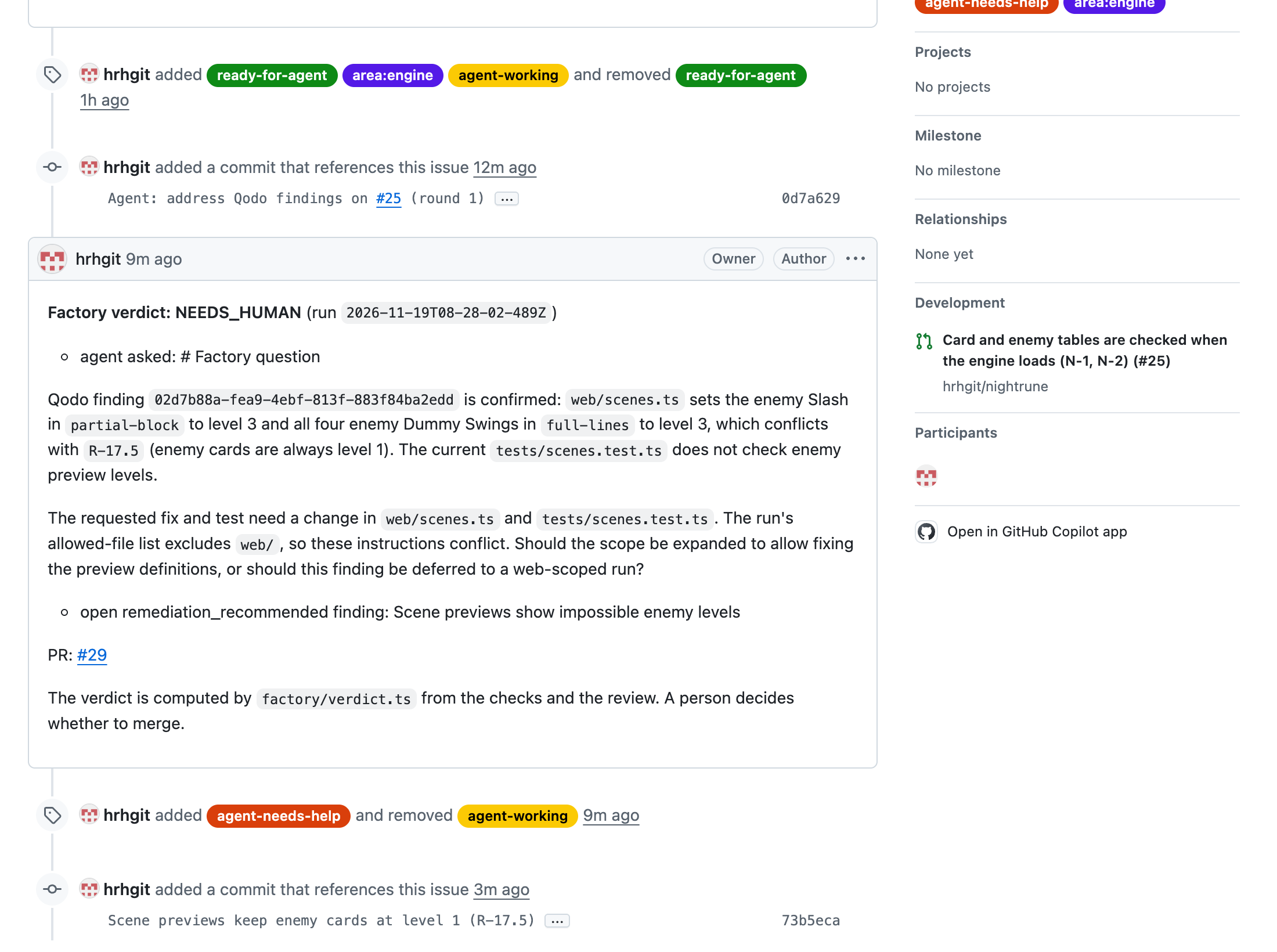

|
Trigger and workflow/source link: a GitHub listener on omerts/LamedDB that fires when I assign an issue. It only picks up issues labeled
|

|
Trigger and workflow source I set up a one-shot label listener for public Quotaline issue #12 in an already-running Codex session. Before I applied the label, the Sol agent read the issue and the project rules, confirmed the issue was open and unlabeled, started a read-only polling process, and reported it was armed at 23:53:17 UTC on November 20. The local procedure was to run the following command every five seconds for up to 15 minutes, stop at the first matching event, and verify the issue was still open and labeled before dispatching work. Project rules and merge gates gh api --paginate repos/mlemes/quotaline/issues/12/events \
--jq '.[] | select(.event=="labeled" and .label.name=="ready-for-agent" and .actor.login=="mlemes") | .id'Ticket and PR I added Checks, review and retries A pre-push check found two cases where an unusable window erased a valid reading in the same slot. One correction passed both regressions. On What still needed me I approved the ticket, armed the run through the project orchestrator, applied the label and explicitly delegated the acceptance decision. I made no manual code edits. The orchestrator checked the evidence, posted the decision using my GitHub access and merged. This run used an armed local session. It did not launch a new agent from a hosted workflow. Acceptance decision · Merge |

|
Trigger and workflow/source link: a label plus always-on loops, not a cron job. Two loops, ralph and rafa, run under systemd as long-lived supervisors ( Ticket and PR (or partial work): #16 → PR #34. After #14 merged, #16 became unblocked, and ralph claimed it at its next gate check, 19:22 UTC. The PR was open at 19:31 and merged at 19:41. I did nothing in between. Run on the same trigger, later: #17 → PR #35 (rafa) and #18 → PR #36 (ralph). What happened, including checks, Qodo review and retries:
What still needed me, or where it stopped:
Written with Claude Code (Anthropic); the loops are Claude Code sessions. |

Polson's first automatic jobPolson is an AI co-founder that ships one verified improvement every night ("no slop" backwards). Today the agent started working without anyone opening a session. Trigger and workflow
Workflow: https://github.com/shrooms08/polson/blob/main/.github/workflows/polson-agent.yml Ticket and PR
What happened (three runs)
What still needed me
Lesson: both failures ended in Built with Claude Code; reviewed by Qodo. |

|
Trigger and workflow/source link: a schedule. A launchd job on my Mac runs
Ticket and PR (or partial work): issue #5 (mask the user name in home-directory paths) → PR #18, opened by the runner (merged). What happened, including checks, Qodo review and retries: three runs on the same ticket. The first two stopped for help, as designed.
What still needed me, or where it stopped: each run stopped once, and I stepped in each time.
Takeaway: every stop was the safety net working: nothing failing was ever pushed, and each stop came with a comment saying why. Qodo again caught what our own fuzzing didn't. This time the misses were case and escape variants that the generator never produced. Assistance: AI-assisted, human-led. Claude Code built the runner and drafted this post; the scheduled agent itself is Claude Code. I chose the trigger and limits, approved each push, and decide the merge. |

ChallengeDay 4 (2026-11-05): Automate your factory’s first job. Project
What I completed
Evidence
What I learned / what is blocked
|


 and others
Uh oh!
There was an error while loading. Please reload this page.
Day 4: Automate your factory’s first job
Thursday, November 5, 2026 · Week 1: Lay your factory’s foundations
Yesterday, you connected your agent to the backlog. Today, make it pick up work automatically. Set up a trigger, such as a schedule or a tag on a ticket, so your agent can start working without you opening a session and prompting it.
Today’s challenge
ready-for-agent. Limit it to one small ticket from your hackathon project.Show your automation
Share your automation in a comment below. Include partial work if the run got stuck.
All reactions