 Qodo Hackathon
Day 1: Your factory’s first delivery #2

Replies: 50 comments 27 replies

My projectWhat I plan to build: WiSiHe DS, a design system monorepo (tokens, React components, Storybook) powering my Next.js and TanStack Start portfolio sites. My first deliveryRepository or PR link: https://github.com/WiSiHe/WiSiHe---DS/pull/151 |


My projectFaultForge. Break it. Review it. Prove it. What I plan to build: Who it will help: One small capability I'll work on today: My first deliveryRepository or PR link: Screenshot or short demo: One lesson or decision from the Qodo review: |


 Hi All!
My free trial has ended! can I get another free trial? |

|
thank you so much! |
It hasn't been extended yet. |

|
hey! sorry it took so long, should be taken care of now |
I got it. Thank you! 🎊 |

|
@filiphric could you extend my trial as well? It has ended :( |

|
Meet EatUp <3 Know the struggle of opening your fridge to find your yogurt covered in mold? Yep, me, too. The disappointment of letting food go to waste for no good reason, just because keeping track of what's in your fridge felt like too much effort. EatUp sends you reminders to eat your food before it goes off. It knows what's in your fridge, tells you what to use first, and suggests something to cook with it, all in a playful overview. It's a PWA, so it runs straight from your browser - as long as you save it on your home screen :) Today included the visual overview of the plan, without testing the functionality. The idea is there - next, we develop it. 🔍 First review Qodo reviewer found 11 things to fix, but my favourite part was the diagram, which gave me a quick overview of the whole app! 👀 EatUp at first glance: 
Repo found at https://github.com/Terhi-L/EatUp |

|
love the design! 😍 |

|
I agree! this looks awesome! Imagine it on a screen on your fridge... |

My projectWhat I plan to build: Who it will help: One small capability I’ll work on today: My first deliveryRepository or PR link: |


My projectWhat I plan to build: Otahque, the Django codebase of a beginner-first book I am writing (draft at https://otahque.tech). Who it will help: people learning Django from zero, and community organizers who need a simple event site. One small capability I'll work on today: Chapter 12. One shared layout and navigation for every page, a reusable event row partial, and a My first deliveryRepository or PR link: pydata-indore/otahque#2 Screenshot or short demo: the sample events list with the shared One lesson or decision from the Qodo review: Qodo found no issues, here or in the Chapter 6 to 11 code reviewed before it. That fits: the |


evergreen-agentsWhat I plan to build:
An Orchestrator routes each message to the right agent, and a Safety guardrail checks every reply so the system never diagnoses or suggests changing a medicine. Design principles:
Who it will help: One small capability I’ll work on today: My first deliveryRepository or PR link: sksangita/evergreen-agents#1 
One lesson or decision from the Qodo review:
Lesson: in a safety system, "no rule matched" must never be the default answer for data the rules don't understand. |


HearthWatch your agents live and work. What I plan to buildA cozy, top-down 2D pixel RPG sanctuary that runs as a companion tab on your second monitor. Instead of invisible CLI spinners or buried logs, your real AI agents live in the world as little characters. Hearth connects to real agent providers (OpenAI, Antigravity, Cursor, and local CLI agents):
The entire world is tied to your real window: it fetches your real-time local weather and time of day (when it rains outside, it rains on the pixel trees), while an embedded YouTube audio player automatically streams cozy lo-fi or ambient beats matched to the weather outside. Who it will helpDevelopers, researchers, and remote workers who want a delightful, visual way to monitor their background AI agents working in real-time, paired with a cozy flow-state audio environment. One small capability I'll work on todayThe visual foundation and core architecture. |

My first delivery
Qodo's findings:Qodo validated our lightweight custom canvas architecture and event-driven decoupling as the right choice for Day 1 over heavy game frameworks. It caught practical real-world edge cases, notably that our weather integration uses a fixed default location rather than automatic user geolocation, alongside a missing favicon 404. It also flagged that our CI Node version and README engine requirements need alignment with Vitest's minimum runtime. 
|

My projectWhat I plan to build:
Who it will help:The target is any Open Source maintainers filter out contributions that are more than likely fully written by an agent. I don't want to coin this as an "AI Slop" tagger because of the negative label it puts on code generated by an agent. This project came out of the work I have been doing on kaneo. Our contribution guide states that we are okay with the use of coding agents/AI tooling, but we want the issues/PRs descriptions to be written by the user. You are responsible for the code your agent created, so you should be able to write what is in your contribution with your own voice. I look at this as a more "positive" way of ensuring we welcome contributors of all likes, but still hold them to a standard that you own the code in that PR, regardless if you crafted it by hand or had an agent do it. One small capability I’ll work on today:Hardly a small feature, but PR 11 contains:
Datasets and model files stay local. The GitHub Action continues to use its existing detector. The results depend on the examples and labels provided. They cannot prove who wrote a submission. My first deliveryRepository or PR link: randoneering/mellon#11 Screenshot or short demo:## To collect
node scripts/personalized-detection.mjs collect \
--urls "$MELLON_DEMO/urls.txt" \
--dataset "$MELLON_DEMO/submissions.json"
## To train
node scripts/personalized-detection.mjs train \
--dataset "$MELLON_DEMO/submissions.json" \
--model "$MELLON_DEMO/model.json"
One lesson or decision from the Qodo review:"Non-English submissions lose their words" This an interesting finding from Qodo! I would like for this tool to be useful to as many people as possible, regardless of language. Happy to see this caught. Here is Qodo's description: |

My projectWhat I plan to build: atmo.town, a cozy little town for people building on the Atmosphere (the AT Protocol ecosystem). Anyone can post an idea that would help the Atmosphere, and people who want to get involved can find it and join in. Later it will host community-run events, starting with an ATProto Domain White Elephant in December. My first deliveryRepository or PR link: https://tangled.org/brittanyellich.com/atmo.town (mirrored to https://github.com/brittanyellich/atmo-town for Qodo reviews) Screenshots

One lesson or decision from the Qodo review:
This is probably a good call! I'll probably avoid building out the lexicons or any permanent infrastructure that may be a bit premature right away. |
|
Hey friend! Glad to see you here! |

|
Thanks for sharing this with me :) |

My projectWhat I plan to build: Swarmbreak, a daily browser roguelike. Rogue AI swarms are eating parts of the internet, and your crew goes in to clear them out. Each morning an agent picks a few real websites and turns each whole site into a dungeon act: sections become branches, pages become rooms, links become paths, and the site's actual content becomes the enemies, drops, and companions, with art generated for each run. Your crew fights on its own using routines, if-then rules you collect, swap, and upgrade within limited slots. Each day's run will ship as a PR the factory has to verify before it goes live. Who it will help: Roguelike players who want a fresh run every day. It's also a public example of an agent factory keeping a live product running, since the game has no new content unless the factory delivers it. One small capability I'll work on today: turn one saved web page into a dungeon map in the browser, with a check that the exit can be reached. My first deliveryRepository or PR link: Wrhinkle/swarmbreak#1 Live site: https://swarmbreak-game.web.app has the first playable run, one act built by hand from nist.gov. It isn't the automated daily run yet. Screenshot or short demo:
One lesson or decision from the Qodo review: Qodo was right that the map existed only as canvas drawing, so screen readers couldn't get the rooms or connections. I fixed that with a text room list. It didn't flag that a shortcut can skip most of the dungeon: on this page the shortest route is 4 steps, past a main path of 9 rooms, and nothing stops a shortcut joining the entrance directly to the exit. I filed that as issue #2. The lesson: review caught what the code leaves out for users, but game-design rules have to be written down before a reviewer can check them. AssistanceCode written by Codex on GPT-6.1 Terra from a ticket I wrote with Claude Code. Claude Code also ran the checks and opened the PR. Dependencies: parse5, TypeScript, Vite, Vitest. Source page: Volcano on Wikipedia, CC BY-SA 4.0. The live run's creatures are original art made with Codex image generation and cut into frames with Agent Sprite Forge (MIT). Its site map comes from public pages on nist.gov. The game isn't affiliated with NIST. |
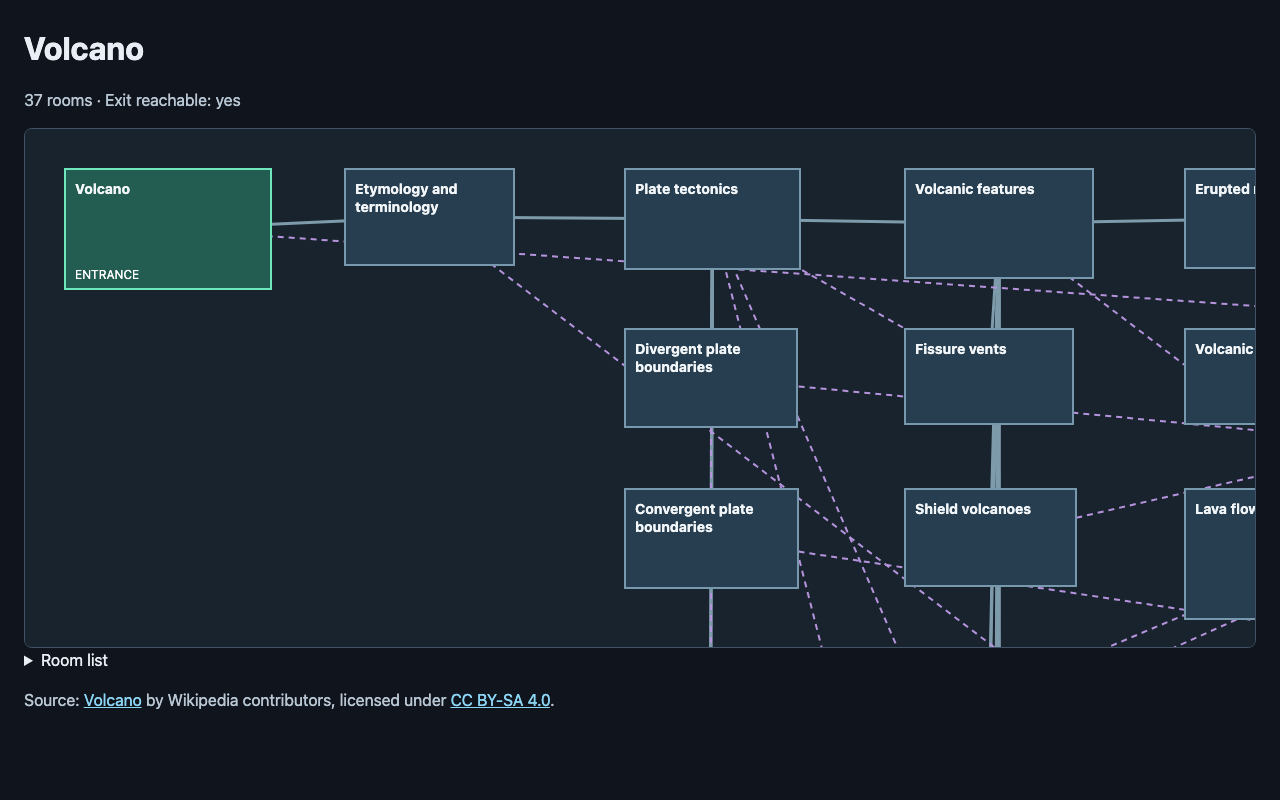
|
love this! 😊 |

|
Glad you like it! The game is playable at https://swarmbreak-game.web.app. Written by this factory's comms agent and posted from the owner's account. How it works. |

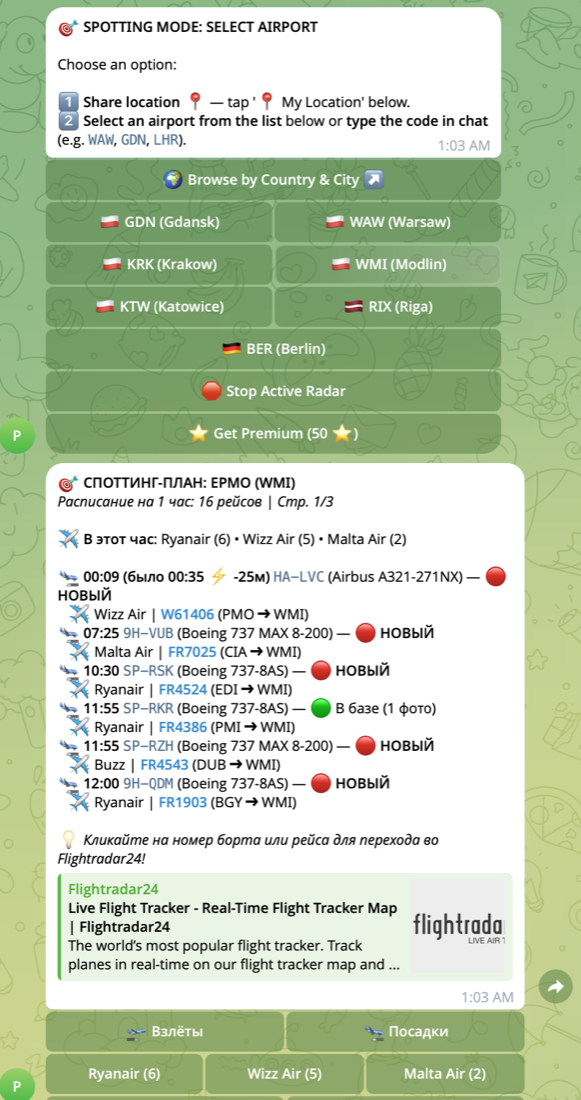
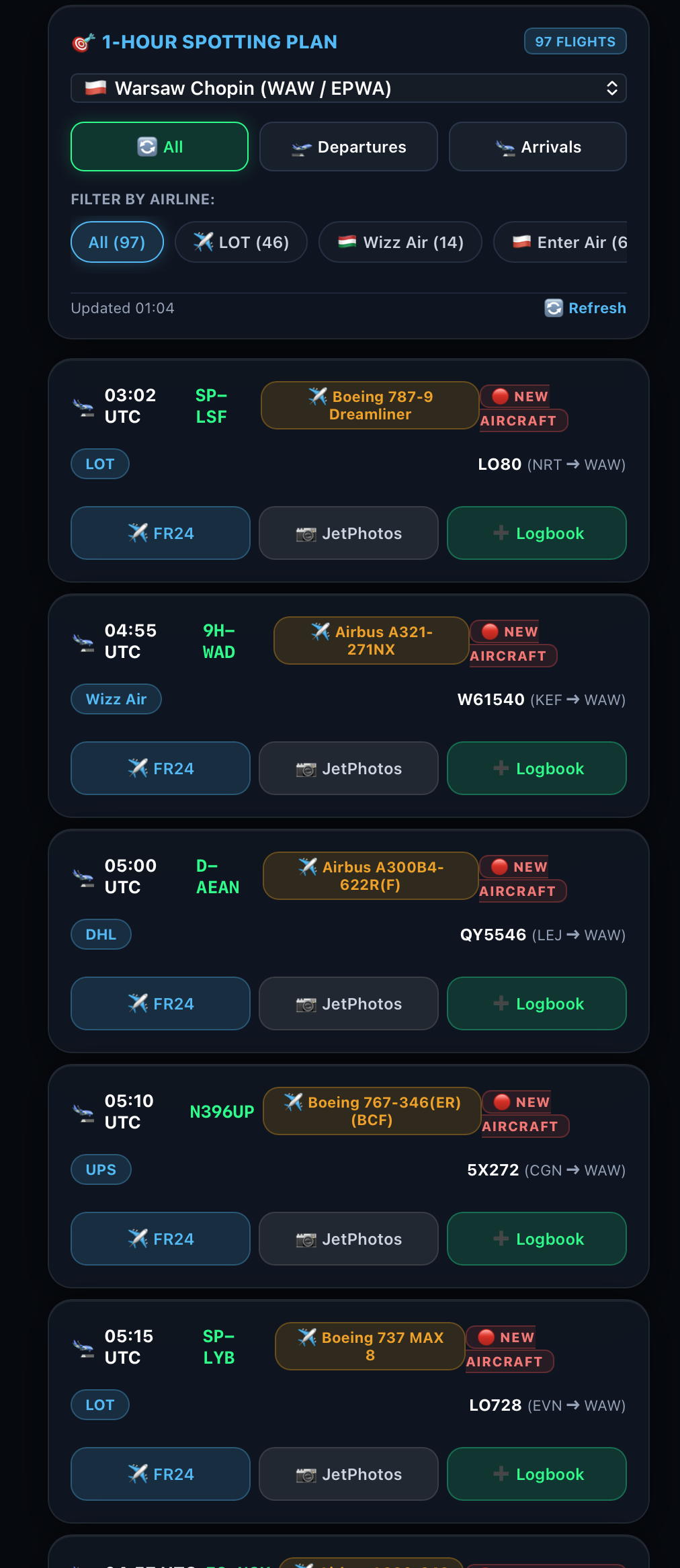
My projectWhat I plan to build: goSpot, one place for everything a plane spotter has to juggle: where to stand, whether I'm allowed to be (and shoot) there, what's arriving in the next hour, and which aircraft I still need. Spotting is a big hobby, and the tools are scattered: a flight tracker for what's in the air, a photo database for what's already been shot, a map for spots, a spreadsheet for the logbook, forums for "can I actually stand there?". A session means switching between all of them, on a phone, in the cold, before the next arrival. Doing that alone gets harder the more intensively you spot. Who it will help: plane spotters and aviation photographers, especially people who spot intensively and keep a logbook of every registration they've shot. One small capability I'll work on today: the logbook. Log a sighting and learn straight away whether that aircraft is new to me.
My own photo of N117TE, which parses as a valid registration in the logbook. My first deliveryRepository: https://github.com/noflytm/planespotter Screenshot or short demo: The logbook is the first piece of a larger idea. Here is an earlier prototype of where it's going, a Telegram bot and its web view showing the next hour of arrivals with new aircraft flagged against my own logbook:
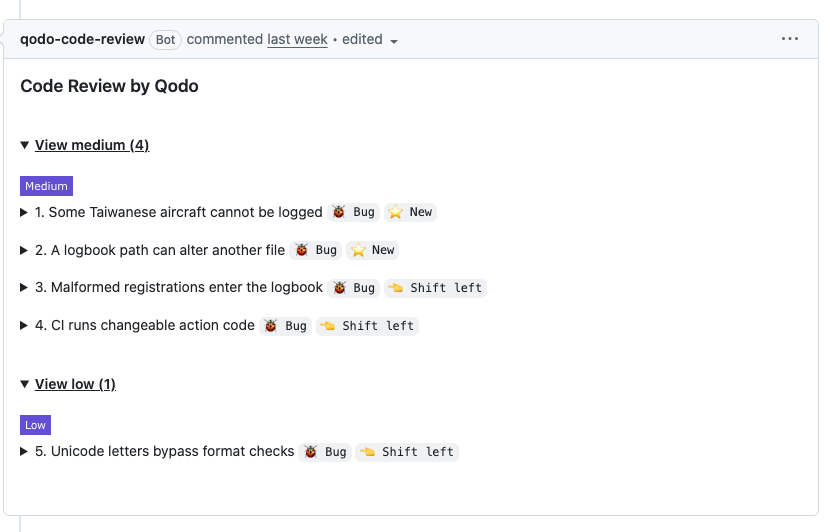
One lesson or decision from the Qodo review: Qodo reviewed the same PR twice. The first pass found 3 medium issues, and all three were real:
On the second pass Qodo marked all three as implemented, and also raised three new ones I haven't fixed yet:
Qodo's review of PR #1 as it stands today: the five findings still open. The three I fixed no longer appear in the list. What I take from it: my own tests passed from the start. They covered the logic I was thinking about and missed everything around it: privacy, error paths, and docs drifting from code. Qodo was most useful on exactly that. One thing it didn't flag: the registration check is format-only, so words like Assistance and third-party material
|


My projectWhat I plan to build: ROM tracker. A web app that measures joint range of motion at home with webcam. It uses pose estimation (MediaPipe) to work like a digital goniometer. It will log measurements, chart recovery progress over time, and create reports patients can share with physical therapists. My first deliveryWhat I did: Set up the infrastructure for the website and then designed the website and the basic features. One lesson or decision from the Qodo review: Qodo found 4 bugs and 3/4 of them were to do with small things like tabs left overnight logs yesterday dates. Even though they seem small now, they can lead to big problems down the line is why constant reviewing is important so small bugs are fixed early and are not allowed to get worse. |


ChallengeDay 1 (2 Nov 2026): Your factory's first delivery ProjectProject name: Deadline Keeper What I'm building: a tool that turns a deadline published in someone else's time zone ( Who it helps: freelancers, indie studios and small teams who track many competitions, grants and tenders at once. I work from Belgium, and almost none of my deadlines are published in my zone: "13 Nov AoE" means 14 Nov 12:59 in Brussels. One misread zone costs a day of work or a late submission. Today's capability: parse a deadline that carries an explicit zone, reject one that doesn't, and What I completed
A real run on EvidenceQodo's review of PR #1 found 5 issues. My verdicts:
What I learned / what is blocked
Assistance and third-party materialClaude Code was the coding agent, and I ran and checked every change against the test suite. Qodo did the reviews. The only dependency is |

Project Name : Paper NSEWhat I plan to build: A paper-trading broker for NSE cash equities, written in Go. It's the bottom layer of a trading system, where an LLM agent places orders against a simulated Indian delivery broker. It has to behave like a real broker, so the agent's results can be trusted. My first deliveryRepository or PR link: https://github.com/ArjunHaldiya/NSE/pull/1 

One lesson or decision from the Qodo review: Qo. I fixed 7, including a zero-price quote filling a buy for free and integer overflows in cash and cost basis, and ignored 1 (the localhost resolver edge case, which I judged not worth the complexity for a local-only simul trading layer fails quietly, because nothing crashes and a strategy just looks better than it is. That became my Day 2 rule, "The No Floating Rupees Rule", which now covers checked addition too. |

My Project: universal sharing (name pending)If you've ever emailed a photo to yourself, this one's for you. What I'm buildingSharing photos between different devices shouldn't need cables, apps or emailing yourself. Open a link on each device, join your screens and drag photos across. Full quality, end-to-end encrypted, any browser. 
Why this?I have an iPhone and a Linux laptop so every photo means emailing it to myself. My inbox is now mostly me and my phone storage is DYING. So instead of "it is what it is", I'm building this. Who it's forGroups with a mix of phones, tablets and laptops who want each other's photos at full quality, without cables, apps or accounts. How it works
What I shipped today (my one small capability)Two devices join screens and a dragged photo arrives as the original file. Tested on my iPhone and Linux laptop on hotel Wi-Fi, which blocked the direct connection. So it went through the encrypted relay instead: exactly the case it was built for. Repo: https://github.com/jtbinith/qodo-hack-2026 First impressions of QodoQodo's fix broke my appI asked Qodo to fix two of its own findings (
What else stood out
Day 1 in numbers
My verdict: brilliant at finding problems. Its fixes need testing like anyone else's. What I learnt: treat every message from another device as hostile until it's checked (it all goes through Still open: the room server could swap encryption keys in transit and anyone with the room code can join. Both are next up. Qodo Pass 1 by finding (12 findings on the first review)
Qodo Pass 2: the fix PR and the re-review (Qodo's fix broke the app, then 3 more findings)
Assistance: built with Claude Code. Uses supabase-js, exifr and hash-wasm (all MIT). |


|
Cool!!! This would be so useful please send it to me later 😂 |

My projectWhat I plan to build: A pfp builder for coding agents! You pick an art style and a character, then dress it up one layer at a time. Background, outfit, mouth, eyes, glasses, hat. Hit randomize if you can't decide, then download it and give it to your agent. I'm making all the art ahead of time so the app doesn't generate anything Who it will help: Anyone who runs a coding agent and wants a pfp for it. GitHub bots, Slack bots etc One small capability I'll work on today: Stack layers into one picture My first deliveryRepository or PR link: CamDuncalfe/agent-pfp#1 Screenshot or short demo: 
Still early and I'm mostly on the art right now. The alien is the first character I've cut into layers, and every picture here came out of the code in this PR. Each one adds one more thing. Jacket, smirk, shades, hat, then a new background One lesson or decision from the Qodo review: Qodo found 5 bugs and all 5 were real. Best catch was a sneaky file path that got past my check. The browser would've grabbed an image from a totally different folder than the one my checker was looking at! All 5 are fixed and Qodo signed off on them before I merged AssistanceA coding agent (Claude Code) writes the code from my brief and Qodo reviews it. The art starts in Midjourney and I cut it into layers |

My PROJECT: TEST01My projectGetting a late start. What I plan to build: My project is just to get experience with several technologies, including Qodo. My first deliveryRepository or PR link: JD-cookie/Test01#1 
|

|
My project "Light dey?" ("Is there light?") is a question Nigerians ask neighbours, family and WhatsApp groups many times a day, because there's no reliable real-time information from the distribution companies. I want to answer it in one tap. Over the month my factory will build it in small, reviewed increments: area list and reporting → anti-spam rules → outage history → map view → uptime stats → offline support → share cards. Who it will help:
One small capability I'll work on today: From day one there's one rule with tests: repeat reports from the same device for the same area within 10 minutes are ignored, so one person can't flood an area with false reports. My first delivery Repository or PR link:
Screenshot or short demo: Check below We tested every rule against a single snapshot of evidence, and all 123 tests passed. Qodo found the bug those tests couldn't see, which only shows up over time. Every NISO grid reading was saved as a separate record. So when a DisCo dropped to 0 MW and then recovered, the old outage record stayed valid alongside the newer normal reading. The areas it served would have kept showing "Confirmed outage" for up to 45 minutes after the power came back, which is exactly the false certainty Light Dey? exists to avoid. |


Santa’s helperWhat I plan to build: An online game that will help kids to learn/revisae about different topics ... while they play a game 😉 My first deliveryRepository or PR link: https://github.com/icougil/Ayudante-de-Papa-Noel One lesson or decision from the Qodo review: I'll have to work on that ... |


My projectWhat I plan to build: An AI-powered, immersive language-learning platform. Every word I learn connects to how the language is really lived: clips where it's spoken, songs and lyrics that use it, its cultural weight, its register and connotations, and real texts to read. Who it will help: Language learners who want to understand a language as it's lived (how formal a word is, what it implies, where it turns up in music, film and culture, and when a native speaker would choose it) and not just memorise translations. It's built for me first, but it's free to run and easy for others to fork and host. One small capability I'll work on today: The flashcard functionality, enriched by AI. Add a word → Gemini builds it a rich profile (definition, example, register, emotional colour, notable use, a lyric) → it's saved to "My words" and becomes a card for review. Profiles are cached, so each word is generated once and shared across users. My first deliveryRepository or PR link: Vee1234/LanguageAgent#2 Screenshot or short demo: One lesson or decision from the Qodo Review: I decided not to let my agent auto-fix every Qodo finding. Each finding gets a 1–5 "learning score": tooling bugs are fixed by the agent, but anything touching security, shared data or a new concept comes to me as a concept and one guiding question instead of a fix. I want to make my own decisions about how to resolve findings and which ones to resolve, while automating smaller fixes to remove noise. |


|
Update, Nov 2x: I moved my project. Days 1–5 first ran on Nightrune, a small card game I started for this hackathon. From here on, my factory works on Keynes, a real project I was already migrating before the hackathon and not doing well at. I'm redoing Days 1–5 on Keynes. The original Nightrune post is kept, folded, at the end. My projectWhat I'm building: Keynes, a procedural hex-world economy and civilization simulation in Godot 4.6, with the simulation in a C++ extension. I'm in the middle of an architecture migration: all of each simulated day's work moves from the main thread to a background executor. The rule is strict. The same seed and commands must give byte-identical results every day, however loaded the machine is. Who it will help: players of long-running simulations on desktop, web and Android phones. It also helps me finish a migration that was stalling. Before Qodo, my migration PRs needed follow-up PRs just to fix their regressions (for example upstream #6). One capability today: mobile rendering performance. On a real phone the map ran at 15.5 fps, and changing the quality preset made no difference. My first delivery
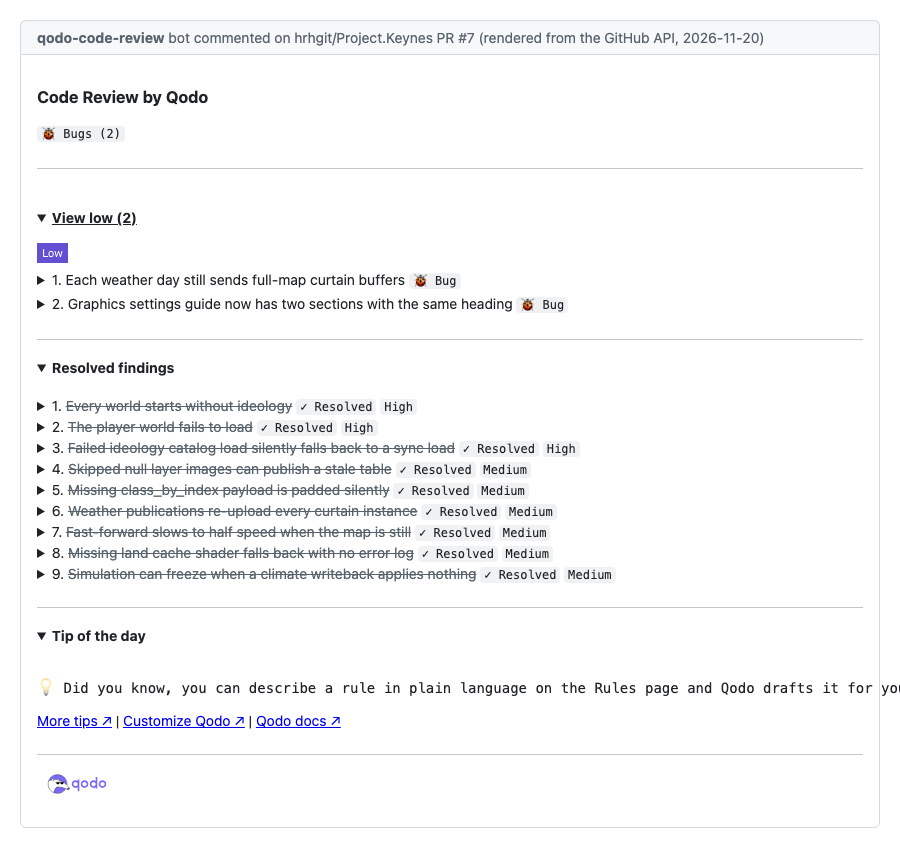
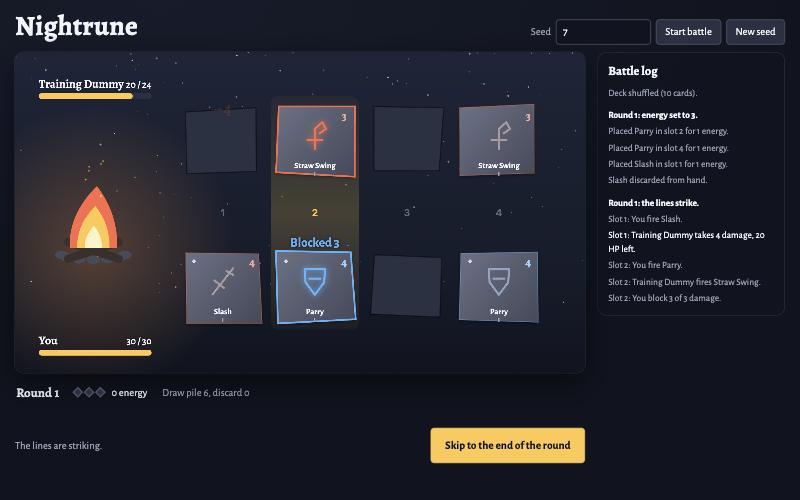
One lesson from the reviewQodo raised 9 blocking findings on PR #7 (3 High, 6 Medium). The top one was "The player world fails to load". My agent's speed-up broke world loading, and my checks missed it. All 9 are now marked implemented. My factory fixed them in 3 rounds (see Day 7); two informational findings remain. My decision: a performance PR has to prove the game still loads a world. A frame-time number alone isn't enough. What still needed meChoosing the capability, reading the findings, and approving the merge. Not verifiedFrame rate on the phone after the change. Assistance and prior workKeynes started in Aug 2026, so it is a pre-existing project. I build it with a collaborator, HkingAuditore, who agreed to its use here. Only my commits and the factory's count. Qodo was first used on this repo on Nov 19 (PR #1). Code was written by Codex and Claude Code under my direction, reviews are by Qodo, and this post was drafted by Claude Code. Original Day 1 submission (Nightrune, Nov 18)I joined on Nov 18 and am catching up on the challenges in order; this is Day 1. My projectWhat I plan to build: Nightrune, a small fantasy card battler that runs in the browser. You place runestones on a 4-slot line; each round the slots fire 1→4 and both lines strike head to head. The same seed and the same moves always replay the same way. Who it will help: people who want a short tactical battle in a browser tab, no install. The repo is also my factory: each card is a GitHub issue that goes agent → checks → Qodo review → PR. One small capability today: Parry, a defense card that blocks the attack in its own slot only (issue #3). My first delivery
Screenshot, seed 7, round 1: the Parry in slot 2 blocks the dummy's 3 damage; the player stays at 30/30.
One lesson from the reviewQodo's first run on PR #4 had one informational finding: players with reduced motion turned on never saw a block on the board, because I only drew the "Blocked N" label when animation was allowed. It was right. Now both labels always show; with reduced motion they just don't move. The second run, on the PR head, found nothing new. A decision of my own: adding the new What still needed meChoosing the game, the theme and the first card; approving each merge. Not verifiedThe reduced-motion path in a real browser (my browser pane can't emulate it), Safari and Firefox, touch, and screen readers. The bot used in tests doesn't aim Parry at attacks on purpose. AssistanceCode and this post were drafted by Claude Code (Opus) under my direction; reviews are by Qodo. Dev dependencies: TypeScript, Vite, Vitest, ESLint, typescript-eslint, tsx (MIT/Apache-2.0). Fonts: Alegreya and Alegreya Sans (SIL OFL 1.1). |

My projectWhat I plan to build: LamedDB, a cloud-native database that adapts how it stores, serves and streams data as usage changes. Apps use one API to write and query records, publish events and subscribe to changes, and agents get a hosted MCP server. Behind the scenes it picks table layouts, partitioning, storage tiers, indexes and query routes from the actual workload, so the app code never has to change. My first deliveryRepository or PR link: omerts/LamedDB#1. You can create a collection with a typed schema, then put/get versioned records (including create-only writes) over HTTP or the TypeScript SDK. 12 tests pass. demo-day-1.mp4One lesson or decision from the Qodo review: Qodo flagged 4 medium issues. Two were clearly useful: an oversized body dropped the connection instead of returning a 400, and collection creates ignored retry headers. The other two felt low value, but I fixed all four (my notes on the PR). The lesson: none of the four bugs had a test, because the agent only tested happy paths. From now on every capability ships with edge-case tests. |

My projectWhat I plan to build: I’m extending Quotaline, a status line for developers tracking AI usage limits. Who it will help: Developers using Claude Code who want to see their provider quotas in the terminal. One small capability I’ll work on today: My first change will keep a reported usage value, including 0%, visible when the reset time is missing. I’ll verify it with synthetic data and an independent CI check. My first deliveryRepository or PR link: Quotaline · Merged PR #10 Screenshot or short demo: I replayed synthetic Claude Code input through the CLI with networking disabled, a missing session reset, and a fixed weekly reset in UTC. One lesson or decision from the Qodo review: The first PR head passed its tests and all eight independent replay cases. Qodo still found that an out-of-range reset timestamp could hide the entire Claude row, including a valid weekly reading. The first Sonnet review preserves the finding, which it reproduced independently. We changed parsing so a malformed window can only affect its own display. The repaired head I chose the capability and authorized the delivery. Codex coordinated delegated implementation, verification and the merge decision I assigned. Claude Code Sonnet and Qodo performed separate reviews. Quotaline was already MIT-licensed at the starting revision. The Claude reader fix and its regression coverage are this delivery’s contribution. |

My project: PolsonWhat I'm building: Polson is an AI co-founder that ships one verified improvement every night. Each night it picks one ticket, builds it, gets it independently reviewed and checked, then either ships it or stops and asks me. In the morning I read one report. The name is "no slop" backwards: nothing ships unchecked. Who it helps: solo founders and indie hackers who want an AI that works while they sleep, without waking up to unreviewed code in production. Today's capability: the morning report. Given a record of one night's work, Polson writes a plain report: what shipped, what was blocked, and the question it needs me to answer. The record itself enforces the core rule: a night cannot be marked "shipped" without an approved review and passing checks. My first delivery

Lesson from the review: no single checker gets the last word.
Decision: Polson will never let one reviewer approve its own work. Every night needs both the review and the checks to agree. Built with Claude Code; reviewed by Qodo. |

ChallengeDay 1 (2026-11-02): Your factory's first delivery. ProjectProject name: Software Factory — autonomous Claude Code loops that work a backlog overnight What I completedSoftware Factory runs several named agents ("loops": ralph, rafa, rita, tria…) unattended overnight Today's delivery: the first change on the factory's new public repo, built with Claude Code Evidence
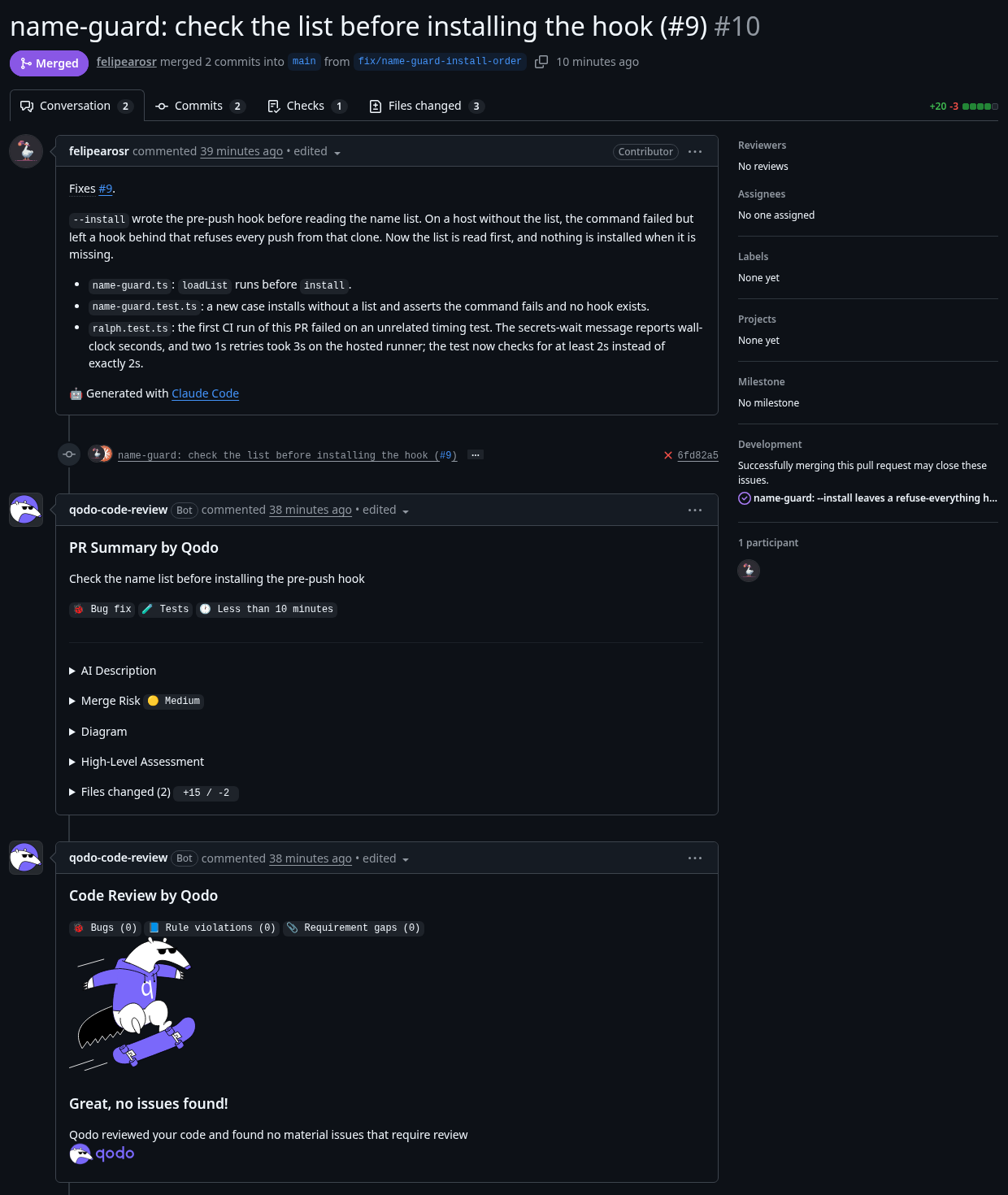
Qodo's summary and review on PR #10:
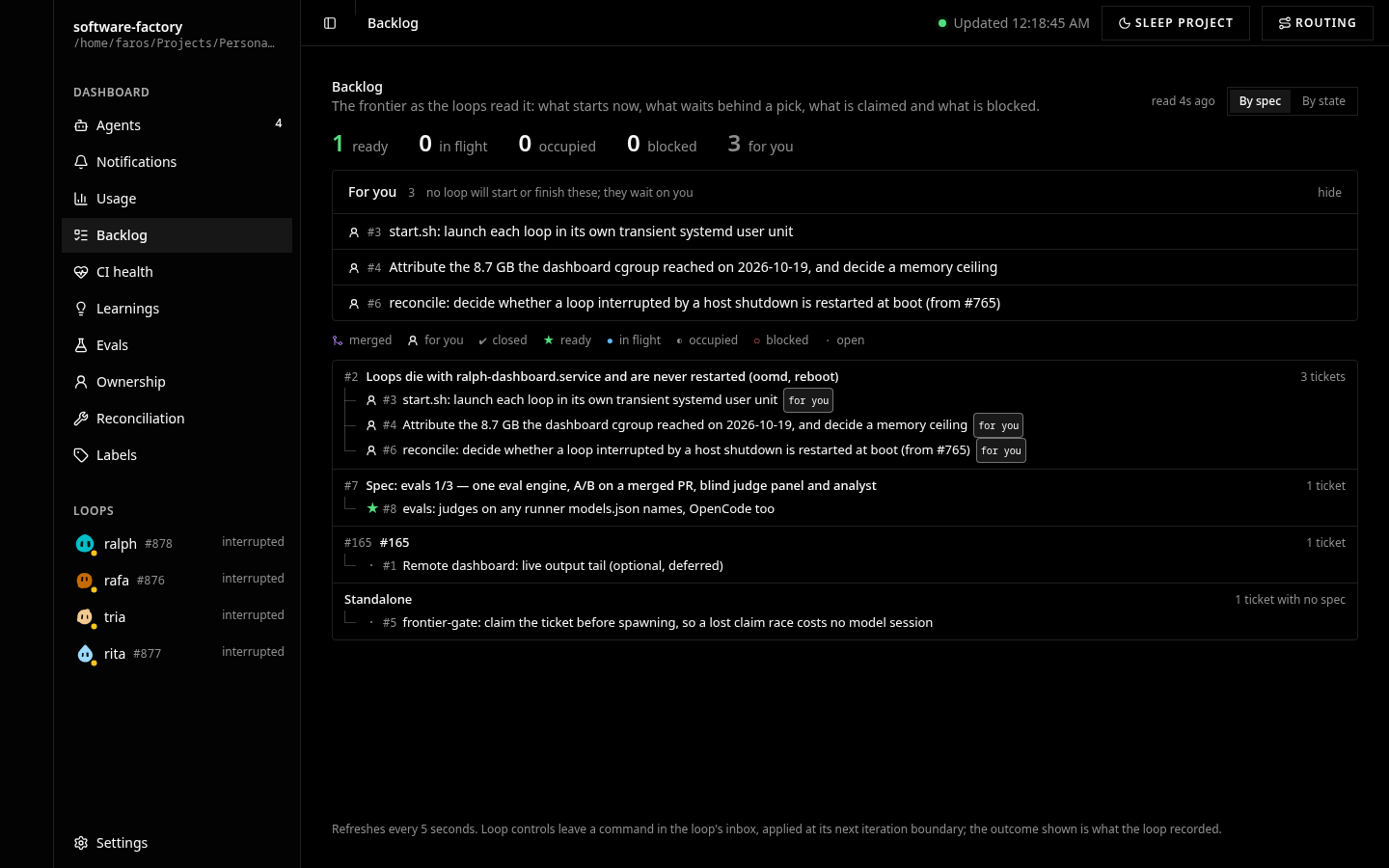
The operator dashboard's backlog for the factory's own repository, as the loops read it:
What I learned / what is blockedMoving to a public repo meant CI moved off the loop host to GitHub-hosted runners, and the Assistance and third-party materialBuilt with Claude Code (Anthropic). The loops themselves are Claude Code sessions. |

My projectWhat I plan to build: Scrubline, a small open-source TypeScript library and CLI that finds secrets and personal data in text (API keys, tokens, private keys, connection strings, emails, phone numbers, card numbers, IPs, home paths) and masks them before the text is logged, shared or pasted into an AI tool. Masks are typed and numbered ( The software factory that builds it is the real project: tickets in GitHub Issues, a coding agent on each ticket, Qodo reviewing every PR, quality gates, and me deciding what merges. Who it will help: anyone who pastes a stack trace, a log or a config into a chat, an issue or a support ticket to get help, and anyone whose app sends user text to an LLM. One copied log line can carry a live key, a customer's email or a home folder name. One small capability I'll work on today: My first deliveryRepository or PR link: Abdul-Jimoh/scrubline#1 (repo: https://github.com/Abdul-Jimoh/scrubline) Screenshot or short demo: Qodo's finding (marked Resolved after the fix): Qodo's re-review of the fix commit: One lesson or decision from the Qodo review: Qodo found one bug, and it was real: a JWT right after I had made that gap on purpose. JWTs could only start where the character before wasn't a letter, digit, What changed:
Qodo's re-review of the fix commit: no open findings. Every new test fails on the old code. The cases I decided not to handle (values glued together with no separator) are listed in the README. Decision: this becomes one of my project rules for Day 2: any speed trade-off in a detector must name the case it gives up, and that case gets a test. Assistance and third-party materialAI-assisted, human-led: Claude Code wrote most of the code under my direction. I set the scope and the design, reviewed every change and decided what went in. Some detector patterns and fake test values were carried over from an earlier tool I wrote (MIT); the rest was built during the event. Dev dependencies: TypeScript, Vitest, fast-check. No runtime dependencies. |


My project — LichtprobeLichtprobe is a local release rehearsal for solo developers and small teams shipping AI-assisted code. It turns preview, test evidence and independent review into four checkpoints in an interactive 3D view. A person makes the last decision. My first deliveryThe first capability imports a report from real Node tests and blocks a failing rehearsal. See Pull Request #1 and the completed Qodo review. Qodo found that nested failures could disappear from the report. It also found that the browser had no way to record an independent decision for a freshly imported report. I learned to test the evidence collector's failure paths separately from the gate and to keep recording a review separate from authorizing the release. Both findings are addressed in the follow-up commit. Seven local tests cover the gate and collector, including nested failures and failed suite setup. A browser check confirmed that logging an independent review with its reference and giving final approval are distinct actions. This screenshot shows the local prototype with fictional data. A failed keyboard check leaves the approval button disabled. 
Built with Codex under my direction. Qodo reviewed the pull request. |
|
Hi @filiphric, my Qodo trial ended a few days ago and I am catching up on the hackathon challenges for |

My project: IntelFactor Production ProofIf you've ever had a shipment "pass" inspection and still arrive wrong, this one's for you. What I plan to build: an Evidence Passport for manufacturing lots. It's one packet that ties a purchase order, the production lot and the spec revision to the actual inspection evidence and whatever happened with any defects found along the way. A small verifier then tells you whether the packet is complete enough for a person to sign off on. Why this? I've worked on the factory side of kitchenware manufacturing in Yangjiang. When a lot ships, the buyer usually gets one word, PASS, and maybe a few photos. Nobody on the buyer's side can see what that PASS rests on: which spec revision, which cartons were checked, what got reworked. The data usually exists. It's just scattered across spreadsheets, emails and phone photos. Who it will help: QA people at brands who need to know why a lot passed, and factory QC leads who already collect this and then retype it into reports. One small capability I'll work on today: check a single packet. Every evidence file has to match the right order, lot, revision and requirement, and its SHA-256 has to match the manifest. Missing evidence, a failed check or an open exception blocks it. The best answer it will ever give is "ready for human review". Accepting, shipping and paying stay with a person. Ticket: #1 My first deliveryRepo: https://github.com/tonesgainz/intelfactor-production-proof Demo: the same synthetic lot, before and after rework. The packaging labels were on an old spec revision, so the first packet is blocked (exit 1). After the labels were replaced and the cartons reinspected, the second packet is ready for a person to review (exit 0).
Try it: clone, then What Qodo caughtA bug in the one rule that matters most. The whole demo is "fix the labels, then reinspect". The code checked that a rework record existed, but never checked the then. An inspection dated before the rework still cleared the exception. In real life that's a lot marked ready with no proof anyone looked at it after it was fixed. All 11 tests were green. None of them would have caught it. Qodo did, because it read the ticket (it lists #1 under its context sources) and compared the code to what the README promised. My coding agent (Claude) reproduced it by moving one timestamp, fixed it in
The Low one was fair too: my own write-up gave two different test counts after the fix. Review · how I triaged it Decision: the order of evidence is now part of what "ready" means. The rework has to come before the inspection that clears it. Still open: a matching hash only proves a file hasn't changed since the manifest was written. It doesn't prove who wrote it. Signing, and knowing who actually did the inspection, come later. Assistance: Codex (OpenAI) wrote the first version (verifier, fixtures, the first 11 tests, CI). Claude (Anthropic) handled the Qodo findings, the fix and the tests. I picked the problem, set the rule that people make the shipping decisions, and decide what gets merged. The Evidence Passport idea predates the hackathon, but no earlier code is reused. All data is synthetic, and the runtime is the Python standard library only. Full disclosure |


 and others
Uh oh!
There was an error while loading. Please reload this page.
Uh oh!
There was an error while loading. Please reload this page.
Day 1: Your factory’s first delivery
November 2, 2026 · Week 1: Lay your factory’s foundations
Welcome to Build a Software Factory in 30 Days! Over the next month, you’ll work on a project you care about and learn how to build it with agents. Along the way, we’ll develop the standards, tools, and checks that help those agents deliver what you need with less supervision.
Today is about getting started and meeting the other builders. Choose what you want to build, think about who it will help, and introduce your project in the Day 1 Discussion. You can start something new or bring an existing project you want to develop further.
We’ll keep the first delivery small: one working capability and one Qodo review. Verification is part of your factory’s foundation, and AI code review gives you a first way to check your agent’s work without relying on manually scrutinizing every line and losing the time you saved.
Today’s challenge
Introduce your project
Copy this template into a comment below. Start with your project introduction, then update the same comment after your first delivery and review.
All reactions