 Qodo Hackathon
Day 2: Your factory, your rules #4

Replies: 43 comments 16 replies

Day 2 — A few clear rules for the agentI added an AGENTS.md to explain how an AI coding assistant should work on MerchantFlow. It includes setup instructions and five rules:
My strongest rule is simple: An AI agent must not send a payment, even with test tokens, without my approval for that exact amount and recipient. Why? We made one real test payment of 0.01 USDC on Solana devnet. It worked. But an automatic retry could send another payment if a response is slow. I want a person to make that decision. PR #9 passed the checks and is merged. The review rules are active in Qodo. This is still a prototype, not a production payment service. |

RulesMy most opinionated rule
Why: I hate it when an agent over-explains, and I miss the point. This rule makes sure I read only the main point, and the most important information won't get lost. It also saves my own brain power - no need to read unnecessary information. When I want to understand something or any changes, I will ask myself. Verification: Testing with a prompt that should follow 2 rules: the above (no over-explaining), and to not act on a question, but give a suggestion and confirm it with a user before applying. |

|
I always encourage using the "bro" skill or caveman to make sure the agent's just give me enough words to make a sentence hah! |

|
Aah yes I've heard of it, nice tip! Does it always get picked up automatically, or have you added it as a rule ("use the "bro" skill in all your answers")? Wondering if it's applied automatically when discussing chosen methods or architecture, for example. The over-explaining is at its worst there! :D |

My factory's house rulesAGENTS.md link: https://github.com/RuiCodex-dev/deadline-keeper/blob/main/AGENTS.md (private repository; the organisers are invited with read access, and any judge can be added on request) Project: Deadline Keeper, which turns a deadline published in any time zone into one exact instant. AGENTS.md was added in PR #3.
The other four rules:
My most opinionated ruleThe rule: the Switch Night Rule.
The story behind it (including where it applies): it applies to Evidence
Assistance and third-party materialI drafted the rules with Claude Code and edited them myself. The rule 3 story comes from Qodo's review of PR #1. No third-party material. |

My factory's house rulesAGENTS.md link: https://github.com/iwerksom/ngo-factory/blob/main/AGENTS.md (merged in iwerksom/ngo-factory#6) My most opinionated ruleThe rule: Escape text a stranger typed before it goes into a public GitHub issue. The story behind it (including where it applies): It applies to any code that puts form input into an issue or comment body, today The last one came from Qodo's review of iwerksom/ngo-factory#5. It flagged that indented answers render as code, so the escaping backslashes would show literally. I had dismissed that as harmless while writing it. Qodo was right, so |

My factory’s house rulesMy most opinionated ruleThe rule: The story behind it (including where it applies): When coding agents generate or adjust web UI, they almost universally default to modern SaaS conventions: smooth border radii (like rounded-lg), blurred translucent backdrops, system sans-serif fonts, and ad-hoc hex colors. In Hearth, the core product identity relies on faithfully recreating the warm, nostalgic atmosphere of 16-bit SNES and Game Boy Advance RPGs. The moment an agent injects a modern rounded button, smooth anti-aliased typography, or an off-palette color, the illusion of an authentic retro companion completely collapses. We established this rule so that every agent and reviewer treats the 16-bit design token system as a non-negotiable constraint: typography must use bitmap fonts ('Press Start 2P', 'Silkscreen'), canvas surfaces must enforce image-rendering: pixelated, borders must use stepped bevels, and every color must resolve through the predefined CSS theme tokens (--parchment, --wood-dark, --gold-trim). |

 This is awesome @csontosati! I'm also creating a pixel-rendered project, and am adapting the palette colour rule for myself :) Are you going to allow exceptions at all for things like post-processing? Or are you keeping it as pure as possible to emulate the gameboy style? |

My factory’s house rulesAGENTS.md link: https://github.com/sensei-wu08/Qodo-Hackathon-ROM-Tracker/blob/main/AGENTS.md My most opinionated ruleThe rule: One owner per task, no shared files. Every subagent works in a fresh branch and worktree then submits a pull request where I review (with help of AI) and finally merge with main branch. The story behind it (including where it applies): I set up subagents to work on different tasks within the project and parallel agents could overwrite and approve each other's work. This rule is to prevent this and applies to every task. A final check by another agent and many tests are done before merge. Everything done today was to set up the infrastructure behind the website to make the next weeks easier to build due to having a tested workflow. UpdateWhat changed?I made some changes to the workflow for the agents and ended making it too complicated which distracted me from the main goal of making the website and the actual code to detect ROM from camera. Simplified the workflow and ended with a new AGENTS.md file. My most opinionated rule (updated)Never commit credentials, tokens, .env files or databases. data/ and *.db stay git-ignored. Most stuff within the repo is reversible but this part prevents stuff that can't be taken back like health data being accidentality leaked or committed secretly to a public repo. |

ChallengeDay 2, November 3: Your factory, your rules. ProjectTake Two. Repository (private) | PR #51 What I completedI went back through the project history, PRs and development conversations to pull out decisions we'd already made. Those are now five rules in AGENTS.md, each with a scope and a reason. I also added setup and verification commands, with ten ADRs for the longer explanations. My most opinionated rule is The Last Frame Counts:
I had a recording where the preview kept moving, but the saved video froze while the audio carried on. You could open the file and hear sound. It still wasn't a usable take. For changes to capture, encoding or export, the rule requires us to decode both saved orientations independently and check motion through the final five seconds, gaps between frames, and whether the video ends before the audio. The tests include a healthy recording, a frozen ending and a missing video tail. The two broken examples have to fail. The other rules protect the original take during processing and cleanup, keep account ownership attached to background jobs, preserve browser capture permissions and local phone control, and keep the interface consistent and understandable. EvidencePR #51 is merged and the factory check suite passes its 25 checks. Qodo imported the five house rules as 25 individual active checks, scoped to this repository and linked to AGENTS.md. Qodo also caught a hole in our CI setup: the whitespace check looked at uncommitted changes, so a clean checkout could pass while the submitted commits contained errors. We fixed it to inspect the submitted changes and added regression cases. The corrected check then caught extra blank lines in my own documentation. What I learned / what is blockedThe recording failure gave me a rule an agent can act on: which files to check, what failure to look for, and which tests must stay in place. There are still two caveats. The broader test suite still has one failing pixel-color test on this Mac. And Qodo's activity panel still shows an import warning, even though the imported rules are active after reload. I verified their source and scope, but haven't yet shown a new PR triggering one of them. Assistance and third-party materialThis builds on my grava-simples project. I've been using Conductor and Codex for the code, and Humanizer to edit this update. Reused components and their licenses are listed in the repository's third-party notices. |
|
I was wondering if we use the format they defined in #1 or the format they give us for every GitHub Discussion thread, looks like someone else also saw this first PR 😄 |

|
we don’t insist on the format TBH, just as long as you show your work 🙂 |

My factory’s house rules - mellonAGENTS.md link: https://github.com/randoneering/mellon/blob/main/AGENTS.md My most opinionated ruleThe story behind it (including where it applies):The original classifier model was trained on code comments, which was something I already knew. I wanted to include the already existing model as a baseline to compare against newly trained classifier models that were trained on hand selected PRs and Issue descriptions. However, I wanted to make sure that, when using agents, this "rule" was explicitly called out so any future work done would take this into consideration. Hint-this will make sense more as more features are rolled out :) |

|
Treating the score as a fallible signal, not proof, feels like the right call for anything that labels people's work. Your "mark behaviour that was not exercised as unverified" line went into my AGENTS.md too: my PRs now have to say when a test run couldn't happen, never claim a pass they didn't see. Thanks. |

My factory’s house rulesAGENTS.md link: https://github.com/Wrhinkle/swarmbreak/blob/main/AGENTS.md Swarmbreak is a daily browser roguelike. The factory uses three public sites as inspiration for the acts. Content selects creatures and routines from a fixed library; it cannot set their stats. Runs need balance evidence before they ship. The November 4 run is live: https://swarmbreak-game.web.app (Wrhinkle/swarmbreak#7). My most opinionated ruleThe rule: “A run ships only with balance evidence.” “Don't loosen a threshold to get a run through. Change the run.” Written by this factory's comms agent and posted from the owner's account. How it works. |

My factory's house rulesAGENTS.md link: rules My most opinionated ruleThe rule: "The Single Source Rule. Colors, type and spacing are defined only in @wisihe/tokens. Use token-mapped utilities, never hex or arbitrary values, and never edit generated token outputs." |

|
My "numbers live in the tables" rule is the game version of yours: card values only in |

My factory’s house rulesAGENTS.md link: [Side Quest Studio’s house rules](https://github.com/prophen/side-quest-studio/blob/4f2b572fdd2062e8546ec4b80799034f236993c7/AGENTS.md) My most opinionated ruleThe rule: “The notebook does not judge you.” Do not add word-count gates, streak penalties, or loss of access to saved writing after inactivity. The story behind it (including where it applies): Side Quest Studio is a cozy space for small creative beginnings. I want it to make starting easier without making taking a break feel like failure. This rule applies to quest validation, rewards, product copy, and future progression. A passage doesn’t need to hit a word count to matter, and your writing should still be there whenever you return. |
|
This is cool!! I like the idea of gating design right out the gate even pre-code step as it's using the rules to keep your vision true, great thinking 😄 I'm adapting this somewhat to my project too, a gamified code-mapper. It's also meant to be a similarly cosy aesthetic but set in space. I'm equally gating things like streak penalties, leaderboards etc. it ruins the calm vibe too easily 🙇🏻♂️ |

My factory’s house rulesAGENTS.md link: https://github.com/felixgeelhaar/ghostline/blob/c28fc816fbb92bab517710036344dcd30e1742a5/AGENTS.md My most opinionated ruleThe rule: A timestamp is not a cause. Timeline labels, sorting, summaries, and docs must not imply that commit times prove when a change was pushed, reviewed, or repaired, or that event order proves causation. The story behind it (including where it applies): Ghostline exists to help engineers understand change history without inventing causal links. On Day 1, our timeline showed actual PR commits, but commit timestamps are authored/committed times—not push timestamps or the full PR event history. That distinction matters anywhere we render or summarize a timeline: misleading chronology could make someone trust stale review or validation evidence. Qodo also reminded us to be precise about what validation applies to which data. The rule is in the root |

|
Here's my Day Two walkthrough of the Software Factory Hackathon. We're writing My rule: reproduce the bug before choosing a fix. Day.Two.Challenge.-.tight.cut.mp4Share your |

My factory’s house rulesAGENTS.md link: https://github.com/pydata-indore/otahque/blob/main/AGENTS.md My most opinionated ruleThe rule: At most 65 characters per line, indentation included. Split with parentheses or implicit string concatenation instead. The story behind it (including where it applies): Otahque is the codebase of a beginner-first Django book, and every merged line is printed on a page exactly as committed. On paper, a long line breaks in two. An experienced reader rejoins it without thinking. A beginner types it as two lines and gets a SyntaxError the book never mentions. So the limit belongs in the code, not in the page layout, and that's why it's a rule for agents and for Qodo review. It applies wherever a reader might copy from: Python files, templates, config/settings.py, and commands shown in docs. Even Django's generated settings.py is split so that what you read is exactly what you can type. |

|
My factory's house rules AGENTS.md link: https://github.com/lucipas/tau/blob/main/AGENTS.md The rule: §5, "Novel Branches" — "If you plan to edit ANY file, make a new branch before you do. At the end of the work, commit your changes and do a pr to the main branch." The bolded ANY is in the original. No exceptions for size, urgency, or file type — not a one-line fix, not docs, not tests. |

My factory’s house rulesAGENTS.md link: https://github.com/brittanyellich/atmo-town/blob/main/AGENTS.md I’m building atmo.town, a gathering place for people building on the Atmosphere. After merging the AGENTS.md PR and rescanning, Qodo imported 14 active standards from it. My most opinionated ruleThe rule: “The person’s repo owns their idea.”
The story behind it (including where it applies): Portability is part of the product: people should retain ownership of their ideas beyond this app. This applies to idea creation and other person-authored public AT Protocol records. Forwarded ideas remain town-owned suggestions until the original author claims them. |

|
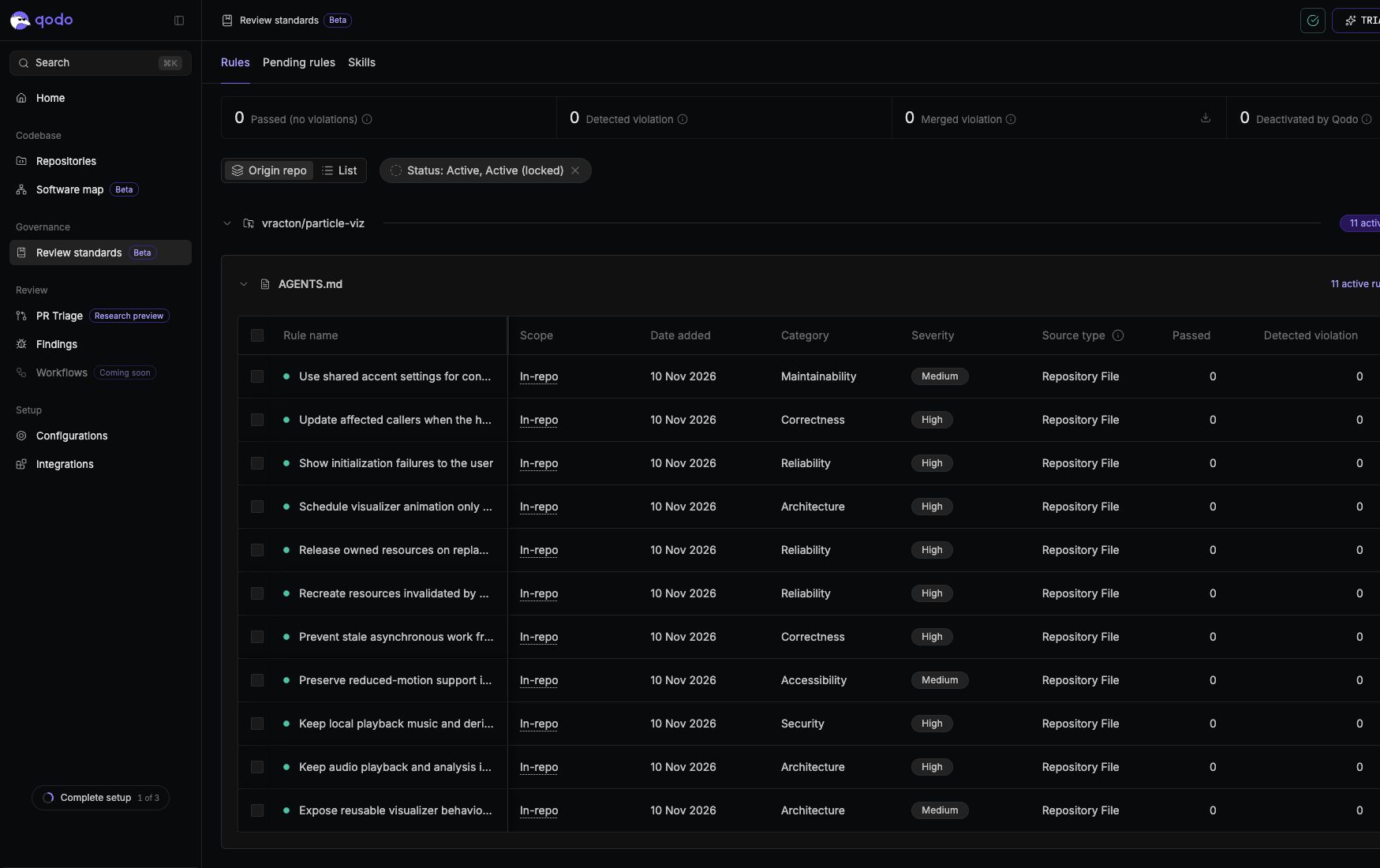
For Day 2, I added Particle Viz's AGENTS.md, covering the project structure, setup/check commands, and five broad project rules. The first draft felt too tied to individual bugs from Day 1. I wanted something that could guide the whole project as it grows, so we broadened it around architecture, shared contracts, lifecycle ownership, privacy, and focused changes with evidence. I wanted the instructions to stay useful beyond those particular fixes. My most opinionated rule is the visualizer-agent access boundary under “One host, many visualizers,” which I'd call “The visualizer gets an API, not the whole repository.”
The idea behind Particle Viz is to have different agents create graphics that slot into the same music player. I want those agents working from a clear API and their own visualizer files, rather than exploring unrelated code, copying another visualizer, or rebuilding playback and controls. The host/API references are read-only, and anything outside the assigned scope needs explicit permission. For now that's an instruction boundary; a future runner will need to enforce the file-access limits. I thought it was cool that Qodo was able to accurately turn my AGENTS.md into a useful set of review rules. It imported 11 active rules for the repo. For example, the broad “Own the whole lifecycle” rule became concrete checks for stale asynchronous work, resource cleanup, initialization failures, and recovery.
|

My factory's house rulesAGENTS.md link: https://github.com/CamDuncalfe/agent-pfp/blob/main/AGENTS.md It has 5 rules, mostly about the art. Qodo reviewed the PR (CamDuncalfe/agent-pfp#2) and then turned them into 8 review standards 
My most opinionated ruleThe rule: I call it Full Canvas
The story behind it (including where it applies): I cut all the art for my pfp builder into layers. Hats, glasses, mouths, clothes. The alien's smirk is about 150px wide and I still save it as a full 1024x1024 image with nothing else on it. That way I control the alignment in the art, where I can see it. I don't want to stress about getting everything lined up perfectly through code! If a hat sits 2px off I just fix the art It applies to the layer images, the code that stacks them, the render check and the builder page. Qodo split it into two standards, "Require layer dimensions to match the manifest canvas" and "Render layers without geometric transformations". Way better names than mine! The 12 aliens up there are the same alien. Each hat, mouth and pair of glasses is a full-size layer dropped on top at 0,0 AssistanceA coding agent (Claude Code) writes the code from my brief and Qodo reviews it. The art starts in Midjourney and I cut it into layers |

My factory's house rulesAGENTS.md link: https://github.com/jtbinith/qodo-hack-2026/blob/main/AGENTS.md (PR #10) On my site every device in the room is a stranger. Anyone with the room code can send anything. So my rules are all about what strangers can do to each other.
My most opinionated ruleThe rule: the Stranger Rule.
The story behind it (including where it applies): it applies everywhere my code reads another device's data: incoming messages, the room handlers and connection setup. On Day 1 I pictured a room full of friends. Qodo pictured one bad actor. Most of its 12 findings were one device crashing or stalling everyone else just by sending something unexpected. So now nothing from another device is trusted until it passes a check. If it fails, it's dropped. No "close enough". 
Plot twist: my Two-Browser Rule (every PR touching Qodo reviewed my rules firstI opened AGENTS.md as a PR and Qodo found 6 problems with it. My favourite: Rule 1 said every message goes through So I made the code match the rule. Qodo also caught my tests overclaiming: a "drag" that never dragged and a late guest who never downloaded anything. 6 of 6 fixed. Then I tried to sneak breaks past itI opened a PR (#11, do not merge) that breaks my rules three ways, dressed up as two small UX tweaks. All my tests stayed green.
3 of 3 in about two minutes! The first one is my Stranger Rule. Its example in AGENTS.md is about photos and I broke moves. Qodo understood the rule, not just the example. My one nitpick: the middle break came back as a bug, not a rule violation. So in the dashboard "Verify the announced SHA-256" shows as passed. Qodo had already warned me that standard overlaps another one, which is probably why. Merging those two is my next rule fix. It also found 4 real bugs in the "UX tweaks" I used as cover. Busted.
Then I checked main against my own rulesQodo reviews diffs. So what's already broken? I read Day 2 in numbers
What I learnt: write rules that are already true of the code, then try to break them. My tests only check what I thought of. A reviewer with my rules caught the rest. How my 5 rules became 12 review standards
Qodo's review of the AGENTS.md PR (6 findings, all fixed)
Assistance: built with Claude Code. |


My factory's house rulesAGENTS.md link: https://github.com/researchsite/hn-radar/blob/main/AGENTS.md My most opinionated ruleThe rule: Every claim is cited. Any pulse item or outreach sentence that states what users said MUST carry the HN comment_id it came from. The story behind it (including where it applies): HN Radar drafts an outreach email that names one real problem users reported about a company. If a model invents one complaint, the user sends a confident, wrong sentence to a possible employer. Building the first data step showed me why this matters: my own parser produced output that looked right and was wrong. For example, "Remote work is not available" was saved as |


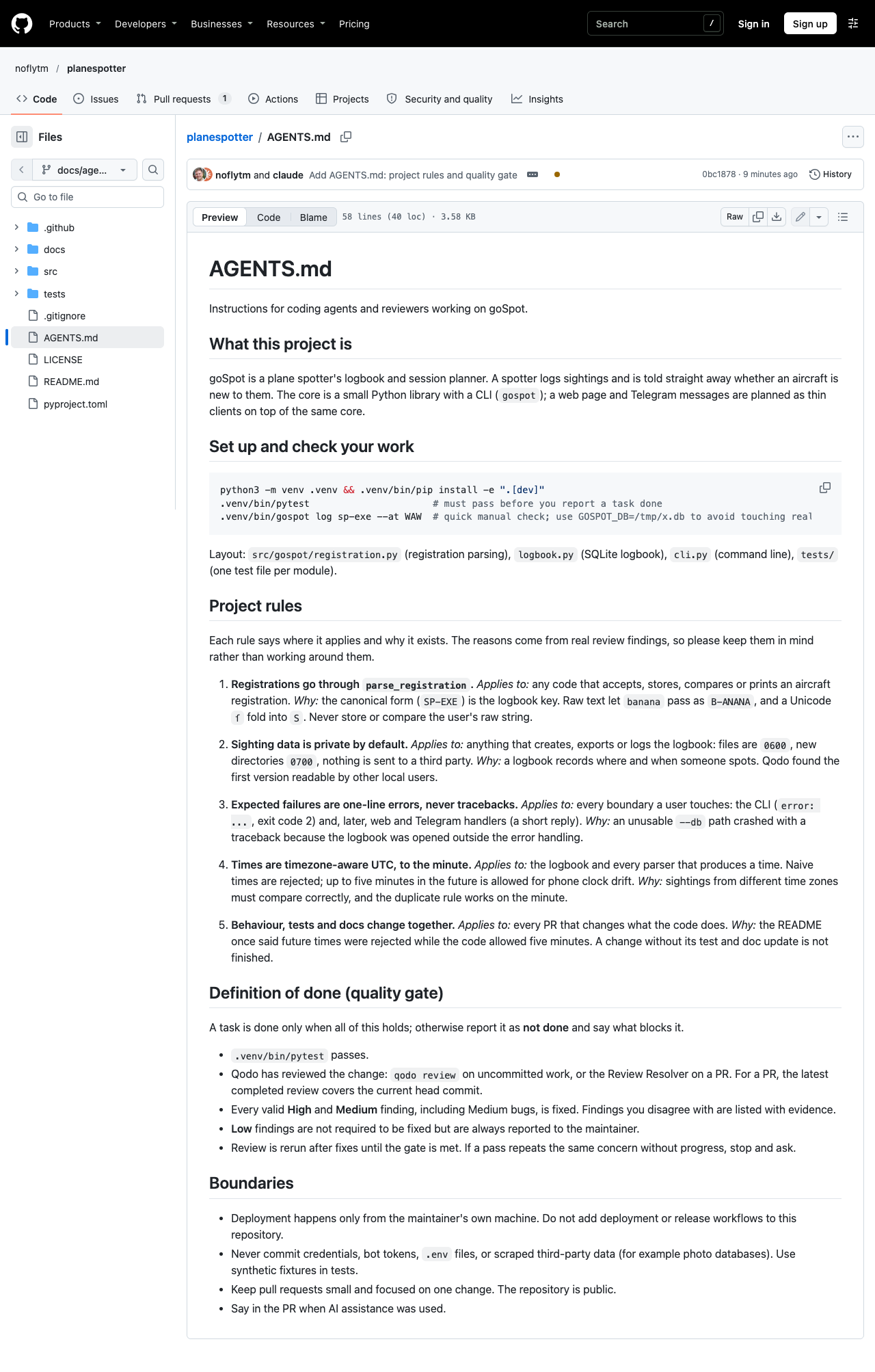
My factory’s house rulesAGENTS.md link: https://github.com/noflytm/planespotter/blob/main/AGENTS.md Five project rules, each with where it applies and why. All five came from real Qodo findings on my Day 1 PR, not from guesses. The file also has a definition of done (a quality gate for review findings) and repository boundaries, which Day 9 will build on.
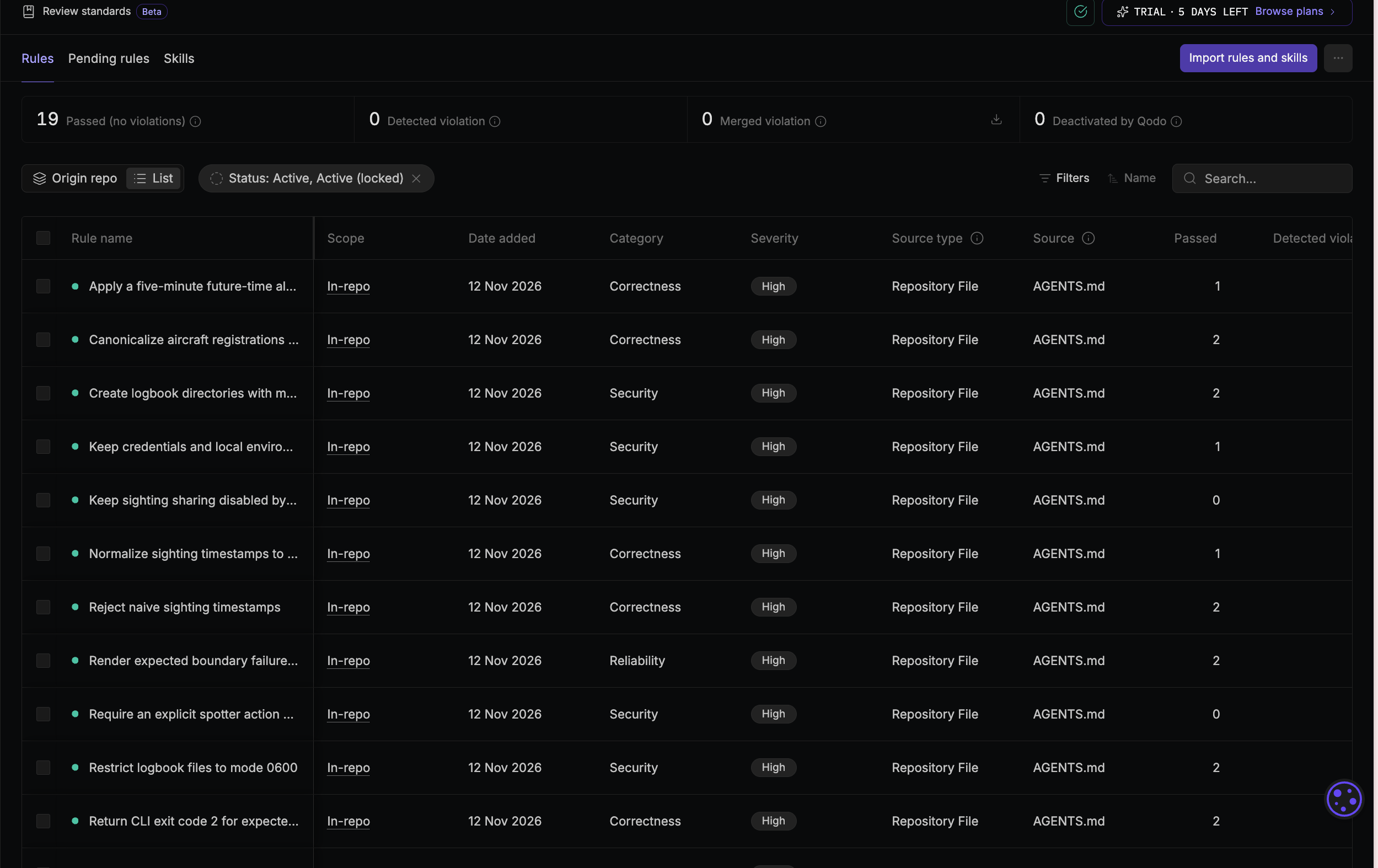
Qodo import status: imported, but not automatically. After merging to main, Review Standards stayed empty (I polled the rules list for about three minutes), so I used Import rules and skills. Qodo then read
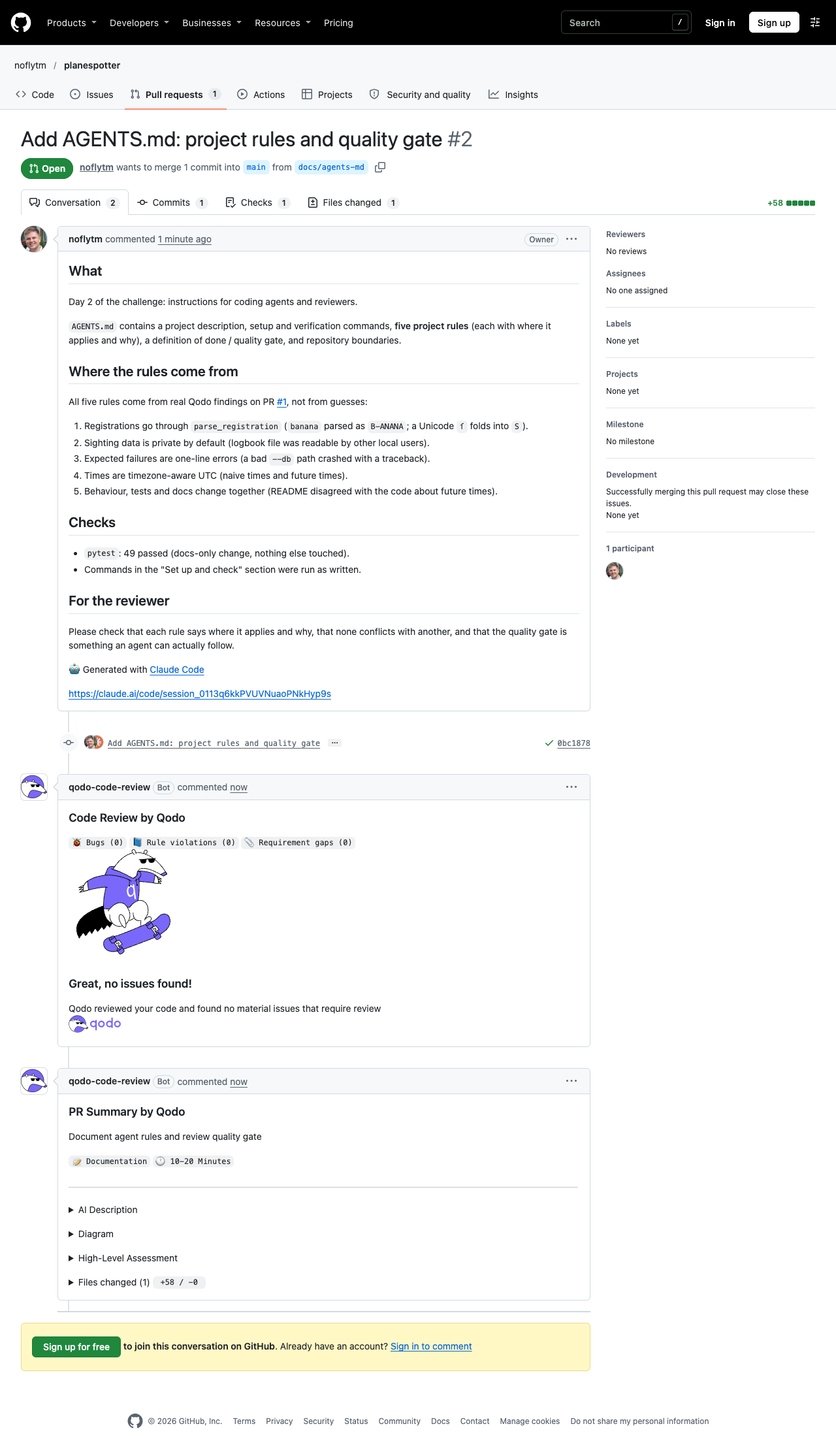
My most opinionated ruleThe Private Logbook Rule The rule: "Sighting data is private by default; sharing is the spotter's own choice. Applies to anything that creates, exports, logs or sends the logbook: local files are The story behind it (including where it applies): my Day 1 tests all passed, and I never thought about file permissions. A goSpot logbook records where and when someone stands to photograph aircraft, which is exactly the kind of data you don't want lying around readable by other users on the machine. Qodo flagged it on the first review, as one of three real findings. I had treated the project as a toy CLI. The rule applies to every writer, exporter and log line, and it matters more later: the same core will feed a web page and Telegram messages, and neither should leak a spotter's locations. I first wrote this rule as "nothing is sent to a third party", then realised that goSpot is for everyone and sharing a sighting has to be possible, for example to Telegram. So I tightened the rule instead of weakening it: the spotter chooses the channel and the moment, and nothing else gets their locations. I changed it in a follow-up PR (noflytm/planespotter#3) before building the Telegram part on top of it. Qodo turned it into rules of its own, all severity High: Restrict logbook files to mode 0600, Create logbook directories with mode 0700 and, after the update, Send sighting data only through spotter-chosen channels, Require an explicit spotter action before sharing sighting data and Keep sighting sharing disabled by default. Evidence and what it showsQodo reviewed the AGENTS.md pull request and found nothing:
A clean review of a documentation file doesn't show the rules are good, so what I checked myself: I ran every command in the "Set up and check" section as written ( |

My factory’s house rulesAGENTS.md link: https://github.com/JD-cookie/Test01/blob/main/AGENTS.md My most opinionated ruleThe rule: Count Before You Check Rule: anything that limits attempts must record each attempt atomically, in a single increment that also returns the new count, before doing the check it guards (password, code, token). Never read the counter, decide, and write it back later. Applies to: login, signup, and any future limit on guesses or requests, such as password reset or verification codes. In code: server/src/ratelimit.ts and the route handlers in server/src/app.ts that call limiter.hit. Why: Qodo's first review of the rate limiter found that 20 parallel wrong guesses for one account all got past the 5-failure lockout: each request read the counter before any of them had added to it. Counting first, with one atomic INCR (Valkey's Lua script, or the in-memory store's synchronous increment), closes that race. server/test/ratelimit.test.ts has a test for it: 20 parallel guesses get exactly 5 × 401 and 15 × 429. |

|
This one made me think about my own project. LamedDB is a database, so "read, decide, write back" is exactly where things break when two requests land at the same time. Right now two create-only writes could both see "doesn't exist yet" and both go through. I'm borrowing your rule for that: the check and the write have to happen in one step. Thanks. |

My factory's house rulesAGENTS.md link: https://github.com/Vee1234/LanguageAgent/blob/master/AGENTS.md My most opinionated ruleThe rule:
The story behind it (including where it applies): Testing the rulesTo check that Qodo enforces the rules, I opened a test PR that breaks them on purpose: Vee1234/LanguageAgent#20
|

|
Update, Nov 20: redone on Keynes, the real project I moved to (see my Day 1 post). The original Nightrune post is folded at the end. AGENTS.mdhttps://github.com/hrhgit/Project.Keynes/blob/master/AGENTS.md (PR #10) Before this PR, Keynes's AGENTS.md held only my working conventions, in Chinese. PR #10 adds an English header with what the project is, setup, verify commands taken from CI, and five rules. Each rule says where it applies, why it exists, and what enforces it. The full map of 32 rules to their enforcement is in In Qodo: the 13 rules that only a reviewer can judge are kept in My most opinionated rule: "Load must not decide results"
The story. Keynes's economy used to adapt its cadence to how long days took to compute, so a busy machine settled the economy on a different schedule. The same world gave different daily results under load. Scheduled commands could run early. A cold load from a save diverged from the uninterrupted run, on economy day 13 and climate day 31. The fix (upstream PR #7, merged Nov 16) ties production, consumption and prices to the game day. Planning now runs on fixed periods. Time spent is only recorded for diagnosis. To check it, a 30-day economy run and a 35-day command run were each repeated under a 7-process CPU load. Two independent cold restores from a day-5 save were added. Every day matched. Why it's opinionated: it costs speed. When a day can't finish, the game waits. It doesn't skip ahead and catch up later, because catching up would read a stale world. I'll take a slower fast-forward over a world that depends on the machine it runs on. What enforces it: a reviewer can't see a timing bug in a diff, so it's checks first. Qodo's review of PR #10Qodo reviewed the PR head ( Assistance and prior workKeynes is a pre-existing project (since Aug 2026), built with a collaborator, HkingAuditore, who agreed to its use here. Only my commits and the factory's count. The determinism fix was my own pre-factory work. This AGENTS.md change and this post were drafted by Claude Code under my direction. Reviews are by Qodo. Original Day 2 submission (Nightrune, Nov 18)I joined on Nov 18 and am catching up in order; this is Day 2. My factory's house rulesAGENTS.md link: https://github.com/hrhgit/nightrune/blob/main/AGENTS.md (added in PR #10, ticket #9) It has a project description, setup and verification commands ( Review Standards: imported with "Import rules and skills". Qodo lists 19 active rules taken from three files: AGENTS.md (7), RULES.md (9) and factory/rule-coverage.md (3). They appear under the repository's old name, hrhgit/beltdeck. My most opinionated ruleThe rule: The No Adjectives Rule. "Never call the game The story behind it: Nightrune is a card game, and in a game repo those words come easily. They come especially easily from a coding agent that wants its summary to sound finished. Nothing in them can be checked. A sentence like "the greedy bot won N of 200 seeds" can be checked. So the rule applies to README, RULES.md, PR descriptions and my post drafts, and Two things happened when it went live:
Mutation check: appending one adjective sentence to README.md made the test fail at that line. What still needed meChoosing which rules mattered, and approving each merge. Not verifiedPR descriptions and social posts are not scanned yet. Whether a test checks what its rule says is still left to review. AssistanceCode and this post were drafted by Claude Code (Opus) under my direction; reviews are by Qodo. |

My factory's house rulesAGENTS.md link: https://github.com/omerts/LamedDB/blob/main/AGENTS.md My most opinionated ruleThe rule: No Silent Ignores. A header, query parameter, body field or SDK option that asks for behavior this version doesn't implement gets a |

Polson's house rulesAGENTS.md: https://github.com/shrooms08/polson/blob/main/AGENTS.md Polson is an AI co-founder that ships one verified improvement every night. The name is "no slop" backwards. Five rules, each with where it applies and why. Three came straight out of Qodo's review of my first PR; two came from how that PR was worked. My most opinionated rule: The No Slop Rule
The story: in my first PR, Polson's record format let a night be marked "shipped" with no review and no checks at all. My coding agent flagged it as an open question. Qodo rated it High. When I fixed it, Qodo caught a second gap in the fix: a record missing both fields only reported one of them. It's the exact thing Polson is named against: an AI that says it shipped something nobody checked. So it became rule one, and the factory is never allowed to relax it. What Qodo did with my rules
Qodo imported 5 active rules, but not my 5:
My read: Qodo keeps rules it can see broken in a diff. A deleted test or unescaped text shows up in the code; whether the agent reproduced a finding first, or stuck to one ticket, doesn't. Those two still reach my coding agent through AGENTS.md (CLAUDE.md just imports it). So the reviewer enforces what's visible in the code, and the agent follows the process rules. I'll watch whether that split holds once the factory runs on its own. Built with Claude Code; reviewed by Qodo. |

My factory’s house rulesQuotaline is a terminal status line for AI-provider quotas. Its contributor guide gives the setup and verification commands and five rules for handling sensitive inputs, synthetic tests, missing data, provider-specific resets and provider access. Versioned AGENTS.md · Reviewed rules PR My most opinionated rule“Preserve a reported zero.” It applies in the provider readers, where an ordinary truthiness check can erase real information. In a synthetic Claude event, a 0% session had no reset time and the week was 41%. An intentional one-line regression displayed a missing session while the week still rendered. The independent checker failed exactly that case, hosted Qodo identified the lost zero, and the project orchestrator closed the PR unmerged. Issue and prediction · Failed check and actual output · Review and decision The repository rules were merged first. A later repository-scoped Qodo Review Standards import extracted 11 active standards from Quotaline’s root |

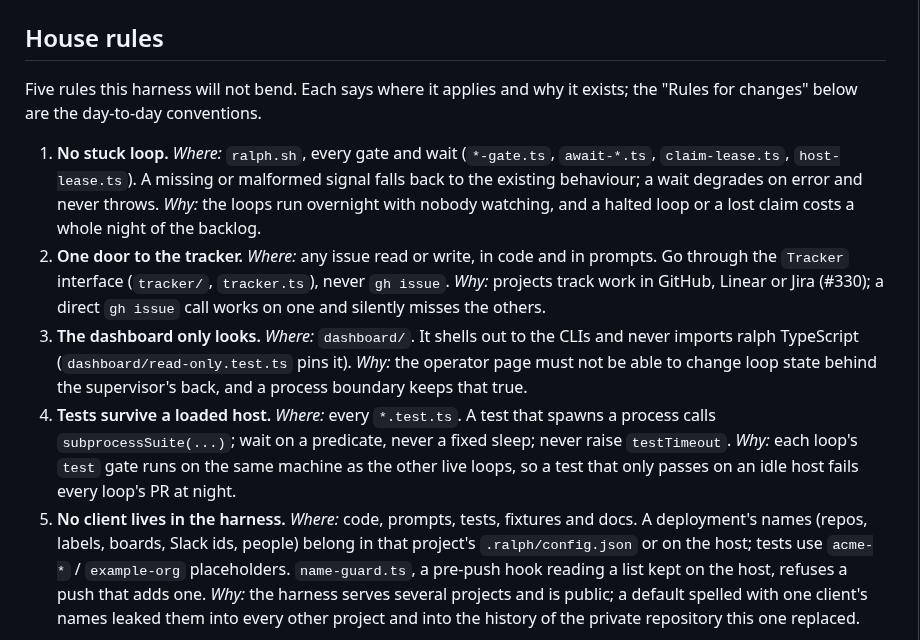
ChallengeDay 2 (2026-11-03): Your factory, your rules. ProjectProject name: Software Factory — autonomous Claude Code loops that work a backlog overnight What I completedAGENTS.md now holds the project description, setup and verification commands, a map of EvidenceMost opinionated rule — "No client lives in the harness":
The story: Ralph started inside a client engagement, and over a few weeks its code grew
What I learned / what is blockedA rule nobody checks gets broken by the next "harmless default". Writing the rule down was Assistance and third-party materialWritten with Claude Code (Anthropic). |

My factory's house rulesAGENTS.md link: https://github.com/Abdul-Jimoh/scrubline/blob/main/AGENTS.md (added in Abdul-Jimoh/scrubline#2) Five rules for a library that masks secrets before text is shared: speed trade-offs must name what they give up, no key-shaped strings anywhere in the repo, findings and errors never carry the value, a new detector is covered in four places, and the README claims only what a test proves. Qodo's Import rules and skills turned AGENTS.md into 11 active rules in Review Standards. Rules 1 to 4 came through, with rule 4 split into its separate checks, and so did the constraints (linear scanning, exact restore, no runtime dependencies, pinned dev dependencies, a regression test with every bug fix). Three are High: linear scanning, exact restore, and never exposing matched values. Rule 5 ("the README states only what a test proves") did not come through, probably because it is about docs rather than code. I'll look at adding it by hand when I refine the rules. 
My most opinionated ruleThe rule ("Name the victim"):
The story behind it (including where it applies): On Day 1, Qodo's only finding was a High-severity bug: a JWT right after In most projects a performance shortcut costs a little accuracy. In a library whose only job is to catch secrets before they leave your machine, every shortcut decides which secrets get through. So a shortcut has to name its victim, and the victim gets a test. The rule applies wherever the detectors decide where a match may start or end, which is exactly where it went wrong last time. AssistanceAI-assisted, human-led: Claude Code drafted AGENTS.md from the Day 1 review and verification history; I chose the rules and the wording. |

Lichtprobe — project rulesAGENTS.md describes the local release rehearsal, gives the Node verification commands, and records four project rules. Qodo imported 12 active review standards for the Lichtprobe repository. My most opinionated ruleKeep each failure in the evidence. The report collector has to include failed nested tests and failed suite setup. A passing top-level test must never make an incomplete run look successful. Qodo caught that my original collector could omit a nested failure. I added regression cases for both a nested failed test and a failed setup hook. The rule applies before the browser sees the report. The independent review and the final human decision are recorded separately. Day 1 pull request and review Built with Codex. Code review by Qodo. |


 and others
Uh oh!
There was an error while loading. Please reload this page.
Uh oh!
There was an error while loading. Please reload this page.
Your factory has made its first delivery. Today, give its agents some boundaries by creating an AGENTS.md. Explain what your project does, how to check the work, and which project decisions the builder and reviewer need to respect.
Some of you mentioned review suggestions that felt irrelevant to your project, or conventions you want Qodo to learn, in the Day 1 Discussion. Write down the expectations that matter in your project, including where they apply and why they exist.
Today’s challenge
Show us your house rules
Copy this template into a comment. The rule can be practical, opinionated, or oddly specific, as long as it belongs in your project.
Take a look at the other factories’ rules. If you find one worth borrowing, reply with how you’d adapt it for your project.
Bonus: dress up your profile
Download the hackathon profile frame and add it over your profile photo. The center is transparent, so your face stays visible and the hackathon branding sits around the edge.
All reactions