Repository navigation
Home
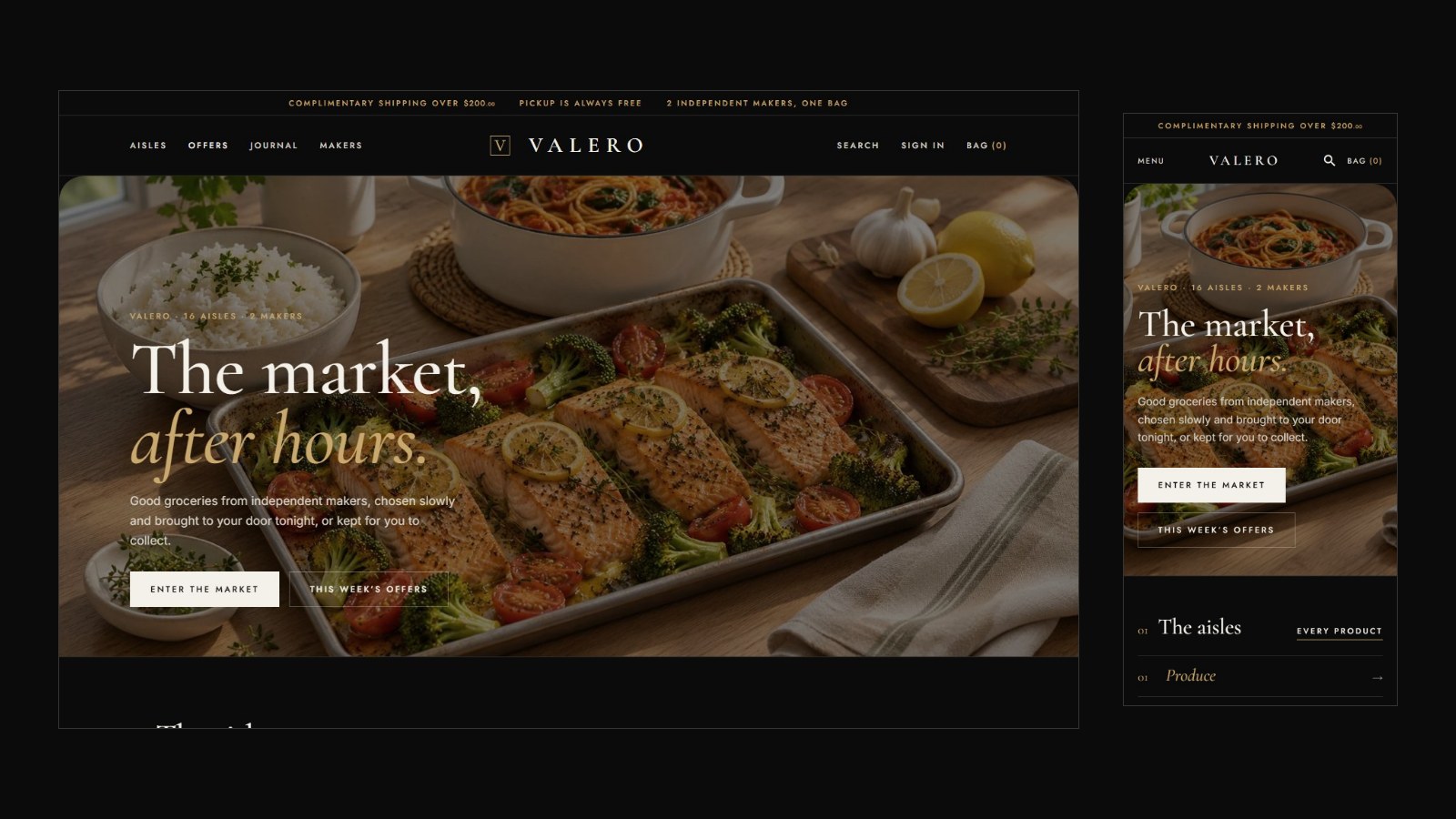
Valero Market is a custom storefront Layout for Selldone shops: a multi-vendor grocery marketplace as an after-dark food hall: a black page with ivory type and champagne hairlines, an editorial hero, the aisles as a numbered index, hairline grids of cards on ivory squares, a split product page with the sellers as a table, a full-height bag panel, a numbered checkout and makers' pages, in Cormorant Garamond and Jost. It runs on valero.selldone.shop, a second address of the shop molino, whose main address carries Molino Market Hall: one shop, one Layout per domain (see Go Live). It is built on the official selldone/storefront, so Selldone's basket, checkout, payments, vendor offers and orders keep working underneath a completely new design.
| I want to… | Page |
|---|---|
| Have an AI agent set it up on my shop | Install with AI |
| Set it up myself | Manual Setup |
| Know what my shop's data needs | Shop Requirements |
| Build, upload and verify a release | Build and Upload |
| Put it live on my shop and domain | Go Live |
| Change colours, fonts, sections, pages | Customize |
| Fix a problem | Troubleshooting |
- A Layout is a complete storefront app (Vue 3) that runs on Selldone's own servers instead of the default storefront.
- You build it, zip it, and upload it to your Selldone developer account with the official selldone-cli. Each upload is a new version.
- You attach a version to your shop: shop dashboard › Domains › Default layout › Change layout. Every domain of the shop can inherit it.
- Selldone injects your shop into the Layout: its products, categories, sellers, prices, theme, languages and settings. Nothing about molino is hard-coded.
- Home: a deals banner, two rows of aisles, a row of best sellers for every aisle, an aisle mosaic, seller cards and a market shelf.
- Cards: "Add to cart" turns into "− n in cart +" in place, "Choose options" for products with sizes, and the seller is named on every card.
- Shop pages: a compact aisle head, quiet filters built from product specs, one sort menu.
- Product page: gallery, details and a sticky buy box with every seller's offer.
- Seller storefronts.
- Cart and checkout: a cart drawer with the free-shipping meter and View cart / Check out; a cart page with a card per seller, "How do you want it?" tiles, a map-first address sheet and an order summary that leads to whatever is missing.
- Orders: the receipt, delivery, the trip and chat.
- Buyer account: in two designs.
- Content pages: journal, article, About, Terms and Privacy.
- Live shop: https://valero.selldone.shop
- Repository: https://github.com/selldone-custom-layouts/official-valero
- Design notes and release log:
KALIO.md - All official custom Layouts: https://github.com/selldone-custom-layouts
- Selldone: https://selldone.com