Repository navigation
Releases
Visers v1.1.1

Visers 1.1.1
Add Visers to a Python 3.10+ project with uv add visers. The GitHub and PyPI guides now show how to install the native image encoder and build a custom embedding width with uv.
Visers v1.1.0
Visers 1.1.0
Install the Python package with python -m pip install visers. The native image encoder accepts paths and encoded JPEG, PNG, and WebP bytes. This release includes CPython 3.10+ wheels for Linux and macOS on x86-64 and ARM64, and for Windows x86-64. Existing visers_nano imports remain supported.
Visers v1.0.0
Nano visual encoder
Visers v1.0.0 ships Nano, a compact CPU model for visual embeddings. It takes interleaved 128×128 RGB bytes and returns an L2-normalized vector with 256, 128, or 64 dimensions.
MobileNetV4-Conv-Small-0.50backbone distilled fromSigLIP2 Base, with a Matryoshka projection head.- Per-channel
W8weights embedded at compile time. The 256D model stores about 489 KiB of weights in the binary. - Pure Rust inference with AVX2/FMA on supported x86-64 CPUs, a scalar path, and allocation-free encoding after initialization.
Benchmarks
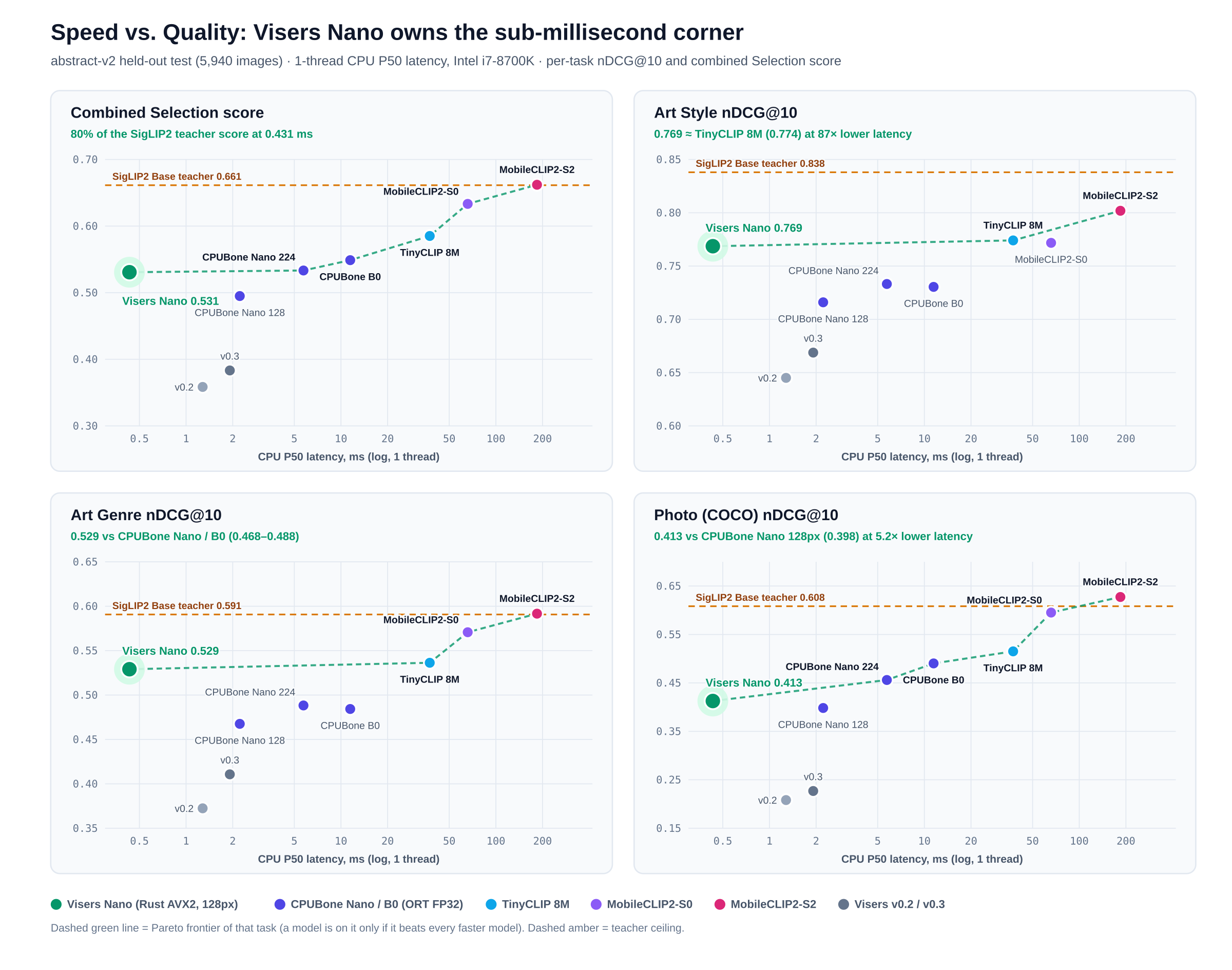
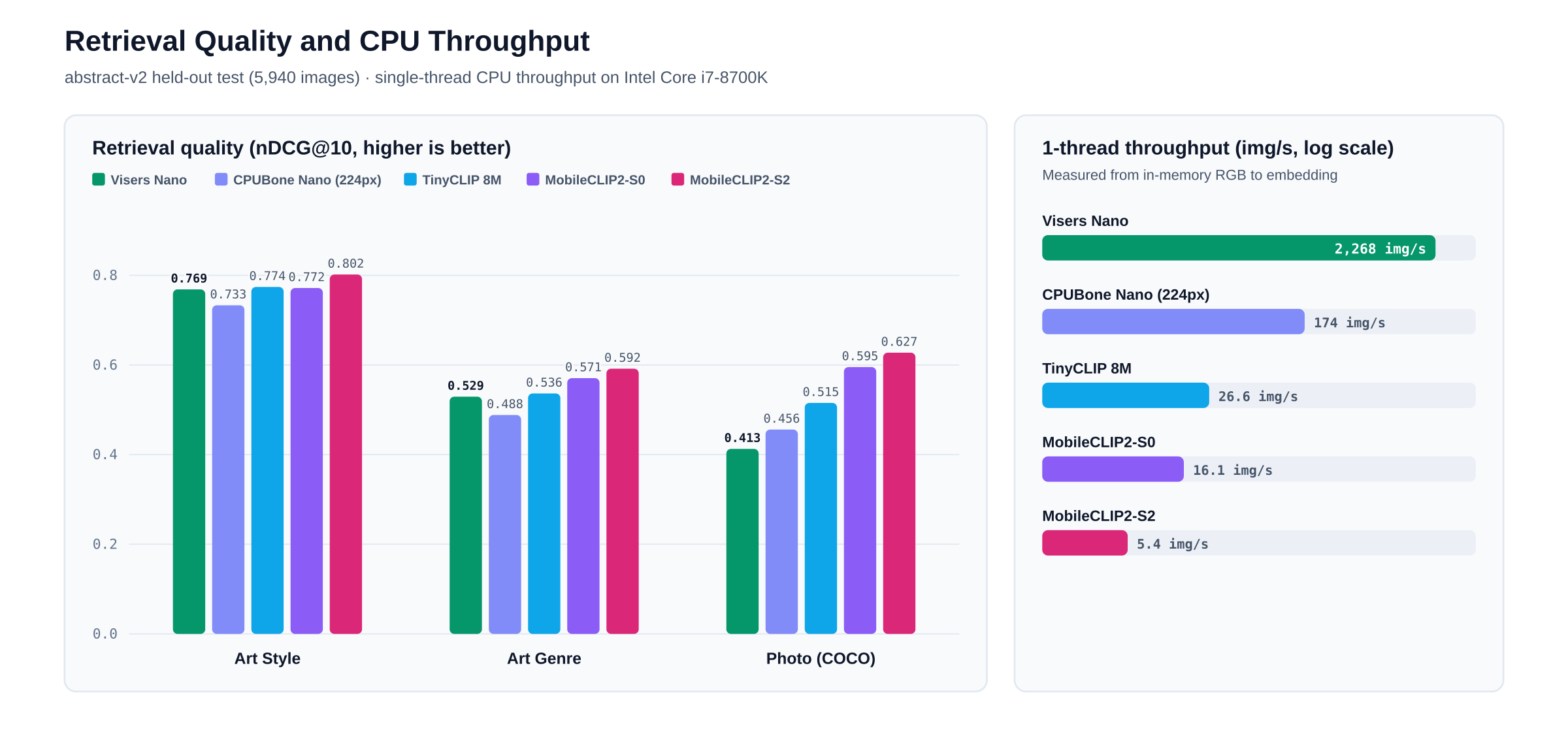
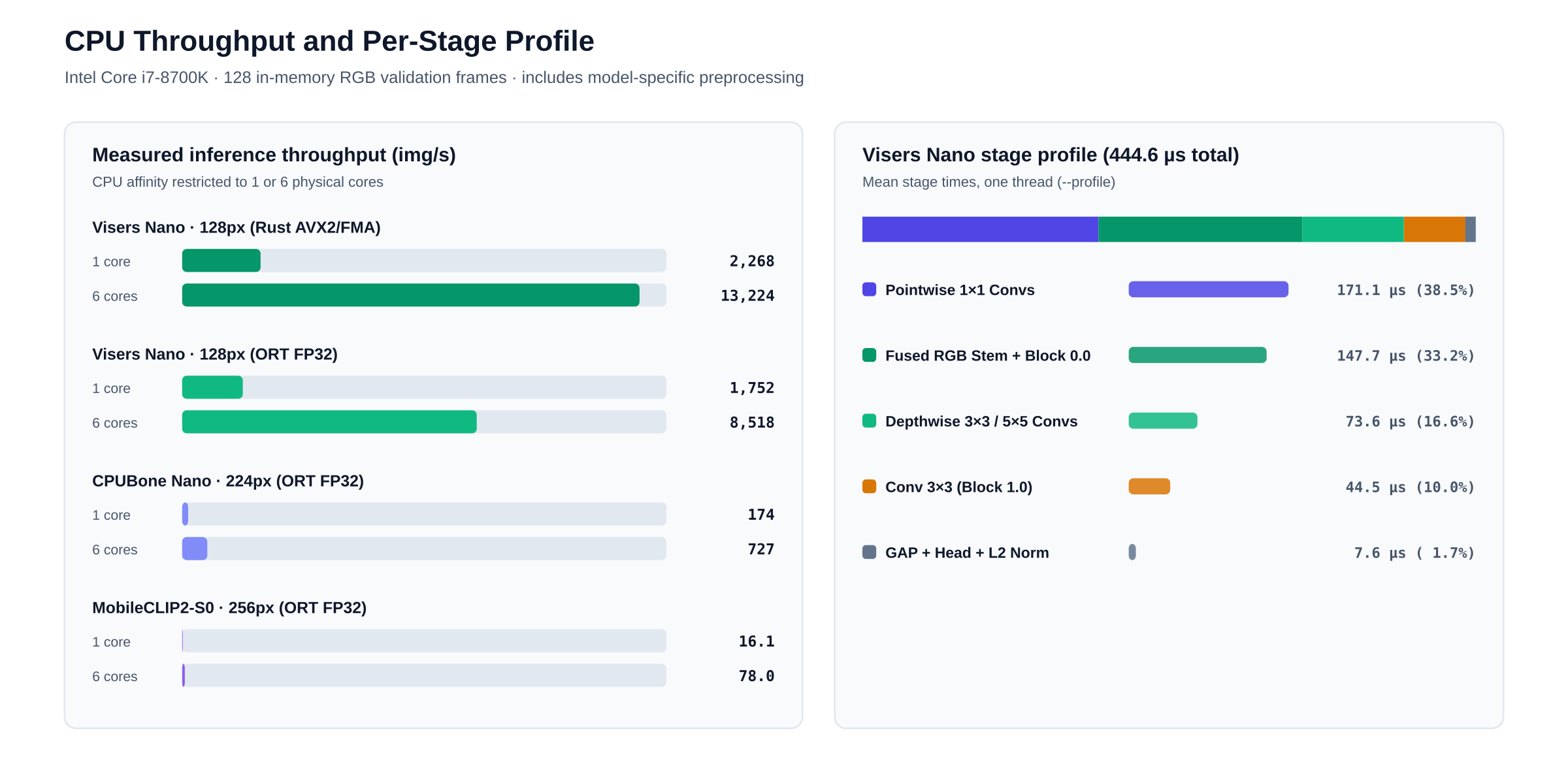
On an Intel Core i7-8700K, the 256D Rust build reached 0.431 ms P50 and 2,268 images/s on one core. NanoSpinPool reached 13,224 images/s on six cores. Timings include preprocessing from in-memory RGB. Retrieval scores use the abstract-v2 held-out test of 5,940 images. Benchmark methodology
Speed and retrieval quality
Retrieval by domain and single-core throughput
Multi-core throughput and stage profile
Installation
[dependencies]
visers = { package = "visers-nano", git = "https://github.com/0himera/visers", tag = "v1.0.0" }
The Linux x86-64 archive contains nano_rgb with the 256D Nano weights and the Apache 2.0 license. The three benchmark charts are also attached as PNGs.