Repository navigation

Real AI pixel game sprites: pixel looks and hibit
Ask an image model for pixel art and it paints a picture of pixels: blocks of uneven size, 88,410 colours in one small figure, soft edges. This release gives your agent two ways to real pixel art, in Claude Code, Codex and Grok:
- Pixel looks (new in 0.6.0): classic small sprites that follow a reference. The picture the model paints is read back onto a real grid.
- Hibit (0.5.0, announced here for the first time): high-bit pixel art. The model paints only a flat, lineless master and the Forge computes every pixel.
▶ Watch the update video (attached below: asf-v0.6.0-real-pixels.mp4; Chinese subtitles: asf-v0.6.0-real-pixels-zh.mp4)
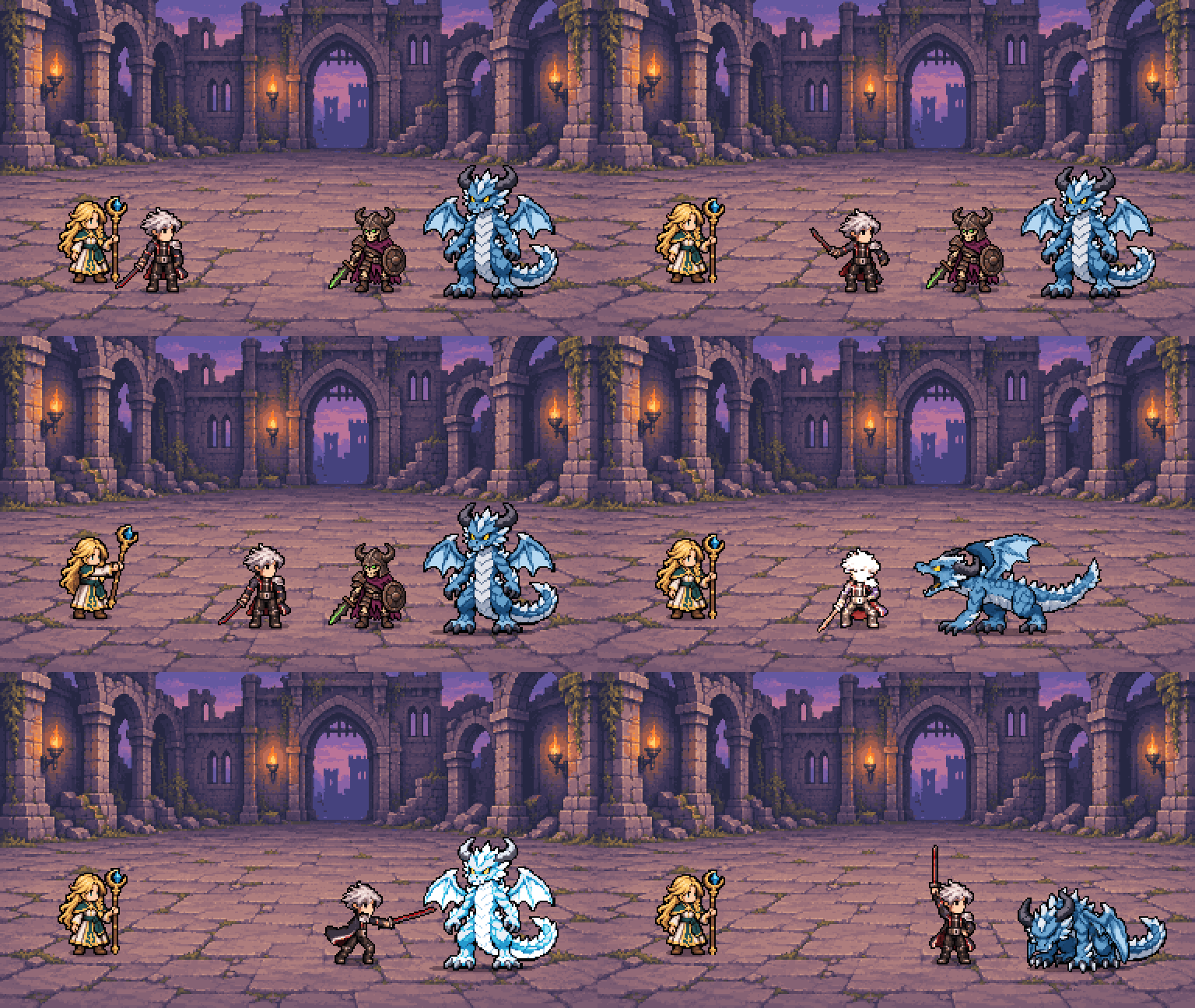
The fighters above are real output from the 2026-11-12 run: four characters of our own and 14 sets with 168 drawings read back from image-to-video clips, rendered at 1x and shown at 2x. The plate behind them is a generated painting brought down to 384x216 and 40 colours.
Pixel looks: 1x sprites that follow a reference
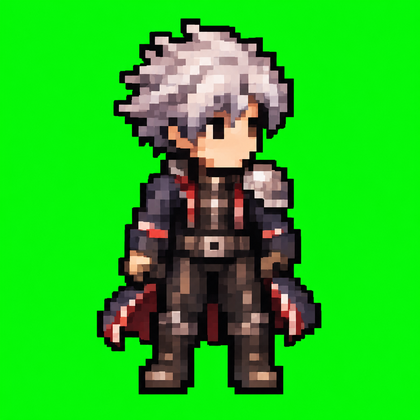
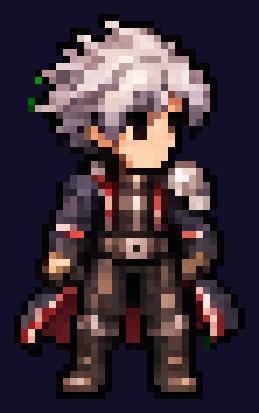
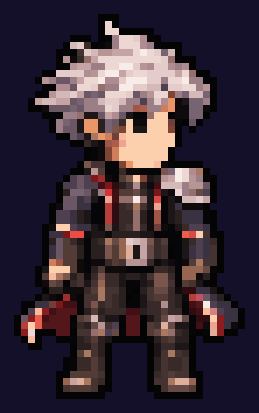
You show your agent one sprite whose look you like; it draws your own character in that look, finds the picture's own grid, takes one flat colour from every block and closes the outline by rule. What comes out can be counted: 33x55 pixels, 48 colours, alpha 0 or 255.
pixel_look.py(generate2dsprite), the stills:ask-masterandmasterdraw the figure again, alone and large, and read it as the 1x master: the picture's own grid, one colour a block, the figure's proportions kept, a palette, the outline closed by rule;ask-castandcastdraw every further character beside the master, so the cast keeps one pixel size and one look;ask-pose,pose,ask-viewandviewmake poses and side or back views from the master (the sword pose changes 217 cells and keeps 91% of the master);lineupputs every sprite and every drawing on one ground line and reports the heights.
pixel_motion.py(video2dsprite), the motion:prepare,frames,finish,measure,breath. The frames of an image-to-video clip are read back on the sprite's lattice and palette; a loop or an action is picked from them and packaged asanimation.json3.0 with nearest sampling. Every drawing of the 14 sets has only its sprite's own colours and no soft pixel.- Only on request. Nothing else changes: the HD, pixel and hibit finishes and their defaults are untouched.
| Measured in the 2026-11-12 run | |
|---|---|
| The generated picture (the figure) | 1254x1254, 88,410 colours, blocks 15-30 px |
| The same picture resized to 33x55 (nearest / bilinear) | 1,033 colours / 1,275 colours, 413 soft pixels |
pixel_look.py master |
33x55, 48 colours, 0 soft pixels, 2.5 KB |
| The cast (mage / skeleton knight / frost dragon) | 45x56 / 50x55 / 87x86, 48 colours each |
| The attack set from one clip | 21 drawings from 145 video frames |
| The fight | 14 sets, 168 drawings |
Hibit: real pixel art from flat AI art
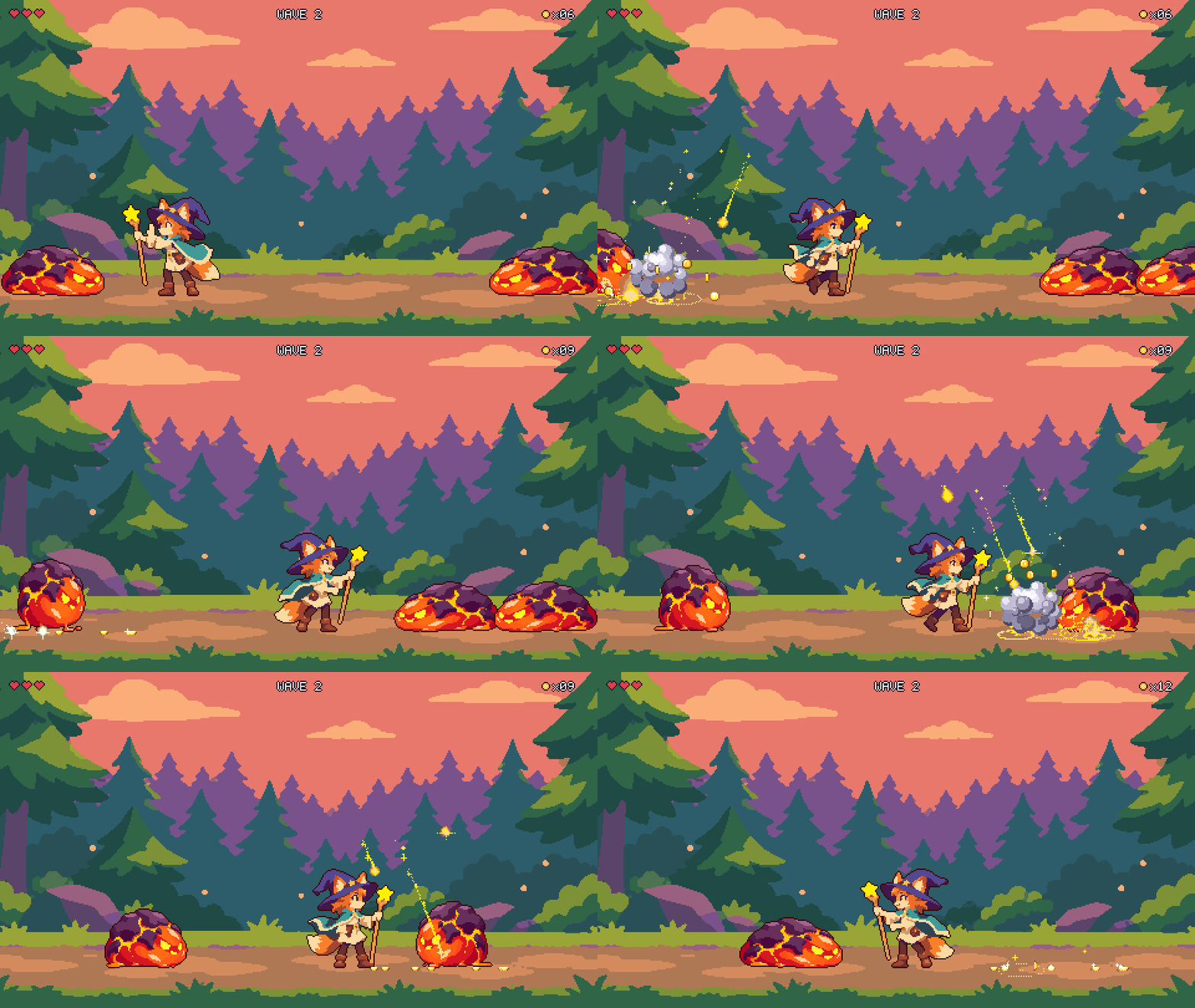
--finish hibitformaster_still.py,finish_frames.pyandsprite_set.py: flat lineless masters; one 16-colour palette per character, learned from the source pixels; an 8x8 majority-vote downscale that never blends, with temporal hysteresis (32-40% of the noise flicker removed on Pip's clips); an outline colour taken from the sprite itself.hibit_plate.py(generate2dmap): 480x270 backgrounds with a 14-colour palette and shade maps.- Hibit FX on two routes, picked by
fx_pixelfx.py check: A (recommended), pixelfx by Patch (MIT), which you clone yourself (it is never vendored here; every render comes with aCREDITS.txt); B, the image route,hibit_fx.py pixelize. - Pip's Star Grove, the one-screen demo above, is built only from hibit output (FX: pixelfx by Patch, MIT).
Also in this release
- Host API, for a tool that drives the skills:
--progress-fileon the long-running tools (one JSON line per stage);forge_index.py scanlists the masters, sets, FX, plates and maps of a folder in one document; contracts (JSON schemas) for the documents a host reads;engine_export.py reviewrecords a review verdict in an existing package. - Changed: exit code 4. A tool that publishes its output for inspection although its QA status is
failnow exits 4 instead of 1; exit 1 still means an error that published nothing. - Fixes:
set_state.jsonis locked while a run works; JSON replaces wait for Windows readers; Grok children no longer load the user's other plugins; the spend ledger names the published folder. - Showcases in all five READMEs (
src/pixel-looks/,src/hibit/),references/pixel-looks.md,references/hibit.md,THIRD_PARTY_NOTICES.md.
Install
Claude Code:
claude plugin marketplace add 0x0funky/agent-sprite-forge --sparse .claude-plugin skills
claude plugin install agent-sprite-forge@agent-sprite-forge
Already installed? Refresh the marketplace and update the plugin from /plugin. For Codex and Grok, see the README. The full list of changes is in the CHANGELOG.
Notes:
- Both runs used pictures from Codex image generation and image-to-video clips from Grok. Other models have not been run through these two routes yet.
- For pixel looks the reference sets a look (pixel size, shading, outline); the characters must be your own.
- A pixel-look sprite of about 80x110 with a wide swing gets only 4 px a sprite pixel in a 720p clip, where dark shades flip more. The limits are in
references/pixel-looks.md. - The video's score was generated with Lyria.