Repository navigation
v0.1
Pre-release
Pseudocode
Hash (string s)
h1 ← 0
pow ← 257
for i ← 0 to s length do
h1 ← (h1 + s[i] ASCII code * pow) % (1e9 + 7)
pow ← (pow * 257) % (1e9 + 7)
h2 ← 0
pow ← 263
for i ← 0 to s length do
h2 ← (h2 + s[i] ASCII code * pow) % (1e9 + 9)
pow ← (pow * 263) % (1e9 + 9)
hash ← ""
random number generator 1 seed ← h1
random number generator 2 seed ← h2
for i ← 0 to 32 do
hash ← hash + random number generator 1 number from 0 to f
hash ← hash + random number generator 2 number from 0 to f
return hash
Testing
Input and outup size
Input of any size can be hashed and output is always a 256 bit number in hexadecimal format:
- Hash of a 1 character string:
40344f3f1c0ea114cef5ace64671d745b842e43bc0eff51bd63a0b13d98dfd8e - Hash of a 10000 chacarter string:
a16fa28de23ff7d4ea9648a984e380fa69c6c0d0c5ffc197e1b4aa3a4cb9bef1
Hash output is deterministic
For instance hashing an empty file will always return
8899bbdd99dd88dd6699aa667744ee00ff446677cccc88779966eedd115511aa
Hashing performance
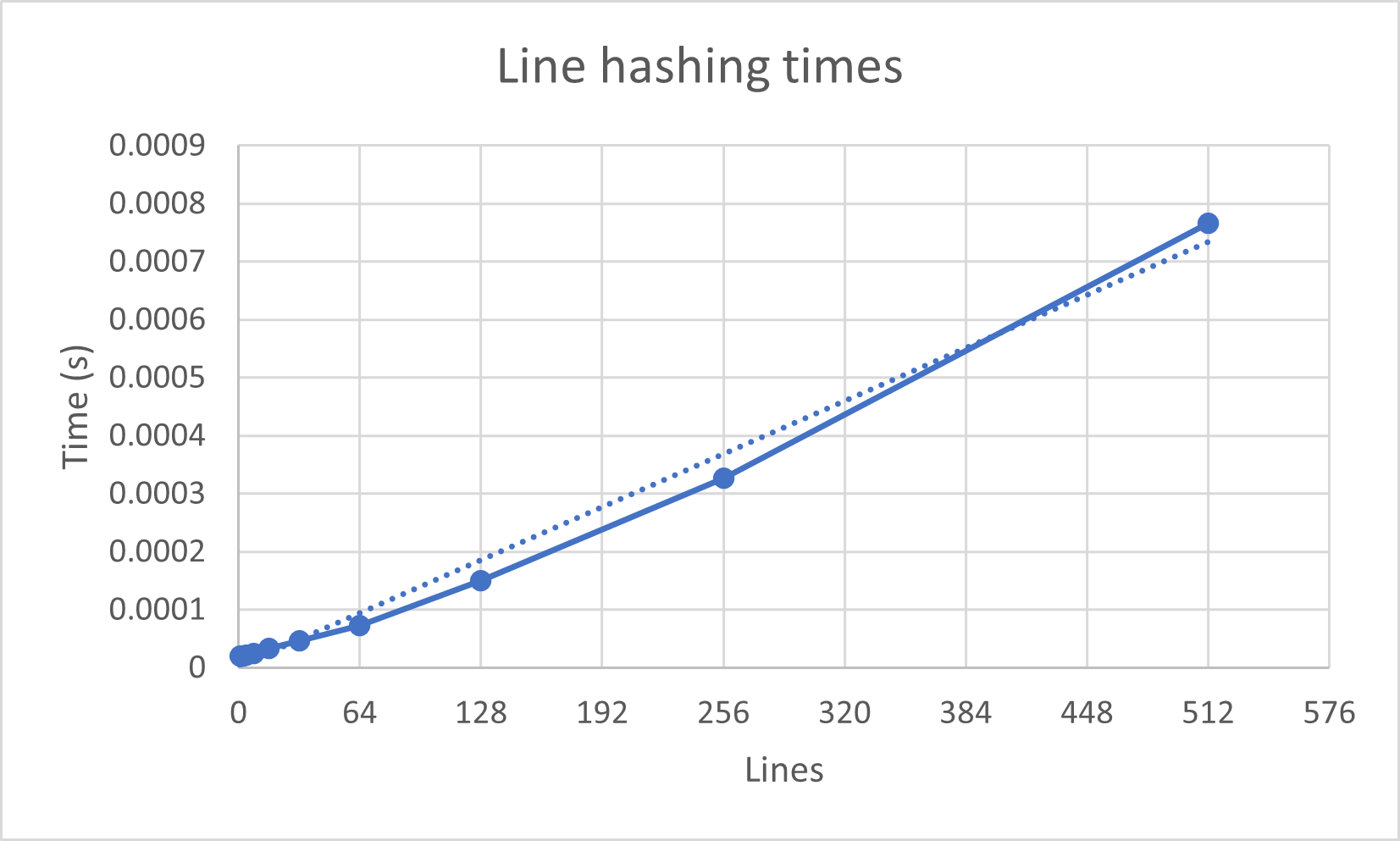
Hashing times rise somewhat linearly.
Tested by hashing different number of lines from constitution of Lithuania:
Collision resistance
0 collisions found by testing 100000 pairs of random text strings - 25000 of 10, 100, 500 and 1000 characters long.
Avalanche effect
100000 pairs of string with 1 character difference between them - 25000 of 10, 100, 500 and 1000 characters long where tested:
- Bitwise difference:
- Average: 50.01%
- Minimum: 36.72%
- Maximum: 63.28%
- Hexwise difference:
- Average: 93.77%
- Minimum: 78.13%
- Maximum: 100%
Conclusion
By this limited testing it can be concluded that:
- The hashing function can process inputs of variable length and output a 256 bit number in hexadecimal form.
- Hashing times rise somewhat linearly while increasing input size.
- The hashing function is somewhat collision resistant as no collisions were found while testing 100000 pairs of random strings.
- While hashing function's hexwise difference while hashing random strings with 1 character difference is high, bitwise difference is a bit low as difference equal or above 50% is preferred.