Repository navigation
Releases
SmoothWheel v0.4.0 — Saved presets

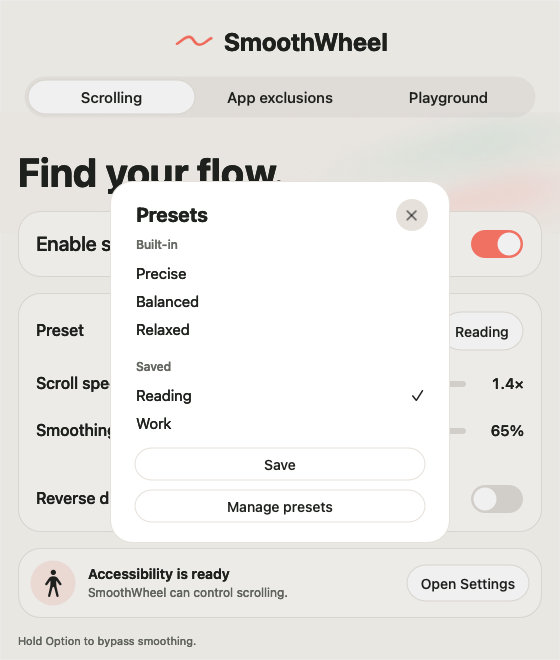
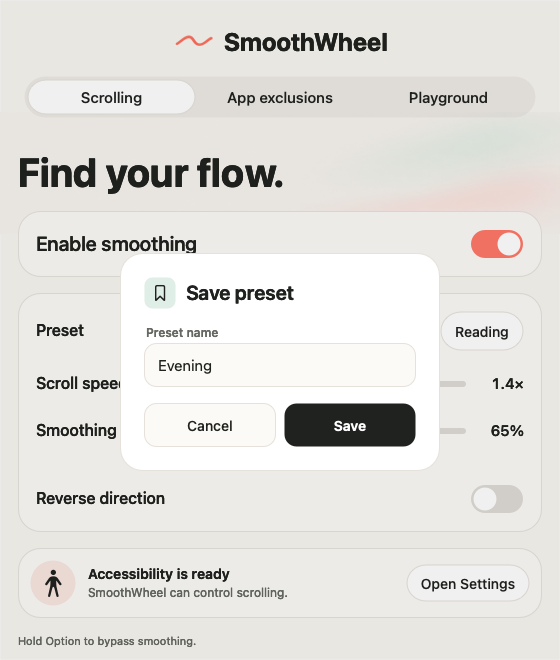
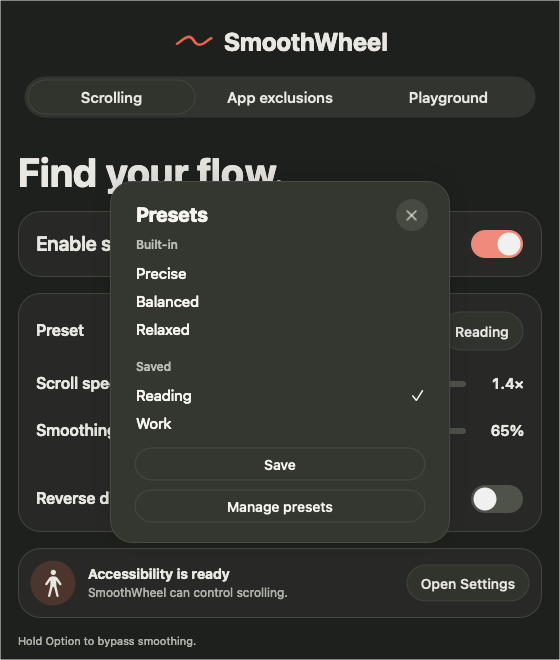
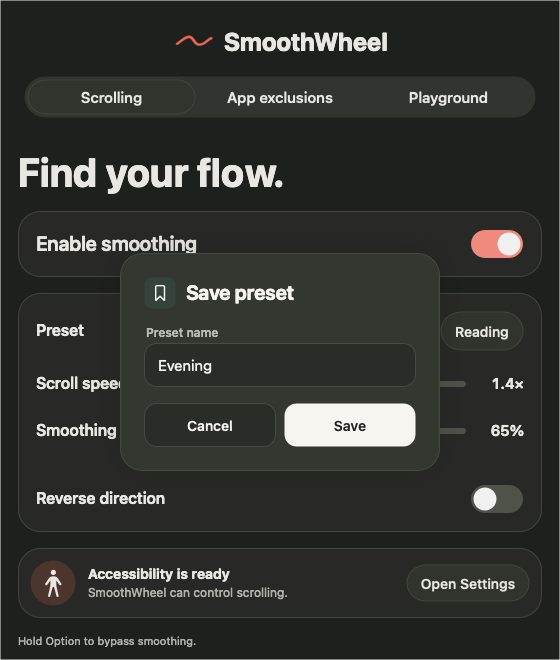
- Save named scrolling presets containing speed, smoothing, and reverse direction. Choose built-in or saved presets from a names-only library with consistent spacing and a clear selection mark.
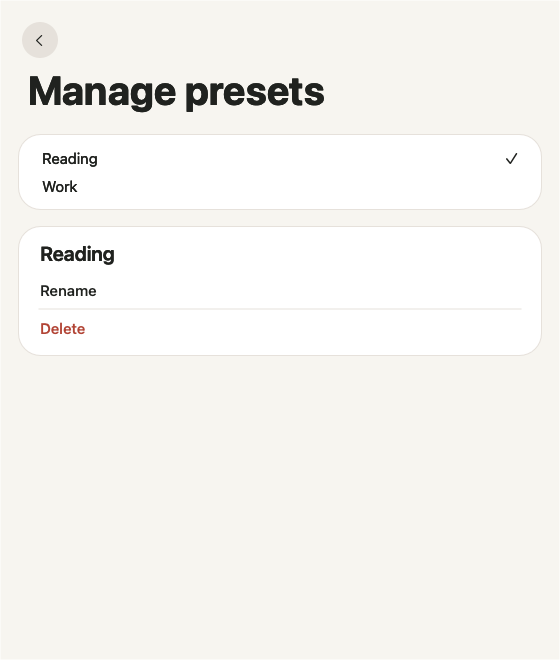
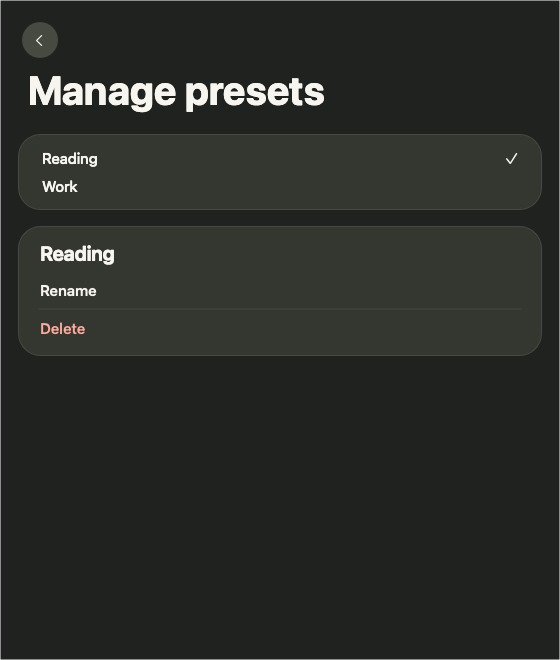
- Rename or delete saved presets in a dedicated manager. Choosing a record to manage leaves the current settings intact. Manual adjustments mark a preset as modified, and Save current settings creates a new preset.
- Keep presets locally across launches, with validation and recovery for unreadable preferences. Existing settings, exclusions, built-in values, and launch-disabled behavior are preserved.
- Refine Settings transitions. The Save form appears immediately, new and deleted rows fade in place, and the active preset checkmark stays visible during Rename. Reduce Motion resolves transitions immediately.
- Add 24 saved-preset snapshots, bringing the total to 32, and check 194 AppKit animation frames at 120 Hz in light and dark mode. The checks found 0 pt of saved or deleted row drift and zero missing checkmark frames during Rename.
Applying a saved preset took 0.475 ms p95 across 1,000 applications with 50 saved presets on Apple Silicon. This measures the release build with isolated preferences. Aggregate measurements and methodology.
Apple Silicon download, targeting macOS 13 or later. See the installation guide for Accessibility setup and first launch of the ad-hoc-signed build.
Light appearance
 |
 |
 |
Dark appearance
 |
 |
 |
SmoothWheel v0.3.17
Public update from 0.3.11, including the 0.3.12–0.3.16 development fixes below.
Improved scrolling
- Immediate smoothing after switching apps. Use macOS’s assigned event recipient and cached process identities, so a scroll in excluded ChatGPT no longer keeps the next Telegram or system-overlay scroll native while a hit-test catches up.
- Consistent scrolling in Notes attachments. Track background renderers through the workspace’s running-app updates. Embedded documents now receive the same smoothing and reverse-direction settings as the notes list; the physical trial confirmed both.
- Keep blocking work away from input and frames. Accessibility hit-testing runs on a coalesced worker only as a fallback. Known recipients use a cached identity lookup, without per-wheel process queries. Old lookup completions cannot override a known event recipient.
- Avoid mixed wheel bursts. Unknown recipients pass through natively for their current burst; switching to a different known process starts a new routing transaction. Input distance, the existing motion curve, display pacing, and trackpad passthrough remain unchanged.
- Regression protection. 45 functional tests, eight light/dark UI snapshot states, line-coverage floors, and release-mode callback budgets now run in CI. Replays cover exclusions, system overlays, overlapping apps, delayed lookups, background renderers, direction and distance.
Public measurements
One physical Razer-wheel session on Apple Silicon, macOS 26.6.2, using the display-linked clock:
| Measurement | Result |
|---|---|
| Routed wheel events / generated output frames | 692 / 8,372 |
| Input-callback time, p95 / maximum | 0.228 / 1.185 ms |
| Emission-frame interval, p95 / maximum | 8.766 / 25.215 ms |
| Unknown event destinations in this sample | 0 |
| Motion-core / events-and-routing line coverage | 97.18% / 87.79% |
| Frame-clock / coordinator line coverage | 76.36% / 74.58% |
These timings measure SmoothWheel’s callbacks and emission cadence, not another app’s rendering FPS or end-to-end input latency. This is one development session, not a controlled before/after or competitor benchmark. Optimized local callback measurements also passed the 2 ms p95 regression budget; those exclude global posting and rendering. Aggregate JSON and complete measurement scope, methodology and limitations.
The measurements contain no recordings, note contents, app-usage list, process IDs or local filesystem paths. The app still collects no analytics; diagnostics are opt-in and local.
Distribution
Apple Silicon, macOS 13+ target; ad-hoc signed and not notarized. The oldest supported macOS and Intel remain unvalidated. Updating may require removing the old Accessibility entry and adding the current app from Applications, then enabling smoothing again. Residual landing behavior in Gmail remains a known compatibility report; this release does not claim every visual hitch is resolved.
Download SmoothWheel.zip and move the extracted app to Applications. The source ZIP, aggregate metrics JSON and SHA-256 manifest are attached. Installation and update guide.
SmoothWheel v0.3.11
SmoothWheel v0.3.11
Free, MIT-licensed mouse-wheel smoothing for macOS, built natively in Swift.
- Precise, Balanced, and Relaxed presets
- Adjustable speed and smoothing
- Per-app exclusions and independent reverse direction
- Continuous trackpad input passes through unchanged; hold Option to bypass smoothing
Download SmoothWheel.zip, extract the app, and move it to Applications. Apple Silicon build; macOS 13 or later. Enable Accessibility access when requested, then enable smoothing in the app.
The build is ad-hoc signed and is not notarized. macOS may require explicit approval before opening it. Hardware-specific compatibility testing remains limited.
Website and setup: https://smoothwheel.vercel.app
Source and known limitations: https://github.com/AntonMazur/SmoothWheel