Repository navigation
Releases
Vinkulum Studio 0.6.0a2.dev7 · Linux · Unified project window

Vinkulum Studio 0.6.0a2.dev7 — one project window, from geometry to analysis.
This Linux alpha preview keeps geometry, analyses and motion results in a
persistent project browser. Python, the native Vinkulum 0.20.0 kernel, Qt/VTK,
OCCT 8.0.1 and the adapted build123d are included. No Python installation or
compilation is needed to launch Studio, edit CAD or inspect the shipped examples.
Select a body to edit its properties or an analysis to show its parameters in
the same window. Returning preserves pending inputs and camera position. Right-click
opens object or scene actions; selecting mesh faces exposes boundary controls.
Save and Undo follow the active context. Mechanism and analysis inputs still use
separate files. A background CAD preparation cannot overwrite newer target input.
Scene draws are coalesced and compatible CAD requests reuse a supervised worker.
Start with Examples/README.md inside the extracted application folder:
- Edit the plate's stock length and regenerate its dependent cut and fillets.
- Open a captured CAD mesh, select boundary faces in 3D, and edit supports,
inward pressure or a total force. Undo and redo preserve condition identity. - Inspect the saved quadratic-tetrahedron CalculiX result, including displacement,
integration-point stress, reactions, energy and the actual numerical inputs. - Open the two-link Pinocchio capture and inspect its mass matrix and body
Jacobians with explicit units, frames and derivative scope.
To compute a new CAD mesh, install Gmsh built with OCCT 8 or newer; the repository
provides a pinned source-build recipe. New static calculations require the
external ccx executable (qualified here with CalculiX 2.21). New Pinocchio
operators require its documented separate Python environment. These three
engines are not bundled. Saved captures open without executing them. Native
Vinkulum simulation and the OCCT/build123d CAD worker are bundled.
The current statics domain is linear isotropic elasticity on admitted C3D4,
curved C3D10 and affine C3D8 meshes. Mesh sizes are bounded. Face identities
belong to a captured mesh; successful remeshing clears previous conditions.
The plate is a workflow demonstration, not a certified stress solution. The
separate tetrahedral pure-bending example has an independent analytic reference.
Local Jacobian bounds, numerical input transport and balance checks have
explicit domains. The complete application and arbitrary models are not certified.
Packaging targets Linux x86-64, Ubuntu 24.04 / glibc 2.39, X11 and Mesa OpenGL.
The system supplies its graphics driver and Qt/X11 platform libraries. Older
glibc, ARM64 and native Wayland remain unqualified. See INSTALLATION.txt.
The extracted archive must pass startup, rendering, CAD/STEP, feature
regeneration, native dynamics, external Gmsh/OCCT 8 and CalculiX execution,
and unchanged-file reopening of the delivered CAD/FEM/Pinocchio captures.
The accompanying build-info.json and check reports identify the actual build.
This Linux release does not qualify macOS or provide a new Apple Silicon DMG.
Contributors: try an example and help with an independent CAD part, a desktop
interaction check, FEM convergence or articulated-load derivatives. Concrete
starting tasks: https://github.com/Brietat71/vinkulum-public/blob/main/docs/CONTRIBUTOR_PROJECTS.md
Original code is Apache-2.0. Dependency notices, licences and CAD adaptation
patches are included; external engines retain their own licences and assumptions.
This published archive was built locally from clean source
023fe5e588df966a2e42c84433b00d03903ce547 and passed the extracted-binary checks
on Ubuntu 24.04, X11/Xvfb and Mesa llvmpipe. The qualification ZIP contains
reports, full-window screenshots, the actual Gmsh/CalculiX outputs and logs.
The complete local pre-push checks passed on the same source revision.
GitHub PR #26 tracks the repository CI and integration separately.
Download Vinkulum-Studio-0.6.0a2.dev7-linux-x86_64.tar.gz (330 MB), extract it
and launch ./Vinkulum\ Studio/Vinkulum\ Studio from the extraction directory.
The SHA-256 of that archive is
e0fe74e016a15c459e13f0b6472b35fb26c3d09dc252eeb42cdd5d830b580355.

Vinkulum Studio 0.6.0a2.dev5 — Apple Silicon preview 9

Vinkulum Studio — current Apple Silicon research preview
This DMG includes the native Vinkulum kernel, Qt/VTK, OCCT 8.0.1 and the
adapted build123d. Studio can edit and regenerate CAD, run native multibody
simulations, and inspect saved CAD/FEM/Pinocchio captures without a Python
installation. The release title, DMG filename and build-info.json identify the
exact Studio version and source commit; build-info.json also lists dependencies.
The current desktop runs CAD admission and saved-result validation in background
threads. Its shared CPU budget bounds admitted native engine jobs. The packaged
examples cover parametric CAD, boundary conditions, a CalculiX displacement and
stress capture, a tetrahedral bending reference, and articulated operators.
Drag the app into Applications. Copy Examples from the DMG to a writable folder
and start with Examples/README.md. Copies also travel inside the app's Resources.
macOS 14 or later on Apple Silicon is required. This build uses ad-hoc signing;
it has no Apple Developer ID signature or notarisation. See INSTALLATION.txt for
macOS's explicit approval procedure.
The application copied from this DMG is checked on a native ARM64 macOS runner:
normal startup, nonblack 3D rendering, native dynamics, OCCT/STEP operations,
parametric CAD regeneration, and unchanged-file reopening of delivered captures.
The attached reports and screenshots record those checks. Live external Gmsh,
CalculiX and Pinocchio execution is not qualified by this macOS build; those
engines remain external and are not bundled. Saved results open without them.
This is an alpha research application. The complete application and arbitrary
engineering models are not certified. Original code is Apache-2.0; dependency
licences and CAD adaptation patches are included.
Contributor projects: https://github.com/Brietat71/vinkulum-public/blob/main/docs/CONTRIBUTOR_PROJECTS.md
Vinkulum Studio 0.6 alpha — CAD, loads and inspectable results
Vinkulum Studio 0.6.0a1 — a CAD part, its loads and the files behind the result.
This Linux alpha preview brings the developing 0.6 workspaces into one
standalone application. Python, the native Vinkulum 0.19.0 kernel, Qt/VTK,
OCCT 8.0.1 and the adapted build123d are included. No Python installation or
compilation is needed to launch Studio, edit CAD or inspect the shipped examples.
Start with Examples/README.md inside the extracted application folder:
- Edit the plate's stock length and regenerate its dependent cut and fillets.
- Open a captured CAD mesh, select boundary faces in 3D, and edit supports,
inward pressure or a total force. Undo and redo preserve condition identity. - Inspect the saved quadratic-tetrahedron CalculiX result, including displacement,
integration-point stress, reactions, energy and the actual numerical inputs. - Open the two-link Pinocchio capture and inspect its mass matrix and body
Jacobians with explicit units, frames and derivative scope.
To compute a new CAD mesh, install Gmsh built with OCCT 8 or newer; the repository
provides a pinned source-build recipe. New static calculations require the
external ccx executable (qualified here with CalculiX 2.21). New Pinocchio
operators require its documented separate Python environment. These three
engines are not bundled. Saved captures open without executing them. Native
Vinkulum simulation and the OCCT/build123d CAD worker are bundled.
The current statics domain is linear isotropic elasticity on admitted C3D4,
curved C3D10 and affine C3D8 meshes. Mesh sizes are bounded. Face identities
belong to a captured mesh; successful remeshing clears previous conditions.
The plate is a workflow demonstration, not a certified stress solution. The
separate tetrahedral pure-bending example has an independent analytic reference.
Local Jacobian bounds, numerical input transport and balance checks have
explicit domains. The complete application and arbitrary models are not certified.
Packaging targets Linux x86-64, Ubuntu 24.04 / glibc 2.39, X11 and Mesa OpenGL.
The system supplies its graphics driver and Qt/X11 platform libraries. Older
glibc, ARM64 and native Wayland remain unqualified. See INSTALLATION.txt.
The extracted archive must pass startup, rendering, CAD/STEP, feature
regeneration, native dynamics, external Gmsh/OCCT 8 and CalculiX execution,
and unchanged-file reopening of the delivered CAD/FEM/Pinocchio captures.
The accompanying build-info.json and check reports identify the actual build.
This Linux release does not qualify macOS or provide a new Apple Silicon DMG.
Contributors: try an example and help with an independent CAD part, a desktop
interaction check, FEM convergence or articulated-load derivatives. Concrete
starting tasks: https://github.com/Brietat71/vinkulum-public/blob/main/docs/CONTRIBUTOR_PROJECTS.md
Original code is Apache-2.0. Dependency notices, licences and CAD adaptation
patches are included; external engines retain their own licences and assumptions.
Validation at publication: local kernel/proof checks, the installed-wheel suite
(117 passed, 10 Pinocchio-engine cases skipped) and all extracted-binary checks
passed. GitHub checks subsequently passed for both
PR #10 and
PR #11;
both changes are now merged into main.
The attached reports describe the local qualification. The binary was built
from clean commit 2aee370e5d116344a806bcabe28c89ca6e4bbb12; the seven uploaded
assets were downloaded again and matched the qualified local files byte for byte.
Vinkulum Studio 0.5.0 — CAD, mechanisms and CalculiX
Vinkulum Studio 0.5.0 adds a first CalculiX linear-statics workspace to the open CAD and multibody workbench.
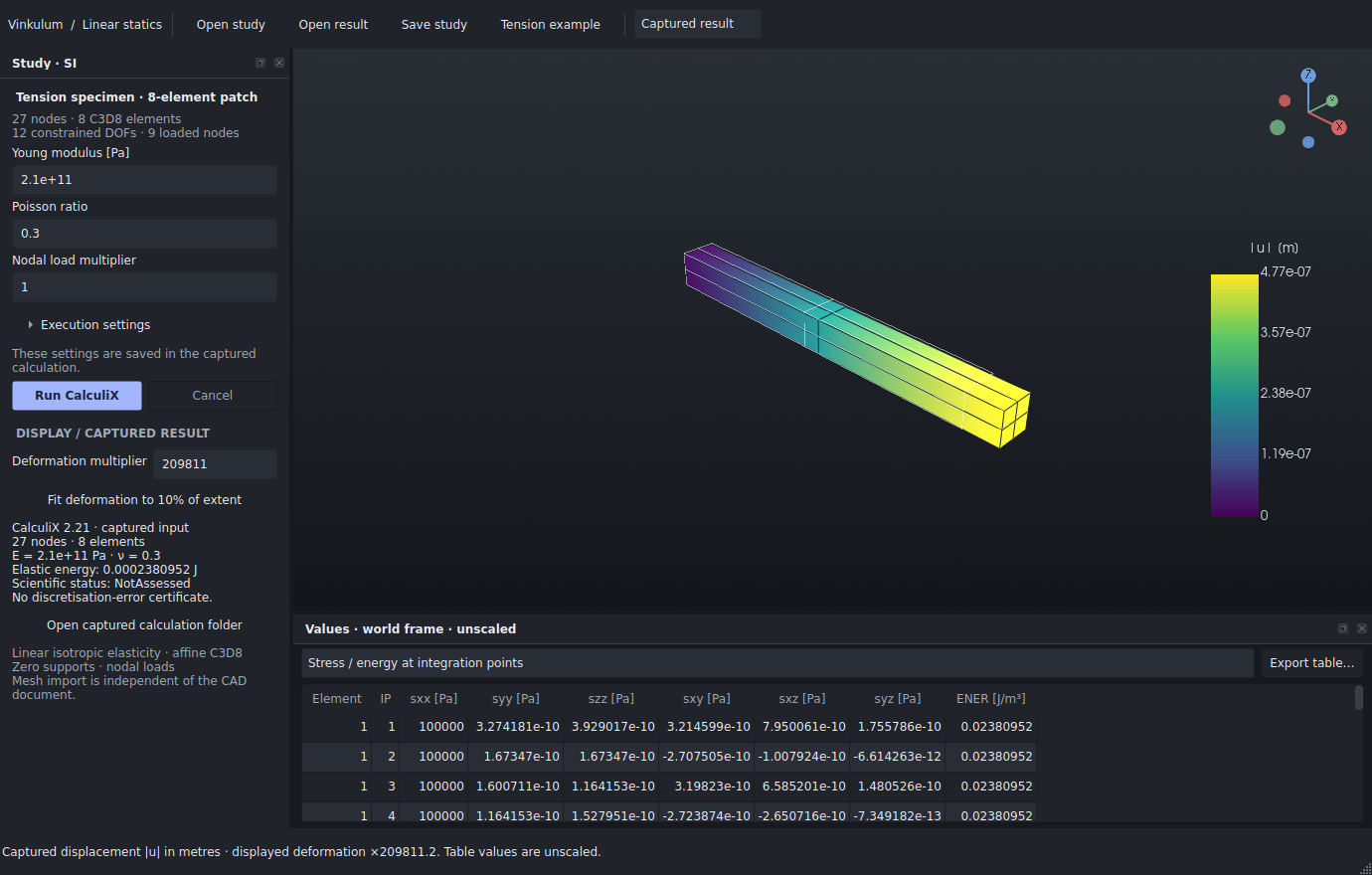
Load a mesh study, set material and load values, run a separately installed solver, and inspect captured displacement, reactions, integration-point stress and energy. Reopen a saved calculation without a solver: Studio checks the captured study, input deck, raw output and stored values before displaying them.
Try it
- Download
Vinkulum-Studio-0.5.0-linux-x86_64.tar.gzand verify it withSHA256SUMS. - Extract it and launch
./Vinkulum\ Studio/Vinkulum\ Studio. - Choose Run → Linear statics · CalculiX…. To calculate, install the external solver (
sudo apt-get install calculix-ccxon Ubuntu 24.04), then choose Run CalculiX. - To inspect an existing calculation without installing the solver, extract
Vinkulum-CalculiX-tension-example.zip, choose Open result…, and selectcalculation/result.json.
The small example includes its mesh, raw output, expected analytic values and an actual screenshot. Geometry deformation is explicitly amplified for display; tables and exports stay in physical SI units. It is an eight-element uniform-strain tension reference.
This local build targets Linux x86-64 / Ubuntu 24.04 / glibc 2.39 / X11. Python, Qt, VTK, OCCT 8 and adapted build123d are included; system graphics libraries remain required. CalculiX is external and is not bundled. See the installation instructions.
Changes and evidence
- Captured FEM inputs and results remain available after editing the current study. Archive opening preserves those edits; invalid archives are rejected.
- CalculiX opens with Ctrl+Shift+E. Cylinder and load creation use Ctrl+Shift+C/F; the English menu mnemonics remain available.
- Scene framing includes visible joints and load symbols. Glyph sizes stay stable under world translations, and the reference grid no longer clips a distant mechanism.
- 67 local Studio tests passed, including real CalculiX reference calculations, cancellation, archive corruption rejection and Qt/VTK interactions.
- The extracted executable passed English startup, OCCT 8 CAD/STEP, native double-pendulum simulation, rendering, external CalculiX 2.21 and saved-result reopening checks. See
startup-check.json,bundle-check.jsonand the scene captures. - An external X11 check also launched the executable without arguments, observed its live main window and captured it (
normal-launch.jsonandnormal-launch.png). archive-open.jsonandarchive-open.png: the final extracted executable opened the example through Ctrl+Shift+E → Open result, with an empty executable search path. Visual inspection confirmed the captured 27-node / 8-element result and archive-loaded status.build-info.jsonrecords the clean source commit and exact package versions.SHA256SUMScovers both downloadable archives.
The native kernel remains 0.19.0. CAD retains its existing OCCT 8.0.1 / build123d workflow.
Current limits
The FEM adapter accepts linear isotropic elasticity on affine C3D8 elements, zero supports and nodal loads. There is no automatic CAD meshing, nonlinear FEM or general mesh/discretisation-error certificate. Reopening establishes internal file consistency, not archive authorship. Scientific status remains NotAssessed. See the complete contract and reference.
Pinocchio and further engine workflows remain integration work. This Linux release does not qualify macOS, ARM64, older glibc or native Wayland. Original Vinkulum code is Apache-2.0; dependencies and external solvers retain their own licences.
Help build open engineering
Start with a CAD reference part (#1), a keyboard/high-DPI workflow (#2), or a FEM convergence study (#4). The share kit provides reproducible demonstrations and introductions to adapt.
Vinkulum Studio 0.4.2 — corrected and verified Linux launch
Vinkulum Studio 0.4.2 fixes the normal desktop launch with bundled PySide6 6.11.2.
Version 0.4.1 called an unavailable QLocale.Territory enum and exited before creating its window. Its diagnostic entry point bypassed that initialisation, so the previous package checks missed the defect. The locale now uses the stable en_GB identifier. Diagnostic checks run only after the normal application and window have been created.
Download and run
Download Vinkulum-Studio-0.4.2-linux-x86_64.tar.gz, verify it against SHA256SUMS, extract the archive and run:
./Vinkulum\ Studio/Vinkulum\ StudioKeep the executable and _internal directory together. This local build targets Linux x86-64, Ubuntu 24.04 / glibc 2.39, X11 and Mesa OpenGL. System graphics libraries are still required; see the installation instructions.
Verified on the extracted archive
- 50 local Studio tests passed, including a new test of the application entry point.
startup-check.json: frozen executable, exposed English window, expected version and a nonblack native 3D renderer.normal-launch.jsonandnormal-launch.png: an additional external X11 check launched the executable with no arguments, observed its live 1440 × 950 main window and captured that window. The test process was then stopped.bundle-check.json: real OCCT 8 CAD operations, STEP round-trip, native double-pendulum simulation, rendering and package versions.build-info.json: exact source commit and clean source state.SHA256SUMSidentifies the archive.
The desktop retains OCCT 8.0.1 CAD, adapted build123d, English Model / Simulate / Inspect workspaces and the Vinkulum 0.19.0 kernel. This is research software; these checks do not certify the complete kernel or general solver accuracy.
The new CalculiX graphical study is being developed separately and is not included in this maintenance binary. Pinocchio and other connectors remain separate integration work. Linux qualification does not qualify macOS, Linux ARM64, native Wayland or older glibc releases.
Try the machined plate example or the built-in double pendulum. Contributors can start with the public CAD reference task, keyboard/high-DPI workflow or FEM refinement study.
Vinkulum for FreeCAD 0.1.0a2 — persistent analyses · Linux
Save a motion analysis with your FreeCAD design, then resume it from the document tree.
This Linux research preview adds persistent Motion objects: source link, density, world pivot/axis, duration, native time step, thread budget and last capture folder. Double-click or right-click the object to reopen its panel. Task edits support native Undo/Redo. The Vinkulum menu stays available in the current FreeCAD workbench.
Calculations read the document's stored precision and run in a separate Vinkulum process. Updating parameters while a run is active does not change its capture, and completion does not overwrite newer edits. Reopen last calculation loads the retained result explicitly; opening a document starts no calculation or replay.
The release also fixes a reproducible native crash when closing the example during animated view fitting, and restores source visibility when its analysis link is removed during playback.
Validation: the installed archive passes 18 FreeCAD document, mechanics and lifecycle checks, plus five rapid example open/close cycles. Reports, saved native documents, actual captures and a screenshot are included in the qualification archive. The original crash was reproduced independently before the fix. No solver or geometry-admission tolerance changed.
Install: close FreeCAD and replace the Vinkulum folder in your user Mod directory with the folder from the extension ZIP, then restart. Read INSTALLATION.txt first. Do not install a second OCCT binding inside FreeCAD's Python.
Requirements: qualified FreeCAD 1.1.3 / Qt 6 on Linux x86-64 and a separate Vinkulum 0.20 / OCCT 8 Python environment with the existing Studio backend adapters. These runtimes are not bundled. FreeCAD keeps its own OCCT 7.8.1; the external worker uses OCCT 8.0.1.
Scope: one top-level rigid solid and one revolute joint, rest initial velocities and gravity −Z. This is not yet general FreeCAD Assembly conversion or a complete multicorps/FEM interface. Calculation folders remain external; the saved last-capture path must be relocated explicitly if moved. Native FCStd serialization retains FreeCAD's own precision. Other hosts and operating systems remain unqualified.
Built from clean commit 818bbaa; source and packaged-file hashes are in extension-info.json, and artifact checksums are in SHA256SUMS. Original extension code: Apache-2.0.
Vinkulum for FreeCAD 0.1.0a1 · Linux preview
Superseded by FreeCAD 0.1.0a2, which adds persistent analyses and fixes a reproducible native crash when closing the example during animated view fitting. The original artifacts below are retained unchanged for reproducibility.
FreeCAD becomes Vinkulum's primary desktop interface. This first Linux extension adds a Vinkulum menu and a native task panel, available without switching to a separate Vinkulum workbench.
Select a solid, specify the revolute joint and calculation settings, then run Vinkulum in its separate process. Inspect native motion samples in FreeCAD while retaining the original feature graph and placement. Cancellation, source-document close, saved-capture reopening and native FCStd save/reopen are exercised in the real GUI.
Download Vinkulum-FreeCAD-0.1.0a1.zip (31 kB). Close FreeCAD, extract its Vinkulum folder into your user FreeCAD/Mod directory, then restart. On the qualified Linux runtime the usual directory is ~/.local/share/FreeCAD/Mod. Read the attached INSTALLATION.txt for custom data paths and engine configuration.
Prerequisites: FreeCAD 1.1.3 / Qt 6 on Linux x86-64, and a separate Python environment containing Vinkulum 0.20 and its OCCT 8 CAD backend. The existing vinkulum_studio package supplies the backend adapters; its GUI is not opened. FreeCAD, Python and the engine are not bundled in this small extension ZIP. FreeCAD keeps its own OCCT 7.8.1 libraries; the worker checks the STEP capture with OCCT 8.0.1.
Start with Vinkulum → Open pendulum example, select the Rod body, then Vinkulum → Motion analysis. Choose the engine's Python and a directory for saved calculations, then click Run motion.
The final archive was built from clean source 0493d34e939d76e0e29ecb8a2e8e1ac535e04d26, extracted into a fresh FreeCAD user environment and passed 12 qualification checks. The accompanying qualification ZIP contains the actual reports, screenshot, saved FCStd and native calculation captures. SHA256SUMS and extension-info.json identify the published files. The independent pendulum reference remains in the repository.
The first scope is one top-level rigid solid, one explicit revolute joint, rest initial velocities and gravity -Z, with at most 10 seconds and 2001 native samples. World pivot/axis and engine threads are explicit. General assembly conversion, multiple-body host models, FEM controls and other platforms remain future work. The FCStd design and calculation folders remain separate. No general trajectory guarantee or large-model UI performance claim is made.
Original extension code and example: Apache-2.0. FreeCAD and external engines keep their own licences.

Vinkulum 0.18.1 — première publication publique (alpha)
Première publication publique de Vinkulum, noyau multicorps généraliste Rust/Python, en phase alpha.
Le code original est publié sous Apache-2.0. Les modèles tiers conservent leurs licences et leurs notices sont embarquées. Les sources numériques sont inchangées par rapport à la 0.18.0.
Le noyau entier n’est pas certifié : voir le registre de certification et les limites documentées. Les comparaisons de solveurs restent limitées aux cas mesurés.
La roue jointe cible CPython 3.14 et Linux x86_64 avec glibc 2.39 ou plus. Elle a été construite puis testée dans un environnement indépendant. Pour les autres plateformes, construire depuis les sources selon le README. Aucun paquet n’est publié sur PyPI.
Voir le dossier de publication, les notes de version et SHA256SUMS.
Vinkulum Studio 0.4.1 — superseded; use 0.4.2
Superseded: use Studio 0.4.2 Linux.
This 0.4.1 archive fails during normal launch with its bundled PySide6 6.11.2 because the launcher references an unavailable QLocale.Territory name. Its CAD/solver diagnostic checks bypassed that initialisation. Version 0.4.2 fixes the locale and verifies the actual launch path, including an external test with no diagnostic arguments. The older archive is retained for traceability.
Build the mechanism. Run the physics. Inspect the evidence.
Vinkulum Studio 0.4.1 brings an English interface and a locally built Linux preview to the open engineering workbench. The project combines OCCT 8 CAD, a Rust multibody kernel and a Qt/VTK desktop, under Apache-2.0 for its original code.
Try it
Download Vinkulum-Studio-0.4.1-linux-x86_64.tar.gz, verify it against SHA256SUMS, extract it, then run:
./Vinkulum\ Studio/Vinkulum\ StudioKeep the executable and _internal directory together. The bundle includes Python, the Vinkulum 0.19.0 kernel, Qt, VTK, OCCT 8.0.1 and the explicit build123d compatibility adaptations. System graphics libraries and an OpenGL driver are still required: see the installation instructions.
Qualified platform: Linux x86-64, Ubuntu 24.04 / glibc 2.39, X11 and Mesa OpenGL. This is an experimental preview. It does not qualify older glibc, Linux ARM64, native Wayland or macOS.
What to explore
- Create a solid, subtract a hole, fillet all edges, and inspect SI mass and inertia derived from the BREP. Single-solid STEP import/export is included.
- Build a rigid mechanism using bodies, joints, time laws and loads. Run the native kernel in a separate process.
- Inspect captured results, animate native samples and compare runs with their original models and settings.
- Use the English command palette and dense numerical Inspector. Existing project identifiers and full unedited numerical precision are preserved.
The machined plate example and screenshot recipe are available. Load the built-in double pendulum for a separate simulation example.
Evidence and limits
The source passed 49 local Studio tests, including CAD properties, independent dynamics references, cancellation, result capture and numerical precision. The attached bundle-check.json reports checks on this archive's extracted executable: real CAD, STEP round-trip, native double-pendulum simulation, rendering and versions. build-info.json records the source commit and package versions.
The complete kernel is not certified. The workbench exposes a subset of its capabilities. Interactive constrained sketches and a regenerating feature tree are future work. Pinocchio, CalculiX and other solver connectors are not selectable engines in this release. Several technical research reports remain in French.
Help build open engineering
We welcome students, researchers, engineers and curious builders. Contributor projects include CAD regression parts, independent physical references, Qt accessibility, numerical verification and solver adapters.
Try an example, report what you observe, or propose a small contribution. If the direction interests you, star the repository and share the demonstration kit.
Vinkulum Studio 0.2.0 — Apple Silicon preview 6
Application autonome Apple Silicon pour macOS 14 ou ultérieur : Python, noyau
Vinkulum 0.19.0, PySide6 6.11.2 et VTK 9.7.0 embarqués. Télécharger le DMG et
glisser Vinkulum Studio dans Applications. Aucune compilation locale nécessaire.
Version expérimentale, signature ad hoc, sans notarisation Apple. macOS peut
demander une autorisation d’ouverture dans Confidentialité et sécurité.
La construction vérifie les tests natifs et Studio sur ARM64, la signature,
l’architecture, le démarrage du bundle, le rendu OpenGL et un calcul du double
pendule par le worker embarqué. Le rapport et la capture sont joints. Ces
contrôles ne constituent pas une certification générale du noyau.
Le DMG est conservé comme asset de release, sans stockage volumineux dans les
artefacts GitHub Actions. La compilation utilise le runner public macos-14
standard. Sources exactes : tag de cette prerelease ; licences incluses au DMG.