Repository navigation
Releases
v5.2.0

One file. Download binmodem.exe and run it. There is nothing to install, and no Visual C++ redistributable is needed because the C runtime is linked in.
binmodem.exe                  a modem on a real line
binmodem.exe --devices        what audio this machine has
binmodem.exe --telnet         a board over a socket
binmodem.exe --capture        replay the golden capture
docs/usage.md has the setup.
What's new in 5.2.0
- V.ARC compresses. A V.ARC call had no compression at all:
+DSand+DS44are about V.42, and V.ARC has its own retransmission in place of V.42. Its stream is now compressed with the best method both ends have, each direction for itself, and the window says which and what it has been worth. - LZ, a compressor of its own, in LZMA's manner: matches against the last 256 kilobytes, and everything coded by a range coder with probabilities learnt as it goes. Text goes in under a third and tables of records in about a seventh; what will not compress costs a fiftieth more. It is not LZMA's format and reads no
.lzmaor.xzfile. - V.44 and V.42bis as well, with their largest dictionaries, for whichever of
+DS44and+DSis on. AT+VARCZ=<n>: 0 for none, 1 for V.44 and V.42bis only, 2 (as it comes) for LZ as well.- The two ends agree while the call runs, with a frame an older build ignores, so a call to one of those is carried as it was. An end holds back what is written for one round trip while the far end learns where the compressed stream begins.
What's new in 5.1.0
- V.ARC/G.711. V.ARC on a SIP call in G.711, which until now quietly became an ordinary V.90 call. Between two BinModems on a direct call the 8-bit codewords arrive as they were sent, so they are the data, in both directions alike: 60 928 bit/s each way in A-law and 56 832 in mu-law, where V.90 on the same call is 56 000 down and 31 200 up. Any of the three V.ARC modes becomes it on such a call. If something on the way recodes the call, or the far end is not V.ARC, it carries on as an ordinary call after four seconds. mu-law is the slower because it has two codewords for nought that arrive as one.
- The direct modes stop spending a fifth of the line on check octets. V.ARC/L16 and V.ARC/G.711 carried forty-eight check octets a codeword, enough to rebuild a lost packet, whether or not any packet was being lost: the code rate sat at 0.80. After five seconds with nothing missing they now ask for none, and go back to the full count the moment a packet is lost. V.ARC/L16 at 48 kHz: 744 186 bit/s where it was 601 302.
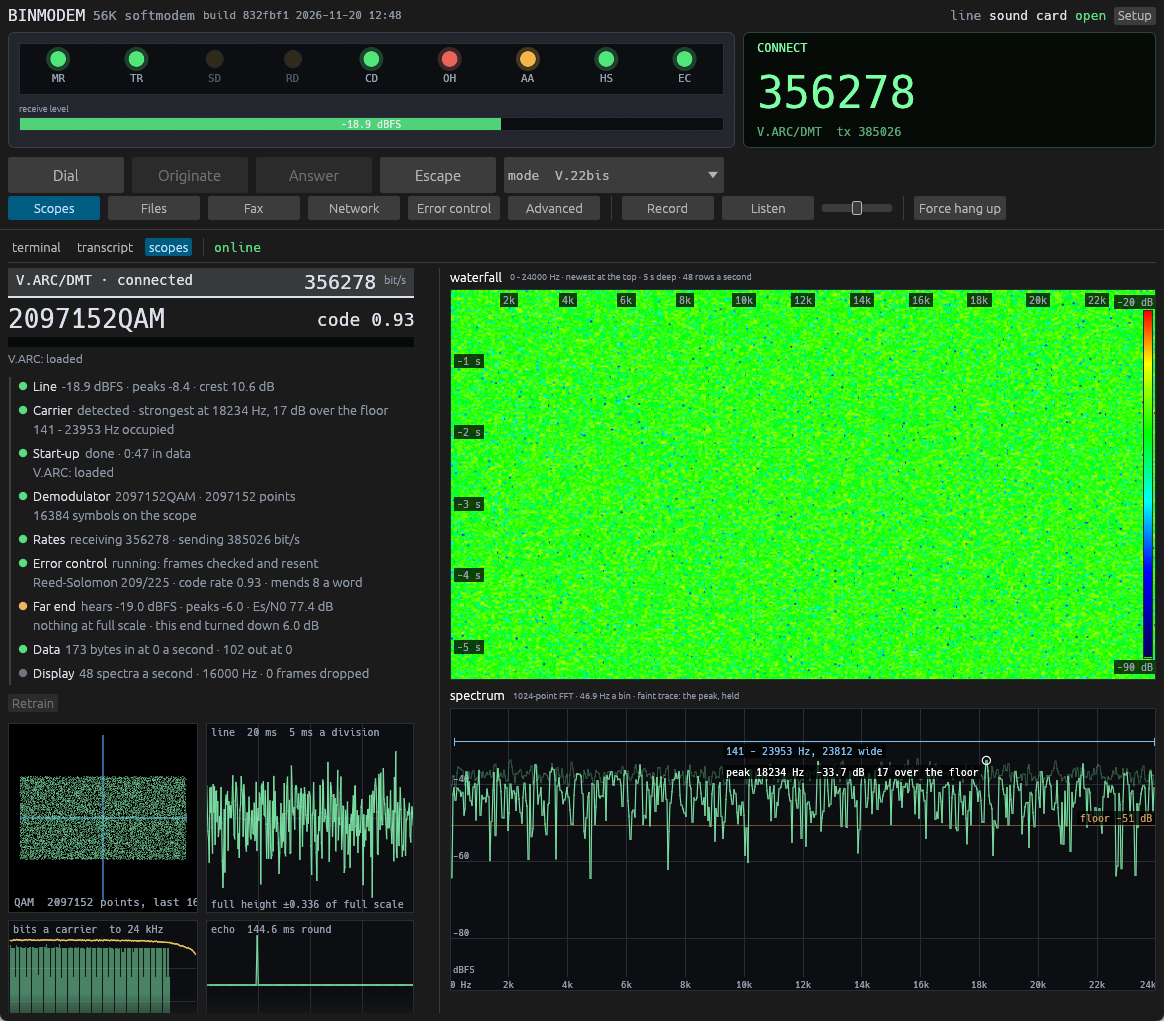
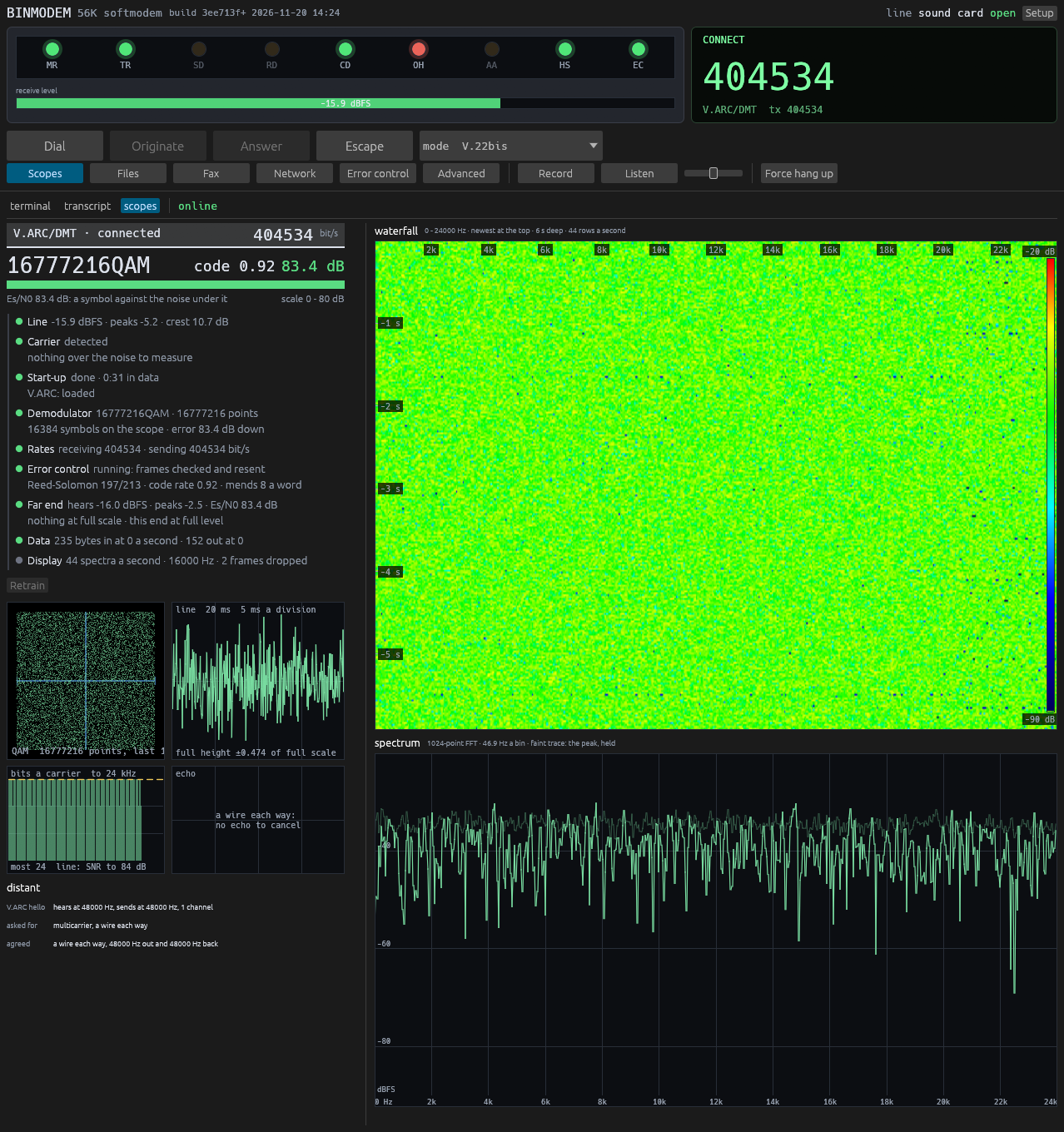
- Code rates of 0.99 and 1.0 for every mode. Two check octets a codeword, and none. The receiver asks for them when the line has more in hand than its grid can use. On two virtual cables V.ARC/DMT took 0.99 and went from 404 534 to 432 941 bit/s, and V.ARC/QAM from 348 000 to 353 500. With no check octets a frame that arrives wrong is sent again, and one that does counts against the code as a failed codeword would.
- EasySip through a router, by UPnP. A tick box on the EasySip row: the router is asked for its outside address and to forward this end's two ports, the far end is told that address, and the transcript says what to give the other end. The ports close when the line does. Not used for a far end on this network. Tested as far as the router, which listed the port while it was open and not after; no call across the internet has been made with it.
What's new in 5.0.1
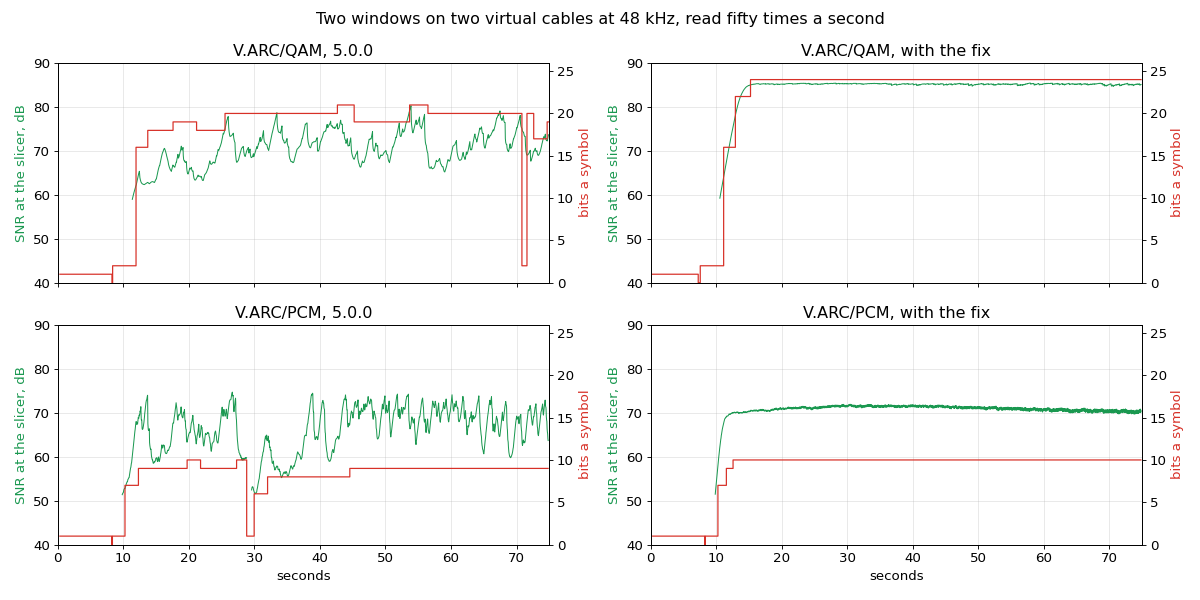
- V.ARC/QAM and V.ARC/PCM hold their rate. In 5.0.0 the signal to noise on a good line swung by ten to fifteen decibels every few seconds, and the two ends kept renegotiating the grid to follow it. The timing loop never settled and the equaliser was too slow to keep up with it; both are fixed. On two virtual cables the reading now moves by under half a decibel and the rate, once reached, stays.
- V.ARC/L16 shows its symbols. The diagram was empty on a linear SIP call. A sample is sixteen bits at once, and its two octets are now the two axes.
- The window says what a SIP call is carried in, in the line at the top:
L16/48000,PCMA. - EasySip chooses its coding. The fastest linear coding both ends have, any one of the eight linear codings, or G.711 in either law, which is what the ordinary modes (V.34, V.90 and the rest) are for. V.ARC/QAM and V.ARC/PCM also run on an EasySip call at 48 kHz: 270 and 305 kbit/s between two windows on one machine.
- Fixed: V.90 and V.92 on a linear SIP call at anything but 8 kHz. The digital end sent one level to a sample as it does into G.711, which at 16 kHz filled half of every packet: "gaps sent" by the hundred and a far end stuck in phase 2. It is now carried as a waveform there, as on a sound card: 56 000 down and 31 200 up between two windows on EasySip at 16 kHz stereo.
- Fixed: V.90 and V.92 on an A-law SIP call. The digital end built its levels for mu-law and said mu-law in INFO0d whatever the call was in, so on A-law every level was moved to the nearest the line had and the call came up at its lowest rate, 28 000. It is now told the call's law: 56 000 down on A-law, the same as on mu-law.
- Fixed: with the Setup row showing, an EasySip line opened from the command line was reopened with an empty address.
- Not fixed: a gap of a few milliseconds in the sound still costs V.ARC/QAM and V.ARC/PCM several seconds while the two ends renegotiate.
What's new in 5.0.0
V.ARC: a mode of our own, for a sound card and not a telephone line
No Recommendation covers this one. Both ends have to be BinModem, and both have to be this release. docs/design/v-arc.md is the design and every measurement.
- V.ARC in the mode box, or
AT+MS=VARC, then Dial and Answer as for any call. Hundreds of carriers 47 Hz apart, each given the bits its own stretch of the line will bear, from none to 24. The window opens the sound card at its own rate on both channels and the waterfall follows it out to half that rate. - Through a lead from a Realtek line output to its line input at 192 kHz: 1.4 Mbit/s, no octet wrong. A call is one signal, the same on both channels and both added together on the way in.
- V.ARC/QAM and V.ARC/PCM are one carrier and baseband levels, at a third and two-thirds of the card's sample rate in baud, so they fill its band whatever it is: 64 000 and 128 000 baud at 192 kHz, where the lead carries 1.14 Mbit/s and 972 kbit/s. Four points to sixteen million; 2PCM to 65 536PCM, of which a real line has borne 2048.
AT+VARC=<baud>,<code>,<bits>, and "by hand" in the modulation window, set the baud, the code and the grid a single-carrier call is asked for, for whoever wants to choose them.- It starts on a line it knows nothing about. The starting signal is 48 four-point symbols, each sent on every carrier in turn and added together by the receiver, so any 2.3 kHz of the band that works is enough; every carrier's noise is measured against the result and the table loads only where the line is. In simulation it starts on 300 to 3400 Hz, and on the whole band with a carrier 3 dB above its noise.
- A call starts with a handshake any line will carry: 200 bit/s in two tones a direction, in the middle of the voice band. Each end says what rates it hears and sends at, how many channels, which modulation it was asked for and whether it was told the line is two-wire, and both work out the same answer. A fast card and a slow one meet at the slow one's rate; ends told two-wire that cannot be run a wire each way and say why. The "distant" panel shows what the far end said.
- An end that cannot hear the other says so, and is sent to slower. A line can carry the modulation one way and not the other. The end that reads nothing says so in the handshake's tones, and the far end runs the modulation at half the speed, then a quarter, then an eighth, until it is read. Each direction for itself.
- Codes from 0.93 down to 0.25, chosen by the receiver with the bits. A line at 8 dB that carried nothing carries a bit a symbol.
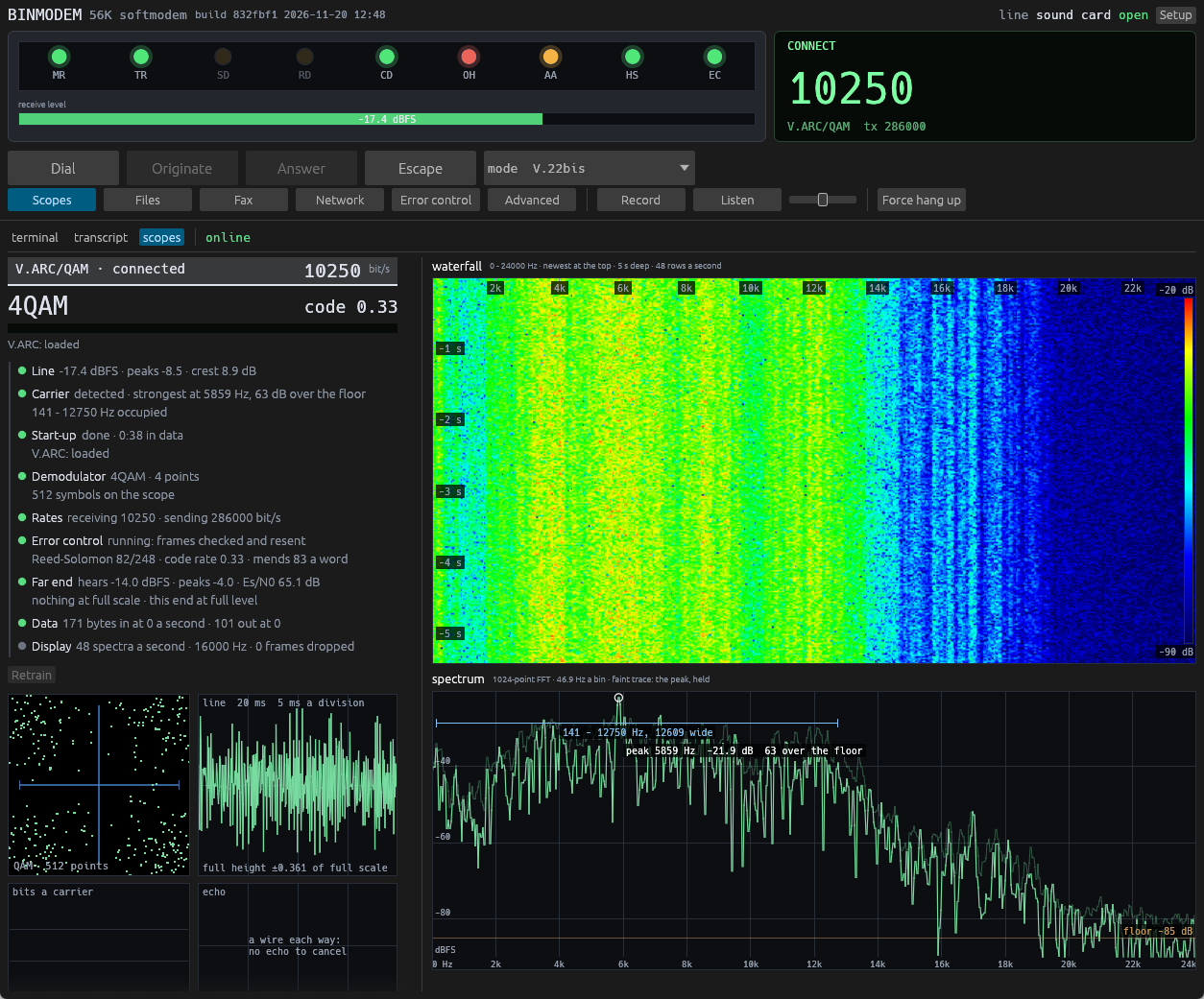
- It has been through the air: one direction out of a monitor's loudspeakers into a webcam's microphone. The multicarrier mode carried 20 kbit/s that way and V.ARC/QAM 10 kbit/s at half speed, with nothing wrong.
- Two sound devices at two rates are a line each way. An input at 192 kHz and an output at 48 kHz run each direction at its own.
- Each end tells the other what it hears: level, peaks, samples at full scale, and Es/N0. A sender told it is reaching the far converter's stops turns itself down. The window has a Far end line for it.
- V.ARC two-wire (
AT+MS=VARC2W) is the same mode on one pair of wires, both ends sending into it, with this end's echo taken out. A canceller finds the echo and fits a filter to it; then the receiver, once it has read a symbol, takes the far end's part of it away and fits a second filter to what is left. Each end first has the line to itself for two seconds, the caller and then the answerer, so each learns its echo with nobody talking over it. Two ends sharing one virtual cable connect at 327 kbit/s, reach 384, and go on improving past 75 dB, a million octets and none wrong. It wants one sound card, input and output at one rate.VARCQ2WandVARCP2Ware the single-carrier modes the same way, by the first canceller alone: 139 kbit/s for QAM. - An ordinary call finds it, through V.8 bis.
AT+VARCBIS=1, or "list ...
v5.1.0
One file. Download binmodem.exe and run it. There is nothing to install, and no Visual C++ redistributable is needed because the C runtime is linked in.
binmodem.exe                  a modem on a real line
binmodem.exe --devices        what audio this machine has
binmodem.exe --telnet         a board over a socket
binmodem.exe --capture        replay the golden capture
docs/usage.md has the setup.
What's new in 5.1.0
- V.ARC/G.711. V.ARC on a SIP call in G.711, which until now quietly became an ordinary V.90 call. Between two BinModems on a direct call the 8-bit codewords arrive as they were sent, so they are the data, in both directions alike: 60 928 bit/s each way in A-law and 56 832 in mu-law, where V.90 on the same call is 56 000 down and 31 200 up. Any of the three V.ARC modes becomes it on such a call. If something on the way recodes the call, or the far end is not V.ARC, it carries on as an ordinary call after four seconds. mu-law is the slower because it has two codewords for nought that arrive as one.
- The direct modes stop spending a fifth of the line on check octets. V.ARC/L16 and V.ARC/G.711 carried forty-eight check octets a codeword, enough to rebuild a lost packet, whether or not any packet was being lost: the code rate sat at 0.80. After five seconds with nothing missing they now ask for none, and go back to the full count the moment a packet is lost. V.ARC/L16 at 48 kHz: 744 186 bit/s where it was 601 302.
- Code rates of 0.99 and 1.0 for every mode. Two check octets a codeword, and none. The receiver asks for them when the line has more in hand than its grid can use. On two virtual cables V.ARC/DMT took 0.99 and went from 404 534 to 432 941 bit/s, and V.ARC/QAM from 348 000 to 353 500. With no check octets a frame that arrives wrong is sent again, and one that does counts against the code as a failed codeword would.
- EasySip through a router, by UPnP. A tick box on the EasySip row: the router is asked for its outside address and to forward this end's two ports, the far end is told that address, and the transcript says what to give the other end. The ports close when the line does. Not used for a far end on this network. Tested as far as the router, which listed the port while it was open and not after; no call across the internet has been made with it.
What's new in 5.0.1
- V.ARC/QAM and V.ARC/PCM hold their rate. In 5.0.0 the signal to noise on a good line swung by ten to fifteen decibels every few seconds, and the two ends kept renegotiating the grid to follow it. The timing loop never settled and the equaliser was too slow to keep up with it; both are fixed. On two virtual cables the reading now moves by under half a decibel and the rate, once reached, stays.
- V.ARC/L16 shows its symbols. The diagram was empty on a linear SIP call. A sample is sixteen bits at once, and its two octets are now the two axes.
- The window says what a SIP call is carried in, in the line at the top:
L16/48000,PCMA. - EasySip chooses its coding. The fastest linear coding both ends have, any one of the eight linear codings, or G.711 in either law, which is what the ordinary modes (V.34, V.90 and the rest) are for. V.ARC/QAM and V.ARC/PCM also run on an EasySip call at 48 kHz: 270 and 305 kbit/s between two windows on one machine.
- Fixed: V.90 and V.92 on a linear SIP call at anything but 8 kHz. The digital end sent one level to a sample as it does into G.711, which at 16 kHz filled half of every packet: "gaps sent" by the hundred and a far end stuck in phase 2. It is now carried as a waveform there, as on a sound card: 56 000 down and 31 200 up between two windows on EasySip at 16 kHz stereo.
- Fixed: V.90 and V.92 on an A-law SIP call. The digital end built its levels for mu-law and said mu-law in INFO0d whatever the call was in, so on A-law every level was moved to the nearest the line had and the call came up at its lowest rate, 28 000. It is now told the call's law: 56 000 down on A-law, the same as on mu-law.
- Fixed: with the Setup row showing, an EasySip line opened from the command line was reopened with an empty address.
- Not fixed: a gap of a few milliseconds in the sound still costs V.ARC/QAM and V.ARC/PCM several seconds while the two ends renegotiate.
What's new in 5.0.0
V.ARC: a mode of our own, for a sound card and not a telephone line
No Recommendation covers this one. Both ends have to be BinModem, and both have to be this release. docs/design/v-arc.md is the design and every measurement.
- V.ARC in the mode box, or
AT+MS=VARC, then Dial and Answer as for any call. Hundreds of carriers 47 Hz apart, each given the bits its own stretch of the line will bear, from none to 24. The window opens the sound card at its own rate on both channels and the waterfall follows it out to half that rate. - Through a lead from a Realtek line output to its line input at 192 kHz: 1.4 Mbit/s, no octet wrong. A call is one signal, the same on both channels and both added together on the way in.
- V.ARC/QAM and V.ARC/PCM are one carrier and baseband levels, at a third and two-thirds of the card's sample rate in baud, so they fill its band whatever it is: 64 000 and 128 000 baud at 192 kHz, where the lead carries 1.14 Mbit/s and 972 kbit/s. Four points to sixteen million; 2PCM to 65 536PCM, of which a real line has borne 2048.
AT+VARC=<baud>,<code>,<bits>, and "by hand" in the modulation window, set the baud, the code and the grid a single-carrier call is asked for, for whoever wants to choose them.- It starts on a line it knows nothing about. The starting signal is 48 four-point symbols, each sent on every carrier in turn and added together by the receiver, so any 2.3 kHz of the band that works is enough; every carrier's noise is measured against the result and the table loads only where the line is. In simulation it starts on 300 to 3400 Hz, and on the whole band with a carrier 3 dB above its noise.
- A call starts with a handshake any line will carry: 200 bit/s in two tones a direction, in the middle of the voice band. Each end says what rates it hears and sends at, how many channels, which modulation it was asked for and whether it was told the line is two-wire, and both work out the same answer. A fast card and a slow one meet at the slow one's rate; ends told two-wire that cannot be run a wire each way and say why. The "distant" panel shows what the far end said.
- An end that cannot hear the other says so, and is sent to slower. A line can carry the modulation one way and not the other. The end that reads nothing says so in the handshake's tones, and the far end runs the modulation at half the speed, then a quarter, then an eighth, until it is read. Each direction for itself.
- Codes from 0.93 down to 0.25, chosen by the receiver with the bits. A line at 8 dB that carried nothing carries a bit a symbol.
- It has been through the air: one direction out of a monitor's loudspeakers into a webcam's microphone. The multicarrier mode carried 20 kbit/s that way and V.ARC/QAM 10 kbit/s at half speed, with nothing wrong.
- Two sound devices at two rates are a line each way. An input at 192 kHz and an output at 48 kHz run each direction at its own.
- Each end tells the other what it hears: level, peaks, samples at full scale, and Es/N0. A sender told it is reaching the far converter's stops turns itself down. The window has a Far end line for it.
- V.ARC two-wire (
AT+MS=VARC2W) is the same mode on one pair of wires, both ends sending into it, with this end's echo taken out. A canceller finds the echo and fits a filter to it; then the receiver, once it has read a symbol, takes the far end's part of it away and fits a second filter to what is left. Each end first has the line to itself for two seconds, the caller and then the answerer, so each learns its echo with nobody talking over it. Two ends sharing one virtual cable connect at 327 kbit/s, reach 384, and go on improving past 75 dB, a million octets and none wrong. It wants one sound card, input and output at one rate.VARCQ2WandVARCP2Ware the single-carrier modes the same way, by the first canceller alone: 139 kbit/s for QAM. - An ordinary call finds it, through V.8 bis.
AT+VARCBIS=1, or "list V.ARC" under the V.8 bis switch, puts V.ARC in the non-standard field of the V.8 bis capabilities. Two BinModems that both list it choose it there and go to V.ARC's handshake in place of V.8; with a far end that does not, or is not BinModem, the call is what it would have been. Between two windows on two virtual cables, each set to V.92: 404 kbit/s, and 164 kbit/s with noise added at -55 dBFS. The country and provider codes in the block are made up, not registered. - Over SIP, the call carries sixteen-bit samples exactly, the samples are the data, and the rate is the sample rate: 601 kbit/s at 48 kHz, 200 kbit/s at 16 kHz.
SIP: linear PCM at every rate, and EasySip
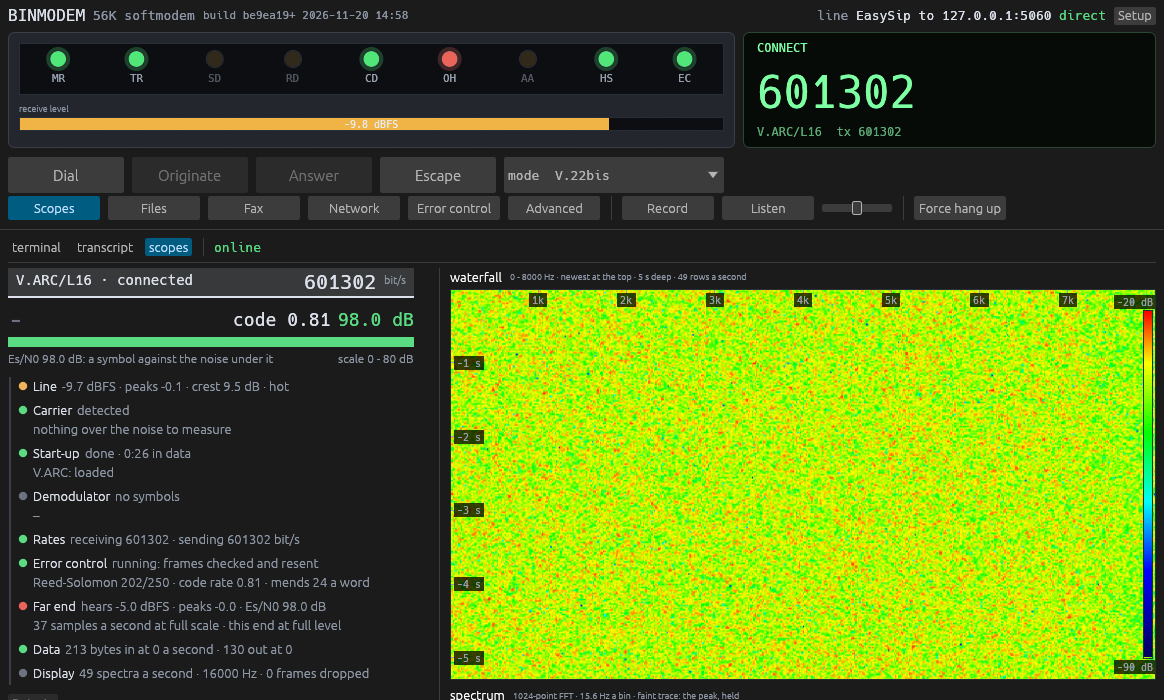
- EasySip is a third kind of line, beside the sound card and SIP. Type the other BinModem's address, open, and dial: no account, no registrar and no password. Each end listens on a port (5060 unless changed) and calls the other's. Linear samples are offered first and G.711 behind them. The far end answers with Answer when it rings.
- Linear PCM at 8, 16, 44.1 and 48 kHz, on one channel or two, which are the codings softphones list as LPCM. An account with
linear = yes, and every EasySip line, offers all eight ahead of G.711, the fastest first, and takes the first of them it is offered. Two channels carry one signal. 4.2 had 16 kHz on one channel only, and still gets it from this. - A packet is the packet time at any rate, so at 44.1 and 48 kHz it is larger than one Ethernet frame and the network sends it in pieces. That is how other softphones send these codings; a network that drops fragments will not carry them.
The window
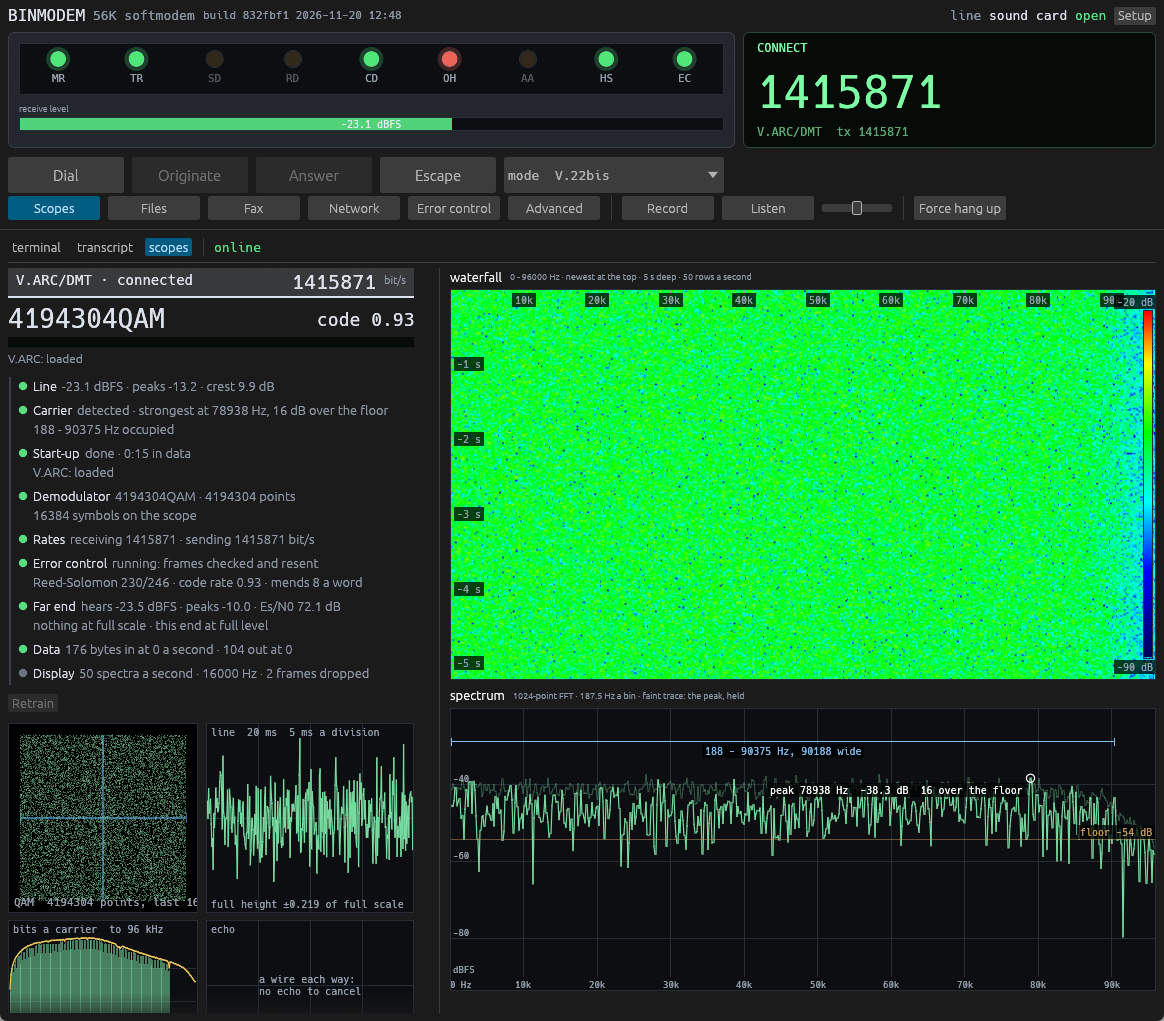
- The symbol diagram draws on a V.ARC call, and beside the grid's size is the code rate (
code 0.94). - Two more scopes under it on a V.ARC call: the bits on each carrier with the signal to noise they were chosen from, and the echo as the canceller has learned it.
- The window says which build it is, top left. Two windows that will not talk are often two builds.
- A call the line cannot run says why, in red on the line's row. It used to say
NO CARRIERand keep the reason in the transcript.
Calls between two of these without a window
modem-sipdrives the line a tenth as hard, as the window does. It was clipping i...
v5.0.0
One file. Download binmodem.exe and run it. There is nothing to install, and no Visual C++ redistributable is needed because the C runtime is linked in.
binmodem.exe                  a modem on a real line
binmodem.exe --devices        what audio this machine has
binmodem.exe --telnet         a board over a socket
binmodem.exe --capture        replay the golden capture
docs/usage.md has the setup.
What's new in 5.0.0
V.ARC: a mode of our own, for a sound card and not a telephone line
No Recommendation covers this one. Both ends have to be BinModem, and both have to be this release. docs/design/v-arc.md is the design and every measurement.
- V.ARC in the mode box, or
AT+MS=VARC, then Dial and Answer as for any call. Hundreds of carriers 47 Hz apart, each given the bits its own stretch of the line will bear, from none to 24. The window opens the sound card at its own rate on both channels and the waterfall follows it out to half that rate. - Through a lead from a Realtek line output to its line input at 192 kHz: 1.4 Mbit/s, no octet wrong. A call is one signal, the same on both channels and both added together on the way in.
- V.ARC/QAM and V.ARC/PCM are one carrier and baseband levels, at a third and two-thirds of the card's sample rate in baud, so they fill its band whatever it is: 64 000 and 128 000 baud at 192 kHz, where the lead carries 1.14 Mbit/s and 972 kbit/s. Four points to sixteen million; 2PCM to 65 536PCM, of which a real line has borne 2048.
AT+VARC=<baud>,<code>,<bits>, and "by hand" in the modulation window, set the baud, the code and the grid a single-carrier call is asked for, for whoever wants to choose them.- It starts on a line it knows nothing about. The starting signal is 48 four-point symbols, each sent on every carrier in turn and added together by the receiver, so any 2.3 kHz of the band that works is enough; every carrier's noise is measured against the result and the table loads only where the line is. In simulation it starts on 300 to 3400 Hz, and on the whole band with a carrier 3 dB above its noise.
- A call starts with a handshake any line will carry: 200 bit/s in two tones a direction, in the middle of the voice band. Each end says what rates it hears and sends at, how many channels, which modulation it was asked for and whether it was told the line is two-wire, and both work out the same answer. A fast card and a slow one meet at the slow one's rate; ends told two-wire that cannot be run a wire each way and say why. The "distant" panel shows what the far end said.
- An end that cannot hear the other says so, and is sent to slower. A line can carry the modulation one way and not the other. The end that reads nothing says so in the handshake's tones, and the far end runs the modulation at half the speed, then a quarter, then an eighth, until it is read. Each direction for itself.
- Codes from 0.93 down to 0.25, chosen by the receiver with the bits. A line at 8 dB that carried nothing carries a bit a symbol.
- It has been through the air: one direction out of a monitor's loudspeakers into a webcam's microphone. The multicarrier mode carried 20 kbit/s that way and V.ARC/QAM 10 kbit/s at half speed, with nothing wrong.
- Two sound devices at two rates are a line each way. An input at 192 kHz and an output at 48 kHz run each direction at its own.
- Each end tells the other what it hears: level, peaks, samples at full scale, and Es/N0. A sender told it is reaching the far converter's stops turns itself down. The window has a Far end line for it.
- V.ARC two-wire (
AT+MS=VARC2W) is the same mode on one pair of wires, both ends sending into it, with this end's echo taken out. A canceller finds the echo and fits a filter to it; then the receiver, once it has read a symbol, takes the far end's part of it away and fits a second filter to what is left. Each end first has the line to itself for two seconds, the caller and then the answerer, so each learns its echo with nobody talking over it. Two ends sharing one virtual cable connect at 327 kbit/s, reach 384, and go on improving past 75 dB, a million octets and none wrong. It wants one sound card, input and output at one rate.VARCQ2WandVARCP2Ware the single-carrier modes the same way, by the first canceller alone: 139 kbit/s for QAM. - An ordinary call finds it, through V.8 bis.
AT+VARCBIS=1, or "list V.ARC" under the V.8 bis switch, puts V.ARC in the non-standard field of the V.8 bis capabilities. Two BinModems that both list it choose it there and go to V.ARC's handshake in place of V.8; with a far end that does not, or is not BinModem, the call is what it would have been. Between two windows on two virtual cables, each set to V.92: 404 kbit/s, and 164 kbit/s with noise added at -55 dBFS. The country and provider codes in the block are made up, not registered. - Over SIP, the call carries sixteen-bit samples exactly, the samples are the data, and the rate is the sample rate: 601 kbit/s at 48 kHz, 200 kbit/s at 16 kHz.
SIP: linear PCM at every rate, and EasySip
- EasySip is a third kind of line, beside the sound card and SIP. Type the other BinModem's address, open, and dial: no account, no registrar and no password. Each end listens on a port (5060 unless changed) and calls the other's. Linear samples are offered first and G.711 behind them. The far end answers with Answer when it rings.
- Linear PCM at 8, 16, 44.1 and 48 kHz, on one channel or two, which are the codings softphones list as LPCM. An account with
linear = yes, and every EasySip line, offers all eight ahead of G.711, the fastest first, and takes the first of them it is offered. Two channels carry one signal. 4.2 had 16 kHz on one channel only, and still gets it from this. - A packet is the packet time at any rate, so at 44.1 and 48 kHz it is larger than one Ethernet frame and the network sends it in pieces. That is how other softphones send these codings; a network that drops fragments will not carry them.
The window
- The symbol diagram draws on a V.ARC call, and beside the grid's size is the code rate (
code 0.94). - Two more scopes under it on a V.ARC call: the bits on each carrier with the signal to noise they were chosen from, and the echo as the canceller has learned it.
- The window says which build it is, top left. Two windows that will not talk are often two builds.
- A call the line cannot run says why, in red on the line's row. It used to say
NO CARRIERand keep the reason in the transcript.
Calls between two of these without a window
modem-sipdrives the line a tenth as hard, as the window does. It was clipping its own signal into G.711, and a V.34 call between two of them ended inNO CARRIERmore often than not. With the fix V.34 connected 13 times of 13 at 33 600, and V.92 3 of 3.
What V.ARC has not done
- It has never run between two machines. Every figure above is one computer: one sound card, a lead, or virtual cables. Clock recovery is tested in simulation, to 150 parts in a million.
- Two-wire has only met a virtual cable, whose echo is one spike with no tail and no noise. A real hybrid or a telephone pair has not been tried, and neither has an echo through the air.
- The starting signal on a poor line is tested in simulation only, and so is a fast sound card calling a slow one.
- A gap in the sound costs a call seconds: half the blocks bad until the tables are made again.
- Over SIP and EasySip it has run between two processes on one machine and over no network, and with no softphone or exchange at the far end. The single-carrier modes have not been tried on a SIP call at all.
- Through V.8 bis it has run on virtual cables only. A caller that misses the ACK goes on to V.8 while the answerer is in V.ARC, and that call does not recover.
- On a SIP call the scopes show the line brought down to 16 kHz, whatever the call's rate, and call an exact line "hot" for reaching full scale, which on that line is only data.
What's new in 4.2.0
V.92 quick connect
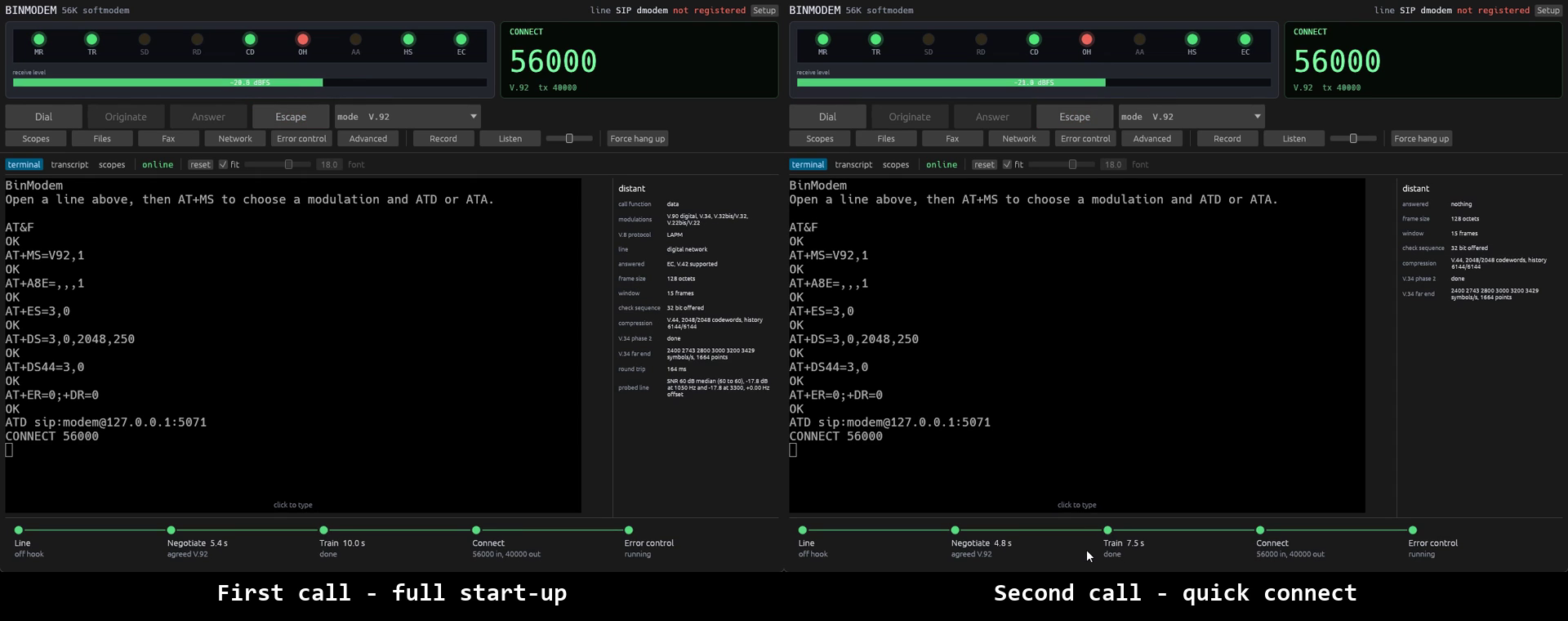
- A second V.92 call to the same number starts up the short way (V.92 9.2, 9.4 and 9.2.5): QC1a and QCA1d in place of V.8's menus, a Phase 2 with no line probe, and no ODP/ADP. Both ends do it, calling and answering. It takes about three seconds off: from the window to D-Modem over SIP, 15.4 s from ring to CONNECT in full and 12.2 s the short way; D-Modem dialling in, 15.1 s and 12.4 s.
- It is automatic. A V.92 call that connects is remembered by the number dialled, in ...
v4.2.0
One file. Download binmodem.exe and run it. There is nothing to install, and no Visual C++ redistributable is needed because the C runtime is linked in.
binmodem.exe                  a modem on a real line
binmodem.exe --devices        what audio this machine has
binmodem.exe --telnet         a board over a socket
binmodem.exe --capture        replay the golden capture
docs/usage.md has the setup.
What's new in 4.2.0
V.92 quick connect
- A second V.92 call to the same number starts up the short way (V.92 9.2, 9.4 and 9.2.5): QC1a and QCA1d in place of V.8's menus, a Phase 2 with no line probe, and no ODP/ADP. Both ends do it, calling and answering. It takes about three seconds off: from the window to D-Modem over SIP, 15.4 s from ring to CONNECT in full and 12.2 s the short way; D-Modem dialling in, 15.1 s and 12.4 s.
- It is automatic. A V.92 call that connects is remembered by the number dialled, in
v92-connections.txtbeside the window's settings, and the next call to that number asks for the short start-up. The first call to anywhere is the full one. A far end that does not answer the QC1a gets ordinary V.8, and a remembered call that does not reach V.92 is forgotten. - A Quick connect tick under the mode list, beside PCM upstream, turns it off.
BINMODEM_V92_QC=0does the same from outside, andalwaysasks every server whether it has been called before or not.modem-sip --memos <file>is the same memory without a window. - Not in it: the Table 19 INFO1a (V.34 upstream after a short Phase 2), the analogue answerer's and digital caller's sequences, V.8 bis's QC2, and the
+PQCand+PSScommands. It has not been tried against a hardware V.92 modem.
What's new in 4.1.0
Calls with somebody else's modem
This release was tested against D-Modem, a softmodem written by other people from the same Recommendations, over SIP on one machine. None of its code is here; it is the far end.
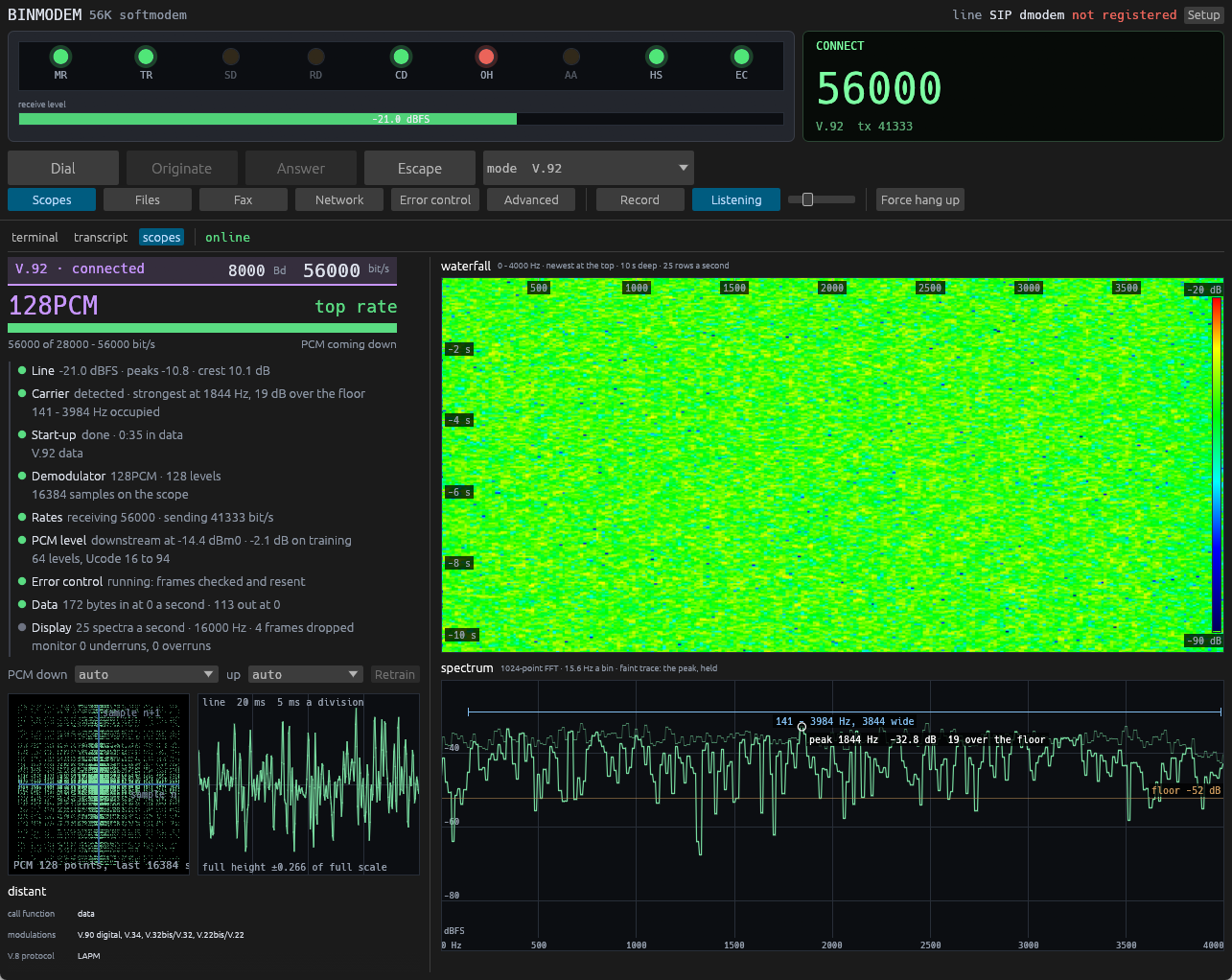
- V.34, V.90 and V.92 connect in both directions, with either modem dialling: 33 600 on V.34, 56 000 down on V.90, and on V.92 56 000 down with PCM upstream at about 41 000 when BinModem calls and 24 000 when it answers. A group 3 fax goes through as well.
- The server's codewords reach a SIP line exact. A V.90 or V.92 server chooses its levels at the network's 8000 Hz, and they used to go up to the modem's rate and back down on the way out, which blurred them. They now go straight to the G.711 encoder, and what the network delivers comes straight back in the same way. A modem dialling in to BinModem over a trunk trains at 56 000 first time where it had fallen back to V.34.
- The V.92 server reads TRN2u in either bit order. Tables 28 and 29 do not say which of a symbol's bits goes first; the fit tries both and the reader follows the one the line has.
- The V.92 server allows for the codec. Handed the network's own levels it can see that they are codewords, and it asks for an upstream rate the A/D converter's rounding leaves room for.
- V.92 with no DIL no longer waits for ever. The text has the server send Ri first and Figure 11 has the caller send CPt first; after 24 000 symbols of TRN1u with no Ri, the caller goes first.
run-dmodem.batstarts a D-Modem built beside this repository and dials it, andmodem-sipis the same call without a window.BINMODEM_V92_PAIR_OFFSET=0reads 6.4.2's equivalence classes as printed, which D-Modem does; the default is the reading fitted to an Agere capture.
The window
- A volume slider beside the Listen key.
- The mode box lists modulations, V.92 down to Bell 103, and names no rate: the modem finds the fastest the line carries. A ceiling set on purpose is under Advanced.
- V.92 in the mode box is V.92 with PCM upstream. It used to want
BINMODEM_V92_PCM_UP=1as well, and without it a V.92 call was V.90 in all but name. There is a tick under the list to have V.92 without it. - On a SIP line the window follows the modem after a call ends. A call the trunk refused left it on "negotiating" with the hook lamp lit, although the modem had said NO CARRIER; and the scopes kept the call's last moment. Both are put right, and the error is shown for three seconds and not for ever.
- The seconds down the side of the waterfall hold still, and the call card names a start-up once.
binmodem --recordstarts the window already recording.
The picture is a call from the window to D-Modem on the same machine, over SIP with G.711 between them: a codec, and no line. 56 000 down and 41 333 up there is what the two do with nothing in the way.
Linux
- Sound goes through PipeWire or PulseAudio where there is one, so a device BinModem is using is not taken from everything else.
BINMODEM_AUDIO_HOST=alsaopens the hardware as before. This has been built on Linux by CI and not yet run there by us: reports are welcome. - The README has the build, from the clone to the window. The release itself is still the Windows executable.
Status
- Sending over Super G3 is not yet confirmed against a real machine. On the first try, both control channels came up, and each end read the other's MPh and E. Then the far end sent its NSF and DIS and never answered our TSI and DCS, four times over. Every frame in the recording decodes whole in both directions, with the headers right. The likeliest cause is that our E reached that machine about 50 ms before it had sent its own, so it never started reading ours. The last change above answers that, but it has not been tried live yet. Untick V.34 to send at V.17.
- V.32's round-trip measurement can still be halved by a lost packet. On a V.32bis call over a trunk, the concealment brought the far end's alternation back inverted, and the reversal that came out of it stopped the clock at 706 ms on a line whose real round trip is 1.22 s. The call connects regardless; the bad reading still costs the echo canceller's tap placement.
- One ISP's V.90 pool sometimes stops dead just as its modem takes up our constellation, at the end of phase 4 or in a renegotiation. Every CP we sent was checked against V.90 Table 14 bit for bit, and they are correct.
- Known: after a V.90 call falls back to V.34, the V.34 retrain watch can still take the hang-up beep for tone B.
- V.92 has only carried data between softmodems: two of these, and one of these with D-Modem. PCM upstream comes with V.92 chosen in the window;
AT+MS=V92typed at a terminal still wantsBINMODEM_V92_PCM_UP=1, and both ends have to ask for it. Against a real V.92 modem the server has reached Phase 3 and no further. Super G3 to D-Modem does not come up: it does not recognise our control channel's start. The calling side chooses its sample phase once and follows no clock, cancels no echo and asks for no DIL, so it wants a four-wire line with both ends on one clock, which a pair of virtual cables is and a telephone line is not. V.92's own rate renegotiation, cleardown and modem on hold are not built. From the window, a V.92 call to D-Modem sometimes fails in Phase 3 and comes up as V.90 or not at all (two of seven while this release was being filmed); the same call without a window has not done it, and the cause is not yet known. - Not yet tried against real far ends: V.17, and the V.29 and V.27 ter receivers, have been measured against our own modems and simulated lines only.
Checksums are in SHA256SUMS.txt.
v4.1.0
One file. Download binmodem.exe and run it. There is nothing to install, and no Visual C++ redistributable is needed because the C runtime is linked in.
binmodem.exe                  a modem on a real line
binmodem.exe --devices        what audio this machine has
binmodem.exe --telnet         a board over a socket
binmodem.exe --capture        replay the golden capture
docs/usage.md has the setup.
What's new in 4.1.0
Calls with somebody else's modem
This release was tested against D-Modem, a softmodem written by other people from the same Recommendations, over SIP on one machine. None of its code is here; it is the far end.
- V.34, V.90 and V.92 connect in both directions, with either modem dialling: 33 600 on V.34, 56 000 down on V.90, and on V.92 56 000 down with PCM upstream at about 41 000 when BinModem calls and 24 000 when it answers. A group 3 fax goes through as well.
- The server's codewords reach a SIP line exact. A V.90 or V.92 server chooses its levels at the network's 8000 Hz, and they used to go up to the modem's rate and back down on the way out, which blurred them. They now go straight to the G.711 encoder, and what the network delivers comes straight back in the same way. A modem dialling in to BinModem over a trunk trains at 56 000 first time where it had fallen back to V.34.
- The V.92 server reads TRN2u in either bit order. Tables 28 and 29 do not say which of a symbol's bits goes first; the fit tries both and the reader follows the one the line has.
- The V.92 server allows for the codec. Handed the network's own levels it can see that they are codewords, and it asks for an upstream rate the A/D converter's rounding leaves room for.
- V.92 with no DIL no longer waits for ever. The text has the server send Ri first and Figure 11 has the caller send CPt first; after 24 000 symbols of TRN1u with no Ri, the caller goes first.
run-dmodem.batstarts a D-Modem built beside this repository and dials it, andmodem-sipis the same call without a window.BINMODEM_V92_PAIR_OFFSET=0reads 6.4.2's equivalence classes as printed, which D-Modem does; the default is the reading fitted to an Agere capture.
The window
- A volume slider beside the Listen key.
- The mode box lists modulations, V.92 down to Bell 103, and names no rate: the modem finds the fastest the line carries. A ceiling set on purpose is under Advanced.
- V.92 in the mode box is V.92 with PCM upstream. It used to want
BINMODEM_V92_PCM_UP=1as well, and without it a V.92 call was V.90 in all but name. There is a tick under the list to have V.92 without it. - On a SIP line the window follows the modem after a call ends. A call the trunk refused left it on "negotiating" with the hook lamp lit, although the modem had said NO CARRIER; and the scopes kept the call's last moment. Both are put right, and the error is shown for three seconds and not for ever.
- The seconds down the side of the waterfall hold still, and the call card names a start-up once.
binmodem --recordstarts the window already recording.
The picture is a call from the window to D-Modem on the same machine, over SIP with G.711 between them: a codec, and no line. 56 000 down and 41 333 up there is what the two do with nothing in the way.
Linux
- Sound goes through PipeWire or PulseAudio where there is one, so a device BinModem is using is not taken from everything else.
BINMODEM_AUDIO_HOST=alsaopens the hardware as before. This has been built on Linux by CI and not yet run there by us: reports are welcome. - The README has the build, from the clone to the window. The release itself is still the Windows executable.
Status
- Sending over Super G3 is not yet confirmed against a real machine. On the first try, both control channels came up, and each end read the other's MPh and E. Then the far end sent its NSF and DIS and never answered our TSI and DCS, four times over. Every frame in the recording decodes whole in both directions, with the headers right. The likeliest cause is that our E reached that machine about 50 ms before it had sent its own, so it never started reading ours. The last change above answers that, but it has not been tried live yet. Untick V.34 to send at V.17.
- V.32's round-trip measurement can still be halved by a lost packet. On a V.32bis call over a trunk, the concealment brought the far end's alternation back inverted, and the reversal that came out of it stopped the clock at 706 ms on a line whose real round trip is 1.22 s. The call connects regardless; the bad reading still costs the echo canceller's tap placement.
- One ISP's V.90 pool sometimes stops dead just as its modem takes up our constellation, at the end of phase 4 or in a renegotiation. Every CP we sent was checked against V.90 Table 14 bit for bit, and they are correct.
- Known: after a V.90 call falls back to V.34, the V.34 retrain watch can still take the hang-up beep for tone B.
- V.92 has only carried data between softmodems: two of these, and one of these with D-Modem. PCM upstream comes with V.92 chosen in the window;
AT+MS=V92typed at a terminal still wantsBINMODEM_V92_PCM_UP=1, and both ends have to ask for it. Against a real V.92 modem the server has reached Phase 3 and no further. Super G3 to D-Modem does not come up: it does not recognise our control channel's start. The calling side chooses its sample phase once and follows no clock, cancels no echo and asks for no DIL, so it wants a four-wire line with both ends on one clock, which a pair of virtual cables is and a telephone line is not. V.92's own rate renegotiation, cleardown, quick connect and modem on hold are not built. - Not yet tried against real far ends: V.17, and the V.29 and V.27 ter receivers, have been measured against our own modems and simulated lines only.
Checksums are in SHA256SUMS.txt.
v4.0.0
One file. Download binmodem.exe and run it. There is nothing to install, and no Visual C++ redistributable is needed because the C runtime is linked in.
binmodem.exe                  a modem on a real line
binmodem.exe --devices        what audio this machine has
binmodem.exe --telnet         a board over a socket
binmodem.exe --capture        replay the golden capture
docs/usage.md has the setup.
What's new in 4.0.0
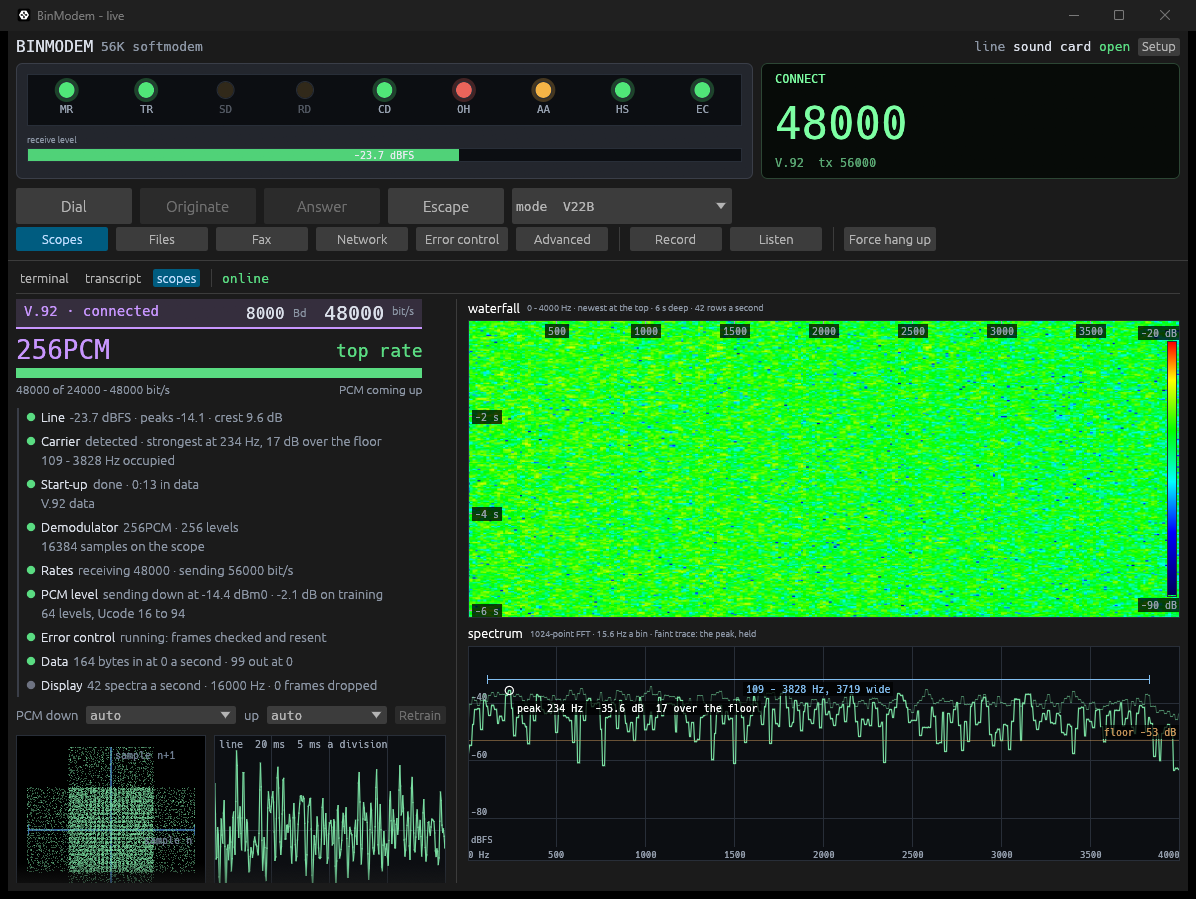
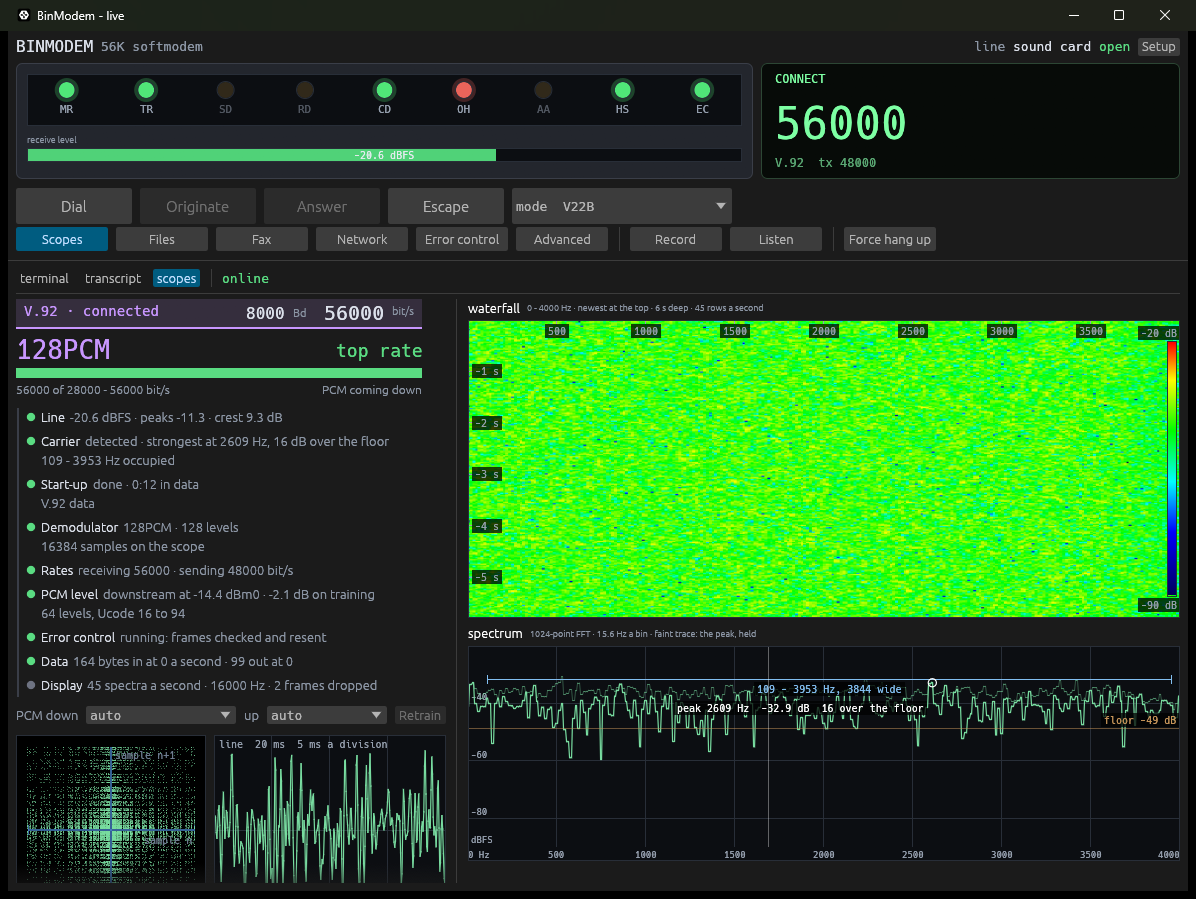
V.92: PCM both ways
- A whole V.92 call between two of these modems.
AT+MS=V92at both ends, withBINMODEM_V92_PCM_UP=1set for both: V.8, phase 2 with V.92's INFO sequences, a Table 18 INFO1a, V.92's Phases 3 and 4, and data with PCM going up the line as well as down. Over a pair of virtual cables it connects first time at 56 000 down and 48 000 up, with V.42 and V.44 on top. - The server.
AT+MS=V92on the answering end is a V.92 digital modem: INFO0d's capability bits, PCM upstream offered in INFO1d, and the analogue modem's Ru, TRN1u, Ja, Su, CPt and E1u read and answered. The V.92 server was contributed by rgwan, and has taken a real Agere modem through Phase 3. - The calling side, on a sound card. The analogue modem reads the downstream one sample a symbol on the phase the server's Sd gives it, and sends its upstream through a transmitter that takes S-bar-u's half symbol and Jp's epsilon as the steps they are.
- The downstream rate is chosen from the line too. With no DIL, what the caller has is how cleanly TRN1d trained its receiver: it asks for the fastest rate whose levels stand clear of that noise, 56 000 on a line with nothing on it and a slow, careful rate on one where the fit reads low.
- The upstream rate is chosen from the line. The calling modem is silent while the server sends TRN1d, and what arrives then is the noise the upstream will have against it: the server asks for the fastest of 6.1's nineteen rates that stands clear of it. Behind a codec it stays at 24 000, which is where it used to stay always.
- A ladder to choose from. The window has PCM down and up menus: any downstream rate from 28 000 to 56 000 and any upstream rate from 24 000 to 48 000, from either end. Chosen during a V.92 call, the line retrains to take it.
- The call card has V.92's figures. The bar is the rate this end receives along the rates it could be sent at, and a PCM level row gives the downstream's power in dBm0 and which levels it is made of. PCM has no gain to turn, so the power is the constellation's: 32 levels spread over Ucodes 16 to 93 come to -14.6 dBm0.
- Phase 2's DPSK is on the scope, for V.34 and V.90 as well: each INFO symbol set against the one before it, a 0 on one side and a 1 on the other. Constellations of two or four points are drawn large enough to see.
- Both scopes have something to draw. PCM has no plane, so each symbol is set against the next: the calling end shows the downstream's grid, the answering end the upstream's.
V.8 bis
- Signals, messages and transactions (ITU-T V.8 bis, 11/2000): MRe, MRd, CRe, CRd, ESi and ESr as their tone pairs, and MS, CL, CLR, ACK and NAK as HDLC frames on V.21, with the capabilities tree coded both ways. The window turns it on with its other settings (
AT+A8E=,,,1, V.251), with a box in the modulation window to turn it off; the modem's own factory setting is off. - A call that starts with it. The answering end sends CRe, the caller answers with its capabilities or a mode, and the mode selected is the one the call then trains in. A far end with no V.8 bis is heard answering and gets V.8 as before, and the answering end tries three times before it gives up on it.
Also
- No console window behind the program's own when it is opened from Explorer or a shortcut. From a shell it still prints to that shell, but the shell no longer waits for it:
start /wait binmodem ...does. binmodem --answer --statsprints the line's counters, the share of exact silence and the level each second, and--record <file>writes what arrived, which an ignored test replays into a fresh answerer: how a call that would not come up was found to be the window's own drive setting scaling the PCM upstream to nothing.- The answering end's start-up is in its transcript for V.92, a line a step, as the calling end's always was.
The pictures are from a call between two instances over a pair of virtual audio cables, four-wire: no echo, no noise and no codec. 56 000 down and 48 000 up there is what the modems do on a clean line, not what a telephone route gives.
Status
- Sending over Super G3 is not yet confirmed against a real machine. On the first try, both control channels came up, and each end read the other's MPh and E. Then the far end sent its NSF and DIS and never answered our TSI and DCS, four times over. Every frame in the recording decodes whole in both directions, with the headers right. The likeliest cause is that our E reached that machine about 50 ms before it had sent its own, so it never started reading ours. The last change above answers that, but it has not been tried live yet. Untick V.34 to send at V.17.
- V.32's round-trip measurement can still be halved by a lost packet. On a V.32bis call over a trunk, the concealment brought the far end's alternation back inverted, and the reversal that came out of it stopped the clock at 706 ms on a line whose real round trip is 1.22 s. The call connects regardless; the bad reading still costs the echo canceller's tap placement.
- One ISP's V.90 pool sometimes stops dead just as its modem takes up our constellation, at the end of phase 4 or in a renegotiation. Every CP we sent was checked against V.90 Table 14 bit for bit, and they are correct.
- Known: after a V.90 call falls back to V.34, the V.34 retrain watch can still take the hang-up beep for tone B.
- V.92 has only carried data between two of these modems. PCM upstream is off unless
BINMODEM_V92_PCM_UP=1is set at both ends. Against a real V.92 modem the server has reached Phase 3 and no further. The calling side chooses its sample phase once and follows no clock, cancels no echo and asks for no DIL, so it wants a four-wire line with both ends on one clock, which a pair of virtual cables is and a telephone line is not. V.92's own rate renegotiation, cleardown, quick connect and modem on hold are not built. - Not yet tried against real far ends: V.17, and the V.29 and V.27 ter receivers, have been measured against our own modems and simulated lines only.
Checksums are in SHA256SUMS.txt.
v3.0.0
One file. Download binmodem.exe and run it. There is nothing to install, and no Visual C++ redistributable is needed because the C runtime is linked in.
binmodem.exe                  a modem on a real line
binmodem.exe --devices        what audio this machine has
binmodem.exe --telnet         a board over a socket
binmodem.exe --capture        replay the golden capture
docs/usage.md has the setup.
What's new in 3.0.0
The window is a modem's faceplate
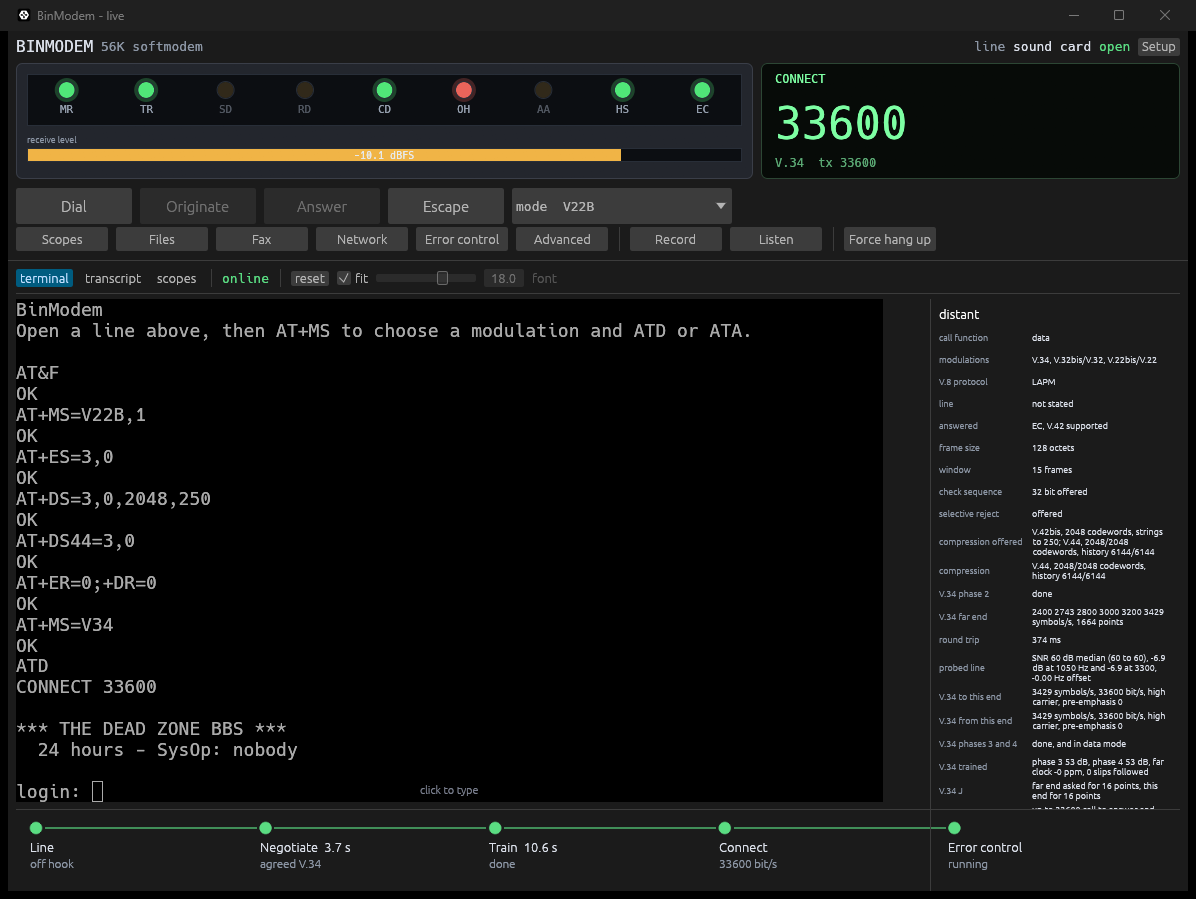
- Lamps, level and the rate, first. The window opens on the front of a modem: the nine lamps, the receive level, and a readout with the state, the rate it connected at and the modulation. Under them, keys that dial, originate, answer and hang up, and the mode. Line setup is behind a Setup key and opens by itself when there is no line or it failed.
- The terminal fills its room. Its type is sized so the whole 80 by 24 screen fits the space there is, to the half point. A fit box beside the font slider turns that off.
- A timeline under the terminal. The call as five steps -- line, negotiate, train, connect, error control -- each lit when it is done, with what it settled and how long the two that take time took. A call that is not coming up is stuck at one of them, and the terminal alone shows nothing until the last is over.
The scopes say what they are showing
- The scopes are a tab beside the terminal and the transcript, and a key on the faceplate goes straight to them.
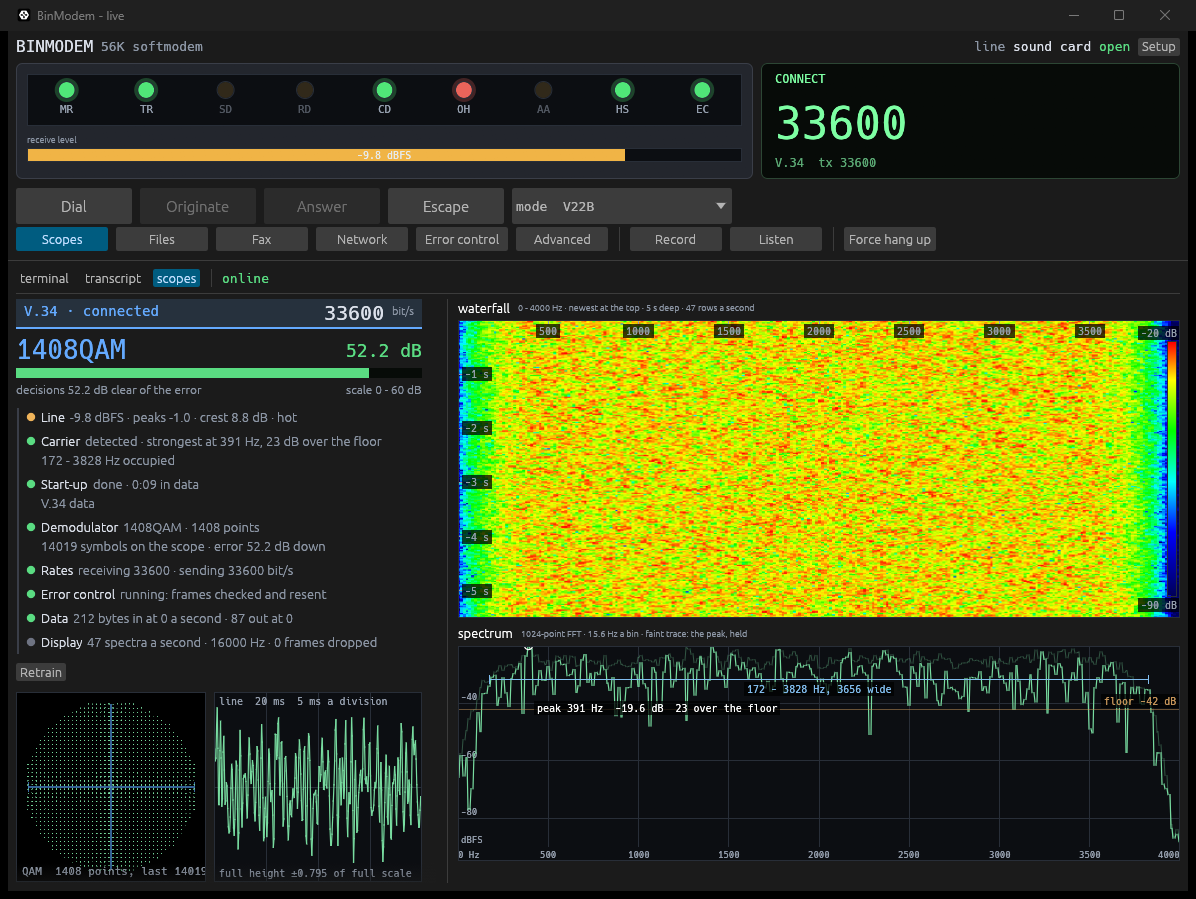
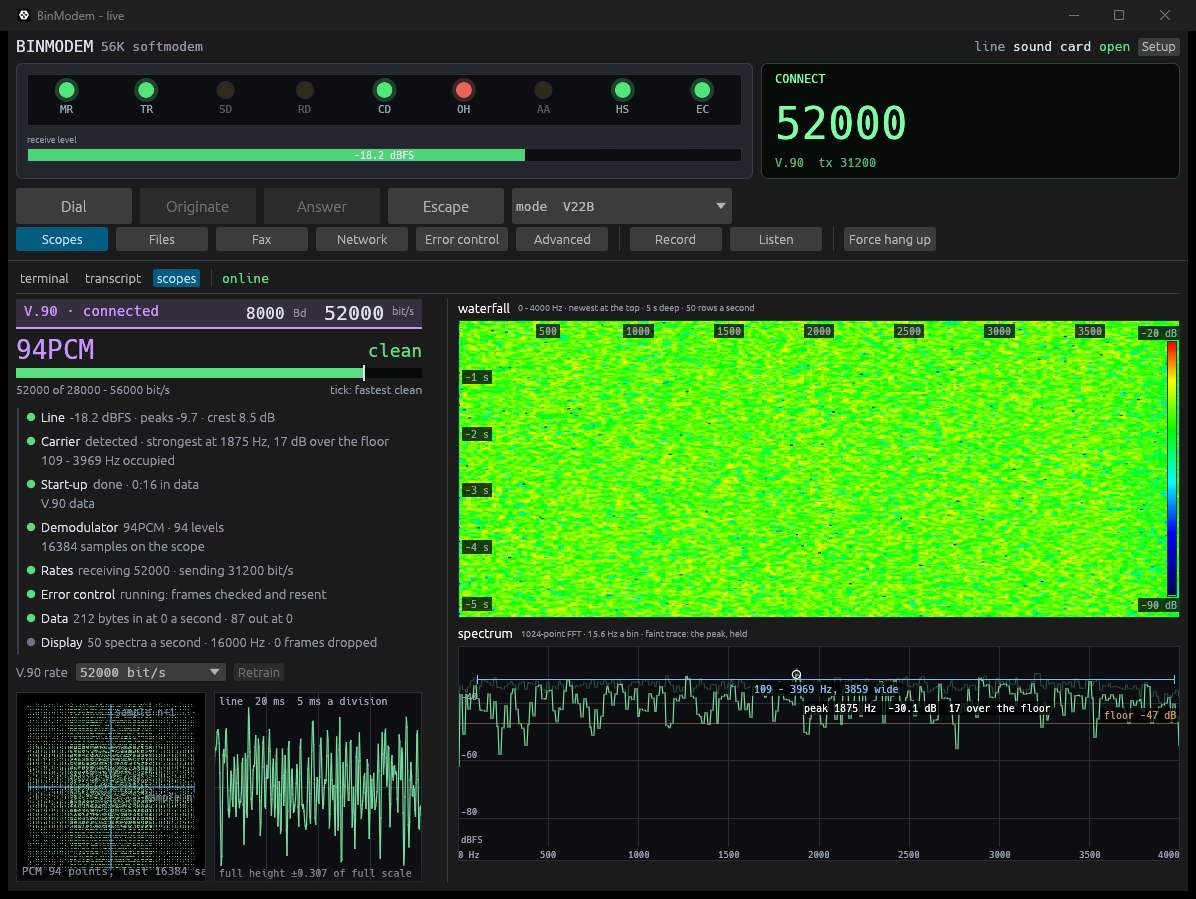
- A call card, laid out as DecSAT lays out a DVB carrier's: a title bar in the modulation's colour with the symbol rate and the bit rate; what the receiver is slicing, large -- 2FSK, 16QAM, 1408QAM, 116PCM -- with its margin beside it and a bar of the same; and then the receive chain, a line a stage with a health dot: line, carrier, start-up, demodulator, echo canceller, rates, error control, data, fax.
- Every modulation has a figure on the bar. FSK its slicer's quality; V.32 how far it misses by against the gap between points, as decibels in hand before a retrain; V.22bis and V.34 the signal to noise of their decisions; V.90 the rate in use along the rates the line carries, ticked at the fastest one predicted clean.
- An oscilloscope of the line beside the constellation: the last twenty milliseconds, started on a zero crossing, with its scale written on it.
- The waterfall carries its frequency scale, how long ago each row was, and its colour ramp with the levels at both ends. The spectrum has a held peak, the noise floor, the occupied band and the peak, each named. Both read out what is under the pointer.
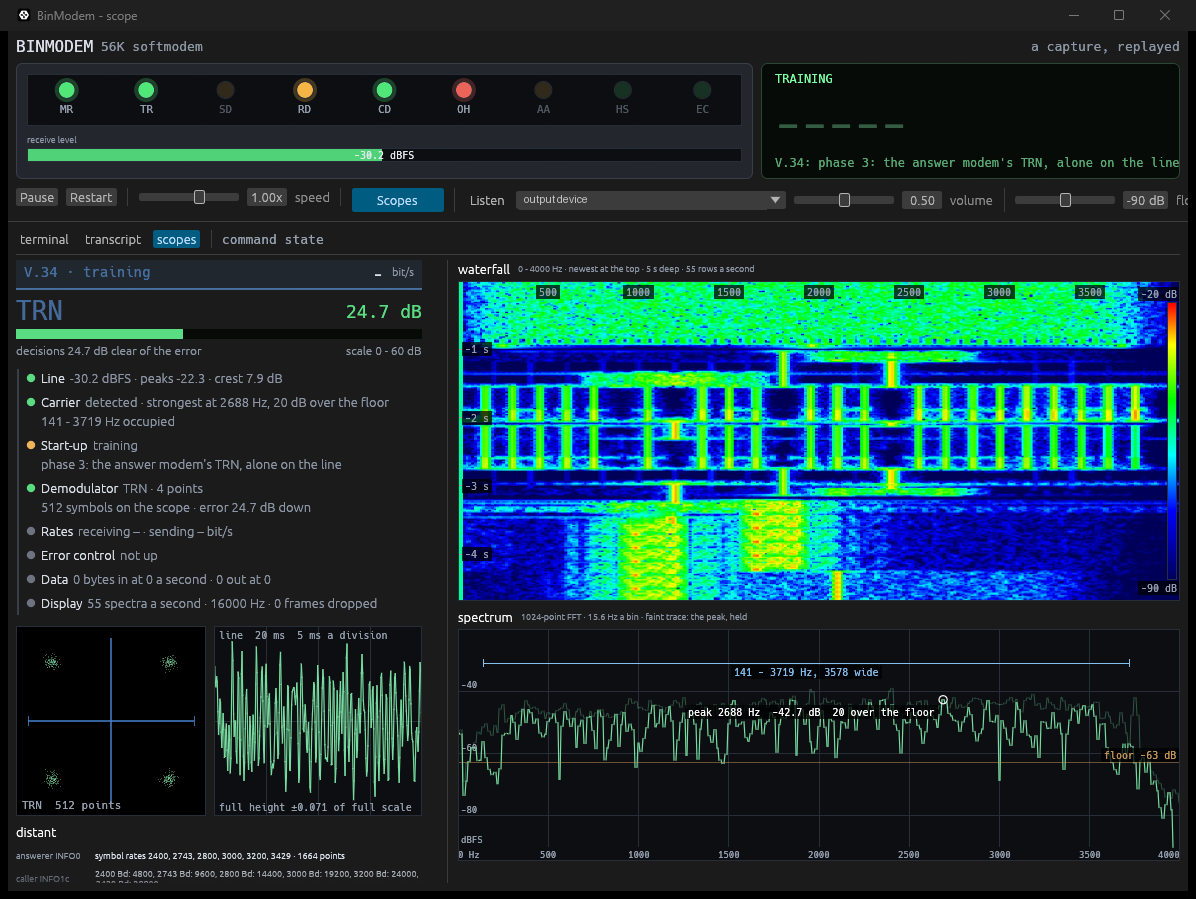
A recording of a V.32 or V.34 call can be followed
- As far as one tap goes. Both put the two directions on one band, so a recording of one tap has their sum and the data cannot be had from it by anybody. Each end's training is sent while the other listens, and that can: V.32's S, S-bar and TRN with the rate signal after it, the answering modem's and then the calling modem's; V.34's INFO sequences, and each modem's S, PP and TRN of phase 3 through to its J. The constellation is drawn while a receiver is trained, what each end said goes in the far-end rows, and when both ends start sending at once the phase says so.
- Nothing is cued by time. Each step starts from what the last one read.
binmodem path.wavreplays one; the name says which modulation.
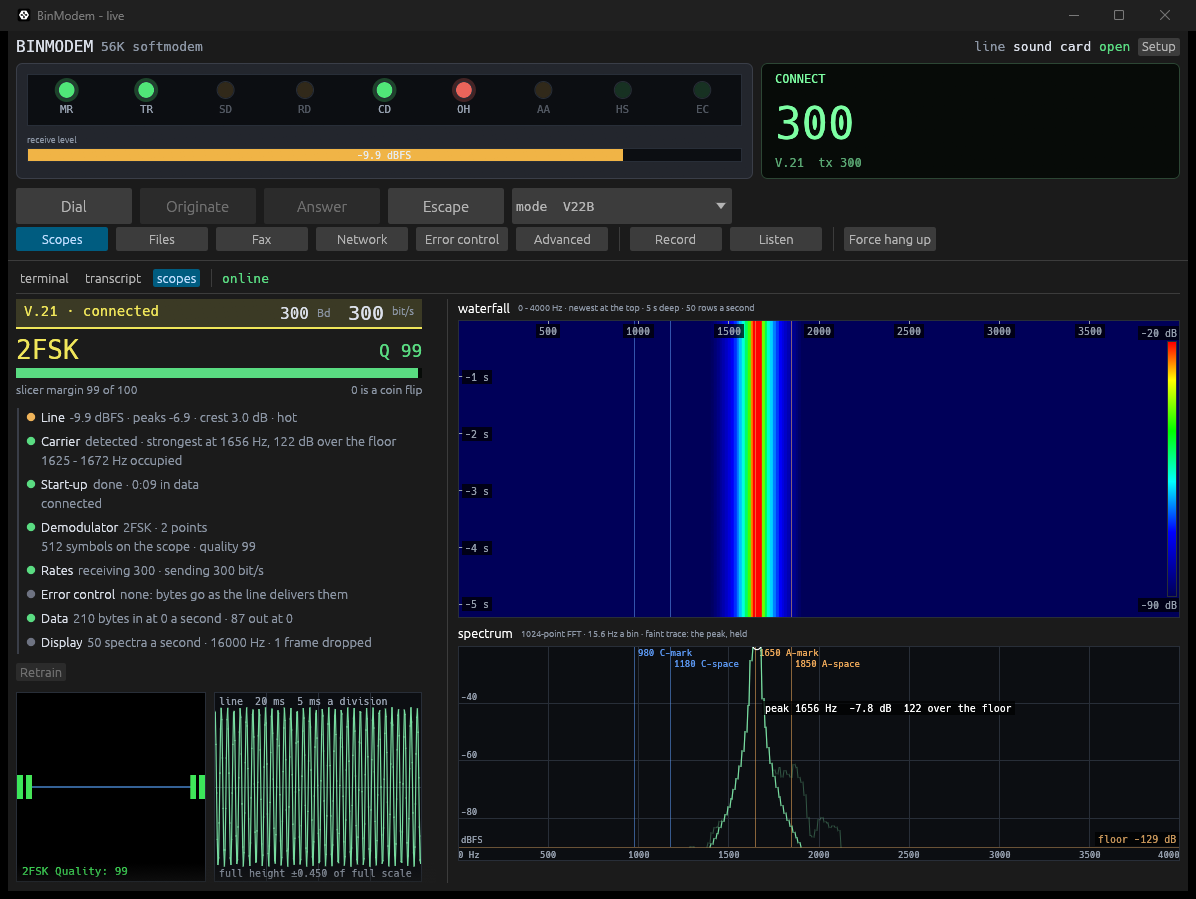
V.21
- V.21 as a data modem at 300 bit/s,
AT+MS=V21, in the mode list and the run scripts. It answers with V.25's 2100 Hz tone and then channel 2. Its four tones are marked on the waterfall and the spectrum. Contributed by FIM43-Redeye.
Also
--type <line>types a line at the modem once its line is open, as many as are given and a second apart, and--scopesopens on the scopes:binmodem --in A --out B --type AT+MS=V34 --type ATD --scopesplaces a call with nobody at the keyboard. Withbinmodem --answeron the other pair of cables, that is one instance calling another, which is how the pictures here were taken.- Fax: a PDF sends a page to a sheet, and the pages received are saved as one PDF.
- V.34 half-duplex: the source's E waits for the recipient's in a resync too.
The pictures are from calls between two instances over a pair of virtual audio cables, four-wire: no echo, no noise and no codec. 33 600 and 54 666 there are what the modem does on a clean line, not what a telephone route gives.
Status
- Sending over Super G3 is not yet confirmed against a real machine. On the first try, both control channels came up, and each end read the other's MPh and E. Then the far end sent its NSF and DIS and never answered our TSI and DCS, four times over. Every frame in the recording decodes whole in both directions, with the headers right. The likeliest cause is that our E reached that machine about 50 ms before it had sent its own, so it never started reading ours. The last change above answers that, but it has not been tried live yet. Untick V.34 to send at V.17.
- V.32's round-trip measurement can still be halved by a lost packet. On a V.32bis call over a trunk, the concealment brought the far end's alternation back inverted, and the reversal that came out of it stopped the clock at 706 ms on a line whose real round trip is 1.22 s. The call connects regardless; the bad reading still costs the echo canceller's tap placement.
- One ISP's V.90 pool sometimes stops dead just as its modem takes up our constellation, at the end of phase 4 or in a renegotiation. Every CP we sent was checked against V.90 Table 14 bit for bit, and they are correct.
- Known: after a V.90 call falls back to V.34, the V.34 retrain watch can still take the hang-up beep for tone B.
- V.92: planned and in progress on a branch; not in this release.
- Not yet tried against real far ends: V.17, and the V.29 and V.27 ter receivers, have been measured against our own modems and simulated lines only.
Checksums are in SHA256SUMS.txt.
v2.0.0
One file. Download binmodem.exe and run it. There is nothing to install, and no Visual C++ redistributable is needed because the C runtime is linked in.
binmodem.exe                  a modem on a real line
binmodem.exe --devices        what audio this machine has
binmodem.exe --telnet         a board over a socket
binmodem.exe --capture        replay the golden capture
docs/usage.md has the setup.
What's new in 2.0.0
Super G3: fax at 33 600
- V.34's half-duplex mode, for fax -- T.30 Annex F on V.34 clause 12. V.8 goes in front of the call: the answering end sends ANSam and offers V.34 half-duplex in its joint menu, and the calling end hears ANSam and sends its call menu. Then phase 2 probes the line one way, phase 3 trains the page channel, and a 1200 bit/s control channel runs both ways at once, carrying every T.30 frame. Each page goes over the primary channel at up to 33 600, retrained on its own PP in front of every burst. There is no training check and no failure to train: the rate comes from the control channel's MPh exchange.
- A real machine's page came in on it. A Super G3 fax sent BinModem a page at 33 600 bit/s on 3429 baud, in JBIG under error correction, with the page channel trained to 53 dB.
- A misprint in V.34, settled by that machine. Equation 10-2 prints PPh, the control channel's training sequence, with a digit one where the clause defines a variable I and then never uses it. Read as printed it is a square wave on one diagonal; read with I it is a perfect periodic sequence, like the duplex PP beside it. It was built the second way, and a real machine's PPh is exactly that.
- A V.34 box in the fax window's offer row, on by default. Unticked, a call is what it was.
JBIG
- T.85's profile of T.82, single-progression sequential, sending and receiving. It matches T.82's own test data to the byte: the 25-byte arithmetic coder sequence, and every byte count of the three artificial-image tests, with Annex C's adaptive template making the same move at the same stripe. Four misprints in T.82's figures and tables turned up on the way, and each is settled by a test.
- Offered and used under error correction when both ends have it (DIS and DCS bits 78 and 79), ahead of MMR. The real machine's page above came in JBIG. A tick box beside ECM turns it off.
What the page is going in, where it can be seen
- While a page moves, the fax window shows its coding, its modulation and rates, and error correction as coloured badges: green for the best a fax has -- JBIG, V.34, ECM -- then yellow and orange for the rungs below, and best mode when all three are green.
- The page to send lists its size in all four codings and its time at V.34's 33 600 beside the other rates.
A V.34 fax's call menu is answered
- A caller that took T.30's plain answer tone for ANSam sent V.8 call menus for as long as the call lasted, straight past every DIS. A recording of one is in the tests now. The answering end hears the call menu and answers it with a joint menu, then goes on with T.30.
Also
- The symbols scope draws a V.34 page to scale. Its range was taken in the decoder's grid units, 41 at 33 600, against points of about one and a half, and every point of the first real page was drawn as one dot at the centre.
- The far-end panel no longer reads a V.34 caller's DCS as V.27 ter. T.30 sends its rate bits as zero on V.34 (Table 2, Note 33), and the panel now says V.34 and the page's rate and symbol rate.
- The sending end of a Super G3 call waits for the far end's E before it sends its own. See the first status item below for why.
Status
- Sending over Super G3 is not yet confirmed against a real machine. On the first try, both control channels came up, and each end read the other's MPh and E. Then the far end sent its NSF and DIS and never answered our TSI and DCS, four times over. Every frame in the recording decodes whole in both directions, with the headers right. The likeliest cause is that our E reached that machine about 50 ms before it had sent its own, so it never started reading ours. The last change above answers that, but it has not been tried live yet. Untick V.34 to send at V.17.
- V.32's round-trip measurement can still be halved by a lost packet. On a V.32bis call over a trunk, the concealment brought the far end's alternation back inverted, and the reversal that came out of it stopped the clock at 706 ms on a line whose real round trip is 1.22 s. The call connects regardless; the bad reading still costs the echo canceller's tap placement.
- One ISP's V.90 pool sometimes stops dead just as its modem takes up our constellation, at the end of phase 4 or in a renegotiation. Every CP we sent was checked against V.90 Table 14 bit for bit, and they are correct.
- Known: after a V.90 call falls back to V.34, the V.34 retrain watch can still take the hang-up beep for tone B.
- Compression between two BinModems in V.90 is not yet offered correctly.
- V.92: planned and in progress on a branch; not in this release.
- Not yet tried against real far ends: V.17, and the V.29 and V.27 ter receivers, have been measured against our own modems and simulated lines only.
- Unchanged: the fax window sends one page per call.
2175 tests. Checksums are in SHA256SUMS.txt.
v1.4.1
One file. Download binmodem.exe and run it. There is nothing to install, and no Visual C++ redistributable is needed because the C runtime is linked in.
binmodem.exe                  a modem on a real line
binmodem.exe --devices        what audio this machine has
binmodem.exe --telnet         a board over a socket
binmodem.exe --capture        replay the golden capture
docs/usage.md has the setup.
What's new in 1.4.1
V.32bis: a start-up that gave up 283 milliseconds too early
- A far end that trains for as long as the Recommendation allows is waited for now. 5.4.1 has R2 sent "until an incoming rate signal R3 is detected" and puts no limit on the waiting, so this end had to — and the limit it set gave the far end one round trip plus 8464 symbols. But 8464 symbols is exactly what a conditioning signal costs when its training segment is at 5.2.3's maximum, so the budget left the far end no time at all to read R2 in, and one at the top of that range missed the deadline by however long reading it took.
- The deadline runs from the far end's conditioning signal instead, which is the one thing here that is heard rather than calculated: from the start of one, a rate signal is 8464 symbols away at the outside and nothing else can be behind it. A far end audibly still working through 5.4.2 is not a far end doing something else.
- Found on a real call. A V.32bis call over a trunk reached the rate exchange and abandoned it 283 ms before the far end's R3 arrived — an R3 offering 14 400, which was the rate the two ends would have agreed on. What followed was worse than the miss: back to repeating state A, opposite a far end in a rate signal that would never alternate again, holding the line for the whole minute of patience. That recording now connects at 14 400, with the receiver 0.04 of the way to the next point and 39 dB of signal to noise.
The line row picks a kind of line
sound cardorSIP, where the box used to list the SIP accounts by name. It was answering two questions at once — what sort of line this is, and whose it is — and named a trunk where it should have named a mechanism. Which account is the dialler's business, and the row shows it beside the box and reads it from there, so the two cannot fall out of step.Openon SIP says why it is disabled when there are no accounts yet. It used to be enabled and quietly do nothing.
Also in 1.4.0, which went out with the previous release's notes by mistake
A SIP caller of our own, so a call needs no softphone
- The softphone is out of the path. Reaching the telephone network through a virtual cable and MicroSIP meant resampling 48 kHz to 8 and back, an adaptive jitter buffer inserting about 20 ms of audio every few seconds, and gain control. The first held a V.90 server's codewords to about 37 dB where a clean path gives 82; the second was measured putting a V.34 receiver out of lock for 1.3 seconds and making a 43 dB line read as 17.
crates/sipreplaces it: RFC 3261 for the signalling, 3581 for rport, 3550 for the packets, 4566 and 3264 for what the two ends agree to, 1321 for the digest a registrar asks for, and G.711 for the samples. No third-party stack and no async runtime — std, threads, and the same rules as everything else here.sip::Lineoffers the same receive and transmit asline::Duplex, so the loop driving the modem does not know which kind of line it is on; and since no packets arrive before the far end answers, the modem is never stepped into a handshake with a call that has not connected.- UDP or TCP, chosen per account. Over TCP a message is framed by its Content-Length and the retransmissions are off. Only G.711 is ever offered: every other codec in a trunk's list is a speech coder, and a modem signal does not survive being fitted to a model of a voice tract.
- The jitter buffer is fixed rather than adaptive. It never stretches or repeats audio, conceals only with silence, and counts every octet of it — so a failed call now says whether it failed in the modem or in the network, which could not be asked before.
- In the window: a keypad dialler, a credentials form, and Connect. Call types
ATDat the terminal rather than reaching past it, so there is one path that places a call and it can be watched.
Status
- V.32's round-trip measurement can still be halved by a lost packet. On the call above, the concealment brought the far end's alternation back inverted — a slip of about one symbol, which is exactly what turns an alternation over — and the reversal that came out of it stopped the clock at 706 ms on a line whose real one is 1.22 s. Nothing available to the start-up separates that from the far end turning over: both invert the sidebands by 180°, and the tone is back at full strength before either is declared. The call connects regardless now; what the bad reading still costs is the echo canceller's tap placement.
- One ISP's V.90 pool sometimes stops dead just as its modem takes up our constellation, at the end of phase 4 or in a renegotiation. Every CP we sent was checked against V.90 Table 14 bit for bit, and they are correct. The same server has also reached data mode at 54 666 and 56 000.
- Known: after a V.90 call falls back to V.34, the V.34 retrain watch can still take the hang-up beep for tone B.
- Compression between two BinModems in V.90 is not yet offered correctly.
- V.92: planned and in progress on a branch; not in this release.
- Not yet tried against real far ends: V.17, and the new V.29 and V.27 ter receivers, have been measured against our own modems and simulated lines only. The V.32bis receiver has now placed a real call at 14 400.
- Unchanged: the fax window sends one page per call.
2000 tests. Checksums are in SHA256SUMS.txt.