Repository navigation
Documentation Index
This repo doubles as a pfSense knowledge base and the documentation for a production pfSense → SIEM deployment. Everything here is written from a real, running stack — pfSense with Suricata, pfBlockerNG and Telegraf feeding OpenSearch, Logstash and Grafana — so others can run the same thing, understand why it is built this way, and keep it healthy.
Prefer browsing to a directory tree? Every page here is also published in the project wiki, regenerated from these files on every push, with a beginner's start-here page, a glossary and an FAQ for people new to pfSense.
Pick the path that matches what you are trying to do:
| I want to... | Start at |
|---|---|
| Run Suricata / pfBlockerNG / Telegraf well on pfSense (no SIEM needed) | pfSense knowledge base |
| Upgrade pfSense (2.8.1 → 2.9.0) without breaking things | Upgrading pfSense |
| Deploy the SIEM stack from scratch | Deploy it |
| Understand the architecture and data model | Understand it |
| Keep a running deployment healthy | Operate it |
| Fix something that broke | Fix it |
| Add capability or another SIEM backend | Extend it |
Directory layout:
docs/
├── DOCUMENTATION_INDEX.md   ← You are here
├── ARCHIVE.md               ← Where superseded material went (git history)
├── pfsense/                 ← Generic pfSense knowledge: Suricata, pfBlockerNG, Telegraf, QoS, upgrades
├── install/                 ← SIEM server, forwarder, GeoIP, dashboards, hardware, checklist
├── operations/              ← Management console, forwarder monitoring, retention
├── troubleshooting/         ← Symptom → root cause → fix
├── reference/               ← Configuration, field reference, architecture
└── siem/                    ← Other backends: comparison, Wazuh, Graylog
Conventions used throughout: admin@<PFSENSE_IP> is your pfSense SSH login,
<SIEM_IP> your SIEM server, interface names like igc0 / igc1.20 are examples —
substitute your own. Example public addresses use RFC 5737 space (203.0.113.x).
These guides apply to any pfSense CE 2.7+/2.8/2.9 box. Only the sections that mention Grafana panels depend on the rest of this repo.
- Suricata Optimization Guide ⭐ — the complete path: install, choose rulesets (ET Open + Snort registered), inline IPS on WAN vs IDS on VLANs, performance tuning (stream memcap, detect profile), testing and validation
- Suricata Configuration & Design Decisions — why Suricata over Snort, interface strategy, and the SID tuning philosophy: start broad, measure noise, then disable/suppress with tracked lists instead of ad-hoc GUI clicks
-
SID lists — the maintainer's
disablesid/dropsid/suppresslists, how they were derived, how to build your own from your alert volume, and how to apply them through SID Mgmt (survives upgrades) - LAN / East-West Monitoring — IDS on internal VLANs to catch lateral movement, with per-VLAN policy examples
- pfBlockerNG Optimization — strategy: which feed tiers, how pfBlockerNG and Suricata divide the work, update cadence, CPU and memory impact
-
pfBlockerNG Feed Reference — the long
catalog: IP and DNSBL feeds by category, whitelisting strategy
(
config/dnsbl_whitelist.txt), privacy notes, troubleshooting
-
Telegraf on pfSense — install, where the config
really lives (config.xml → regenerated
telegraf.conf), the Additional Configuration box, why it runs as root, how to restart it correctly, the pfSense 2.9.0 Telegraf breakage and workaround - Telegraf plugins — gateway status, ARP MAC vendor, temperature and Unbound collectors shipped in this repo
- MAC Vendor Lookup — device manufacturer identification from the ARP table
- Telegraf pfBlockerNG Pipeline — shipping pfBlockerNG block/DNSBL logs to OpenSearch via Telegraf's tail input
- Upgrading pfSense ⭐ — general checklist plus the 2.9.0 specifics (FreeBSD 16-CURRENT, PHP 8.5, sshd algorithm changes, Telegraf package breakage, certificate enforcement), what this repo drops on pfSense and what survives, post-upgrade verification
- pfSense Filterlog Rotation Bug — firewall and pfBlockerNG logging silently stopping after newsyslog rotation, and the Cron-package job that fixes it
- Traffic Shaping Guide — limiters, CoDel and weighted queues for streaming/gaming/VoIP alongside bulk traffic
- Optimizing traffic shaping on a gigabit cable line — measured lessons: ACK starvation, queue sizes, mask direction, failover links, the class design that worked
- October 2026 tuning results — one before/after table across shaping, Suricata CPU, rule volume, DNSBL, forwarder and feed health, with what was not measured
- Hardware Requirements — sizing pfSense for IDS/IPS (and the SIEM server), and why SD cards will ruin your day
- CrowdSec (exploratory) — notes toward a CrowdSec integration; not part of the stack yet
Ordered steps for a from-scratch SIEM deployment. The short version is QUICK_START.md; these are the detailed guides behind each step.
- Hardware Requirements — size both hosts first
- New User Checklist — tick-box path from bare metal to working dashboards
-
Server side — point
config.envat an existing OpenSearch + Grafana (siem-docker-stack is the recommended backend). No server yet? SIEM Stack Installation covers the bare-metal single-box path (install.shand the manual steps behind it) -
pfSense Forwarder Installation — the EVE
forwarder, rc.d service and watchdog on pfSense (what
setup.shautomates) - GeoIP Setup — reusing the GeoLite2 database already on pfSense for the attack map
- Dashboard Installation — datasources, the OpenSearch plugin, importing and adapting the dashboards (inventory)
scripts/preflight.shvalidates config.env, SSH to both hosts, Python on pfSense and OpenSearch reachability before anything is changed.setup.shruns it automatically.
- Architecture diagram (source architecture.mmd) — pfBlockerNG → Suricata → EVE → forwarder (UDP) → Logstash → OpenSearch → Grafana, plus Telegraf → InfluxDB/OpenSearch
-
Field Reference — the authoritative list of what
is stored in
suricata-*andpfblockerng-*, and why fields are flat, not nested -
Configuration Reference — every
config.envvariable, forwarder behaviour, Logstash pipeline, index templates, Grafana datasources, tuning and Logstash maintenance - Config files — the shipped Logstash pipeline and index templates themselves
- SIEM backend comparison — OpenSearch vs Wazuh vs Graylog for this use case, and what was decided
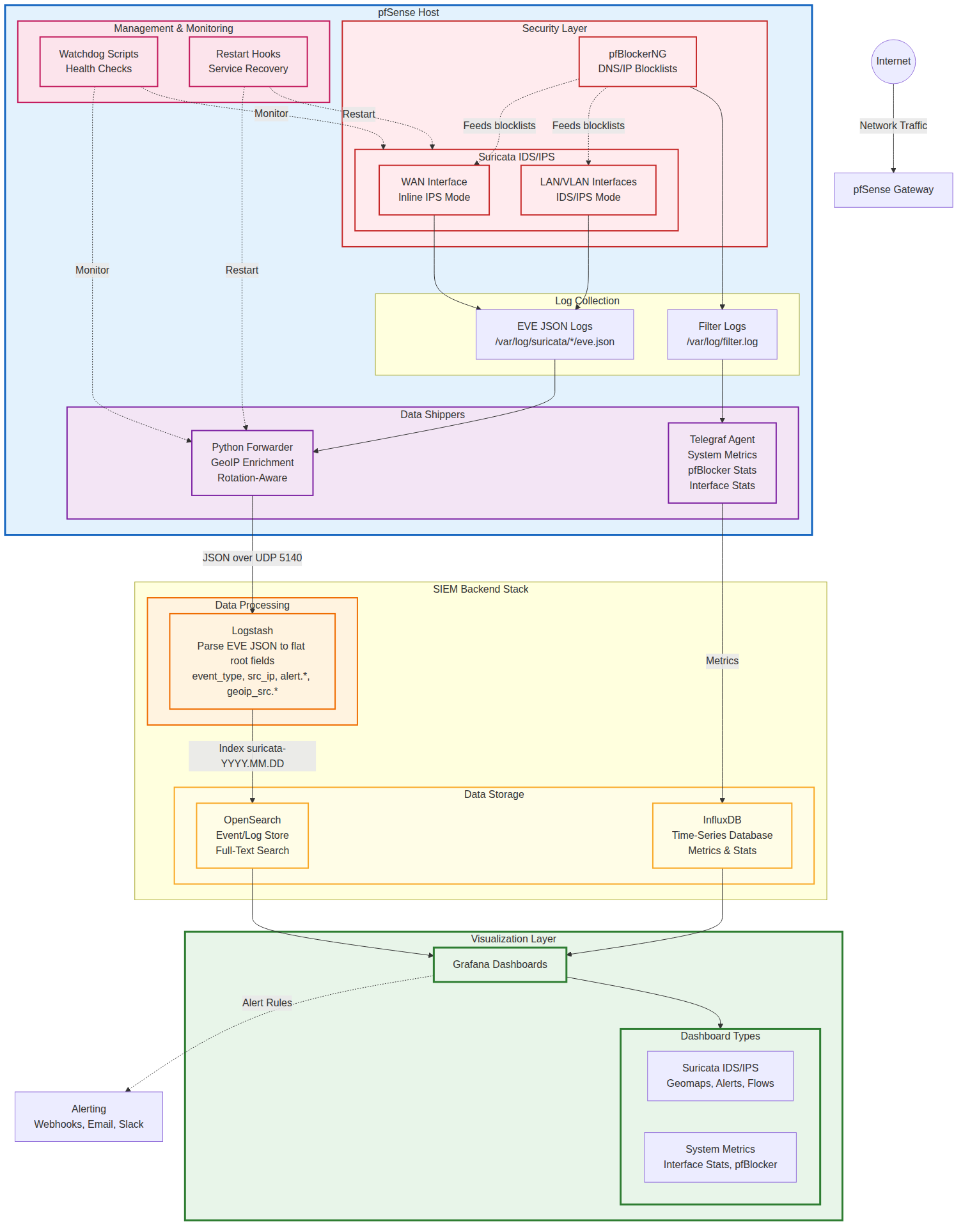
-
Management Console — the
pfsense-siemmenu: install, deploy, status, logs, backups, preflight -
Forwarder Monitoring — how the
forwarder runs (rc.d +
daemon), the watchdog, day-2 commands, what survives reboot/upgrade, uninstall - Multi-Interface & Retention — many Suricata instances at once, and ISM retention to control disk
- Scripts Reference — every helper script, where it runs, and which are legacy
-
Upgrading pfSense — the post-upgrade
procedure for the SIEM pieces (
preflight.sh→setup.sh→status.sh)
-
Troubleshooting Guide — master runbook;
start with
./scripts/status.shand./scripts/diagnose-and-repair.sh - Dashboard shows "No Data" 🔥 — the most common issue: datasource, index pattern, field mapping
-
Data stops at midnight UTC —
action.auto_create_indexblocking the new daily index - Forwarder and rotated logs — how the forwarder follows Suricata's rotation (and how that differs from the filterlog bug)
- pfSense filterlog rotation bug — pfBlockerNG/firewall logs stop after newsyslog rotation
- Telegraf on pfSense → Troubleshooting — PF Information panel empty, exec plugin timeouts, 2.9.0 config rejection
-
Wazuh — what ships here (three dashboards +
deploy-wazuh-dashboards.py), how pfSense feeds Wazuh (RFC 5424 syslog), and where the Wazuh server lives (siem-docker-stack) - Graylog — explored and shelved; what a revival would need
- Roadmap — alerting as code, TLS/queued transport, OpenSearch security, LAN dashboard, multi-firewall
- Contributing — how to submit dashboards, docs and fixes; what CI checks
Superseded docs, scripts, dashboards and plugins were removed from the working tree and live in git history. ARCHIVE.md has the commit hash and recovery commands.
Source: docs/DOCUMENTATION_INDEX.md. This wiki is generated from the repository on every push to main; edit the source file and open a pull request rather than editing the wiki page.
This wiki is generated from the Markdown files in pfsense-siem-stack on every push to main. Edits made here are overwritten; edit the source file named at the bottom of each page and open a pull request. Placeholders used throughout: admin@<PFSENSE_IP> is your pfSense SSH login, <SIEM_IP> your SIEM server, interface names like igc0 are examples. Licensed MPL 2.0.
Getting started
Suricata
pfBlockerNG
Telegraf
pfSense platform
- Upgrading pfSense ⭐
- Filterlog Stops After Rotation
- Traffic Shaping Guide
- Shaping Optimization Notes
- October 2026 Tuning Results
- CrowdSec (exploratory)
SIEM: deploy
- Quick Start
- New User Checklist
- SIEM Server Installation
- Forwarder Installation
- GeoIP Setup
- Dashboard Installation
SIEM: operate
- Management Console
- Forwarder Operations and Watchdog
- Multi-Interface and Retention
- Scripts Reference
SIEM: fix