Repository navigation
Releases
R1.0.1 RC2

Changes since R1.0.1 RC1
- Improved LLDV-to-HDR10 recovery at playback startup. The fallback can select UHD at the requested refresh rate on 8K displays and rejects links known to be limited to 8 bits. (#236, #237)
- Fixed FEL playback when the base decoder changes configuration or the enhancement layer starts late. Kodi now reports when the enhancement layer is genuinely missing. (#245, #247)
- Preserved native SDR BT.2020 through HDMI scanout and corrected a duplicate GBM buffer lock. (#238, #240)
- Improved Intel HDMI audio recovery after link changes. DTS decodes to PCM when the HDMI port reports that it does not support DTS passthrough. (#239, #244)
- Fixed native video-only captures in Dolby Vision Master Reference. (#246)
- Added MT7925U USB Wi-Fi support for Netgear A9000/A8500 and corrected channel reservation during association. (#242, #249)
Credits · phycoforce for the MT7925U enablement and backport, and Mark Anthony Agarro for the upstream mt76 association fix.
Playback and capture were checked on Intel N100 and AMD Ryzen 5 7430U with an LG G5. The 8K fallback and MT7925U association were exercised in test harnesses. The affected 8K HDMI chain, Netgear adapter, Intel N97 audio path, and RTX 4090 HDR10+ report still need hardware confirmation.
Use the .img.gz for a fresh install or the .tar for an update. Verify the download with SHA256SUMS. Build source
R1.0.1 RC1
Changes since R1.0.0
- Expanded LLDV HDMI format support across AMD, Intel and NVIDIA. Improved format selection and recovery when a transport is refused. Experimental formats are selectable without boot flags.
- Improved UHD Blu-ray menu colors and stability across HDR transitions. Corrected Dolby Vision L5 signaling and byte-aligned RPU parsing.
- Added a preference for treating hybrid Dolby Vision + HDR10+ files as either format.
- Improved HDMI display selection at startup and video-to-video transitions. Fixed RX550 TV-led framebuffer imports, AMD deep-color HDR10/HDR10+ over HDMI FRL, and native SDR color signaling.
- Improved Intel HDMI audio recovery and Dolby Digital Plus Atmos passthrough. Fixed blurred text redraws and scoped opt-in background playback to HTTP media.
Credits · fandangos for UHD Blu-ray menus and L5 handling, CorentinB for Kodi font blur and background playback, and Kacper Michajłow for the upstream FFmpeg fix.
Tested on Intel N100 and AMD Ryzen 5 7430U. RX550 and NVIDIA LLDV still need HDMI testing on the affected hardware. Build source
Use the .img.gz for a fresh install or the .tar for an update. See SHA256SUMS to verify either download.
R1.0.0 Stable

R1.0.0 Stable - Reference-Grade Dolby Vision and LLDV now stable
R1.0.0 is the first stable release of LibreELEC × CB1. It delivers state-of-the-art Dolby Vision fidelity in both TV-led and player-led (LLDV) modes, alongside calibrated HDR and SDR rendering tailored to your display’s characteristics. It also improves Blu-ray menu playback, lets you switch rendering modes on the fly, and adds new upscaling options including FSR.
Downloads
- New installation — write the Generic x86-64
.img.gzto a USB drive with LibreELEC USB-SD Creator. - Existing LibreELEC × CB1 installation — place the matching
.tarin the Update share or/storage/.update, then reboot. - Verification — see
SHA256SUMSin Assets. Both files contain the same tested build. Build source
What's new since RC3
- Native Dolby Vision LLDV Reference - CB1 reads the display's target brightness, black level, and color primaries from its EDID. The HDMI format selector shows which formats are available, explains why others are unavailable, and labels experimental modes. LLDV display targeting
- Calibrated SDR conversion and HLG to Dolby Vision - Convert Dolby Vision, HDR10, HDR10+, or HLG to SDR with Reference, Bright room, or Custom / Projector targets. SDR defaults to BT.709, with BT.2020 available on compatible setups. HLG gains a Dolby Vision rendering option alongside native playback. HLG to SDR · BT.2020 SDR
- Improved AV1 playback - Playback resumes more reliably after seeking, including with software decoding. Supported inputs also include 10-bit Dolby Vision in AV1. RC4 notes
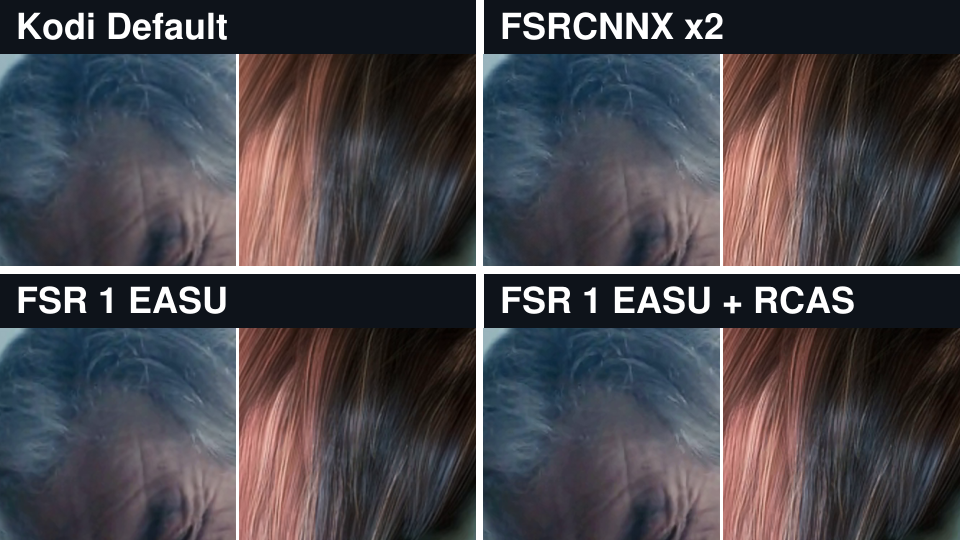
- New video upscalers including FSR - Choose separate filters for 1080p and above and below 1080p, based on the source resolution. Both menus default to Kodi Default and offer the same filters for SDR, HDR, and Dolby Vision, including FSR 1 with or without RCAS, FSRCNNX x2, and Anime4K Fast. Player Information shows the active filter when the picture is upscaled. Upscalers
- Better Blu-ray and UHD Blu-ray ISO playback - More reliable HDMV and BD-J navigation, including animated menus, chapters, extras, and audio and subtitle selection. On supported transitions, the player maintains HDMI output and PCM audio to reduce interruptions. Blu-ray transitions
- New Player Information panel and per-format defaults - Press
Oto see the source, the processing applied, and the HDMI output. Each file starts with the default circuit for its input format. Quick Switch lets you change circuits during playback and explains why an option is unavailable. Thanks to CorentinB for the three-column redesign. Player Information - Smoother playback with overlays open — improved frame pacing on tested HDR10 conversion and native LLDV paths when using Player Information or playback controls. HDR10 cadence · LLDV overlays
- More reliable HDR playback and HDMI switching - Faster signal recovery on Intel when switching from Dolby Vision to HDR10 or SDR, improved HDR10+ frame pacing, and a fix for the recurring stutter observed on the True Black sample. RC4 Preview Update 4
- Broader hardware and audio compatibility - Improved boot and 10-bit HDR10 output on NVIDIA GTX 10-series cards, experimental TV-led Dolby Vision on RX 550 Polaris12 at UHD 23.976 Hz, and Intel Xe3 display fixes. Adds CEC detection on compatible setups, HDMI range and bit-depth settings, and optional Dialnorm neutralization for audio passthrough. GTX 10-series work adapts code from LibreELEC Hades by hadesdevls. Dialnorm adapts CoreELEC p3i work by pannal. RC4 notes · Dialnorm
- Clearer diagnostics - Kodi explains why a circuit cannot start and lets you adjust how much detail CB1 logs. The installer saves logs from the current and previous boot to the USB drive. Playback diagnostics · CB1 logging
What's next?
I'll focus on fixing bugs and reviewing feature requests for future updates.
Report a bug or performance problem
- In Kodi, go to Settings → System → Logging and enable debug logging.
- Reproduce the issue, then open Settings → LibreELEC → System → Submit Log. Choose Upload latest Kodi log and configs, and view the short URL. If Kodi crashed, upload the latest crash log from the same menu.
- Paste the short log URL into your report. Include your build version, GPU, TV or projector, HDMI setup, source format, selected circuit, and steps to reproduce. Open a bug report
- Turn off debug logging once you’ve shared the log.
Suggest a feature
Send your suggestion through the private form. Describe what you would like to do, what is missing today, and how the change would help. An email address is required so we can reply and keep you informed about your suggestion.
| Player Information | Quick Switch | Read and display HDMI Dolby Vision EDID | Upscaler comparison |
|---|---|---|---|
 |
 |
 |
 |
R1.0.0-RC4 Pre-stable Update 4
Work-in-progress preview.
RC4 (Pre-stable) - Update 4 | 2026-11-13
- Dolby Vision Player-led (LLDV) is selectable in Dolby Vision playback. Its HDMI format selector shows which combinations the display and GPU can use and flags experimental forced formats.
- Faster return of the HDMI signal on Intel when switching from Dolby Vision to HDR10 or SDR. Tested at 4K23.976 on an N100 with an LG G5. The HDMI format change can still briefly blank the screen. #128
- Clearer playback errors. Kodi explains why a selected circuit cannot start. HDR10 Rendering and HDR10 Rendering Reference require a 10-bit or deeper link. Quick Switch greys out unavailable circuits while playback continues. #124 · #127
- NVIDIA GTX 10-series (Pascal). Improved driver startup and 10-bit HDR10 output. Feedback from GTX 1050 Ti and GTX 1060 owners is welcome. #72 · #125 · #126
- Playback fixes. Improved Dolby Vision detection for Blu-ray ISOs on Intel Core Ultra 255H, HDR-to-SDR recovery on Wayland, subtitle positioning and A/V sync. #121 · #123
RC4 (Pre-stable) - Update 3 | 2026-11-11
- HDR10, HDR10+ and Dolby Vision to SDR, with Reference, Bright room and Custom / Projector targets.
- HLG to Dolby Vision rendering (AI), alongside native Kodi HLG playback.
- Per-format playback defaults. New files use the circuit selected in Settings. Quick Switch changes the current playback.
- Redesigned O-key Player information and a compact, single-line Quick Switch footer.
- Improved live Dolby Vision ↔ HDR switching and corrected HLG source reporting.
- Fixed periodic HDR10 stutter caused by repeated mastering metadata in the True Black sample.
- Stabilized the HDMI 3D frame-packing separator and aligned the VAAPI startup probe with the actual NVIDIA buffer layout. Projector and GTX 1650 Ti retests are pending.
RC4 (Pre-stable) - Update 2 | 2026-11-07
- More reliable Blu-ray menus, including highlighting, disappearing overlays, animated Java menus and chapter/navigation handling.
- Intel Xe3 / Wildcat Lake display support backports and initialization improvements.
- Automatic installer logs on the USB stick, including the previous boot after a failure. NVIDIA boot messages remain visible when the display allows it.
- HDMI CEC on compatible boards and converters, alongside existing USB CEC adapters.
- Display colour range and maximum bit depth controls, with RGB/YCbCr format selection when exposed by the driver. CB1 playback restores its own output settings correctly.
- Player information continued to use the existing layout in Update 2.
RC4 (Pre-stable) - Update 1 | 2026-11-07
Blu-ray ISO and menus
- Improved HDMV and BD-J menu navigation, button handling, overlays and authored still screens.
- Fixed audio/subtitle selection from disc menus and removal of deselected subtitles.
- Improved chapter seeking, bonus playback and transitions between clips.
- Improved menu access for network-hosted ISO files and authored fallback menus on compatible 3D discs.
- Improved playback startup during automatic refresh-rate changes.
HDR10+ and video playback
- Improved HDR10+ Rendering frame pacing, including the reported uneven playback on Intel N100. Contributed by lessbones in #91.
- Corrected Intel VAAPI bit-depth selection for 10-bit VP9, relevant to the YouTube HDR black-screen report.
- Improved Intel Dolby Vision playback at 60 Hz and HDMI link handling during display-mode changes.
NVIDIA
- Improved Dolby Vision support and driver compatibility on supported NVIDIA GPUs.
- Updated the legacy NVIDIA driver to 580.196.07.
- Corrected startup ordering on NVIDIA systems, targeting the startup freezes reported with ASUS Xonar STX II + RTX 5090 (#88).
- Restored missing 24/30/60 Hz modes on the legacy driver while retaining fractional refresh rates.
Player information
- Kept the existing Player information panel.
Installation and known limits
Use the .img.gz for a fresh USB installation or the .tar for an update. The boot partition saves installer logs in cb1-boot-logs/current.log and cb1-boot-logs/previous.log.
- 4K60 HDR10 → SDR and Dolby Vision → SDR can exceed the N100's performance budget. Heavy FEL and LLDV output depend on the hardware and source.
- Surface display switching, Xonar STX II startup hangs, and wider Xe3 compatibility remain under investigation.
Credits. CorentinB for Player information, subtitle positioning and A/V sync. Hades / hadesdevls for the NVIDIA integration carried over from earlier previews. lessbones for HDR10+ frame pacing. Blu-ray work draws on AVDVPlus, SamuriHL and VideoLAN/libbluray. Display controls build on smp79's Kodi PR 30099 and PR 30192.
R1.0.0 RC3
R1.0.0 RC3 - Stability, hardware support improvement, GUI workload reduction
Changes since R1.0.0 RC2. CB1 0.5.
Dolby Vision
-
Improved scaled Master Reference rendering by removing a redundant full-resolution intermediate pass, without changing movie pixels, metadata or Kodi scaling filters.
-
Added software-decoded 10-bit AV1 Dolby Vision input using Kodi's existing uploaded textures. #85
-
Added an explicit active-area override for already-cropped files retaining incorrect L5 margins. Authored margins remain the default. #84
-
Added GPU bilinear FEL upscaling alongside Reference GPU. Master Reference retains its reference reconstruction filters.
-
Fixed playback freezing on the reported Saving Private Ryan FEL sample. The enhancement decoder now recovers forward after damaged data, preserves already decoded exact pairs and resumes at a verified random-access picture instead of waiting indefinitely.
-
Improved BL/EL pairing after Blu-ray seeks when both tracks contain unmatched preroll. Missing or ambiguous enhancement pictures are never replaced with neighbouring frames.
-
Aligned HDR10-to-Dolby Vision Adaptive processing with the DV-source Adaptive logic while retaining its AI-derived source statistics.
-
Kept independent playback preferences for Dolby Vision, HDR10 and HDR10+ sources. Automatic fallback no longer replaces the user's saved choice for the next file.
-
Added Kodi default consistently to the three playback selectors, leaving normal playback to Kodi without CB1 image processing.
HDR10 rendering
- Reworked HDR10 Expert renamed to HDR10 Rendering Reference around explicit display mapping: manually entered peak brightness, OLED/LCD/projector black presets or a custom black level, and output gamut selection.
- Corrected near-black handling and creative-trim application to preserve shadow steps rather than applying a linear RGB offset that can crush them.
- Added bounded highlight/gamut handling and coherent output metadata, including targets above the source mastering peak.
- Improved HDR10 Rendering startup, resource ownership and transitions back from Dolby Vision; corrected the contrast-state issue reported during live switching.
HDR10+
- Improved HDR10+ to Dolby Vision Rendering metadata mapping with weighted source-distribution estimates, bounded handling of incomplete statistics and continuous scene/seek state. Source video pixels remain unchanged by this metadata conversion. Weighted-percentile estimation adapted from AVDVPlus HistogramPlus.
- Improved conversion startup and playback/seek recovery, with source metadata kept separate from estimated values.
- Retained native HDR10+ playback through Kodi default, without activating the conversion pipeline.
Blu-ray and BD-J menus
- Bundled the Java runtime and the BD-J JAR pair matching the native libbluray 1.5.0, avoiding the mismatch with older add-on JARs.
- Fixed UHD menu video dimensions, missing/unknown video-size handling, audio/subtitle language selection and component inventories. Shared Java control fixes adapted from SamuriHL's CoreELEC work.
- Improved direct-title stream inventory and BL/EL resynchronization without disc-name-specific workarounds.
Playback, HDMI and hardware
-
Intel HDMI now identifies the source as a media player rather than a PC, avoiding LG automatic PC-mode and triggering Low Latency mode (#86). A driver override retains PC identification if required. Based on big-fella, via dangerouslaser.
-
Fixed an HDR10-to-Dolby Vision AI startup wait after fallback/re-entry by correcting the existing preparation order.
-
Fixed Intel HDMI link recovery with active HDR10+ metadata, retaining normal output validation. Contributed by lessbones in #83.
-
Improved return to SDR, live connector-state checks and output recovery after failed playback or mode changes.
-
Retained pending HDMI modesets until the requested timing is actually committed, including when Kodi temporarily reuses its last working configuration.
-
Improved AI frame/pool retirement, re-entry and paused-output resizing, without changing native Kodi scaling filters.
-
Added earlier NVIDIA driver-selection and boot diagnostics to distinguish driver initialization, connector selection and damaged boot media.
-
Corrected audio channel-map handling and retry state without adding artificial audio/video offsets.
Interface and Player information
- Added optional optimized GUI compositing for compatible Dolby Vision output paths; movie pixels and metadata are unchanged. reducing GPU workload by 30% to render GUI on certain circuit
- Clarified file metadata, metadata used by CB1 and metadata sent to the TV. Forwarded metadata is no longer misleadingly described as unused merely because CB1 does not apply it locally.
- Clarified CM2.9/CM4 processing status, including live Auto/Auto 2 decisions.
Known issues
-
Brief stutter or dropped frames may occur immediately after seeking.
-
Some backward-seek sequences on dual-track FEL MP4 files can stop playback; also reproduced on the previous RC3 build.
-
Disc-specific Java applications and repeated-disc memory behaviour are not universally qualified.
-
Some GTX 10-series , Intel Arc and NVIDIA RTX 50-series compatibility reports.
-
DV to HDR10+ need to be refined
Next focuses
- Bug fixing following new issues.
- Continue HDR10/HDR10+ and affected-GPU compatibility qualification.
- Extend Blu-ray menu coverage with further authored discs and logs.
- Player Information UI rebuild
- Code optimization and cleanup.
R1.0.0-RC3 Preview - Update 6
Update 6 | 2026-11-04 16:32 CET (Paris)
Work-in-progress build — not a stable release. RC3 was withdrawn after a FEL seek regression. This preview contains that same build; the FEL implementation is being audited and cleaned up. Some FEL files can currently stop playback after seeking, including through Blu-ray menus.
The images and matching attached sources below are the withdrawn RC3 payloads, unchanged. Their internal build version and filenames still say RC3. New FEL prototypes are not included. Normal RC3 will return only after the FEL cleanup and validation.
For this update, use the attached R1.0.0-RC3-sources.tar.zst and vendor archive. The existing Preview tag is unchanged, so GitHub’s automatic “Source code” links still describe the older Preview commit.
Changes since RC2
Changes since R1.0.0 RC2. CB1 0.5.
Dolby Vision
-
Improved scaled Master Reference rendering by removing a redundant full-resolution intermediate pass, without changing movie pixels, metadata or Kodi scaling filters.
-
Added software-decoded 10-bit AV1 Dolby Vision input using Kodi's existing uploaded textures. #85
-
Added an explicit active-area override for already-cropped files retaining incorrect L5 margins. Authored margins remain the default. #84
-
Added GPU bilinear FEL upscaling alongside Reference GPU. Master Reference retains its reference reconstruction filters.
-
Fixed playback freezing on the reported Saving Private Ryan FEL sample. The enhancement decoder now recovers forward after damaged data, preserves already decoded exact pairs and resumes at a verified random-access picture instead of waiting indefinitely.
-
Improved BL/EL pairing after Blu-ray seeks when both tracks contain unmatched preroll. Missing or ambiguous enhancement pictures are never replaced with neighbouring frames.
-
Aligned HDR10-to-Dolby Vision Adaptive processing with the DV-source Adaptive logic while retaining its AI-derived source statistics.
-
Kept independent playback preferences for Dolby Vision, HDR10 and HDR10+ sources. Automatic fallback no longer replaces the user's saved choice for the next file.
-
Added Kodi default consistently to the three playback selectors, leaving normal playback to Kodi without CB1 image processing.
HDR10 rendering
- Reworked HDR10 Expert renamed to HDR10 Rendering Reference around explicit display mapping: manually entered peak brightness, OLED/LCD/projector black presets or a custom black level, and output gamut selection.
- Corrected near-black handling and creative-trim application to preserve shadow steps rather than applying a linear RGB offset that can crush them.
- Added bounded highlight/gamut handling and coherent output metadata, including targets above the source mastering peak.
- Improved HDR10 Rendering startup, resource ownership and transitions back from Dolby Vision; corrected the contrast-state issue reported during live switching.
HDR10+
- Improved HDR10+ to Dolby Vision Rendering metadata mapping with weighted source-distribution estimates, bounded handling of incomplete statistics and continuous scene/seek state. Source video pixels remain unchanged by this metadata conversion. Weighted-percentile estimation adapted from AVDVPlus HistogramPlus.
- Improved conversion startup and playback/seek recovery, with source metadata kept separate from estimated values.
- Retained native HDR10+ playback through Kodi default, without activating the conversion pipeline.
Blu-ray and BD-J menus
- Bundled the Java runtime and the BD-J JAR pair matching the native libbluray 1.5.0, avoiding the mismatch with older add-on JARs.
- Fixed UHD menu video dimensions, missing/unknown video-size handling, audio/subtitle language selection and component inventories. Shared Java control fixes adapted from SamuriHL's CoreELEC work.
- Improved direct-title stream inventory and BL/EL resynchronization without disc-name-specific workarounds.
Playback, HDMI and hardware
-
Intel HDMI now identifies the source as a media player rather than a PC, avoiding LG automatic PC-mode and triggering Low Latency mode (#86). A driver override retains PC identification if required. Based on big-fella, via dangerouslaser.
-
Fixed an HDR10-to-Dolby Vision AI startup wait after fallback/re-entry by correcting the existing preparation order.
-
Fixed Intel HDMI link recovery with active HDR10+ metadata, retaining normal output validation. Contributed by lessbones in #83.
-
Improved return to SDR, live connector-state checks and output recovery after failed playback or mode changes.
-
Retained pending HDMI modesets until the requested timing is actually committed, including when Kodi temporarily reuses its last working configuration.
-
Improved AI frame/pool retirement, re-entry and paused-output resizing, without changing native Kodi scaling filters.
-
Added earlier NVIDIA driver-selection and boot diagnostics to distinguish driver initialization, connector selection and damaged boot media.
-
Corrected audio channel-map handling and retry state without adding artificial audio/video offsets.
Interface and Player information
- Added optional optimized GUI compositing for compatible Dolby Vision output paths; movie pixels and metadata are unchanged. reducing GPU workload by 30% to render GUI on certain circuit
- Clarified file metadata, metadata used by CB1 and metadata sent to the TV. Forwarded metadata is no longer misleadingly described as unused merely because CB1 does not apply it locally.
- Clarified CM2.9/CM4 processing status, including live Auto/Auto 2 decisions.
Known issues
- Disc-specific Java applications and repeated-disc memory behaviour are not universally qualified.
- Some GTX 10-series , Intel Arc and NVIDIA RTX 50-series compatibility reports.
- DV to HDR10+ need to be refined
Next focuses
- Bug fixing following new issues.
- Continue HDR10/HDR10+ and affected-GPU compatibility qualification.
- Extend Blu-ray menu coverage with further authored discs and logs.
- Player Information UI rebuild
Earlier Preview update history
Update 5 | 2026-11-03 00:09 CET (Paris)
Update 5 changes
Playback and stability
- Fixed conversion startup being interrupted by Kodi's configured display-switch delay.
- Fixed OSD viewport and clipping during conversion startup.
- Fixed seek/re-entry stalls caused by repeated GPU retirement or a retained first frame losing its startup state.
- Drain VAAPI output before reopening a larger decoder surface pool, preventing a startup/reopen crash.
- Intentional cancellation of a video-buffer wait is no longer reported as a timeout or dropped frame.
Dolby Vision
- Fixed incorrect native HDR10 contrast after switching away from Dolby Vision conversion, including automatic fallback. The fix restores native renderer state and reloads its shader; no compensating filter is applied.
HDR10+
- Fixed HDR10+ playback using the plain-HDR10 rendering preference after its first frame.
- Fixed forward/backward seek freezes in HDR10+ to Dolby Vision playback.
Audio and Player information
- Recover ordinary stereo PCM when HDMI/ALSA temporarily reports an unnamed two-channel layout; passthrough is unchanged.
- Corrected Player information when a dual-track Profile 7 base layer is discovered after the initial stream inventory.
Remaining limitation
- Some HDR10+ metadata still triggers native HDR10 fallback. Metadata mapping/validation refinement remains in progress; this update does not add an AI handoff at that transition.
- The final automatic-fallback contrast fix was checked against the same rendered frame in native HDR10: no RGB-code difference in software captures outside the GUI. Additional post-fix whole-file/seek checks were interrupted when the temporary Support connection closed.
Update 4 | 2026-11-02 18:35 CET (Paris)
Update 4 changes
- Included Java and matching libbluray 1.5.0 BD-J support files directly in the image; no Java add-on installation is required.
- The built-in Java runtime takes priority over older installed Java add-ons.
- Fixed BL/EL recovery getting stuck after seeking when matching presentation timestamps have different decode delays.
- Added BL/EL queue-head diagnostics for remaining disc-specific stalls.
- Added early NVIDIA boot messages, persistent boot snapshots and previous-boot journal collection.
- Movie pixel processing and Dolby Vision metadata are unchanged.
Update 3 | 2026-11-02 16:24 CET (Paris)
Work-in-progress build: this preview evolves as fixes are added. Code cleanup is not complete. This is not a stabilized release.
Update 3 changes
- Player information separates File metadata, Used by CB1 and Sent to TV.
- Clearer CM4 option names and actual CM4 status, without conversion arrows.
- Removed reserved blank row space from metadata fields.
- Fixed a Settings-to-playback freeze during automatic refresh-rate changes.
- Preserved the desktop return resolution without opening a display-confirmation dialog during playback.
- Fixed missing startup intent on the later Kodi renderer resolution request, avoiding a separate SDR timing switch before HDR activation.
- Added bounded HDMI startup diagnostics. Movie pixel process...
R1.0.0 RC2
R1.0.0 RC2 - Stability improvement, HDR10+ fixes, BD-J Menu experimental support
Changes since R1.0.0-RC1, including the RC1.1 Debug fixes. CB1 0.5.
Dolby Vision
- Renamed Dolby Vision Standard to Dolby Vision Reference to reflect its precision-oriented output rather than an entry-level mode. The optimized processing path is retained.
- Added optional CM2.9 to CM4.0 controls, including Auto/Auto 2 and independent L2-trim suppression. Selection rules adapted from avdvplus; neutral blocks and PQ formulas from quietvoid/dovi_tool.
- Fixed Master Reference startup readiness and per-file failure counters for YCbCr and IPT output.
- Fixed HDR10 Expert startup when the required TV profile is incomplete.
- Corrected tiny or misplaced OSD during HDR10-to-Dolby Vision playback.
- Fixed in-band MP4 FEL headers, BL/EL seek recovery in M2TS/ISO and valid duplicate luma pivots in the reported Transformers FEL sample.
- Reduced intermediate storage and redundant processing in HDR10 Basic/Expert and source analysis.
HDR10+
- Added HDR10+ to Dolby Vision: preserve decoded film pixels and use compatible source metadata, with AI assistance when source statistics are incomplete. Distribution estimation and scene comparison adapted from Hades.
- Corrected native HDR10+ V1 metadata validation and HEVC/Matroska metadata handling.
- Improved Dolby Vision-to-HDR10+ metadata generation and creative-control handling, with targeted packet-progression diagnostics.
Playback and stability
- Improved return to SDR after playback stops or fails, without artificial audio/video offsets.
- Improved native resolution and refresh-rate selection for cropped and nonstandard source dimensions.
- Added an Auto view mode that avoids unnecessary near-native UHD enlargement while retaining normal Kodi scaling for smaller sources.
- Integrated Christian Hewitt's libplacebo shader-stage correction. Retained the shared rendering optimizations contributed by dangerouslaser.
Blu-ray menus, subtitles and 3D
- Add experimental HDMV and BD-J menus support
- Added PGS/DVB subtitle controls for brightness, saturation, size, placement and vertical offset, adapted from avdvplus.
- Fixed PGS subtitle size and colour defaults, and restored the bitmap size/brightness controls in native Kodi settings.
- Improved AMD HDMI 3D mode entry, switching and return to 2D, building on the work of CinemaOne and popcornmix.
GPU and HDMI support
- Added AMD DCN4 / RX9000 admission and improved Vega M colour-state preservation.
- Improved NVIDIA R615/R580 HDR/SDR packet handling, extended EDID ownership and native-TMDS detection; corrected the Pascal return-thunk build contract, adapted from Hades.
- Improved Intel EDID ownership, BT.2020 YUV signalling, neutral tunnel checks and advertised-CTA HDR10+ selection.
- Added bounded Intel Display9 Skylake/Kaby Lake HDR handling, retaining native output-depth and bandwidth checks. Other Display9/LSPCON restrictions remain unchanged.
Interface and diagnostics
- Kept the compact Quick Switch independent of the active skin while retaining native Kodi controls.
- Fixed Quick Switch availability during paused HDR10+ / Dolby Vision transitions, using native source identity separately from per-picture output validation.
- Shortened some player information labels.
- Added bounded diagnostics for decoder stalls, BL/EL imports, HDR10+ progression, audio settings and HDMI transitions.
Player information and audio
- Expanded audio source information: codec/immersive format, source format and channels, declared bed/objects, presentation, dialnorm, bitrate and language, when available.
- Separated source audio from actual Kodi output: passthrough/RAW, decoded or native PCM, transcode and effective output format/channels. Read-only metadata parsing adapted from avdvplus.
- Compact Video/Audio headings, readable labels across the panel, slightly smaller text and video dimensions without thousands separators.
Known issues
- FEL vertical-detail loss when using Nearest as option
- Repeated DV-to-HDR10+ packets remain under investigation.
- Arc B570 black-screen transitions, and GTX1000 boot compatibility still require confirmation on affected hardware.
- Some disc-specific MP4/BDMV and authored menu paths remain unverified.
- HDR10+ target curves, colour controls and multiple spatial windows cannot all be translated directly into Dolby Vision metadata, work is ongoing to improve current algorithm.
Next focuses
- Bug fixing following new issues
- Improve HDR10+ support and processing
- Improve hardware support
- Improve BD-J support
- Improve Player Information pannel UI
R1.0.0 RC1.1 Debug
R1.0.0 RC1.1 Debug
Updated diagnostic pre-release. CB1 0.4.
Fixes
- Fix native HDR10+ V1 metadata rejection in CB1, Linux and NVIDIA validation, while retaining packet and display compatibility checks.
- Retain the Master Reference startup hotfix for YCbCr and IPT output, including per-file failure accounting.
Diagnostics
- Add bounded HDR10+ progress reports distinguishing submitted/completed analysis, changing statistics, generated packets and software-accepted presentations, including GPU waits.
- Preserve the shared 24-line/30-second ordinary/progress log budget, reserving six lines for HDR10+ progress.
- Add BL/EL texture identifiers for FEL diagnosis and correct Basic/Expert identification in HDR10 configuration logs.
- Retain automatic Master startup, missing TV-profile and AMD capability-gate diagnostics.
Still under investigation
- RX7600 FEL vertical detail loss (#61).
- Repeated generated HDR10+ packets on the reported test clip (#64).
- RX7600 HDR10 Expert startup with a complete TV profile (#63).
- RX9070 XT native Dolby Vision availability (#66). DCN4 is not enabled.
Master Reference pixels, Dolby Vision processing and supported GPU families are unchanged. Positive HDR10+ reception still needs confirmation on a compatible display; the G5 tests cover HDR10 fallback, pause, seek, resume and stop cleanup only.
Source downloads
The updated image and attached complete source archive use commit c91b115f35eea798ec62f951ea88a477dd011d2f. Download the attached R1.0.0-RC1.1-Debug-sources.tar.zst and R1.0.0-RC1.1-Debug-vendor-inputs.tar.zst for these sources. The release tag is unchanged; GitHub's automatic Source code (zip/tar.gz) downloads still contain the initial Debug sources.
R1.0.0 RC1
R1.0.0 RC1 - Performance improvements, DV-to-HDR10+ and wider hardware support
Changes since Beta5.
Performance
- Major AMD performance improvements, including Standard, Master Reference and conversion pipelines.
- Reduced redundant rendering passes, surface imports and memory copies.
- Improved FEL decoding, BL/EL scheduling and asynchronous frame preparation.
- Optimized HDR10-to-Dolby Vision AI and Dolby Vision-to-HDR10 Basic/Expert.
- Dedicated Profile 5 IPT paths: accurate processing in Master Reference and a lighter implementation in Standard.
Dolby Vision
- Extended TV-Led V1 compatibility across Intel, AMD and NVIDIA.
- Improved Standard and Master Reference resource management and presentation timing.
- Added Master Reference IPT-PQc2 output, selectable in Expert settings; YCbCr remains the default.
- Removed the Fast On/Off/Auto selector. Each rendering mode now uses its own fixed processing path.
- Added optional automatic Master Reference → Standard recovery, disabled by default.
- Added Disable L2 trims, disabled by default and limited to Standard and Master Reference.
HDR10+
- Added native HDR10+ playback and Dolby Vision-to-HDR10+ conversion.
- Added output paths for Intel, AMD and NVIDIA, including Pascal.
- Added receiver V0/V1 handling and frame-associated dynamic metadata.
- Improved output-depth validation, packet synchronization and HDR10+/HDR10/Dolby Vision/SDR transitions.
- Added HDR10+ capability reporting in Kodi.
Native Kodi integration
- Process video at source resolution before using Kodi’s native scaler and filters.
- Preserve native zoom, view modes, picture placement, resolution whitelist and refresh-rate selection.
- Keep native playback and fallback behavior outside active CB1 processing.
Playback and stability
- Corrected chroma positioning and HDR10 Expert near-black handling.
- Improved dual-layer MP4/MKV and dual-PID TS/M2TS detection, pairing and seeking.
- Corrected startup timestamps, decoder replay and rendering-mode transitions.
- Improved return to SDR after stopping playback or a failed start.
- Corrected VAAPI import-cache sizing and surface retention, targeting FEL stalls reported with PGS subtitles.
- Fixed mixed PGS subtitles and SDR GUI composition in Master Reference.
- Fixed subtitles disappearing in black bars and missing scrolling notifications.
Hardware
- Added NVIDIA GTX 10 / Pascal R580 support in the same image, with automatic matching of kernel drivers and libraries at boot.
- Added AMD Radeon Vega M output support.
- Improved Intel compatibility and Arc A/B firmware coverage.
- Corrected NVIDIA PQ/HLG capability handling and deep-colour output validation.
Interface and diagnostics
- Improved Player information, source/output reporting and skin compatibility.
- Expanded bounded diagnostics for decoding, FEL pairing, output acceptance and HDMI failures.
Licensing
- Migrated project-owned CB1 components and the L1/L3 AI model to GPL-2.0-or-later, with compatible replacements for affected helpers.
- Third-party licenses remain unchanged. The selected FFmpeg/Kodi builds still carry GPLv3 requirements; the complete image is not GPLv2-only.
Known limitations
- Intel N100/N150 and older AMD APUs, including Ryzen 3200U: heavy conversions and visible menus can exceed GPU capacity.
- Intel Core 6th–9th generation and 10th-generation Comet Lake, using Display9: native HDMI HDR10/HLG/HDR10+ is not covered. This does not include 10th-generation Ice Lake.
- NVIDIA GTX 10, GTX 16 and RTX 20/30 series: some HDMI-VIC, 3D or vendor-packet combinations prevent native HDR10/HLG signaling.
Next focuses
- Bug fixing following new issues.
R1.0.0 Beta5
R1.0.0 Beta5 - Playback stability and wider format support
Compared with Beta4
Playback
- Improved scaling and placement for non-4K video across the shared rendering pipelines.
- Improved Master Reference presentation with menus and during 10-bit/8-bit output transitions.
- Added shared BL/EL assembly for declared dual-track MKV/MP4 and dual-PID TS/M2TS sources.
- Fixed stale enhancement-layer data after seeking and preserved original packet framing during seek-point detection.
- Improved FEL decoder-surface allocation and VAAPI context reuse.
- Improved audio recovery after temporary output loss.
- Corrected HDR state handling after a rejected metadata request.
- Improved extended EDID handling and recovery of available Dolby Vision modes.
- Prefer 3840x2160 over 4096x2160 when selecting a Dolby Vision output mode.
- Added stream-selection diagnostics for ISO/STRM playback without forcing Dolby Vision on unverified streams.
Player information and settings
- Player information now uses shared Kodi resources and native fonts.
- Disabling enhanced information restores the active skin's native panel.
- Quick rendering selection uses the active skin's native selector layout.
- Corrected the consistency of generated L3 metadata and HDR10-to-Dolby Vision AI information.
Known limitations
- HDR10 on some older Intel HDMI configurations remains under investigation.
- Heavy conversions and visible menus can exceed low-power GPU capacity.
- Adaptive HDR Mapping remains subject to visual refinement.
- Dedicated NVIDIA GPU support remains experimental.
Report issues with the CPU/GPU, display, connection chain, build version and kodi.log.