Repository navigation
v0.1.11: Safer local storage, simpler setup

·
7 commits
to main
since this release
Immutable
release. Only release title and notes can be modified.
v0.1.11
 CruxExperts
Slavic Kozyuk
This tag was signed with the committer’s verified signature.
CruxExperts
Slavic Kozyuk
0ae2faf
This commit was signed with the committer’s verified signature.
CruxExperts
Slavic Kozyuk
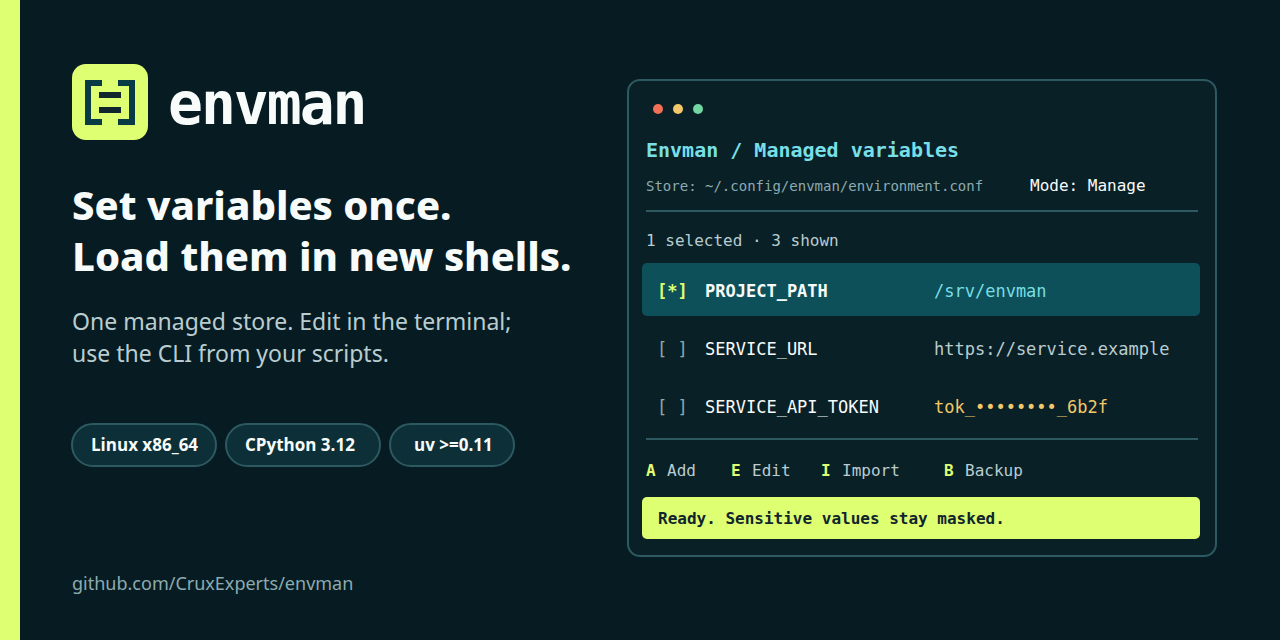
Keep your environment settings easy to use, with a new option to keep their
storage keys outside copied home directories.
Added
- Add an optional local key service for Linux. An administrator can keep keys
outside user homes, with separate access for each user and store. It needs no
TPM, desktop keyring, or network service. - Add explicit enrollment and migration that preserve existing keys and old
snapshots, verify an independent recovery export, and report unfinished cleanup. - Keep the retained shell loader working after CLI removal, including service
retrieval and clear failure without partial assignments or a disk key cache.
Changed
- Refresh the README, product artwork, banners, and social share image with
clearer explanations of the benefits. - Keep documentation on GitHub and retire the separate GitHub Pages site.
- Refresh the generated agent-skill catalog from the latest stable LocalSetup
release and keep installer, skill, and package versions aligned. - Refresh the pinned crypto runtime and build tools after version-specific
advisory checks; keep release downloads and retained loaders on the same pins.
Fixed
- Detect provider changes before a stale writer can overwrite a newer store.
- Make interrupted migrations recoverable without replacing keys or silently
switching back to file storage. - Preserve file-provider compatibility when provider metadata is absent.
Experimental feature
The local key service is opt-in and requires separate administrator provisioning.
It protects passive home/configuration copies after cleanup. It does not protect
against code running as the enrolled user, root, service-account compromise,
hypervisor access, or full VM snapshots containing the keys. Actual systemd,
desktop/SSH, reboot, and VM startup-performance qualification remains outstanding.
See the local key-service guide
before deployment. The existing file provider remains the default.