Repository navigation
v0.5.11

Release v0.5.11
Date: 2026-08-02
Summary
The Risk-Scored Review View ranks every hunk in a diff by blast radius and customer impact
potential instead of showing them in raw diff order. Scoring runs locally against a
codebase-memory-mcp knowledge graph, concurrently with the server-side AI review — neither
waits for the other. The engine is auto-installed on first use; the classic diff-order view
is one toggle away.
Install and Update
New install:
# Linux/macOS
curl -L https://hexmos.com/ipm-install | bash && ipm i HexmosTech/git-lrc

# Windows
iwr https://hexmos.com/ipm-install-ps | iex; ipm i HexmosTech/git-lrc
Update:
lrc self-update
Risk-Scored Review View
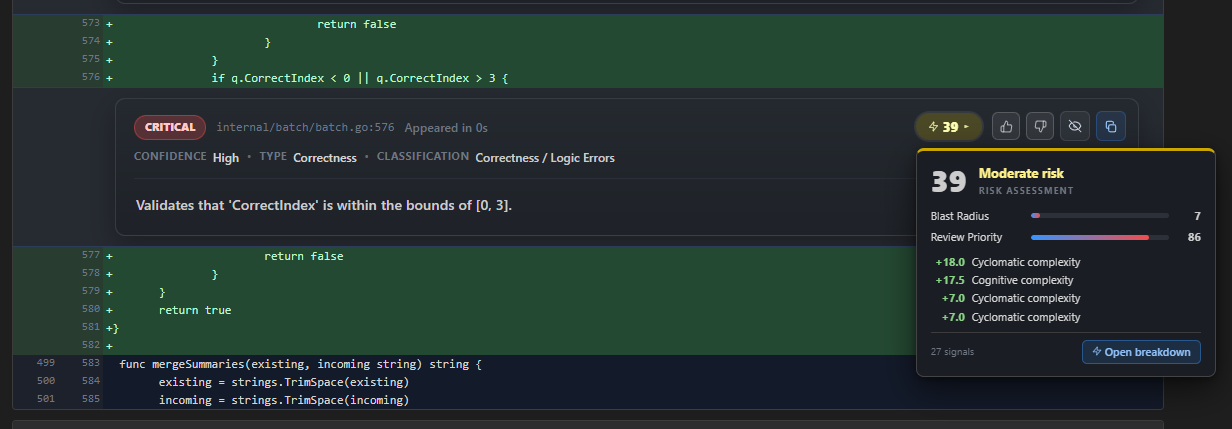
Risk scoring applies two independent 0-100 dimensions to every hunk, each built from labeled
signals so the reviewer understands why a hunk ranked where it did, not just that it did.
Blast Radius — how far a mistake could propagate through the codebase:
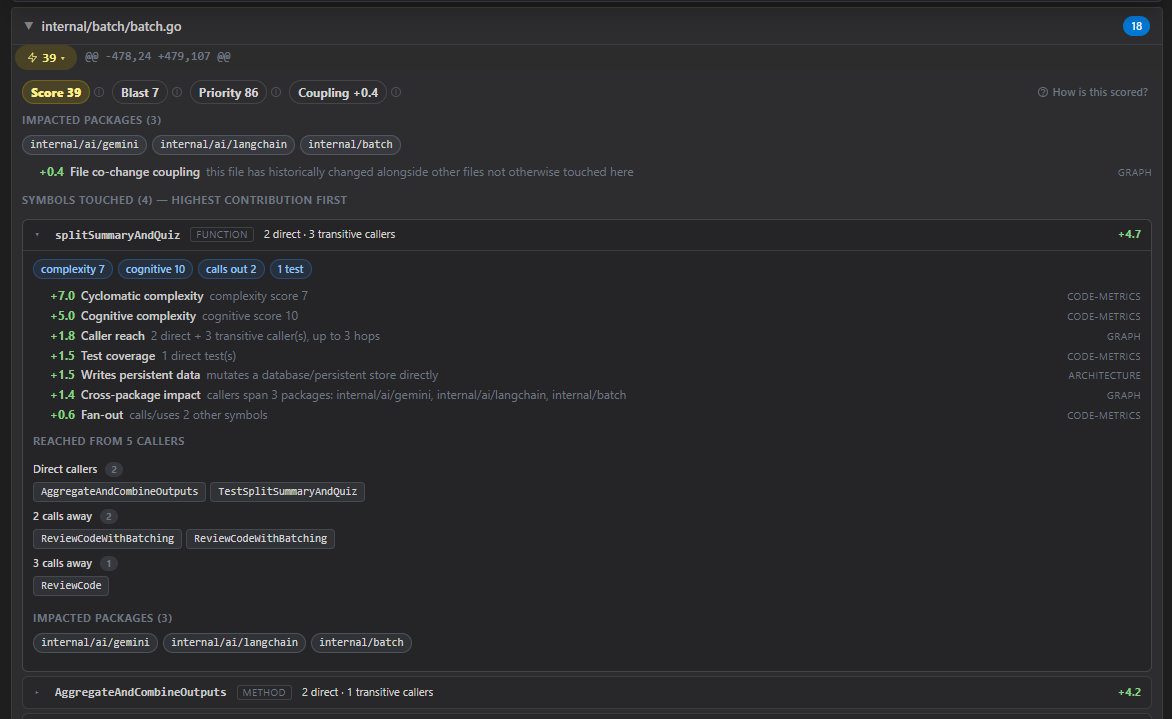
- Transitive callers up to 3 hops (decay-weighted, sqrt-compressed)
- Being an HTTP handler or CLI entry point, or reachable from one
- Repo-wide hotspot and architectural-layer classification
- Implementing or defining a widely-reused interface
- File co-change coupling from git history
- Lightweight heuristics for auth, persistence, config, build, and schema paths
Review Priority — how much reviewer attention this hunk deserves:
- A near-duplicate implementation exists elsewhere (different file weighting higher)
- Missing direct test coverage
- Cyclomatic complexity, loop depth, and fan-out as supplementary signals
Combined blends them at 60/40 into the ranking number. Hygiene signals (formatting-only,
comments-only, generated code, log-only, test-only, dead code removal) multiply the final
score down rather than fighting it with small negative points.
Benefit to CTOs and Engineering Leaders
- Sensitive code gets more attention. Route handlers, auth modules, persistence layers,
and widely-reused interfaces are elevated regardless of how many callers they have — the
tool understands architectural importance, not just fan-in counts. - Review consistency across teams. Every reviewer sees the same objective risk ranking
instead of one engineer's hunch about what "looks important." - Quantified review load per commit. A diff where most hunks rank high deserves more
time; a mostly low-risk diff can be skimmed with confidence. - No new service to manage. Scoring runs completely locally. The codebase-memory-mcp
engine binary is auto-installed into~/.lrc/binonly — no PATH edits, no agent-config
changes, no new infrastructure.
Benefit to Engineers
- Never miss important code in a large diff. When a 500-line diff arrives with 10
hunks, the highest-risk one sits at the top — not buried in the middle where it's easy
to skim over. - Faster, more efficient reviews. Start with what matters; low-risk changes sort to the
bottom with a visible hygiene dampener so they can be handled last or skipped. - Full explainability. Click any score badge to see every contributing signal — caller
chains, HTTP routes, duplicate implementations, test coverage status, architectural-layer
classification, and the exact points each contributed. - Back-button friendly. Every navigation action (comment next/prev, file jump, score
breakdown) writes a visible hash anchor so browser back/forward works intuitively.
How It Works
- Codebase-memory-mcp builds a file-level knowledge graph of the repository.
- On
lrc review, the diff is scored concurrently with the server-side AI review while
the engine auto-indexes the repo on first run. - The review UI opens with hunks ranked by risk across the whole diff.
- Three sort modes: Risk Score (whole diff), Risk Score (per file), and the classic
Diff Order, quickly toggled from the toolbar. - Sidebar shows files with expandable hunk submenus in the ranked view.
- Manage the engine at any time with
lrc graph install/lrc graph status/lrc graph uninstall. - No graph engine installed? Reviews work exactly as before — scoring stays off.
Changes
- Risk-Scored Review View: hunks ranked by blast radius and customer impact potential
- Auto-install of codebase-memory-mcp engine on first
lrc review(no manual step needed
for existing users upgrading) - Full signal breakdown panel per hunk: caller chains, routes, duplicates, architectural
layers, test coverage, hygiene dampeners - 3-state sort control: Score: Whole, Score: Per file, Diff order
- Collapsible sidebar file submenus with per-hunk risk chips in the whole-diff view
- Browser back/forward support with visible hash anchors for all navigation actions
- Risk badge in comment action bar with hover-assessment card and "Open breakdown" button
- Score chip help icons with concise explanations for each metric
- Design harness (
make design-ui) for UI iteration against captured real-review fixtures
Breaking Changes
- None.
Verification
lrc --versionlrc --helplrc graph status— confirm engine installed and projects indexed- Run
lrc review --servein any repo; confirm Risk Score sort modes, breakdown panels,
and browser back/forward all work
Known Issues
- None.