Repository navigation
Results
An empirical comparison of 12 continual-learning methods on 6 benchmarks, run end to end on a 4-core CPU with contilab. The page has three experiments:
| Experiment | Config | What it answers |
|---|---|---|
| Main study |
configs/experiments/cpu_main.yaml (+ cpu_main_seeds.yaml) |
All methods with default hyperparameters on 6 benchmarks |
| Tuned comparison | configs/experiments/cpu_tuned.yaml |
The same methods when each one's hyperparameters are chosen on validation accuracy (two MNIST benchmarks) |
| Smaller student | configs/experiments/cpu_student.yaml |
Distilling full-size experts into a student with 5.3× fewer parameters |
v0.2 update. The results were refreshed after these changes:
- Metric fixes:
cka_final,buffer_bytes, and the continual-evaluation curves of Joint.- New distillation defaults, chosen on validation accuracy in the tuned comparison. The v0.1 defaults under-trained the student.
- A new method: teacher → student continual distillation.
Accuracy numbers of the other methods are unchanged.
Update after v0.2.0. Split CIFAR-100 joined the main study, and the three MNIST benchmarks have 6 seeds instead of 3, so exact paired tests there can reach p < 0.05. The runs of seeds 0–2 are unchanged. Two statements changed:
- With 6 seeds, DER++ instead of multi-teacher distillation has the best mean on Split MNIST Class-IL. The two do not differ significantly.
- Continual distillation no longer beats Naive on every Class-IL benchmark: it falls below Naive on Split CIFAR-100.
The tuned comparison has 6 seeds as well; its selections hold, except that 30 distillation epochs now edge out 10 on Split MNIST Class-IL.
Update: EWC λ = 30, CIFAR without compile. Two defaults changed, and the affected runs were re-run:
- EWC on vision uses λ = 30, the value selected on validation accuracy in the tuned comparison, instead of the literature default λ = 100. The 18 MNIST EWC runs were re-run.
- The CIFAR presets train in bf16 without
torch.compile: compile added no throughput at steady state and took about 50 s per graph. All 72 Split CIFAR-10 and CIFAR-100 runs were re-run.The other runs are unchanged. Without compile the CIFAR runs follow a different numerical path, so every CIFAR number moved, for example Joint on Split CIFAR-10 from 0.398 ± 0.099 to 0.462 ± 0.017. What changed in the statements:
- EWC trains stably on Permuted MNIST (0.832, above Naive's 0.805 on 5 of 6 seeds), but no longer leads Naive on Split MNIST Class-IL (0.196 for both). Success criterion 3 now holds for LwF only.
- EWC still diverges on Split CIFAR-10 (1 of 3 seeds) and Split CIFAR-100 (3 of 3), late in the task stream.
- ER and DER++ no longer tie on Split CIFAR-100: DER++ reaches 0.063 and ER 0.057 (Naive 0.046).
- Average ranks: DER++ 2.3 (was 2.7), multi-teacher distillation 5.0 (4.7), EWC 8.2 (9.5). DER++ is no longer significantly ahead of EWC.
| Hardware | 4 CPU cores (Intel Xeon @ 2.1 GHz, AMX/AVX512-BF16), 15 GB RAM, no GPU |
| Main study | 12 methods × (3 MNIST benchmarks × 6 seeds + 3 other benchmarks × 3 seeds) = 324 runs: 320 done, 4 diverged (EWC on Split CIFAR-10 and CIFAR-100), 0 failed |
| Vision | Split MNIST (Class-IL and Task-IL) and Permuted MNIST (10 tasks, 10k/2k samples per task) with an MLP 2×400, 1 epoch, SGD lr 0.03; Split CIFAR-10 and Split CIFAR-100 (Class-IL; 5 × 2 and 10 × 10 classes) with a reduced ResNet-18, 2 epochs, bf16 |
| Language | text5 (AG News → Yelp → Amazon → DBpedia → Yahoo, 33 classes) with Pythia-70M, 1,000 train / 200 test texts per task, 1 epoch, AdamW lr 1e-4, batch 16 |
| Memory budget | 500 samples (vision) / 200 (text) for ER, DER++, A-GEM and both distillation methods |
| Distillation | multi-teacher: TIES-merged student, targets routed to each sample's teacher, 10 passes over the buffer; continual: one pass (train.epochs) over each task plus the buffer |
| Metrics tier |
full on Split MNIST Class-IL, extended elsewhere; ρ = 20 (MNIST) / 50 (CIFAR, text) |
Deviations from the original design, all made to fit a CPU budget:
- CIFAR-10 and CIFAR-100 were trained for 2 epochs instead of 3.
- text5 used 1,000 training and 200 test texts per task, instead of 2,000 and 500.
- A-GEM on text used a 64-sample reference batch instead of 256.
Final average accuracy (ACC), mean ± std over 6 seeds (MNIST benchmarks) or 3 seeds (CIFAR, text5). † = number of seeds that diverged; the mean is over the other seeds.
| Method | Split MNIST (Class-IL) | Split MNIST (Task-IL) | Permuted MNIST (Domain-IL) | Split CIFAR-10 (Class-IL) | Split CIFAR-100 (Class-IL) | text5 + Pythia-70M (Class-IL) |
|---|---|---|---|---|---|---|
| Naive | 0.196 ± 0.000 | 0.980 ± 0.001 | 0.805 ± 0.011 | 0.182 ± 0.004 | 0.046 ± 0.004 | 0.097 ± 0.016 |
| Joint | 0.950 ± 0.002 | 0.993 ± 0.001 | 0.909 ± 0.006 | 0.462 ± 0.017 | 0.120 ± 0.006 | 0.529 ± 0.015 |
| EWC | 0.196 ± 0.000 | 0.981 ± 0.001 | 0.832 ± 0.015 | 0.165 ± 0.004 †1 | diverged (3/3) | 0.105 ± 0.015 |
| LwF | 0.228 ± 0.005 | 0.990 ± 0.001 | 0.817 ± 0.010 | 0.171 ± 0.004 | 0.047 ± 0.002 | 0.105 ± 0.006 |
| ER | 0.858 ± 0.012 | 0.983 ± 0.001 | 0.869 ± 0.004 | 0.290 ± 0.027 | 0.057 ± 0.007 | 0.329 ± 0.038 |
| DER++ | 0.871 ± 0.014 | 0.991 ± 0.001 | 0.902 ± 0.002 | 0.285 ± 0.018 | 0.063 ± 0.007 | 0.397 ± 0.068 |
| A-GEM | 0.335 ± 0.013 | 0.984 ± 0.001 | 0.864 ± 0.006 | 0.180 ± 0.005 | 0.044 ± 0.004 | 0.100 ± 0.008 |
| LoRA-per-task | 0.184 ± 0.005 | 0.986 ± 0.002 | 0.619 ± 0.021 | 0.129 ± 0.001 | 0.015 ± 0.003 | 0.024 ± 0.002 |
| Task Arithmetic | 0.531 ± 0.019 | 0.979 ± 0.003 | 0.570 ± 0.038 | 0.151 ± 0.020 | 0.011 ± 0.001 | 0.034 ± 0.003 |
| TIES | 0.561 ± 0.020 | 0.983 ± 0.002 | 0.677 ± 0.012 | 0.160 ± 0.034 | 0.013 ± 0.002 | 0.033 ± 0.004 |
| Multi-teacher distill. | 0.863 ± 0.025 | 0.986 ± 0.001 | 0.773 ± 0.010 | 0.267 ± 0.005 | 0.040 ± 0.014 | 0.452 ± 0.013 |
| Continual distill. | 0.586 ± 0.070 | 0.980 ± 0.001 | 0.818 ± 0.005 | 0.229 ± 0.028 | 0.030 ± 0.004 | 0.331 ± 0.045 |
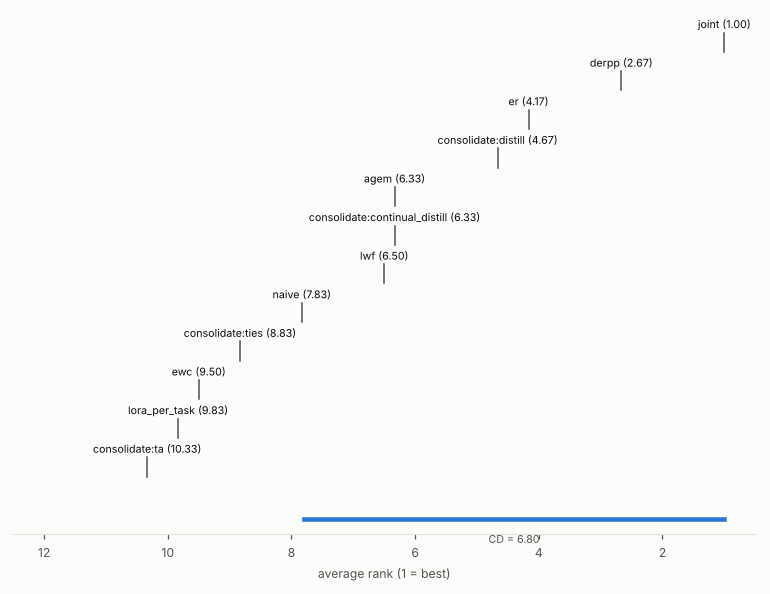
Ranking across the 6 benchmarks (ACC):
| Rank | Method |
|---|---|
| 1.0 | Joint |
| 2.3 | DER++ |
| 4.2 | ER |
| 5.0 | Multi-teacher distillation |
| 6.3 | LwF |
| 6.5 | A-GEM |
| 6.5 | Continual distillation |
| 8.2 | Naive |
| 8.2 | EWC |
| 9.0 | TIES |
| 10.2 | LoRA-per-task |
| 10.7 | Task Arithmetic |
A diverged seed is ranked by the final accuracy of its model, whose parameters stop changing at the divergence. The Friedman test gives p = 4.5·10⁻⁶, and the Nemenyi critical difference is 6.80 (α = 0.05). With 6 benchmarks the CD is still wide:
- Joint is significantly better than Naive, EWC, TIES, LoRA-per-task and Task Arithmetic.
- DER++ is significantly better than LoRA-per-task and Task Arithmetic.
Before v0.2, multi-teacher distillation ranked last (9.8) with under-trained defaults.
Exact Wilcoxon signed-rank tests over the 6 seeds (seed i of one method paired with seed i of the other). With 6 pairs the smallest possible two-sided p is 0.031, reached when every seed agrees.
| Benchmark | A vs B | Mean ACC (A / B) | Seeds where B is higher | p |
|---|---|---|---|---|
| Split MNIST Class-IL | Naive vs EWC | 0.196 / 0.196 | 2 / 6 | 1 |
| Split MNIST Class-IL | EWC vs LwF | 0.196 / 0.228 | 6 / 6 | 0.031 |
| Split MNIST Class-IL | LwF vs ER | 0.228 / 0.858 | 6 / 6 | 0.031 |
| Split MNIST Class-IL | ER vs DER++ | 0.858 / 0.871 | 6 / 6 | 0.031 |
| Split MNIST Class-IL | DER++ vs Joint | 0.871 / 0.950 | 6 / 6 | 0.031 |
| Split MNIST Class-IL | Multi-teacher distill. vs DER++ | 0.863 / 0.871 | 3 / 6 | 0.69 |
| Split MNIST Class-IL | Multi-teacher distill. vs ER | 0.863 / 0.858 | 3 / 6 | 0.84 |
| Split MNIST Class-IL | Task Arithmetic vs TIES | 0.531 / 0.561 | 6 / 6 | 0.031 |
| Split MNIST Class-IL | Naive vs Continual distill. | 0.196 / 0.586 | 6 / 6 | 0.031 |
| Split MNIST Task-IL | LwF vs DER++ | 0.990 / 0.991 | 3 / 6 | 0.44 |
| Permuted MNIST | Naive vs EWC | 0.805 / 0.832 | 5 / 6 | 0.063 |
| Permuted MNIST | EWC vs LwF | 0.832 / 0.817 | 1 / 6 | 0.063 |
| Permuted MNIST | Naive vs LwF | 0.805 / 0.817 | 5 / 6 | 0.094 |
| Permuted MNIST | Naive vs Continual distill. | 0.805 / 0.818 | 5 / 6 | 0.063 |
| Permuted MNIST | Multi-teacher distill. vs Naive | 0.773 / 0.805 | 6 / 6 | 0.031 |
| Permuted MNIST | Multi-teacher distill. vs Continual distill. | 0.773 / 0.818 | 6 / 6 | 0.031 |
| Permuted MNIST | A-GEM vs ER | 0.864 / 0.869 | 5 / 6 | 0.094 |
| Permuted MNIST | Task Arithmetic vs TIES | 0.570 / 0.677 | 6 / 6 | 0.031 |
-
Replay and multi-teacher distillation lead. The best non-Joint method on each benchmark:
- DER++ on Split MNIST Class-IL (0.871), Split MNIST Task-IL (0.991) and Permuted MNIST (0.902). On Split MNIST Class-IL, multi-teacher distillation (0.863) does not differ significantly from it (p = 0.69); on Task-IL, neither does LwF (0.990, p = 0.44).
- ER on Split CIFAR-10 (0.290, DER++ 0.285), and DER++ on Split CIFAR-100 (0.063, ER 0.057)
- multi-teacher distillation on text5 (0.452)
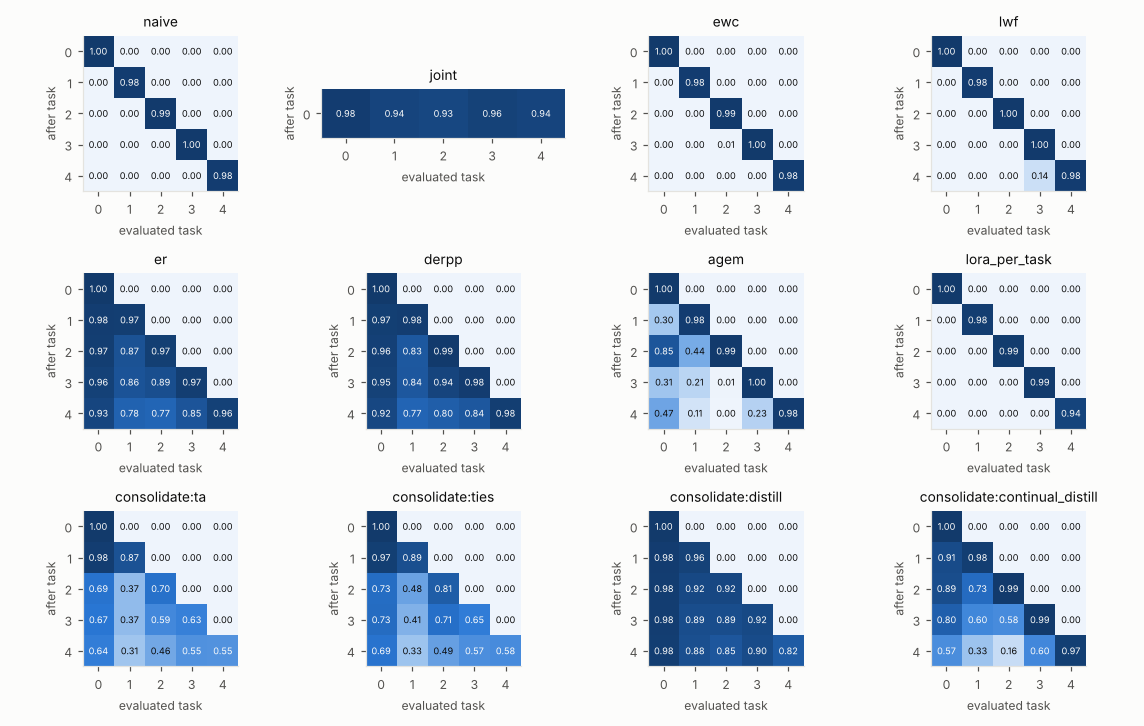
Average ranks: DER++ 2.3, ER 4.2, multi-teacher distillation 5.0. Replay also has the smallest stability gap, for example 0.150 (DER++) vs 0.995 for Naive on Split MNIST Class-IL.
-
Multi-teacher distillation buys accuracy with experts.
- It keeps every task expert: 11 MB of stored models on Split MNIST against 1.8 MB for a single model.
- It trains every expert as well: 1,915 s per text5 run against 1,044 s for DER++.
- In return it forgets little and is well calibrated across tasks, with BWT −0.079 and task-recency bias 0.05 on Split MNIST Class-IL.
- On Permuted MNIST it falls below Naive on every seed (0.773 vs 0.805, p = 0.031): the 500-sample buffer leaves 50 samples for each of the 10 input distributions.
- On Split CIFAR-100 it also falls below Naive (0.040 vs 0.046). The buffer holds 5 samples per class, and the student reaches a learning accuracy of only 0.102.
-
Teacher → student continual distillation is the cheap variant. It never stores an expert: the student is the only model kept (1.8 MB). It beats Naive on every Class- and Domain-IL benchmark except Split CIFAR-100:
- Split MNIST Class-IL 0.586 vs 0.196 (all 6 seeds)
- Permuted MNIST 0.818 vs 0.805 (5 of 6 seeds, p = 0.063), and ahead of multi-teacher distillation (0.773) on every seed
- CIFAR-10 0.229 vs 0.182
- text5 0.331 vs 0.097, on par with ER
- Split CIFAR-100: 0.030 vs 0.046, below Naive
Old knowledge reaches the student only through self-distillation on the buffer, so errors compound task by task: BWT −0.499 and recency bias 0.46 on Split MNIST Class-IL. With 10 tasks of 10 classes on CIFAR-100 the recency bias reaches 1.0.
-
Regularisation alone does not solve Class-IL. EWC (0.196) and LwF (0.228) stay at the Naive level (0.196) on Split MNIST Class-IL, with task-recency bias ≈ 1.0: almost every old-task sample is predicted as a newest-task class. LwF is above Naive on all 6 seeds; EWC with λ = 30 is not (higher on 2 of 6 seeds, p = 1), and λ = 100 led by only 0.001. The same holds on text5 (0.105 vs 0.097), Split CIFAR-10 (LwF 0.171, EWC 0.165, Naive 0.182) and Split CIFAR-100 (LwF 0.047 vs 0.046). Tuning does not change this (see Tuned comparison).
-
EWC is sensitive to λ. With the literature default λ = 100 and an online (accumulated) Fisher, every seed diverged on Permuted MNIST, Split CIFAR-10 and Split CIFAR-100. The default is now λ = 30, chosen on validation accuracy: Permuted MNIST trains stably and reaches 0.832, above Naive (0.805) on 5 of 6 seeds (p = 0.063). On CIFAR λ = 30 only delays the divergence: one Split CIFAR-10 seed diverges in the last of 5 tasks, and every Split CIFAR-100 seed in task 5, 9 or 10 of 10. The accumulated Fisher keeps growing from task to task, so the penalty eventually becomes too stiff for the learning rate.
-
A-GEM helps in Domain-IL but not in Class-IL. It reaches 0.864 on Permuted MNIST but only 0.335 on Split MNIST Class-IL, and stays at the Naive level on CIFAR-10, CIFAR-100 and text5. This matches the known weakness of gradient projection under class-incremental output heads.
-
Merging trails replay.
- TIES is above Task Arithmetic on every seed: 0.561 vs 0.531 on Split MNIST Class-IL, 0.677 vs 0.570 on Permuted MNIST (p = 0.031 each).
- Merged models show little recency bias (0.13 on Split MNIST Class-IL), but learning accuracy drops to 0.78–0.80 because the experts interfere. On Split CIFAR-100 the merged models are near chance (0.011–0.013).
- As a starting point for distillation, the merged model is what made distillation work (see the tuned comparison).
-
Task-IL is easy at this scale. Every method reaches ≥ 0.979 on Split MNIST Task-IL.
-
Language models trade task learning against general ability.
- Full fine-tuning methods raise the WikiText perplexity of the original LM head by +4,500 to +14,000.
- LoRA-per-task (+186) and TIES (+1,709) keep it low but barely learn the tasks (learning accuracy 0.21–0.25).
- Multi-teacher distillation has the best balance: the highest text5 accuracy (0.452) at +3,643.
-
LoRA-per-task on vision uses a frozen randomly initialised backbone (no pretraining), which limits it to 0.184 on Split MNIST Class-IL and 0.619 on Permuted MNIST. It is a meaningful baseline only with pretrained backbones.
-
Split CIFAR-100 at 2 epochs is a floor test. Joint reaches only 0.120 on 100 classes, so every continual method sits between chance (0.010) and 0.063. Only replay (DER++ 0.063, ER 0.057) is clearly above Naive (0.046); LwF (0.047) matches it. The rankings on this benchmark mostly reflect under-training, not forgetting.
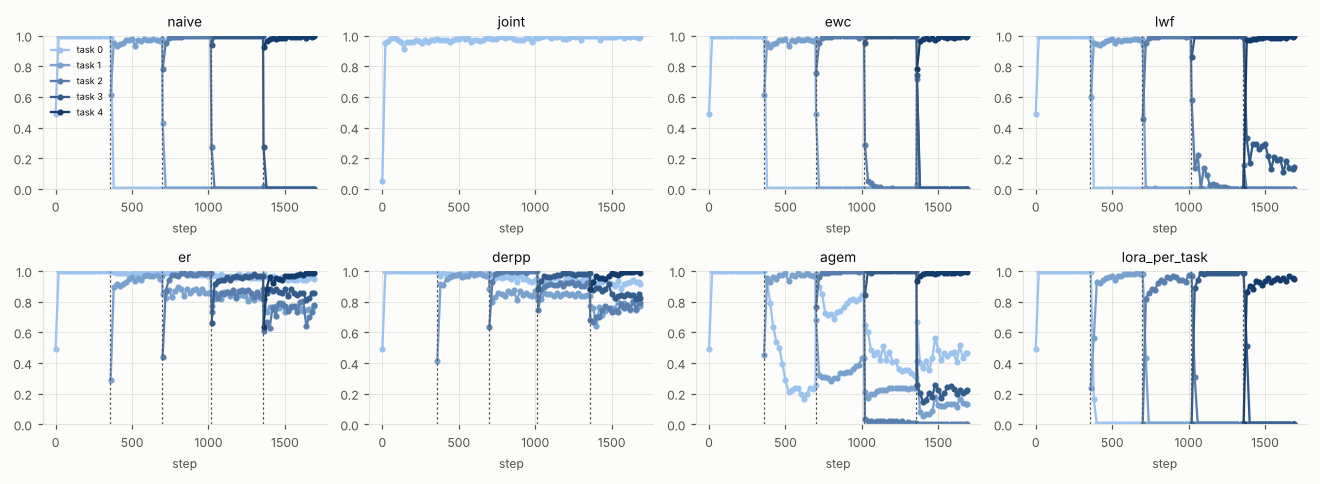
Continual evaluation on Split MNIST Class-IL: accuracy of each task over training steps. Dashed lines are task boundaries. Naive, EWC, LwF and LoRA collapse to zero on old tasks immediately, while ER and DER++ keep them.
Defaults from the literature are not always good settings. cpu_tuned gives every method with hyperparameters a
small grid (method_sweep) on the two MNIST benchmarks:
- EWC: λ ∈ {1, 3, 10, 30, 100, 300}
- LwF: α ∈ {0.5, 1, 2, 4}
- DER++: α ∈ {0.1, 0.3, 1} × β ∈ {0.5, 1}
- TIES: k ∈ {0.1, 0.2, 0.5}
- Multi-teacher distillation: init {θ₀, TIES} × routing {entropy, routed} × epochs {1, 10, 30}
For each method, the variant with the best mean validation accuracy over seeds is selected (spec §5.3); diverged seeds score 0. Optimiser, learning rate, epochs, batch size and memory budget stay fixed by the fairness rules. "Default" is the literature default: λ = 100 for EWC and the v0.1 defaults for distillation. The main study now uses λ = 30 and the selected distillation settings, with 10 instead of 30 epochs. This experiment has 6 seeds, like the MNIST benchmarks of the main study, so its other default and untuned values are the same as in the overview above. † = number of diverged seeds.
| Method | Split MNIST Class-IL: selected | default | tuned | Permuted MNIST: selected | default | tuned |
|---|---|---|---|---|---|---|
| Naive | — | 0.196 | 0.196 | — | 0.805 | 0.805 |
| Joint | — | 0.950 | 0.950 | — | 0.909 | 0.909 |
| EWC | λ=300 | 0.197 | 0.201 | λ=30 | diverged 6/6 | 0.832 |
| LwF | α=1 | 0.229 | 0.229 | α=0.5 | 0.816 | 0.828 |
| ER | — | 0.858 | 0.858 | — | 0.869 | 0.869 |
| DER++ | α=1, β=1 | 0.871 | 0.899 | α=0.3, β=1 | 0.902 | 0.906 |
| A-GEM | — | 0.335 | 0.335 | — | 0.864 | 0.864 |
| LoRA-per-task | — | 0.184 | 0.184 | — | 0.619 | 0.619 |
| Task Arithmetic | — | 0.531 | 0.531 | — | 0.570 | 0.570 |
| TIES | k=0.1 | 0.561 | 0.591 | k=0.2 | 0.677 | 0.677 |
| Multi-teacher distill. | epochs 30, TIES init, routed | 0.223 | 0.871 | epochs 30, TIES init, routed | 0.097 | 0.786 |
| Continual distill. | — | 0.586 | 0.586 | — | 0.818 | 0.818 |
-
Tuning changes the verdict for distillation. The v0.1 defaults trained the student for 16 SGD steps per task from θ₀ with entropy-mixed targets. A TIES-merged start with routed targets lifts Split MNIST Class-IL from 0.223 to 0.871 and Permuted MNIST from 0.097 to 0.786.
- These settings are now the defaults, with 10 distillation epochs.
- With 6 seeds, 30 epochs is selected on both benchmarks. It is 0.008 and 0.013 above 10 epochs (0.863 and 0.773) and takes three times the distillation time, so the default stays at 10.
-
Tuning does not rescue regularisation in Class-IL. No λ makes EWC differ from Naive on Split MNIST Class-IL (0.196–0.201), and no α lifts LwF above 0.230. On Permuted MNIST, λ = 30 avoids the divergence of λ = 100 and λ = 300 and gives 0.832 (Naive 0.805); it is now EWC's default on vision.
-
DER++ gains 0.03 with stronger replay terms (α = β = 1: 0.899 against 0.871). TIES gains 0.03 with sparser task vectors (k = 0.1: 0.591 against 0.561) on Split MNIST Class-IL.
-
Average ranks over the two benchmarks, using the selected variants:
- Joint 1.0, DER++ 2.0, ER 3.5
- A-GEM 6.0, multi-teacher distillation 6.0, continual distillation 6.5
- EWC 7.5, LwF 7.5, TIES 7.5
- Naive 9.5, TA 9.5, LoRA-per-task 11.5
Two benchmarks are too few for significance (Friedman p = 0.13).
cpu_student distils the 2×400 MLP experts (478k parameters) into a 2×100 student (89.6k parameters, 5.3×
fewer). A different architecture cannot start from merged expert weights, so both students start from their own
initialisation. The fair full-size reference for multi-teacher distillation is therefore the θ₀-initialised
variant of the tuned comparison. All rows use seeds 0–2.
| Method | Student | Split MNIST Class-IL | Permuted MNIST | Stored model bytes (Split / Permuted) |
|---|---|---|---|---|
| Multi-teacher distill. | full size (θ₀ init) | 0.856 | 0.534 | 10.9 / 20.1 MB (experts + student) |
| Multi-teacher distill. | 2×100 | 0.857 ± 0.010 | 0.464 ± 0.010 | 9.5 / 18.6 MB (experts + student) |
| Continual distill. | full size | 0.533 ± 0.038 | 0.816 ± 0.004 | 1.8 MB (student only) |
| Continual distill. | 2×100 | 0.490 ± 0.034 | 0.798 ± 0.001 | 0.34 MB (student only) |
- On Split MNIST Class-IL the small student matches the full-size one (0.857 vs 0.856). Permuted MNIST (10 tasks, all 10 classes shared) costs it 0.07.
- Continual distillation never stores an expert. Its 2×100 student keeps 98 % of the full-size accuracy on Permuted MNIST, in 0.34 MB. That is the smallest deployable result in this study.
Means over 6 seeds (MNIST benchmarks) or 3 seeds (CIFAR, text5).
-
wall_timeis training time per run, averaged over seeds 0–2 only: seeds 3–5 ran in a later session with a different CPU load. It includes expert training for consolidation methods and Fisher computation for EWC. Joint and both distillation methods were re-run for v0.2 while other jobs shared the CPU, and wall times of runs from different sessions vary by up to 2× with load. The CIFAR runs and the MNIST EWC runs come from one later session that ran two run groups at a time, so the MNIST EWC wall times are not comparable with the other MNIST rows. -
buffer_bytescounts the stored samples (or the distillation transfer set) and DER++ logits. -
state_bytescounts extra state kept between tasks: the EWC Fisher diagonal and anchor, and the LwF teacher. - EWC has no row on Split CIFAR-100 because every seed diverged. Its Split CIFAR-10 row is the mean of the two seeds that did not diverge.
| Method | acc | bwt | learning_acc | min_acc | stability_gap | recency_bias | buffer_bytes | state_bytes | wall_time |
|---|---|---|---|---|---|---|---|---|---|
| Naive | 0.196 | -0.992 | 0.989 | 0.000 | 0.995 | 1.000 | 0 | 0 | 11 s |
| Joint | 0.950 | — | — | — | — | 0.012 | 0 | 0 | 10 s |
| EWC | 0.196 | -0.992 | 0.989 | 0.000 | 0.995 | 1.000 | 0 | 3.65 MB | 68 s |
| LwF | 0.228 | -0.953 | 0.990 | 0.025 | 0.970 | 0.956 | 0 | 1.82 MB | 18 s |
| ER | 0.858 | -0.148 | 0.976 | 0.757 | 0.155 | 0.125 | 1.50 MB | 0 | 14 s |
| DER++ | 0.871 | -0.143 | 0.986 | 0.764 | 0.150 | 0.120 | 1.52 MB | 0 | 17 s |
| A-GEM | 0.335 | -0.818 | 0.989 | 0.095 | 0.865 | 0.819 | 1.50 MB | 0 | 36 s |
| LoRA-per-task | 0.184 | -0.984 | 0.972 | 0.000 | 0.985 | 1.000 | 0 | 0 | 17 s |
| Task Arithmetic | 0.531 | -0.309 | 0.778 | — | — | 0.130 | 0 | 0 | 15 s |
| TIES | 0.561 | -0.304 | 0.804 | — | — | 0.126 | 0 | 0 | 16 s |
| Multi-teacher distill. | 0.863 | -0.079 | 0.926 | — | — | 0.053 | 1.50 MB | 0 | 21 s |
| Continual distill. | 0.586 | -0.499 | 0.985 | — | — | 0.455 | 1.50 MB | 0 | 23 s |
| Method | acc | bwt | learning_acc | min_acc | stability_gap | buffer_bytes | state_bytes | wall_time |
|---|---|---|---|---|---|---|---|---|
| Naive | 0.980 | -0.012 | 0.990 | 0.970 | 0.016 | 0 | 0 | 10 s |
| Joint | 0.993 | — | — | — | — | 0 | 0 | 10 s |
| EWC | 0.981 | -0.010 | 0.990 | 0.972 | 0.015 | 0 | 3.65 MB | 68 s |
| LwF | 0.990 | -0.001 | 0.990 | 0.991 | 0.003 | 0 | 1.82 MB | 18 s |
| ER | 0.983 | -0.006 | 0.987 | 0.980 | 0.009 | 1.50 MB | 0 | 14 s |
| DER++ | 0.991 | -0.001 | 0.992 | 0.985 | 0.008 | 1.52 MB | 0 | 18 s |
| A-GEM | 0.984 | -0.007 | 0.990 | 0.979 | 0.008 | 1.50 MB | 0 | 35 s |
| LoRA-per-task | 0.986 | 0.000 | 0.986 | 0.992 | 0.000 | 0 | 0 | 10 s |
| Task Arithmetic | 0.979 | -0.004 | 0.983 | — | — | 0 | 0 | 15 s |
| TIES | 0.983 | -0.005 | 0.987 | — | — | 0 | 0 | 15 s |
| Multi-teacher distill. | 0.986 | -0.002 | 0.987 | — | — | 1.50 MB | 0 | 22 s |
| Continual distill. | 0.980 | -0.010 | 0.988 | — | — | 1.50 MB | 0 | 24 s |
| Method | acc | bwt | learning_acc | min_acc | stability_gap | buffer_bytes | state_bytes | wall_time |
|---|---|---|---|---|---|---|---|---|
| Naive | 0.805 | -0.104 | 0.898 | 0.763 | 0.025 | 0 | 0 | 20 s |
| Joint | 0.909 | — | — | — | — | 0 | 0 | 19 s |
| EWC | 0.832 | -0.046 | 0.873 | 0.791 | 0.024 | 0 | 3.65 MB | 131 s |
| LwF | 0.817 | -0.085 | 0.893 | 0.779 | 0.022 | 0 | 1.82 MB | 33 s |
| ER | 0.869 | -0.046 | 0.910 | 0.846 | 0.021 | 1.50 MB | 0 | 27 s |
| DER++ | 0.902 | -0.004 | 0.906 | 0.884 | -0.001 | 1.52 MB | 0 | 34 s |
| A-GEM | 0.864 | -0.038 | 0.898 | 0.835 | 0.008 | 1.50 MB | 0 | 67 s |
| LoRA-per-task | 0.619 | -0.100 | 0.709 | 0.581 | 0.042 | 0 | 0 | 52 s |
| Task Arithmetic | 0.570 | -0.150 | 0.706 | — | — | 0 | 0 | 36 s |
| TIES | 0.677 | -0.108 | 0.774 | — | — | 0 | 0 | 39 s |
| Multi-teacher distill. | 0.773 | -0.056 | 0.824 | — | — | 1.50 MB | 0 | 50 s |
| Continual distill. | 0.818 | -0.048 | 0.861 | — | — | 1.48 MB | 0 | 47 s |
| Method | acc | bwt | learning_acc | min_acc | stability_gap | recency_bias | buffer_bytes | state_bytes | wall_time |
|---|---|---|---|---|---|---|---|---|---|
| Naive | 0.182 | -0.797 | 0.820 | 0.000 | 0.795 | 1.000 | 0 | 0 | 344 s |
| Joint | 0.462 | — | — | — | — | 0.081 | 0 | 0 | 360 s |
| EWC | 0.165 | -0.753 | 0.767 | 0.000 | 0.741 | 1.000 | 0 | 8.35 MB | 439 s |
| LwF | 0.171 | -0.791 | 0.805 | 0.000 | 0.787 | 1.000 | 0 | 4.18 MB | 460 s |
| ER | 0.290 | -0.684 | 0.837 | 0.080 | 0.666 | 0.701 | 5.86 MB | 0 | 641 s |
| DER++ | 0.285 | -0.626 | 0.786 | 0.060 | 0.620 | 0.700 | 5.88 MB | 0 | 632 s |
| A-GEM | 0.180 | -0.818 | 0.834 | 0.000 | 0.818 | 1.000 | 5.86 MB | 0 | 2032 s |
| LoRA-per-task | 0.129 | -0.711 | 0.699 | 0.000 | 0.740 | 1.000 | 0 | 0 | 850 s |
| Task Arithmetic | 0.151 | -0.288 | 0.382 | — | — | 0.016 | 0 | 0 | 561 s |
| TIES | 0.160 | -0.293 | 0.395 | — | — | 0.037 | 0 | 0 | 577 s |
| Multi-teacher distill. | 0.267 | -0.262 | 0.476 | — | — | 0.142 | 5.86 MB | 0 | 682 s |
| Continual distill. | 0.229 | -0.684 | 0.776 | — | — | 0.604 | 5.86 MB | 0 | 806 s |
| Method | acc | bwt | learning_acc | min_acc | stability_gap | recency_bias | buffer_bytes | state_bytes | wall_time |
|---|---|---|---|---|---|---|---|---|---|
| Naive | 0.046 | -0.402 | 0.408 | 0.000 | 0.393 | 1.000 | 0 | 0 | 409 s |
| Joint | 0.120 | — | — | — | — | 0.155 | 0 | 0 | 425 s |
| LwF | 0.047 | -0.408 | 0.414 | 0.000 | 0.396 | 1.000 | 0 | 4.23 MB | 476 s |
| ER | 0.057 | -0.398 | 0.416 | 0.003 | 0.335 | 0.968 | 5.86 MB | 0 | 722 s |
| DER++ | 0.063 | -0.409 | 0.431 | 0.004 | 0.373 | 0.968 | 6.05 MB | 0 | 704 s |
| A-GEM | 0.044 | -0.410 | 0.413 | 0.000 | 0.395 | 1.000 | 5.86 MB | 0 | 3348 s |
| LoRA-per-task | 0.015 | -0.192 | 0.188 | 0.000 | 0.188 | 1.000 | 0 | 0 | 1237 s |
| Task Arithmetic | 0.011 | -0.077 | 0.080 | — | — | 0.040 | 0 | 0 | 601 s |
| TIES | 0.013 | -0.090 | 0.094 | — | — | 0.051 | 0 | 0 | 634 s |
| Multi-teacher distill. | 0.040 | -0.068 | 0.102 | — | — | 0.023 | 5.86 MB | 0 | 877 s |
| Continual distill. | 0.030 | -0.287 | 0.289 | — | — | 1.000 | 5.80 MB | 0 | 662 s |
| Method | acc | bwt | learning_acc | min_acc | stability_gap | general_ppl_delta | buffer_bytes | state_bytes | wall_time |
|---|---|---|---|---|---|---|---|---|---|
| Naive | 0.097 | -0.589 | 0.568 | 0.002 | 0.498 | +7481 | 0 | 0 | 461 s |
| Joint | 0.529 | — | — | — | — | +4488 | 0 | 0 | 674 s |
| EWC | 0.105 | -0.588 | 0.575 | 0.003 | 0.494 | +7541 | 0 | 340.94 MB | 1199 s |
| LwF | 0.105 | -0.606 | 0.590 | 0.000 | 0.480 | +8488 | 0 | 268.72 MB | 816 s |
| ER | 0.329 | -0.294 | 0.564 | 0.292 | 0.068 | +14037 | 0.39 MB | 0 | 733 s |
| DER++ | 0.397 | -0.231 | 0.582 | 0.284 | 0.126 | +6036 | 0.42 MB | 0 | 1044 s |
| A-GEM | 0.100 | -0.602 | 0.582 | 0.001 | 0.505 | +7056 | 0.39 MB | 0 | 1563 s |
| LoRA-per-task | 0.024 | -0.233 | 0.210 | 0.000 | 0.187 | +186 | 0 | 0 | 755 s |
| Task Arithmetic | 0.034 | -0.268 | 0.249 | — | — | +5743 | 0 | 0 | 628 s |
| TIES | 0.033 | -0.277 | 0.254 | — | — | +1709 | 0 | 0 | 674 s |
| Multi-teacher distill. | 0.452 | -0.050 | 0.492 | — | — | +3643 | 0.39 MB | 0 | 1915 s |
| Continual distill. | 0.331 | -0.260 | 0.539 | — | — | +12459 | 0.39 MB | 0 | 916 s |
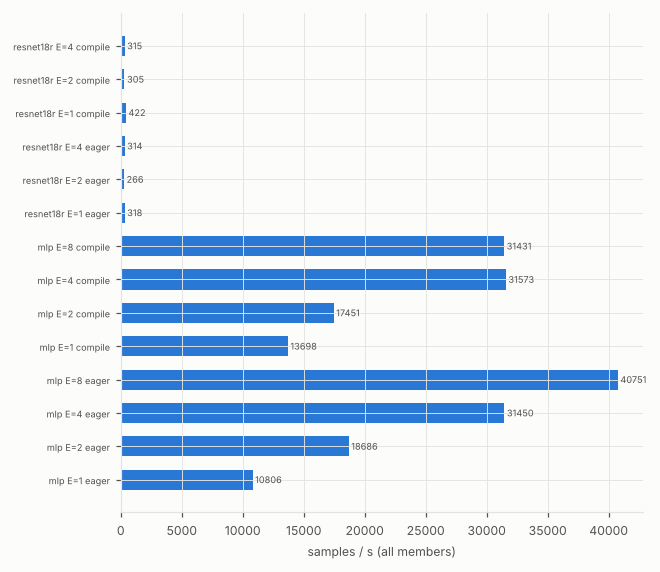
See Performance. For the MLP, training 8 seeds in one vmap ensemble gives 3.8× the
throughput of one seed (40.7k vs 10.8k samples/s). For the reduced ResNet-18, bf16 + torch.compile gives 2.3×,
almost all of it from bf16, so the CIFAR presets train in bf16 without compile.
| # | Criterion | Verdict | Evidence |
|---|---|---|---|
| 1 | Smoke profile: every method and consolidation path finishes within 60 s; all tests pass | Met | 66 smoke runs within the 60 s test on an idle 4-core CPU; 188 tests pass on Python 3.11 and 3.13 in CI (5 network tests skipped by default) |
| 2 | CPU profile matrix completes in the session and produces a report | Met, with the budget deviations listed above | 324/324 runs finished (320 done, 4 diverged, 0 failed); report.md / report.html generated |
| 3 | Split MNIST Class-IL ordering Naive < {EWC, LwF} < {ER, DER++} < Joint (mean ACC) | Partly met: not for EWC | 0.196 < 0.228 (LwF) < 0.858 / 0.871 < 0.950, each step on all 6 seeds (exact Wilcoxon p = 0.031, the minimum for 6 pairs). EWC with λ = 30 equals Naive (0.196, higher on 2 of 6 seeds, p = 1); λ = 100 was ahead by 0.001 on every seed but diverges on Permuted MNIST and CIFAR |
| 4 |
contilab bench reports vmap / compile speed-ups |
Met | MLP vmap E=8: 3.8×; ResNet bf16 + compile: 2.3×; ResNet vmap: no gain (reported) |
| 5 | Equivalence and consistency tests pass | Met | vmap members = single runs, compile = eager, EWC(λ=0) / ER(M=0) / DER++(0,0) = Naive, merge identities, resume = uninterrupted run |
- Statistical power: the MNIST benchmarks have 6 seeds, enough for an exact paired test to reach p < 0.05 when every seed agrees. CIFAR-10, CIFAR-100 and text5 have 3 seeds: enough for means and spreads, not for per-benchmark significance tests.
- Scale: this is a CPU-scale study. CIFAR-10 and CIFAR-100 at 2 epochs (Joint 0.462 and 0.120) and text5 at 1,000 texts per task are far below their converged regimes; read absolute numbers as relative comparisons.
- Tuning scope: hyperparameters were tuned only on the two MNIST benchmarks. CIFAR-10, CIFAR-100 and text5 use the defaults, including the distillation defaults chosen on MNIST.
- Head assembly in merging: Class-IL merging assembles classifier rows from different experts, leaving logit-scale mismatch between tasks.
- Distillation cost: both distillation methods first train one expert per task. Their wall time and FLOPs include that, but a deployment that already has the experts would only pay the distillation.
The per-run results behind every table on this page are in
docs/assets/results/data/: one CSV per
experiment, one row per run with all scalar metrics. The same files are the Hugging Face dataset
jonpark0/contilab-cpu-study, with a dataset card; load one with
datasets.load_dataset("jonpark0/contilab-cpu-study", "cpu_main").
contilab run configs/experiments/cpu_main.yaml        # ~22 h of training on 4 CPU cores (resumable)
contilab run configs/experiments/cpu_main_seeds.yaml  # seeds 3–5 on the MNIST benchmarks, same directory
contilab run configs/experiments/cpu_tuned.yaml       # 456 runs, ~2 h
contilab run configs/experiments/cpu_student.yaml     # ~10 min
contilab report runs/cpu_main