Repository navigation
Releases
v0.4.0 — try it in your browser, share a session as a GIF or a card

Added
A browser demo that needs no install. npm run build:pages builds the real app against a
recording of the real hub, and .github/workflows/pages.yml publishes it to
https://kostakurta8.github.io/roundtable/. scripts/recordDemo.ts stages the same showcase session
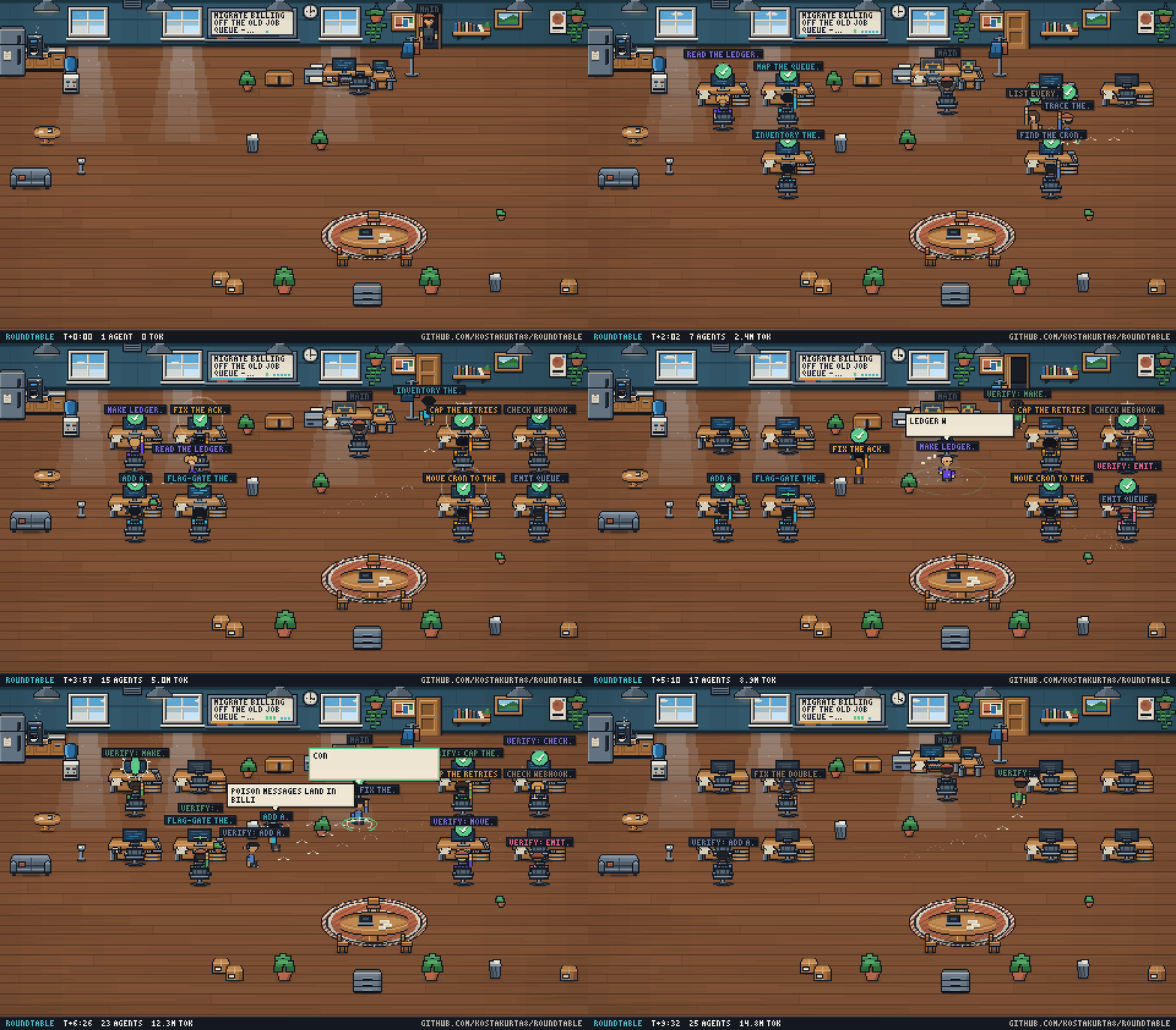
the README's timelapse shows — six scouts, eight builders, a verifier on every change, one refuted
and fixed — reads it with the shipped hub over a socket, and deals the frames out again on a
compressed clock (src/demo/timelapse.ts): each silence clamped to a beat, nine and a half minutes
in seventy seconds, looping every ninety. A banner says it is a staged timelapse and carries the
install command and a copy button, and the status pill reads REPLAY.
The demo lives behind its own entry file, so the bundle people install contains none of it. The
page has Open Graph and Twitter card tags, so a pasted link unfurls with the social card.
Share as GIF, from the app. A Share button in the top bar, G, or the palette renders the
session on screen as a GIF in a Web Worker, previews it, and lets the browser save it. It is the
--gif renderer, moved to src/clip/ so both halves import it: the same events make the same
bytes. Length, busiest stretch or whole session, and "Hide transcript text" are options; nothing is
uploaded. The encoder is also twice as fast, with identical output.
A session card, the second thing you can share. The Share dialog's GIF | Card switch, or
roundtable --card, renders one 1200×630 PNG: subagents, the most at once, tokens and estimated cost
(the top bar's own figures, ≥ included), duration, verdicts and the busiest agent, over a still of
the room at its busiest, with the same "Hide transcript text" switch. The dialog downloads it or
copies it as an image; the CLI writes it with the renderer the page uses. A clip also no longer
holds every frame whole before encoding — a 40-second GIF took 277 MB in the worker and now takes
13 MB, with the same bytes out.
A first-visit guide. A card over the room says what a person, a desk, a bubble, a walk and the
door mean, and that the timeline rewinds. It does not block the room, collapses to a one-row legend
on a short stage, is remembered once dismissed, and is back from the Help sheet or the palette.
Pointing at a person shows a card beside the cursor: who it is, what it is doing, its tokens,
cost and age.
Changed
The room fills its stage. The camera rests on a frame computed from the desks the session has
drawn, wall to floor, as large as the stage allows, and eases as the room grows; Home, ⌂, Escape
and a double-click return to it. The roster becomes a strip under the room whenever that draws the
room larger than a column beside it. At 1440×900 people went from 26×39 to 39×59 pixels on screen.
The feed reads as a conversation. Runs of two or more system lines fold into one expandable
line — "spawned 6 subagents · 6 prompts ▸" — with nothing dropped; search opens the folds.
Every agent's name is legible in both themes. Names keep their hue and take their lightness
from the theme; the worst contrast went from 1.24:1 to 6.45:1 at night, 3.90:1 to 4.93:1 by day.
A phone-width layout. The room gets nearly half the height, session tabs scroll sideways, the
top bar keeps the session's name, and the timeline takes two rows.
The activity strip fills its width at any session length and names the second under the pointer.
The README leads with the demo and the one install line; the screenshots and the social card
show the app as it now is. docs/launch/ holds launch drafts, and .github/workflows/publish-npm.yml
publishes to npm on a release once an NPM_TOKEN secret exists — until then it skips, green.
The "whole app" GIF is the app as it now is: the --demo session filmed at 960×640 through the
current shell, with arrivals, a report and a verdict each way in nineteen seconds, at 1 MB instead of
4.9. npx tsx scripts/promo/demoGif.ts re-films it with Playwright screenshots and the app's own
GIF encoder, so it needs no ffmpeg.
Fixed
Two demos no longer delete each other. --demo, --gif --demo and npm run demo each stage
into a fresh directory under the temp directory, made for that run, instead of one fixed path. With
the fixed path a second demo wiped the first one's room, and whichever exited first deleted the
directory the other's hub was still serving. --root is still ignored with --demo, the hub still
watches the staged directory by polling, and exiting — Ctrl+C and SIGTERM included — deletes
that run's directory and nothing else.
v0.3.1 — /roundtable:gif from inside Claude Code

/plugin marketplace add Kostakurta8/roundtable
/plugin install roundtable@roundtable
Then /roundtable:gif in any session.
Added
A Claude Code plugin. /plugin marketplace add Kostakurta8/roundtable, then /plugin install roundtable@roundtable, gives three commands inside a session: /roundtable:gif renders the session
you are in (the skill passes ${CLAUDE_SESSION_ID}, so it is never whichever session wrote last),
/roundtable:watch starts the live office in the background, and /roundtable:stats prints the
--stats report. They run the packed release tarball, so the plugin needs no build of its own. The
plugin lives in plugin/, the marketplace manifest in .claude-plugin/; both pass
claude plugin validate.
Fixed
--demo now wins over --session, as it already did over --root. The staged directory holds
one session, so an id meant for a real one could only fail to match — which is exactly what
/roundtable:gif --demo did, because the plugin always sends the id of the session it runs in.
v0.3.0 — any session as a timelapse GIF
npx github:Kostakurta8/roundtable --gif          # your latest session
npx github:Kostakurta8/roundtable --gif --demo   # the clip above
Added
--gif: any session, as a looping timelapse of the office, in one file. npx github:Kostakurta8/roundtable --gif reads your latest session (or --session <id>), replays it
through the same engine and the same scene the page draws with, and writes roundtable-<session>.gif
where you ran it — usually in a few seconds. Every silence is cut to a beat before anything is sped
up, so the clip is the part where agents actually arrive, work, hand things back and leave; a session
too long for the clip becomes its busiest stretch unless --full asks for all of it, and the clock
on the wall keeps the real time so the cuts are visible. --bare draws the same run with no text
from the transcripts at all, and the command says so whenever a clip is not bare. --demo --gif
renders a staged fan-out — six scouts, eight builders, a verifier on every change, one refuted and
fixed — which is the timelapse now at the top of the README.
Nothing new reads the transcripts: server/clip.ts starts the hub itself on a loopback port the
operating system picks, follows the session with one socket exactly as the page does, and stops it
before returning. The frames come from scripts/pixpreview.ts's software canvas, the one the
visual-regression tests hash; the encoder (server/gif.ts) is written out rather than installed —
one palette cut from every frame, each frame cropped to what changed, LZW — and its tests decode
every pixel back with a decoder written from the format's description. SECURITY.md says what a
clip does and does not show.
Fixed
Replaying a finished session read whole put every agent's name at the end. The hub stamps a
sidecar's agentSeen with the moment it read the file, not the moment the agent started, so a clip
ordered by timestamps showed nameless people arriving and their names turning up after they had left
— and stretched a nine-minute session to six days. The clip pins each agentSeen to its agent's
first transcript line. The live page is unaffected: it orders by arrival, which is right for a
stream.
v0.2.3 — a line the watcher never reports is read anyway
Fixed
A line the watcher never reports is read anyway.
The main transcript was the one file the hub read on a single, best-effort signal. chokidar arms itself asynchronously, so a line appended between the catch-up read and the poller taking its baseline is folded into that baseline: the change event never fires, and the one sweep on ready has already run.
Nothing re-read the file after that — the rescan swept the subagent directories every 500ms and skipped the parent, and the live sweep returns early for a session it is already streaming. So the line was not late, it was lost, until the session happened to write again. For a session whose last line landed in that window, for ever.
The rescan now reads the main transcript on the same tick it rescans the subagents, which is the floor every other file in the session already had. A read that finds nothing costs one statSync — readNew returns immediately when the offset is already at the end of the file.
This is also what had been failing CI intermittently since August, on whichever matrix leg happened to be busiest: macos/node 24 in August, ubuntu/node 24 on the 0.2.2 release run. The failing run shows the whole shape of it — twenty-six roster sweeps, zero bytes read, no reset and no error.
Install: npx github:Kostakurta8/roundtable
Full changelog: https://github.com/Kostakurta8/roundtable/blob/main/CHANGELOG.md
v0.2.2 — --stats
Added
--stats. One command that reads every transcript under --root and prints what they say about
this machine's own fan-out — how much output is written inside subagents, what a child costs in
cache-creation tokens before it does any work, how many children produced nothing at all, and which
hooks have ever fired — then exits without starting a server. It exists because three counting
mistakes in these files are easy to make and hard to notice: a multi-block response repeats its
complete usage object on every line it is written to (deduplicate on message.id, or over-report
output by about 3x, almost entirely in main transcripts); subagents/ holds a workflow journal.jsonl
that is not an agent; and one hook firing writes two records sharing a toolUseID. The report names
all three rather than quietly correcting them, and says plainly that a hook absent from the list may
have fired without writing a record. server/stats.ts, twelve tests, and a package smoke step that
runs it against an empty root.
0.2.1
Added
--demo. The first run is the product's front door, and on a machine that has never run Claude
Code it opened on an empty office with no explanation. claude-roundtable --demo stages the same
synthetic session npm run demo did from a clone — under the temp directory, deleted on exit,
--root overridden so it can never be pointed at a real directory — and the installed binary
serves it. The package smoke test runs it.
The first screen says where it is looking. The empty state names the directory being watched,
says that the first session to start there appears on its own, and gives the demo command.
OFFLINE says what to do. With a session on screen and the socket down, the top bar said
OFFLINE and nothing else said anything. A note above the panel now names the socket being
retried and the terminal that has to be started again.
Fixed
The feed came up blank. Every replayed card mounted with the entrance fade, sixty at once, and
Chromium ran them at a fraction of real time: at +1.5s the cards in view still had opacity: 0.
Only a card that arrives while the panel is on screen animates now; history lands already there.
The session-tab strip covered the roster's header, and the inspector, when two sessions were
running. Both now start below it.
A finished session read main · talking for ever, and a subagent whose transcript had not
changed since lunch pulsed thinking…. Panels now print a phase as a claim about the present,
expiring it on the same windows the tab strip already used.
A truncated replay called itself "whole session" on the strip and "waiting for a task…" on the
whiteboard. Both now say that earlier history was not replayed.
Focus rings on session tabs, agent cards, tool rows, monologue summaries and the picker's rows,
which had the browser's default or none; a narrow dock clipped the search placeholder mid-word; a
session with three busy seconds drew three columns as one block across the whole strip.
Changed
The shell. The frame around the room was a default: frosted, shadowed cards on an untinted
ground, eight-point type. It is now flat paper in daylight and warm charcoal at night, every neutral
tinted toward the room, hairlines instead of shadows, the roster as a column down the stage's left
edge instead of a card floating over a corner of the office (which also removes the dead band of
letterbox the inset left beside it), the feed as a list under hairlines with verdicts and the
human's turns as washes rather than boxes, and the type one step larger throughout. Every colour is
a token; the room is untouched.
v0.1.0 — the first release
The first release.
Roundtable is a read-only observer for Claude Code. It tails the JSONL transcripts the CLI already writes under ~/.claude and draws the session as a live pixel-art office — every agent a person at a desk who thinks, runs tools, walks over to report a result, and leaves through the door when it finishes.
git clone https://github.com/Kostakurta8/roundtable
cd roundtable && npm install && npm start
No Claude Code session running? npm run demo stages a synthetic transcript root in your temp directory and drives it through the same watcher, parser, socket and store a real session uses. It never reads your own ~/.claude.
Node 22.12+. Written and used on Windows. As of this release CI runs the type check, the unit suite and the production build on Ubuntu, macOS and Windows across Node 22 and 24 — that means it compiles and the suite passes on all three, not that anyone has watched the office draw itself on a Mac. If you run it there, an issue saying what happened is genuinely useful either way.
What it does that a session viewer usually does not
- Deterministic replay. Click any second on the timeline and the room rebuilds exactly as it stood — the same events replayed into the same simulation, not an approximation.
- Per-agent token and cost accounting. Every agent carries its own total, cache included, and a cost estimate from published list prices.
- Strictly read-only. Never writes to
~/.claude, never calls an API, opens no outbound connection at all.SECURITY.mdnames the file and the mechanism behind each of those claims — and the residual risks they do not cover.
Notable in this release
- Continuous integration across three platforms, where previously nothing had ever been run off Windows.
- Sessions are named by what they were asked to do, not just by the directory they run in — several sessions started in the same place used to be six tabs differing by two hex characters.
- File edits show their size —
+12 −3beside the path. An unknown count renders as nothing rather than as zero. - The room has a ceiling. The strip above the office was painted in two near-blacks and read as a broken viewport.
- The CLI's own markup is no longer read out as your words. Feed cards used to render
<local-command-caveat>and<command-name>/effort</command-name>verbatim.
CHANGELOG.md has the full list, including the fixes and the one dependency removed.