Repository navigation
tests
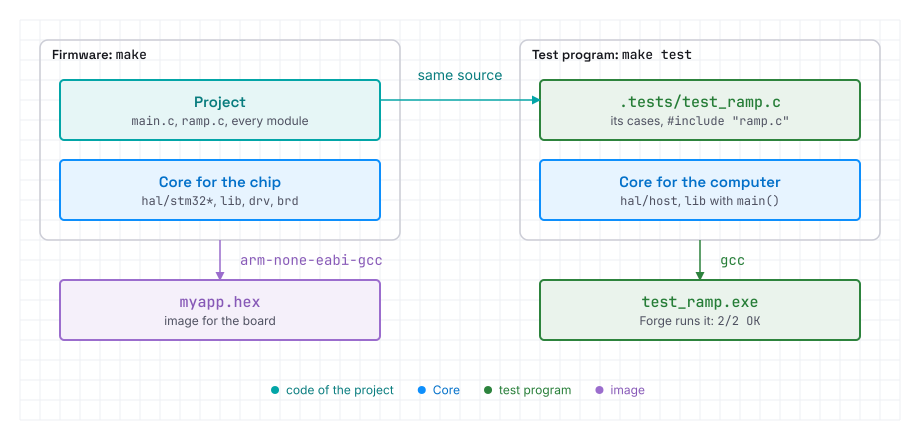
Tests run on the computer, in an STM32 project too, and check the firmware code itself, not a copy of it.
make test builds every program in .tests/ and runs it, and one workflow file does the same on GitHub on every push.
Forge basics are in the readme.
Every .c file directly in .tests/ at the top of a project is one test program, by default test_<module>.c after the module it checks.
.tests/ never lies deeper, so it is plain that it is not part of the firmware.
myapp/
├─ main.c
├─ main.h
├─ ctrl/ramp.c
└─ .tests/
   ├─ test_ramp.c  # test program of module ramp
   ├─ fake/link.c  # fake of module link, not a program
   └─ data/        # fixed inputs and expected values, committed
A test includes the module it checks by name, #include "ramp.c", since modules share one flat namespace, as in firmware.
So it runs the firmware code itself, static functions included.
Only what it includes compiles, so registers elsewhere in the project never stand in the way.
main() comes from the harness, so main.c never enters a test.
No program bears a module's name: quotes look beside the including file first, and .tests/ramp.c would stand in for the module in every test.
The test_ prefix is the simple way out, any name no module has works as well.
// .tests/test_ramp.c

#include "test.h"
#include "ramp.c"

static void ramp_starts_at_zero(void)
{
  RAMP_t ramp = { .target = 100, .step = 30 };
  TEST_Equal(ramp.value, 0, "value before the first step");
}

static void ramp_stops_at_target(void)
{
  RAMP_t ramp = { .target = 100, .step = 30 };
  for(int i = 0; i < 5; i++) RAMP_Step(&ramp);
  TEST_Equal(ramp.value, 100, "no overshoot");
}

void TEST_Cases(void)
{
  TEST(ramp_starts_at_zero);
  TEST(ramp_stops_at_target);
}-
TEST_Cases()lists the cases in run order,TEST(name)each. -
TEST_Check(cond)orTEST_Check(cond, fmt, ...)is a verdict, whileTEST_Equal,TEST_NearandTEST_Bytesshow on a miss the expression as written, its value and the expected one. -
TEST_Logged(text): the firmware logged a line holdingtextsince the case began or since the previousTEST_Logged. -
TEST_Run(ms)makesmssteps of virtual time, each a tick forward and every task due by then.
make test              # every program in `.tests/`
make test T=test_ramp  # only `.tests/test_ramp.c`, with its output
Each program runs in a clean folder of its own and gets a line with its checks passed out of all, and the run ends with a total:
INF test_frame 12/12 OK
INF test_ramp 2/2 OK
INF Test programs 2/2, checks 14/14 in 0.2s OK
A failed program shows below its line its output, as it printed it. A miss names its file and line and the expression with its value, ends its case, and the next case runs:
INF test_frame 12/12 OK
ERR test_ramp 1/2
OK ramp_starts_at_zero
ERR projects/myapp/.tests/test_ramp.c:16 ramp_stops_at_target: no overshoot
  ramp.value is 150, expected 100
ERR Test programs 1/2, checks 13/14 in 0.5s
A run of one program, T= or a project with just one, shows its output even when it passes.
A program that ends early fails, exit(0) of a firmware reset too, and one that hangs is cut after a minute.
make test goes through all programs and fails when any of them did.
A new file in .tests/ needs no reload.
- Waiting moves the clock:
delay()andtimeout()step virtual time, so a test of a timeout takes no time at all.sleep()holds the core, so time passes and no task runs. - A module the tested code calls comes in the same way, or as a fake of the whole module from a folder in
.tests/,#include "fake/link.c", since a fake bears the name of its module. For a fake of part of a Core module the linker would pull the original from the archive and clash with the rest. - Fixed inputs and expected values, such as a recorded frame or a signature made by Forge, lie in
data/and come by its folder too,#include "data/forge.h". They are written by hand or by a script beside them and committed, while a run never writes there: what a program saves stays in its clean folder underbuild/. - A
#definebefore#includemay tune the module it includes, such asLOG_LEVEL. A size or type the rest of Core shares, such asBUFF_MSG_LIMIT, belongs inmain.h, or the test and Core quietly disagree. - Core comes compiled for the test from
hal/hostandlib, and their modules come by name. Headers of the drivers the project selects come by name too, as its board takes them. A module fromplc/,brd/,drv/orhal/stm32*comes by its path from Core root, such as#include "hal/stm32/sys/bld.c". - An STM32 project with tests gets MinGW beside
arm-gcc.
A project repository runs make test and make on every push with one file:
# .github/workflows/test.yml
name: Test
on: [push, pull_request]
jobs:
  test:
    uses: OpenCPLC/Forge/.github/workflows/project.yml@0.5.1
It does what you do in a fresh workspace, for every project in the repository, on Windows with the tools Forge installs.
Each project loads as its main.h sets it up, so one that names no board or chip stays out of this workflow.
Core comes from PRO_FRAMEWORK, as on your computer.
The tag pins the Forge release, so a new Forge never changes the result on its own.
Note
In a private repository runs use the free minutes of your plan, and a Windows minute costs more than a Linux one.
Core tests itself the same way, from .tests/ at its top:
opencplc/develop/.tests/
├─ test_bld.c    # test program of module bld
├─ test_cron.c
├─ data/forge.h  # keys and signature made by Forge, from forge.py
├─ g081/         # project: compile test of STM32G081
├─ g0c1/
├─ wb55/
└─ uno/          # project: PLC layer on the Uno board
A .c file directly in .tests/ is a test program, a folder with main.h is a project, and any other folder helps the tests, such as fake/ and data/.
Core keeps no fakes, since hal/host is its model of the chip: the flash there erases, programs and loses power as the chip does, and a test cuts that power with FLASH_HostCut.
opencplc opencplc/develop              # Core itself
make test                              # its test programs
opencplc opencplc/develop/.tests/g081  # compile test
make                                   # builds it
GitHub runs make in every project of .tests/ and make test of Core on every push and pull request.
A new module or a bug fix comes with the test that checks it, and a new chip or board with its project in .tests/.