Repository navigation
Architecture
flowchart LR
  C[Client / robot] -->|POST /query, /learn/*| API[FastAPI routes]
  API --> P[RAGPipeline]
  P --> R[Retriever: Chroma + BM25 -> RRF -> cross-encoder]
  P --> G[Generator -> llm.complete tier]
  G --> L[(Anthropic / DeepSeek / OpenAI)]
  API -. background task .-> V[NLI verifier] --> D[(SQLite log)]
| Component | Module | Role |
|---|---|---|
| Routes | app/api/routes.py |
HTTP endpoints; schedule background logging |
| Pipeline | app/services/pipeline.py |
Orchestrates preprocess, retrieve, generate |
| Retriever | app/services/retriever.py |
Hybrid retrieval (Retrieval Pipeline) |
| Generator | app/services/generator.py |
Prompts and output handling (Prompts and Lessons) |
| LLM layer | app/services/llm.py |
Provider-agnostic completion by tier (LLM Layer) |
| Verifier | app/core/verifier.py |
Grounding check (Grounding Verification) |
| Logger | app/services/interaction_logger.py |
Verification then database write (Data and Logging) |
| Warm-up | app/services/warmup.py |
Startup model preload |
The project began from this earlier design sketch. It is kept for context and does not match the current implementation.
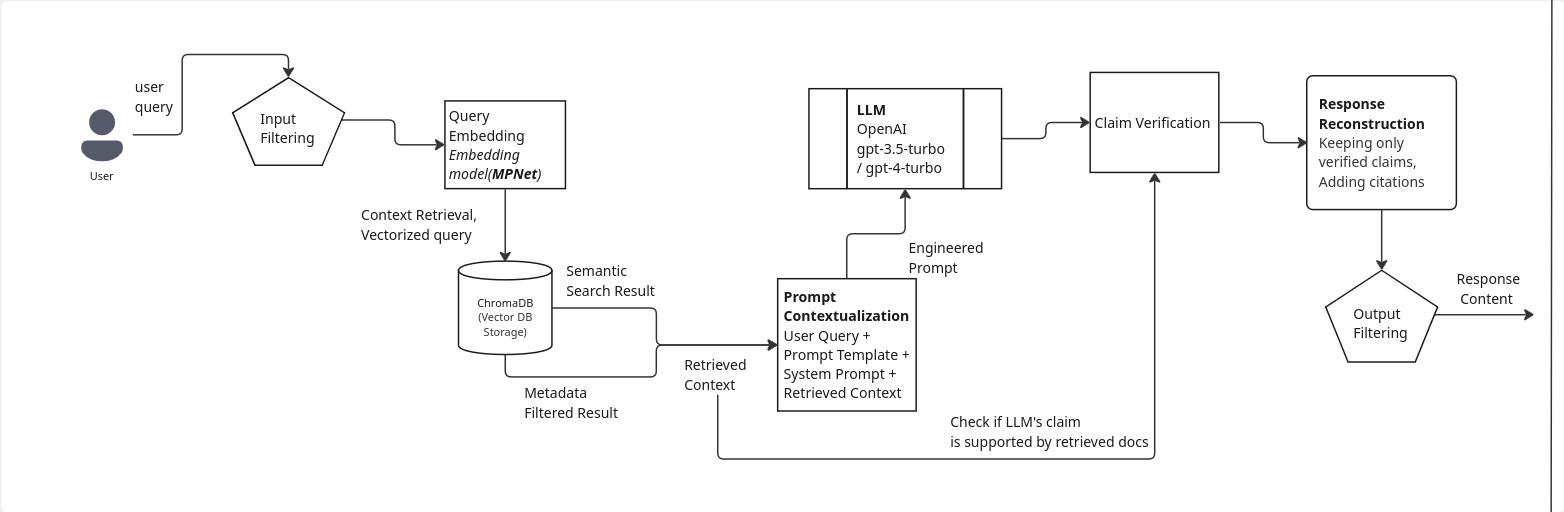
What changed since the sketch:
| In the sketch | In the current code |
|---|---|
| Input filtering | No filtering stage. The query is trimmed and lower-cased, and a small-talk shortcut skips retrieval (API Reference) |
| Semantic search plus a metadata-filtered result | Semantic search and BM25 keyword search, fused with Reciprocal Rank Fusion, then a cross-encoder re-ranker. No metadata filtering (Retrieval Pipeline) |
| OpenAI gpt-3.5-turbo / gpt-4-turbo | Tiered, configurable models from Anthropic, DeepSeek or OpenAI (LLM Layer) |
| Claim verification gates the answer | Verification runs after the response is sent, in the background, and only logs a score (Grounding Verification) |
| Response reconstruction (keep only verified claims, add citations) | Not implemented. The model cites sources itself and the answer is returned as generated |
| Output filtering | Not implemented (Known Issues and Limitations) |
What stayed: MPNet embeddings (all-mpnet-base-v2), ChromaDB as the vector store, and retrieved context placed in the prompt together with a system prompt.
The FastAPI lifespan hook does two things before the server accepts requests:
-
init_db()creates the SQLite tables if missing. - Unless
PRELOAD_MODELS=false,warm_up()runs in a worker thread. It loads the vector store, BM25 index, embedding model, re-ranker and NLI model, and runs one tiny inference through each. A failure is logged and that model loads on first use instead.
- The route calls
RAGPipeline.run_query. - The query is trimmed and lower-cased. If it matches a small-talk trigger, retrieval is skipped and the easy tier answers.
- Otherwise
retrieve()returns the top 3 chunks (in a worker thread, one at a time). -
generate_response()builds the prompt from the chunks and calls the medium tier (in a worker thread). - Citation markers
[n]in the answer are counted. - The route returns the response and schedules a background task.
- The background task runs the NLI verification (in a worker thread, one at a time), then writes the interaction, details and retrieved chunks to SQLite.
/learn/structured and /learn/text follow the same shape without steps 2 and 5, and are logged without verification.
Everything that blocks (language model calls, retrieval, verification) runs in worker threads through asyncio.to_thread, so the event loop stays free to serve other requests and finish database writes.
- Retrieval is serialised by a lock, because it lazily initialises shared models and the BM25 index.
- Verification is serialised by a lock, for the same reason and because it is CPU-heavy.
- SQLite runs in WAL mode with a 30 second busy timeout, so concurrent background writers wait for each other instead of failing.
This design came from a real bug: blocking work on the event loop froze it for tens of seconds, a write transaction in another task could not finish, and the next writer failed with database is locked. The regression tests are in tests/test_concurrency.py (Testing).
- Hand-written pipeline, no orchestration framework. The flow is short and explicit, which keeps it easy to inspect and test.
- Lazy singletons plus startup preload. Models load once per process.
- Verification after the response. Slow NLI scoring never delays the user.
- Tiers instead of model names in code. Callers say how demanding a task is; configuration says which model serves it (LLM Layer).
Authentication, rate limiting, streaming responses, the robot (NAOqi) bridge and a dedicated safety classifier are not implemented (Known Issues and Limitations).