Repository navigation
InflatePaths
Home › clipper.h › InflatePaths
Paths64 InflatePaths(const Paths64& paths, double delta,
 JoinType join_type, EndType end_type,
 double miter_limit = 2.0, double arc_tolerance = 0.0);
PathsD InflatePaths(const PathsD& paths, double delta,
 JoinType join_type, EndType end_type, double miter_limit = 2.0,
 int precision = 2, double arc_tolerance = 0.0);
These functions encapsulate most of the features of ClipperOffset, the class that performs both polygon and open path offsetting. (And it's important to understand the notes pertaining to offsetting too.)
| Parameter | Explanation |
|---|---|
| paths | A Paths64 or PathsD object that is to undergo offsetting. |
| delta | The amount paths are to be offset. |
| joinType | See JoinType. |
| endType | See EndType. |
| miterLimit | See ClipperOffset.MiterLimit. |
| precision | The number of decimal places of precision to consider when paths is type PathsD. (Maximum is 8 decimal places) |
| arcTolerance | See ClipperOffset.ArcTolerance. |
#include "clipper2/clipper.h"
...
using namespace Clipper2Lib;

int main()
{
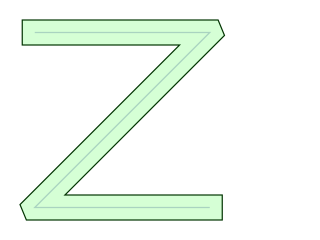
  PathsD polyline, solution;
  polyline.push_back(MakePathD({100,100, 1500,100, 100,1500, 1500,1500}));
  // offset polyline
  solution = InflatePaths(polyline, 200, JoinType::Miter, EndType::Square);

  //draw polyline and inflated solution
}
#include "clipper2/clipper.h"
...
using namespace Clipper2Lib;

int main()
{
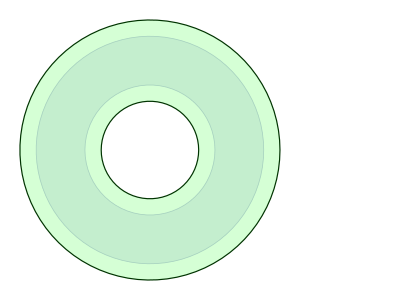
  PathsD polygon, solution;
  // add outer polygon contour
  polygon.push_back(Ellipse(RectD(100, 100, 1500, 1500)));
  // add inner "hole" contour
  PathD p = Ellipse(RectD(400, 400, 1200, 1200));
  std::reverse(p.begin(), p.end());
  polygon.push_back(p);

  // offset polygon
  solution = InflatePaths(polygon, 100, JoinType::Round, EndType::Polygon);

  //draw polygon and inflated solution
}
ClipperOffset, ClipperOffset.ArcTolerance, ClipperOffset.MiterLimit, EndType, JoinType, Paths64, PathsD