Repository navigation
Releases
Frozen Star 0.3.0

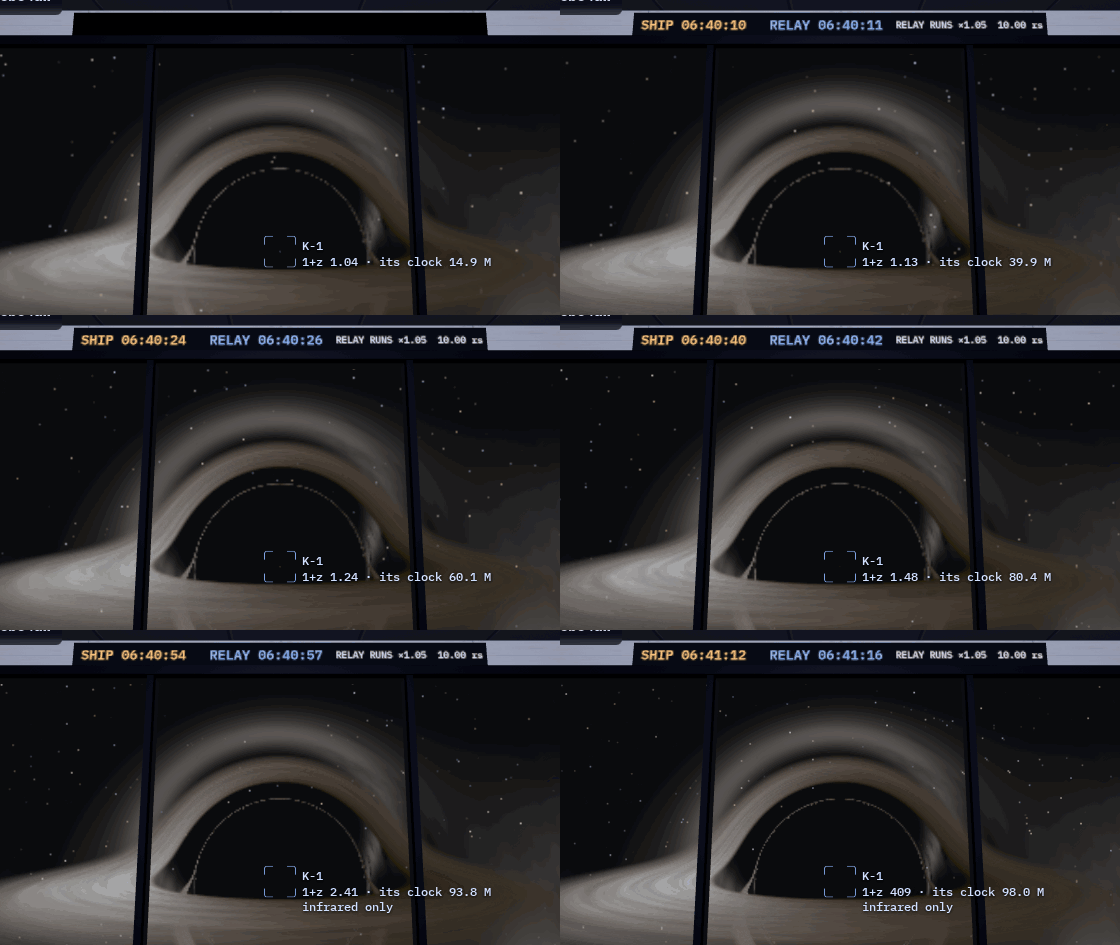
Frozen Star 0.3.0 is a polish release. The ship no longer flashes out of sight, being aboard feels more alive, and the whole game got a pass for touch screens, pacing and robustness.
Download
| Download | How to play |
|---|---|
frozen-star-0.3.0-win-x64.zip |
Windows 10/11 x64. Unzip, then double-click Frozen Star.exe. The app is not signed, so if Windows says it protected your PC, choose "More info", then "Run anyway". |
frozen-star-0.3.0-web.zip |
Any computer. Unzip, serve the folder (python3 -m http.server 8000) and open http://localhost:8000/. |
| No download | In the browser: https://frozen-star.play.danielstephenson.dev |
Saves and settings from 0.1.0 and 0.2.0 carry over.
What's new
- The ship stays on screen. On some PCs the ship's interior flashed away for a single frame, leaving only the black hole. The cause was the automatic resolution change: it resized the ship's layer just after drawing it, and a resized layer is blank until it is drawn again. Resizes now happen before the draw, and the resolution no longer swings back and forth.
- Feel aboard. Footsteps follow your stride, with a gentle head bob (it can be turned off in Settings, and is off with reduced motion). The ship's hum ducks under dialogue, the hull creaks as you go deeper, and doors and consoles answer with small sounds.
- Interior art. Sealed hatches look like closed doors from every angle, the quarters have a padded headboard and shelf, and the consoles, racks, benches and cable trays are textured.
- Touch screens. Thumb-sized buttons, consoles as a full-height side panel in landscape, a resting joystick, and photo mode by touch. Screen readers get proper labels for the menu, objectives and choices.
- Smoother story. Objectives tick off the moment things happen; Ines's question and the Postscript prediction come up without stepping back from the console; a failed rescue is marked "Too late"; the helm has one-press ×2, ×4 and 1.5 rₛ buttons; the spacetime map keeps finished falls in view and its labels no longer overlap.
- Sturdier. Short key taps count even at low frame rates, the page no longer freezes while the ship's shaders compile, an error shows a small notice instead of stopping the game, and damaged saves or settings fall back safely.
- Physics wording. The Orpheus feed now says why its frames stop: the next one was due from inside the horizon, and nothing sent from there gets out.
The full list is in CHANGELOG.md, and the AI playtest evidence in docs/playtests/0.3.0.
Voices: Kokoro-82M (Apache-2.0), see docs/THIRD-PARTY.md. Frozen Star is MIT-licensed.
drafted by Claude on behalf of Daniel Stephenson
Frozen Star 0.2.0
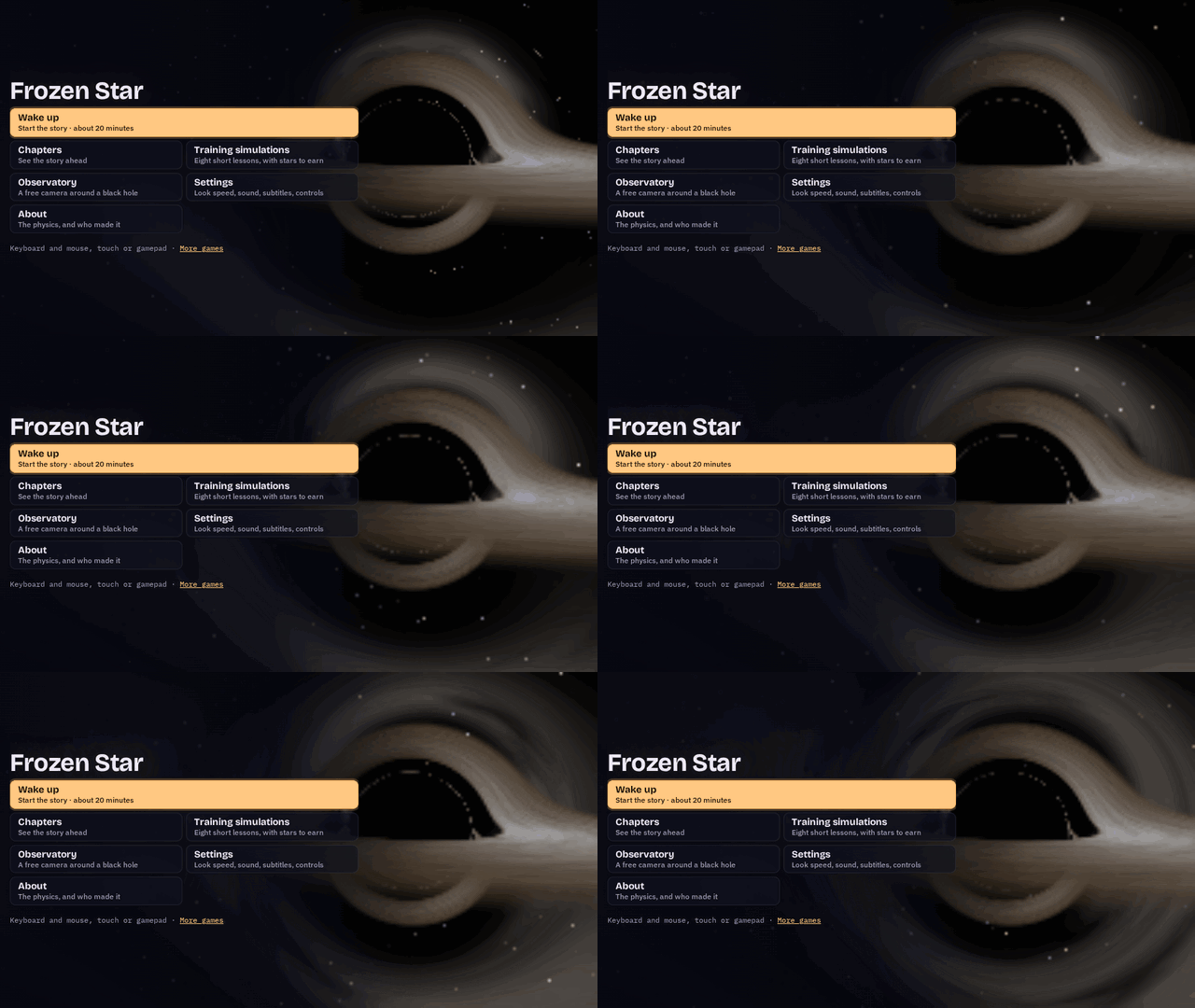
Frozen Star 0.2.0 gives the crew voices, adds a new chapter about light that goes round in circles, and puts Ines where you can see her.
Download
| Download | How to play |
|---|---|
frozen-star-0.2.0-win-x64.zip |
Windows 10/11 x64. Unzip, then double-click Frozen Star.exe. The app is not signed, so if Windows says it protected your PC, choose "More info", then "Run anyway". |
frozen-star-0.2.0-web.zip |
Any computer. Unzip, serve the folder (python3 -m http.server 8000) and open http://localhost:8000/. |
| No download | In the browser: https://frozen-star.play.danielstephenson.dev |
Saves and settings from 0.1.0 carry over.
What's new
- Voices. Ines, the pilot, is voiced by Kokoro-82M's Sky voice. Over the radio during the rescue her voice slows and deepens by exactly her redshift factor 1+z, the same stretch her light gets, until her last words arrive as a slow growl under static. WREN, the ship's AI, speaks in Kokoro's George voice over a clean ship PA, and the two take turns.
- Postscript · The photon sphere. After the story, take the Tern down to 1.5 rₛ and fire a laser along the hull. The pulse circles the hole and comes back 11 seconds later, so you could see the back of your own head. A pulse fired one metre higher drifts off and escapes to the stars: the orbit is a knife edge.
- A capsule bay. Ines is there in her flight suit doing pre-flight, the capsule launches past the bridge window with its running lights, and it docks again after the rescue.
- Discoveries and photo mode. Twenty discoveries, each with a physics fact; press P to freeze time, hide the HUD and save a full-resolution picture.
- Controls and accessibility. Rebind every key and gamepad button; reduce flashing, subtitle background, console text size, hold or toggle run, and colour-safe redshift.
- A smoother ring. The thin photon ring around the shadow is now a continuous line on modest GPUs, and the sky's resolution climbs where the frame rate allows.
- Her climb home. After the rescue, once the light of her engine burn reaches you, you see the capsule climb back out, its light losing its redshift as it comes.
- Many fixes from four more rounds of AI playtesting: the full list is in CHANGELOG.md, and the evidence in docs/playtests/0.2.0.
Voices: Kokoro-82M (Apache-2.0), see docs/THIRD-PARTY.md. Frozen Star is MIT-licensed.
drafted by Claude on behalf of Daniel Stephenson
Frozen Star 0.1.0
Frozen Star is a first-person game about general relativity. You wake aboard the research ship Tern, holding station 10 Schwarzschild radii above Erebus, a black hole of 120,000 suns, and find out whether things really fall in. From far away, nothing ever seems to. On its own clock, it falls straight through. Everything outside the windows is a real light-ray trace through curved spacetime, running at its true speed.
This is the first release.
Download
| Download | How to play |
|---|---|
frozen-star-0.1.0-win-x64.zip |
Windows 10/11 x64. Unzip, then double-click Frozen Star.exe. The app is not signed, so if Windows says it protected your PC, choose "More info", then "Run anyway". |
frozen-star-0.1.0-web.zip |
Any computer. Unzip, serve the folder (python3 -m http.server 8000) and open http://localhost:8000/. |
| No download | In the browser: https://frozen-star.play.danielstephenson.dev |
The game needs WebGL 2. Add --lowgpu (desktop) or ?lowgpu (browser) on slow graphics. Each zip has a .sha256 file; check it with sha256sum -c <file>.sha256.
The story
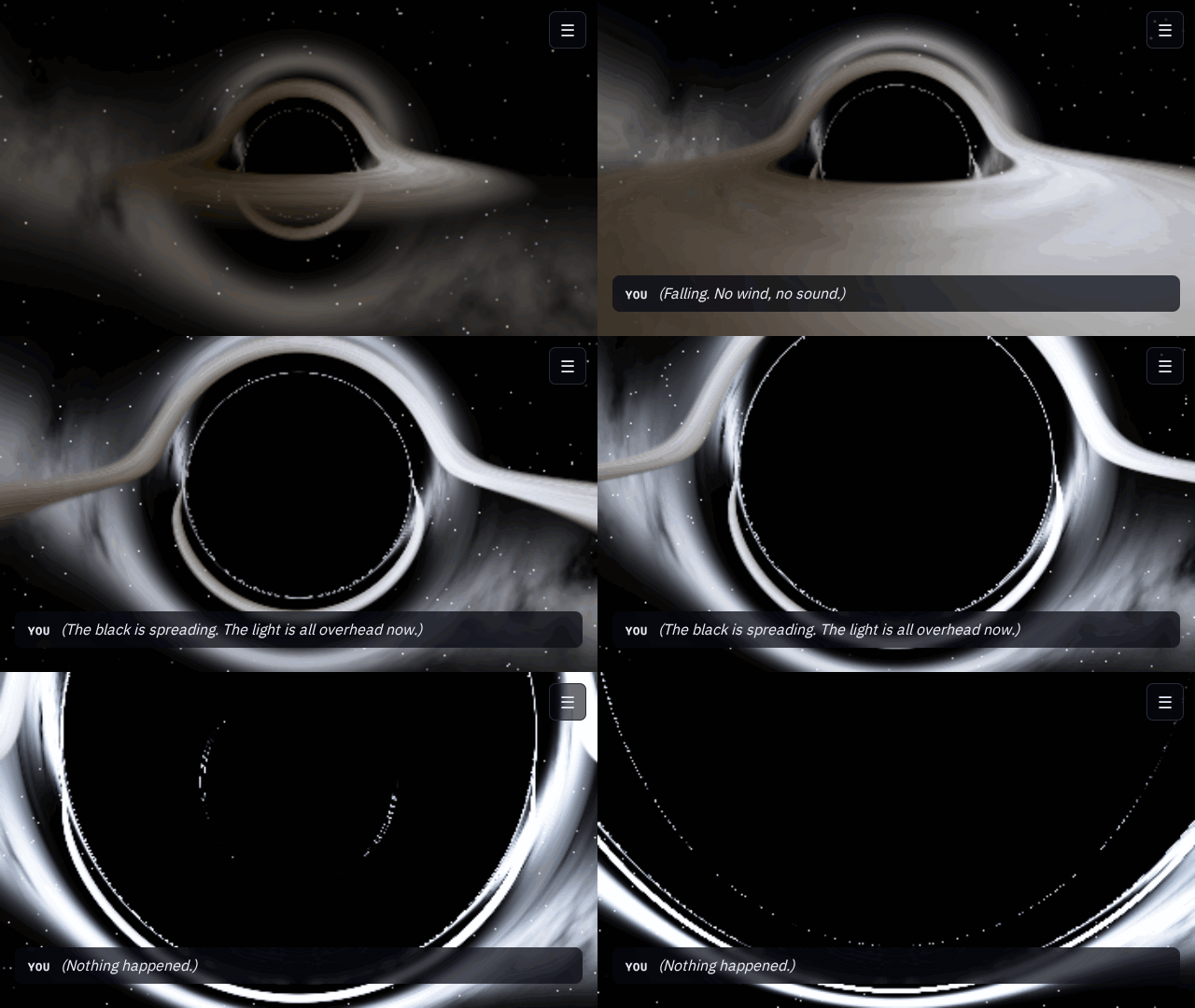
Prologue: a dream. You fall through the horizon, ray-traced as the one falling sees it, and nothing happens.
I · Beacon K-1. You drop a probe and watch its light freeze at the edge of the shadow, while its beacon's pitch slides down on the speakers.
II · The rescue. Ines's capsule drifts in. Her messages arrive slower, redder and deeper. You have to fire the recall beam in time, remembering that the picture on your screen is old light.
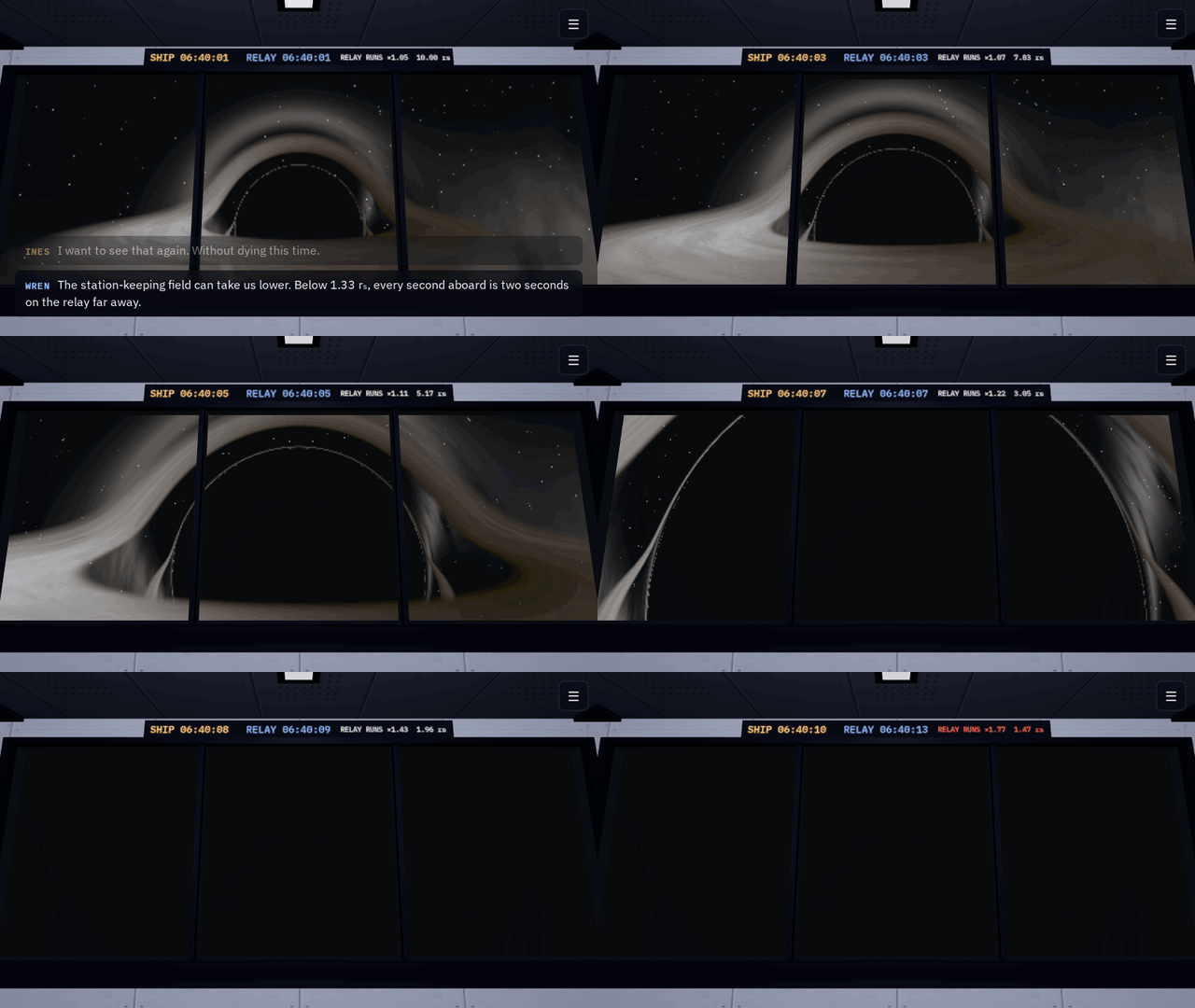
III · The descent. You take the ship down at the helm until far-away clocks run twice as fast as yours, and you hear both clocks tick.
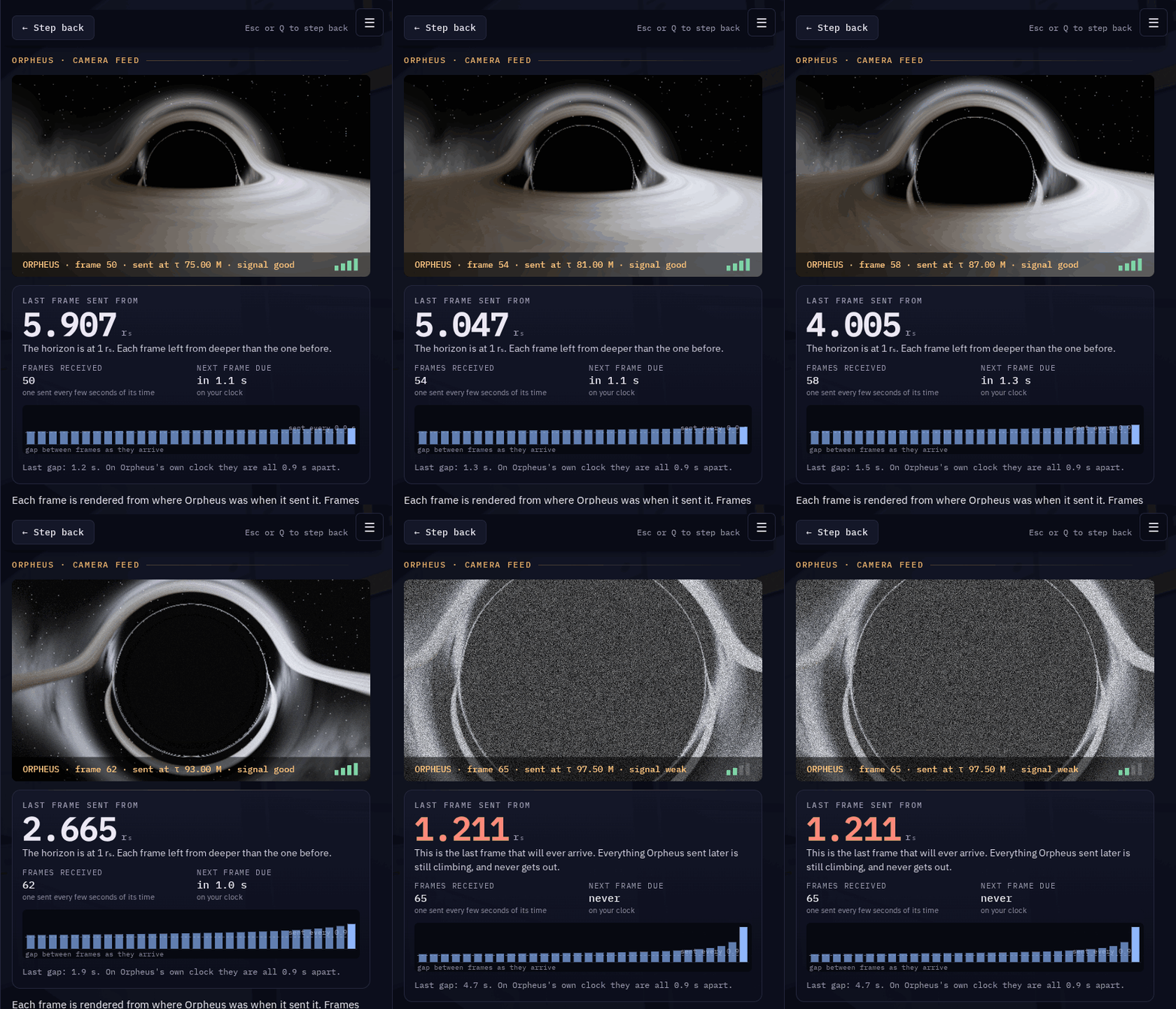
IV · Orpheus. A camera probe's frames arrive further and further apart, until the last one that will ever arrive.
Epilogue. A logbook sets what you saw against what happened, using your own numbers. Then the Tern is yours to explore.
Eight lessons and an observatory
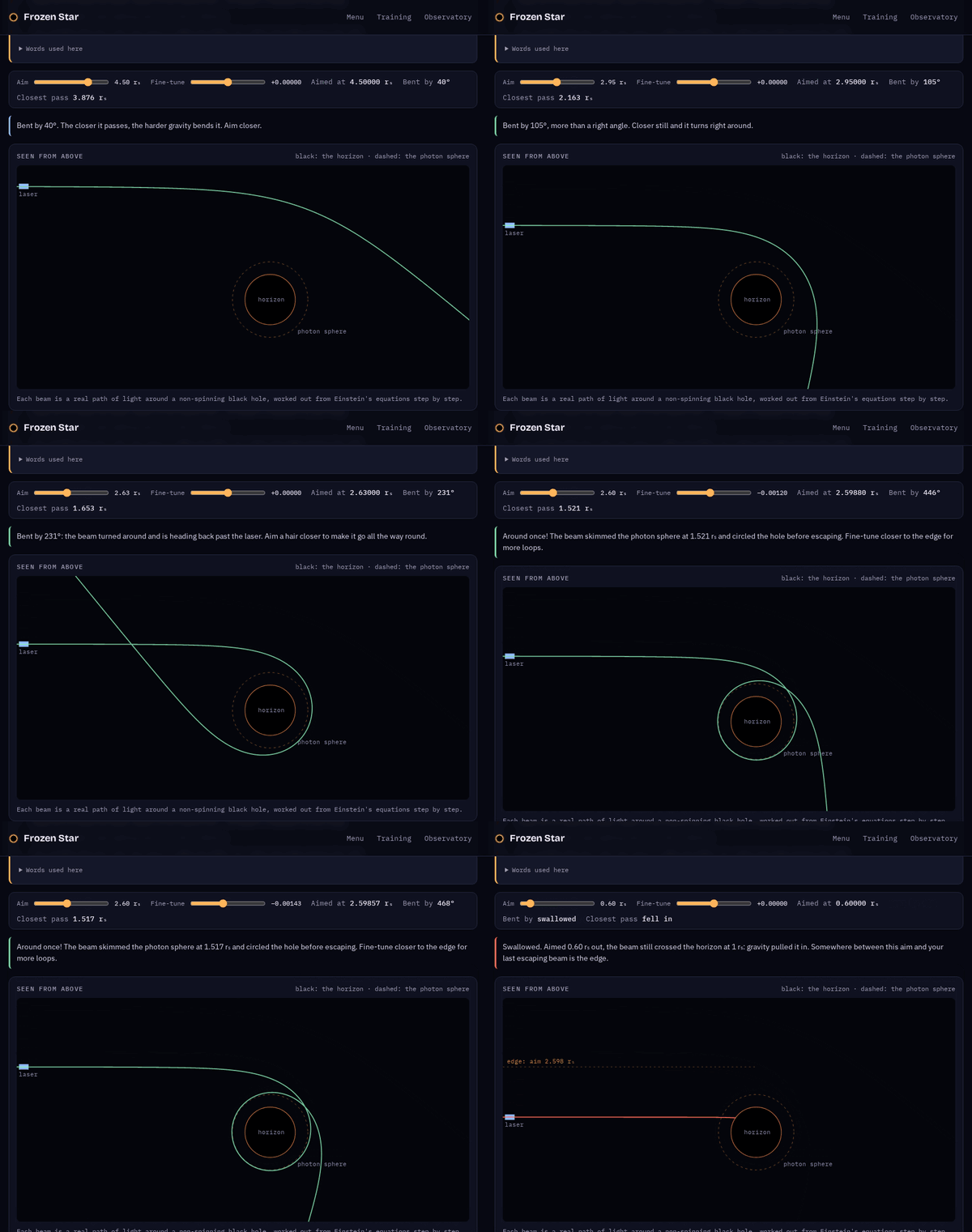
Two Clocks, Last Words, The Rescue, Pick Your Hole, Hover, Bend the Light, Into the Dark and Evaporation are short lessons with stars to earn, and every quiz answer explains itself. The Observatory is a free camera around a black hole.
The physics is real
The game uses exact Schwarzschild geometry and traces a light ray per pixel in Painlevé–Gullstrand coordinates, so the camera works inside the horizon too. The colours are true Doppler and gravitational shifts, and the formulas are covered by unit tests. See docs/PHYSICS.md.
Also in 0.1.0
- Menus with Continue, Chapters and Settings, and support for keyboard and mouse, touch and gamepads; on phones, panels open as a bottom sheet.
- Procedural sound: every room sounds different, the descent can be heard, and the radio reddens.
- Four rounds of AI playtesting, with their fixes; the evidence is in docs/playtests/0.1.0.
The full list is in CHANGELOG.md. Frozen Star is MIT-licensed.
drafted by Claude on behalf of Daniel Stephenson