Repository navigation
Home
Two or more local LLMs talk to each other about a topic you choose, while you watch and can cut in. The models run on your Mac, and nothing is sent to a cloud service unless you point a seat at one.
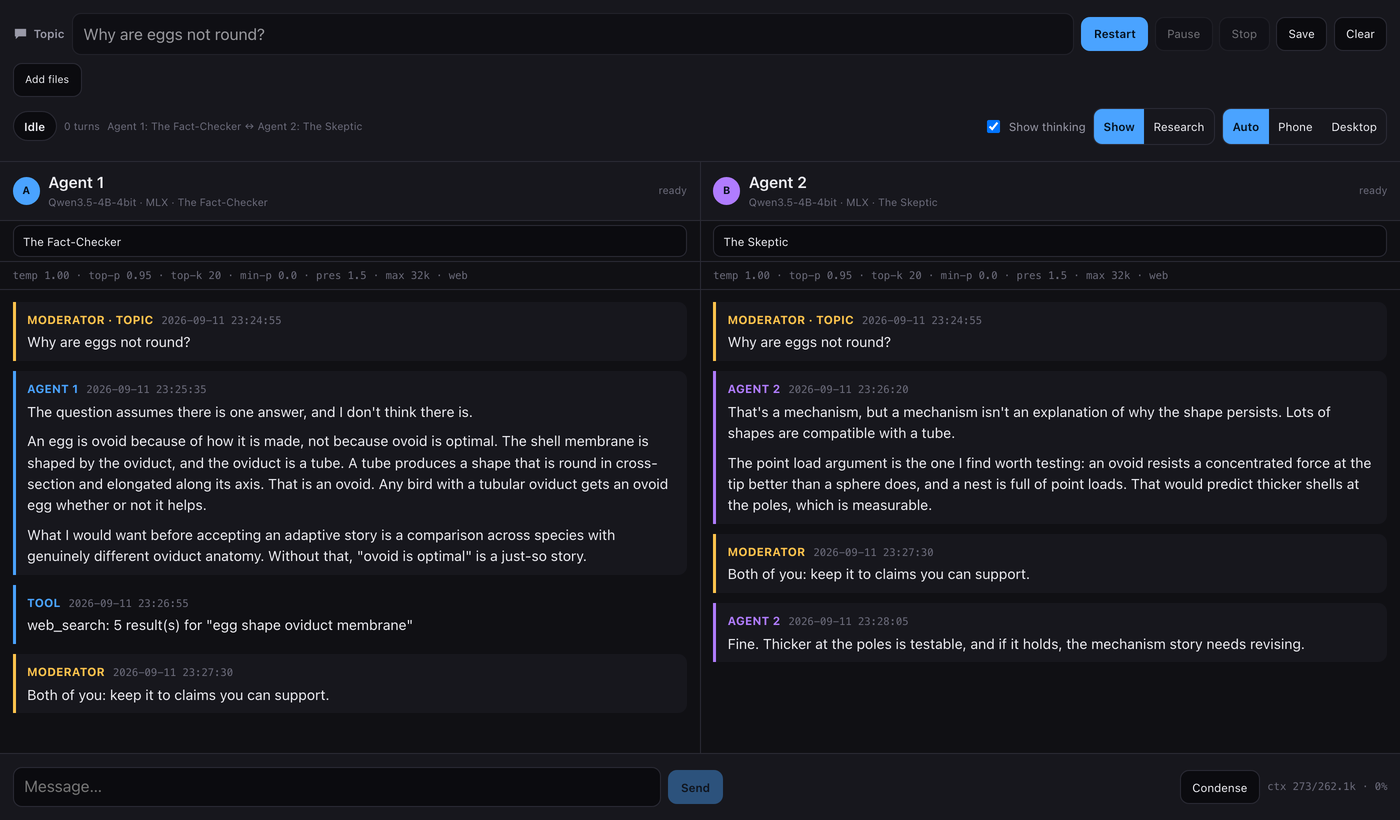
The idea is simple: you give the models a question, they take turns answering each other, and you read what happens. Each model sees everything that has been said — including what the other one wrote — so the conversation develops instead of restarting every message.
I just want to get it running → Installing
It is installed, how do I use it? → Using the desktop app · Using the website
I want the models to argue entertainingly → Personas — 36 characters, from the Alpha to the Grudge Holder
I want an answer to a real question, with evidence → Running a research session
I do not want to run a model on this Mac → Using cloud models — point a seat at DeepSeek or at LM Studio
I want to run a different (or uncensored) model → Choosing models — the checkpoints offered, and how to use any repository id
I want to get back a conversation from yesterday, or send one to somebody → Keeping and sharing
I do not want to think up a topic and a cast → Line-ups and scenarios
I want to cut in, name myself, or score the argument → Taking part
Something is broken → Troubleshooting
How does it actually work? → How it works
What is still broken, or not finished? → What is left to do — the accepted limits, and the one decision waiting
Give strong personalities a topic and let them go. There is no correct answer to reach and no end condition — the point is what happens between them.
"Why are eggs not round?" — the Fact-Checker demands a source, the Skeptic doubts the premise, the Conspiracy Theorist sees a pattern behind it.
Characters remember what happened earlier in the conversation: a grudge persists, an alliance forms when two of them agree, and someone who keeps getting challenged without ever conceding loses the room's respect.
Specialists look at a question from genuinely different methods and produce a report.
"Should Company X enter the German EV market?" — the Economist follows the incentives, the Investor asks what the downside is, the Statistician objects to the words "growing market", and the Fact Checker finds that the growth figure is two years old.
The Moderator runs the investigation rather than only writing it up: as it goes, it assigns the next piece of work — "nothing so far has addressed the economics", "that claim has no evidence attached" — to whichever analyst's method fits it. See Running a research session.
The session stops when its budget runs out or when the analysts stop adding anything new,
and the Moderator writes it up with every claim labelled FACT, SOURCED, INFERENCE,
ASSUMPTION, OPINION or SCENARIO. Only the first two can be relied on without checking,
and the report says so.
One thing first: Xcode 27 does not ship the Metal compiler, and the build needs it. Install that
component once — xcodebuild -downloadComponent MetalToolchain — then:
git clone https://github.com/Pummelchen/ChatBots.git
cd ChatBots
bash tools/install.sh     # downloads the models, builds everything, checks it runs
Then pick a way to run it:
bash tools/start-app.sh           # the macOS app
bash tools/start-web-desktop.sh   # the website, desktop layout
bash tools/start-web-mobile.sh    # the website, phone layout
You can run all three. They are windows onto the same conversation engine, not three separate apps — start something in the app and it appears in the browser.
The two start-web-* scripts listen on every network interface, so a phone on the same Wi-Fi
can open the website — and so can anyone else on that network, because the API has no password.
Add --local-only to keep it on this Mac. The macOS app itself never faces the network.
| Mac | Apple silicon (M1–M6). Intel Macs cannot run the models |
| macOS | 26 or newer — the desktop app reaches the engine over WebTransport, which needs it |
| Xcode | 27, only to install the Metal compiler component: xcodebuild -downloadComponent MetalToolchain
|
| Disk | about 8 GB free — the models are roughly 3 GB and the build needs room |
| Memory | 16 GB is comfortable; 8 GB works with one model loaded |
The one thing to do by hand is the Metal component. Xcode 27 does not ship the Metal compiler, and
without it every build stops on the first GPU kernel — the Command Line Tools alone cannot install
it. Run xcodebuild -downloadComponent MetalToolchain once, then bash tools/install.sh does the
rest. See Installing.
Worth knowing before you start, so nothing is a surprise:
- Two models at once is the tested configuration. Four seats work and have been watched end to end, but a four-way conversation runs slowly on one GPU and two is what most machines should use.
- Conversations are kept. Every conversation is written to disk as it runs and can be reopened from either front end, exported as text, or served as a read-only link with replay controls. The link is local to the machine running the engine — there is no upload and no hosting. See Keeping and sharing.
-
The website is reachable from your network. The
start-web-*scripts listen on every interface so a phone can use the interface, and the API has no password: anyone on the same Wi-Fi can read every kept conversation, start and steer runs, change the topic and the seats, upload documents and open share links.--local-onlybinds it to this Mac instead; the engine and the desktop app themselves never face the network. See Using the website. - A report names whoever found each claim, and says when it cannot. Claims with no analyst behind them are counted and flagged rather than dropped, and a claim attributed to somebody who was not in the room is named as such. See Running a research session.
- The moderator's judgement is structural, not editorial. It decides what is unanswered, unsourced or contradicted. It does not judge whether an argument is persuasive, so criticism phrased in an analyst's own words reads as coverage rather than as a disagreement.
- The directing moderator has not been watched with real models yet. It is driven through the engine by tests, and its decisions are read from transcripts in prose, but a live four-analyst research run with it in the loop is still something to sit through. Treat the first one you run as the experiment it is.
- Images need a model that can see. The local Qwen checkpoint can, and DeepSeek's flash tier can. Others may not, and one that cannot will say so rather than bluff.
- Web search only works on local models. An API-backed seat has no tools, because the search runs inside this app.
More detail on each of these at the end of How it works.