Repository navigation
Flow Examples
- Play an announcement
- Play a sound before speech
- Translate a message
- Search YouTube
- Combine translation and speech
Before you start: add a cloud speech device, set the JSON and default voice, and add a speaker in Homey with a card that plays an audio URL. Ensure the speaker can reach Homey on port 47333 and supports MP3. Card names for the speaker depend on its app.
- Create a Flow with When → Text-to-Speech → Url triggered.
- In Then, select your speaker's play-URL card. Insert this trigger's Url token into the speaker's URL argument. Save and enable this Flow.
- In a second Flow, choose any test trigger, then Text-to-Speech → Start TTS, with Text:
Dinner is ready.
- Run the second Flow. The first Flow receives Url, Text and Duration and asks the player to play the URL. You should hear the sentence. Duration is milliseconds, not a playback acknowledgment. If it fails, follow Troubleshooting.
Alternatively, in Advanced Flow choose the token-returning voice/speed/pitch action and connect its Url output to the player's URL argument. Do not also enable the trigger route for the same player, or it may play twice. For Non-Cloud, use its own Url triggered card and Start TTS, keeping text under 200 characters.
This pattern is based on the app author's announcement tutorial; speaker card names and interfaces can differ today. Edgar's community example routes announcements by room using separate sensors and variables; Google Services itself does not detect a person's room.
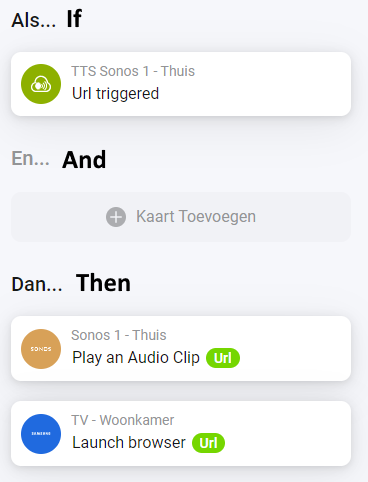
Historical screenshot by the app author from the Google Services topic: notice the green Url token passed to both outputs. Names, cards and layout may differ in current Homey; use the steps above for your own player.
If your Homey supports its built-in speaker, Music Url Converter's setup explains its requirements. In the receiving Flow, connect the speech trigger's Url token to Music Url Converter's Play URL action, URL field. See its audio URL example and format limits. Test with short MP3 speech; the converter's action completion is not proof that all audio finished playing.
You can play a short chime before an announcement, then space out spoken messages. The author's announcement tutorial shows the idea, and the Advanced Triggers discussion shows a historical sequential example. These are ideas to adapt, not a built-in Google Services queue.
Before you start: make the announcement route work. Add a Universal Media Player device connected to a UPnP server, and put a short audio file on that server. For this test use your own two-second file, for example chime.mp3, and a speaker that can play its URL.
- In an Advanced Flow add Universal Media Player's Play a UPnP file action with output tokens. Select your
chime.mp3in File and leave Finish off. - Connect its successful output to your speaker's play-URL action, putting the action's Url token in the speaker's URL field. Universal Media Player returns Url, Duration and Name; it does not play the sound itself. The current Universal Media Player URL-trigger filter can fail to match, so use these direct action outputs rather than its trigger.
- After the speaker action, add a four-second delay before Google Services' Start saying Text and finish condition. Set Text to
Dinner is ready.The separate Google Url triggered Flow from the first test delivers the speech to the same speaker. - Run the Flow. You should hear the two-second chime, then the sentence. If the chime is clipped or speech overlaps, allow more time for your speaker to start and play it.
Four seconds is a test value, not playback feedback. The first action finishing means that a URL was returned, not that the speaker played it. For accurate ordering, prefer completion feedback from your actual player if it provides it. A known file duration plus a conservative delay is only an estimate; check the returned Duration and your player's startup time.
To try two spoken sentences, connect the successful output of one Google Start saying Text and finish condition to another with Text Please come to the table. Each condition starts the Google URL route and waits for the generated duration plus the device delay; it does not check the speaker. Test the spacing and adjust the device delay as needed. The separate Finished trigger has a filter limitation, so don't use it as proof of playback. Another speech request on the same Google device can replace the pending timer; independent Flows are not automatically queued. If you need a shared queue, arrange and test that separately.
The historical forum example uses a Universal Media Player waiting condition before speech. Its trigger-based route has the filter limitation above, so first use the direct-output test instead; don't assume that historical condition will route your chime or report real speaker completion.
Before you start: configure Cloud Translation JSON and project, and add Google Translate.
- In an Advanced Flow add the token-returning Translate action. Enter Text
Hello, select Source Language English (en) and Target Language Dutch (nl) from the suggestions. - Connect its Translation output to a notification's text argument.
- Test: the notification should contain a Dutch translation, typically “Hallo”. Wording is controlled by Google and can vary. If suggestions are empty, check the project, API and billing.
Before you start: enable YouTube Data API v3, save your key and add YouTube.
- Add the token-returning Search within YouTube action to an Advanced Flow. Enter Text
Homey smart home. - Connect YouTube link to a notification's text argument; optionally connect YouTube ID and Searched text too.
- Run it. The notification should contain a link to the first matching video; results vary. Handle the error branch for no result, invalid key or quota exhaustion. The action also fires YouTube triggered.
Configure both cloud services and the announcement route above. In Advanced Flow connect the token-returning Translate action's Translation output to the cloud Start TTS action's Text input. Select English → Dutch and input Hello; select a Dutch default voice in app settings or a Dutch voice on the speech card. Run the Flow. The player should speak the returned Dutch text. Connect an error branch or notification for translation and speech failures; do not pass an error message as speech.
Speech actions and cloud speech conditions decode Better Logic Library expressions in Text. Translation actions also decode their text; the Translate condition and YouTube search currently pass their input directly. See BLL coding for supported fields, syntax, a first test and troubleshooting; do not put secrets in expressions.