Repository navigation

Replies: 7 comments 2 replies

|
i got my first one 😁 |
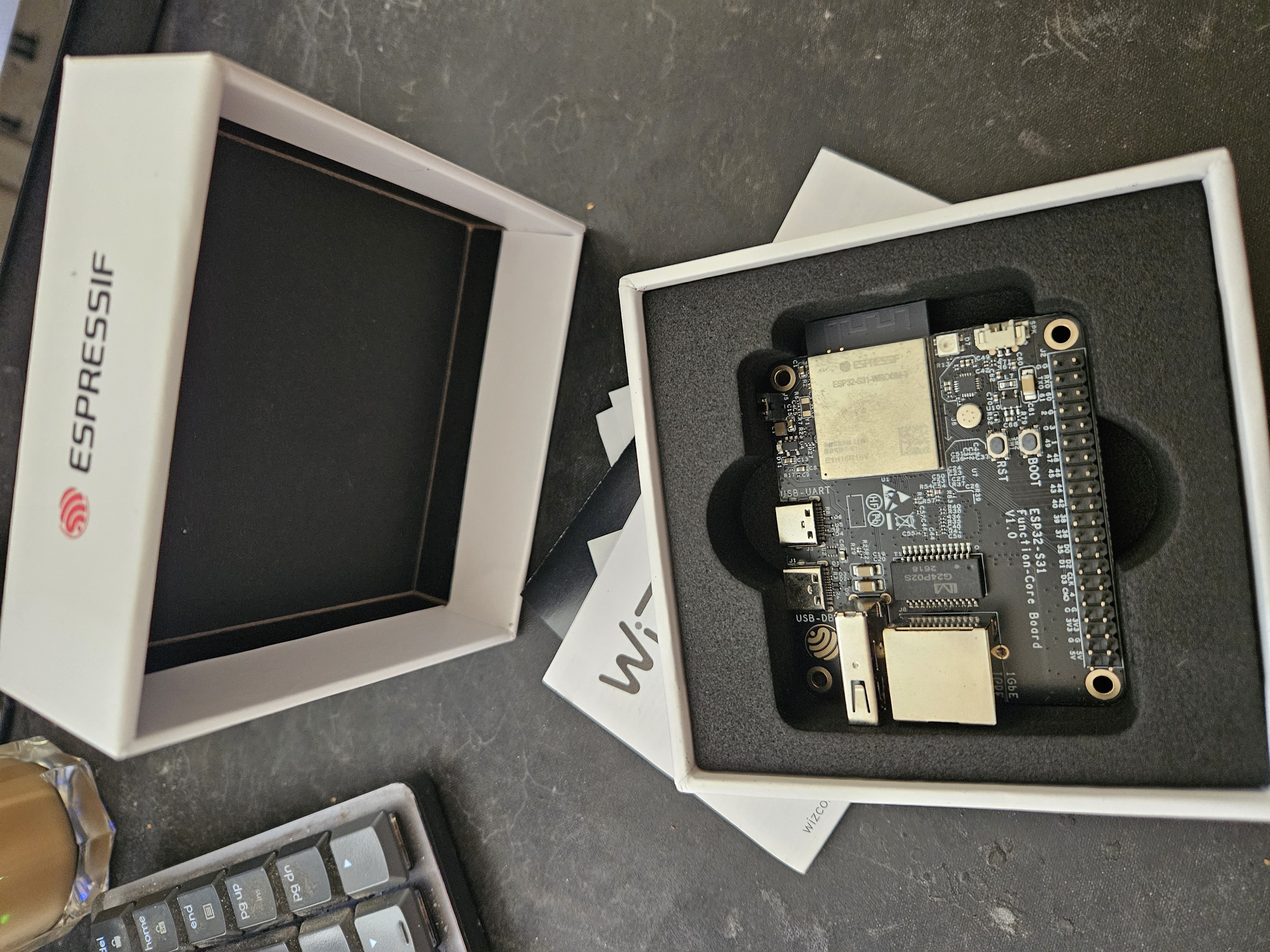

I think the S31 has great potential, and I'm very much looking forward to see products with it. |

@RealDeco if and when you get it working with ESPHome, do you maybe also have a USB USC 2.0 compatible DAC and/or a USB UAC 2.0 speaker/headphone you could try with the USB UAC Audio Support esphome/esphome#11728 pull request? Being able to use as a Sendspin receiver for any USB Audio Device would add another option/choice, and if that could also be fully compatible with USB UAC 2.0 instead of only USB UAC 1.0 would be awesome. |
|
im currently in the stage where opening the fancy box it was shippied in, looking at the board and closing the box again gives me plenty of pleasure, highly impressed with the quality packaging 😅 but yes it looks very promising |
|
@RealDeco Any updates on ESP32-S31? For reference, it has been very exciting just reading that upcoming ESPHome 2026.11 version will get initial USB Audio Class (UAC) host support and that developers recently also begun making progress in Bluetooth A2DP Output and Sink A2DP components for ESPHome. Check out these links and discussions for more informaiton: |

|
i haven't keep updated on the S31 front so my dev board is still in it's box 😅, plenty of things to do with the S3 devices now with duplex, source, wled, upcoming color role and visualizer.. but thanks for the links i will check ithem out 👍 regarding the S31 i did think of getting, no wait i actually ordered the espressifs mosaico, that might be a more insteresting device to get me going on the S31 😁 |

|
By the way, Thread Border Router + Zigbee Coordinator roles are also being worked on as well so is only a matter of time before supported in ESPHome (which needs a IEEE 802.15.4 radio like example ESP32-S31 and ESP32-C6 has): Alternativly if they add ESP32 hosted support for using such ESP32 modules as communication co-processors: |
|
Another btw, what do you think about the concept of combining a ESP32-P4 and a ESP32-S31 as a combo on the same core board? That is, use the ESP32-P4 as the main processor and use that in combination as ESP32-S31 as communcation co-processor in a ESP32 Hosted (ESP-Hosted-MCU) is a solution to off-load some processes -> https://esphome.io/components/esp32_hosted/ In theory it could allow FLAC and OPUS decoding and encoding of higher bit rate / bit deepth up, (Sendspin support up to 384kHz/32 bit), which is at least where the slower performace of an ESP32-S3 is a bottleneck today (and as such ESPHome hardcode it to 16/24-bit). Also , you might be interested this Audio DSP System project with software on a board with multiple ESP32 to off-load DSP processing: In summery he is basically using four ESP32-S3 on the same board and split up the audio DSP processing/tasks between those 4 chips. Quote from readme below: ESP32-S3 Audio DSP SystemThis project is a multi-channel audio system based on ESP32-S3 and ProtoDAC x8 with TDA1387, using DIR9001 as an SPDIF receiver. The system enables flexible audio signal processing, including IIR equalization and FIR crossover filtering, before sending the signal to the DACs. The architecture consists of a central ESP32-S3 that processes the full-range signal and distributes it to three additional ESP32-S3 modules, each applying FIR filtering (crossover) for low, mid, and high frequencies. Features
System OverviewESP32-S3 Assignments
Software Configuration (menuconfig)Select Device Role (U1, U2, U3, U4)
DSP Processing Options
Save & CompileHardware Details
Installation & CompilationClone the ProjectClone the project into the esp-idf examples directory Configure the Project
Compile & FlashFuture Improvements
Important Notes
|
|
Follow-up to related post here -> #97 Not sure if you all heard this yet but in very interesting news related to that you should now be made aware that the upcoming next ESPHome firmware (already in 2026.11.0 Beta) will have added support for a new USB Audio Speaker ( So that means it should be possible to connect a USB DAC that support to something like example the new Home Assistant Connect AUX-2 (device based on ESP32-S3) and flash a different configued ESPHome firmware which have USB Audio enabled. However you would then also have to add DSD support to the Sendspin client (which uses sendspin-cpp on ESPHome). Note as well that believe it is only the newer ESP32-S31 and ESP32-P4 (which bothsupporting high-speed 480 Mbps USB OTG) that support USB Audio Class 2.0 (UAC 2.0) which have higher bandwidth than UAC 1.0 (hence there the Home Assistant Connect AUX-2 is not based on that newer ESP32-S31) . So while ESP32-S31, ESP32-S3, and ESP32-P4 all support support USB Audio Class (UAC) it is only ESP32-S31 and ESP32-P4 that support high-speed needed for USB Audio Class 2.0 (UAC 2.0) DACs. There for it would be better to look at using a ESP32-S31 or ESP32-P4 development board with a USB OTG port if interested in testing it. Ex: FYI, "ESP32-S31-Function-CoreBoard-1" (official development board from Espressif) at least looks to be available from third-party resellers: It also features an GPIO pin header (similar to the standard Raspberry Pi layout) so looks like it could be a nice board for prototyping(?): 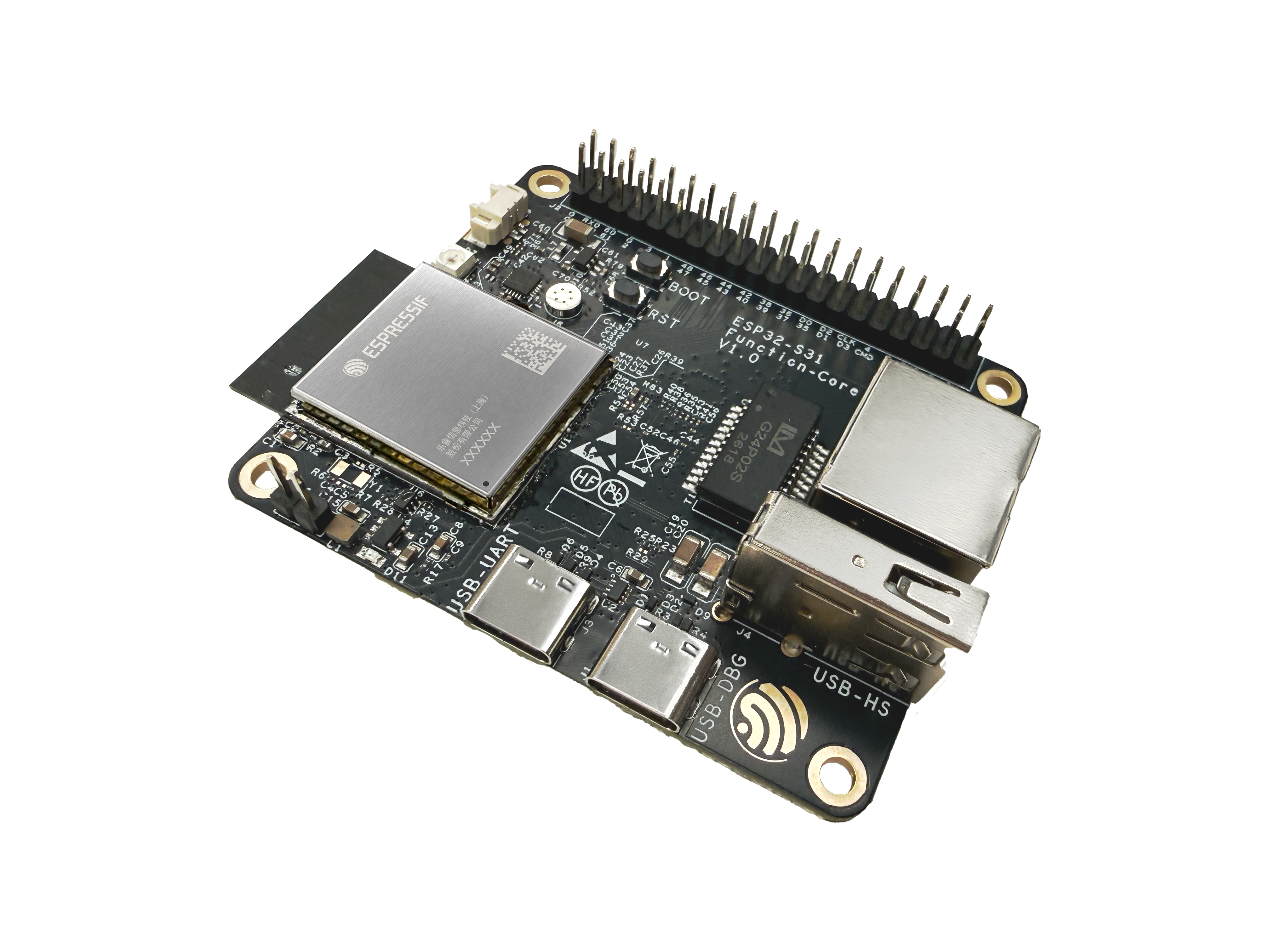
Would also be cool if could combine such a setup a DIY soundcard made with Raspberry Pi Pico with DSPi firmware as USB sound card: DSPi firmware project also has optional support to use PCM1808 ADC module on Pico 2 (I2S Input) for analogue line-in level input as well: Personally l am also looking forward to being able to test connecting inexpensive USB UAC hardware like interface adapters from Behringer which feature both audio output and line-level audio input:
|


Uh oh!
There was an error while loading. Please reload this page.
Uh oh!
There was an error while loading. Please reload this page.
ESP32-S31 (new MCU SoC from Espressif) was just now made availalable (so not yet support in ESPHome, however), looking at specifications for it makes me wonder if this could be a perfect fit as the base for future Sendspin Audio Receiver / Client hardware. What do you all think?
This new ESP32-S31 can be seen as a RISC-V based successor to the ESP32-S3. It features a fast dual-core RISC-V processor with built-in DSP (Digital Signal Processing) instructions so it can technically be capable of running on-device inline audio processing in real-time / low-latency.
In summery when comparing ESP32-S31 to the ESP32-S3, unlike the XTensa architecture of the ESP32-S3, the new ESP32-S31 features a high-performance dual-core 32-bit RISC-V processor running at maximum of 320 MHz (compared to the the ESP32-S3's 240 MHz). ESP32-S31 also features much higher memory bandwidth with high-speed 250 MHz 8-bit DDR PSRAM (which give it a relativly massive speed boost compared to the standard Octal PSRAM in the ESP32-S3) . The high-performance core in the ESP32-S31 features a 128-bit wide data path with SIMD (Single Instruction, Multiple Data) and FPU extensions, which means it has hardware-level vector acceleration provides the math heavy-lifting to handle complex compute directly on-chip, (like example running DSP audio post-processing algorithms onboard, a Bluetooth Proxy, and/or driving a large LVGL UI on a larger display). It also offer more modern connectivity options and feature 1Gbps Ethernet MAC Ethernet, Wi-Fi 6 (2.4GHz-only), Bluetooth 5.4, and IEEE 802.15.4 (Thread/Zigbee) support.
ESP32-S31 could potentialy be a more capable platform and maybe do inline audio processing if they are not done by a hardware DAC?
ESP32-S31 also feature additional bonus features and functions which could add extra value:
What are ESP32-S31 dev boards and usable modules availabile or comming soon?
ESP32-S31-WROOM-3 module (ESP32-S31-WROOM-3) - Official wireless radio module from Espressif
Wireless-Tag ESP32-S31 Tiny (ESP32S31-TINY) - looks to be coming soon but does not look to be available yet.
ESP32-S31-Korvo-1 multimedia development board - All-in-one 4.3-inch LCD 800 x 480 resolution display and camera.
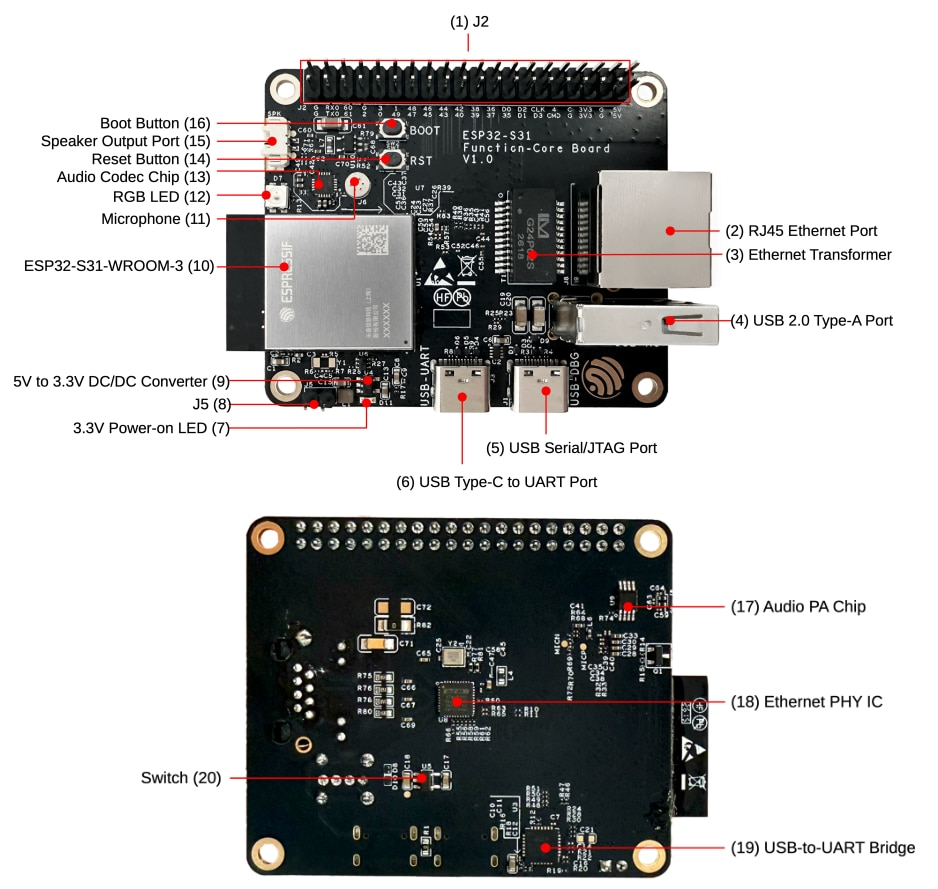
ESP32-S31-Function-CoreBoard-1 is a development board for connected AIoT prototyping based on the ESP32-S31-WROOM-3 module. It supports Wi-Fi 6, IEEE 802.15.4, Bluetooth 5.4 (LE + BR/EDR), and Gigabit Ethernet; provides an onboard microphone and speaker output; routes out all key GPIOs. Most of the I/O pins on the module are broken out to pin header J2 for easy interfacing. It also features a USB 2.0 Type-A Port and USB Type-C port which can be used for USB pheripials (though the USB Type-C port will require a USB-hub if you also want to power the board via USB).
Reference:
For detailed specification description and development kit hardware overview check out:
and
All reactions